The HiGuppy Journal
How Do Guppies Mate? Courtship, Gonopodium and What to Expect
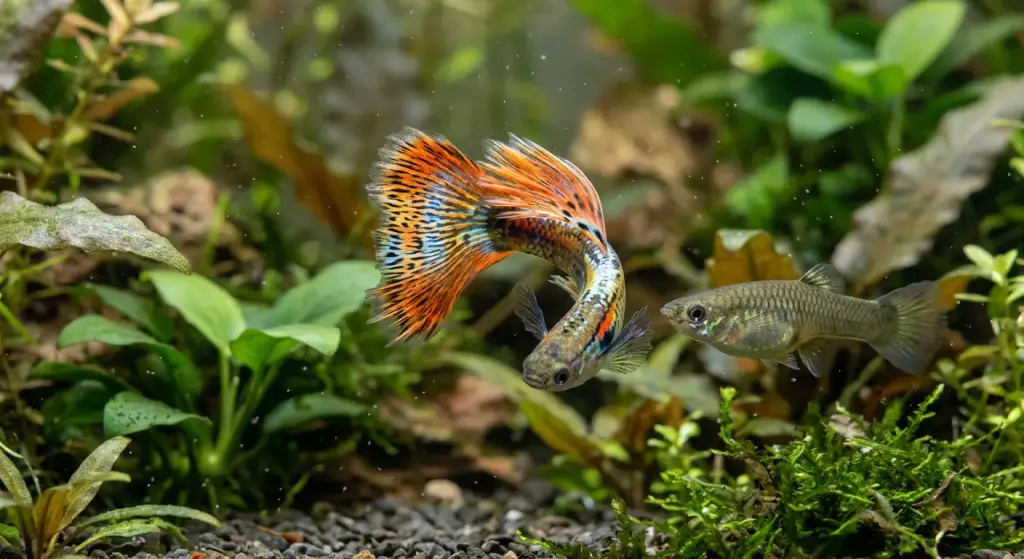
How do guppies mate? A male may perform a courtship display, then use a modified anal fin called the gonopodium to transfer sperm during brief contact. Fertilization is internal. Guppy gestation is often described as about four weeks, but timing varies widely; published literature reports 20 to 65 days in virgin females. Treat four weeks as a rough estimate, not a due-date clock. This guide belongs to our complete guppy care guide and walks through the whole process, from courtship to birth.
If you keep guppies, mating will happen sooner than you expect. Guppies are livebearers, so there are no eggs to watch for and no spawning ritual that needs special conditions. Males may pursue females repeatedly. Females can store sperm for several months, so a previously mated female may produce fry even when no male is currently in the tank. Understanding how guppies mate helps you protect your females, predict pregnancies, and decide whether you want fry at all. Below you will find the courtship steps, the biology behind it, signs of a successful mating, what stresses females, and a practical plan for managing breeding in a home aquarium.
How do guppies mate: the short version
How do guppies mate? Internal fertilization in livebearers
So how do guppies mate? Unlike egg-laying fish such as tetras or barbs, guppies fertilize eggs inside the female’s body. The male does not spray sperm into the water. The male uses the gonopodium to transfer sperm during copulation. Fertilization is internal; embryos develop inside the female, who gives birth to free-swimming fry. For species care information, see OATA’s guppy care sheet.
How do guppies mate? The sequence in five steps
- The male spots a receptive female. Males follow females closely and appear to react to visual cues and possibly chemical signals.
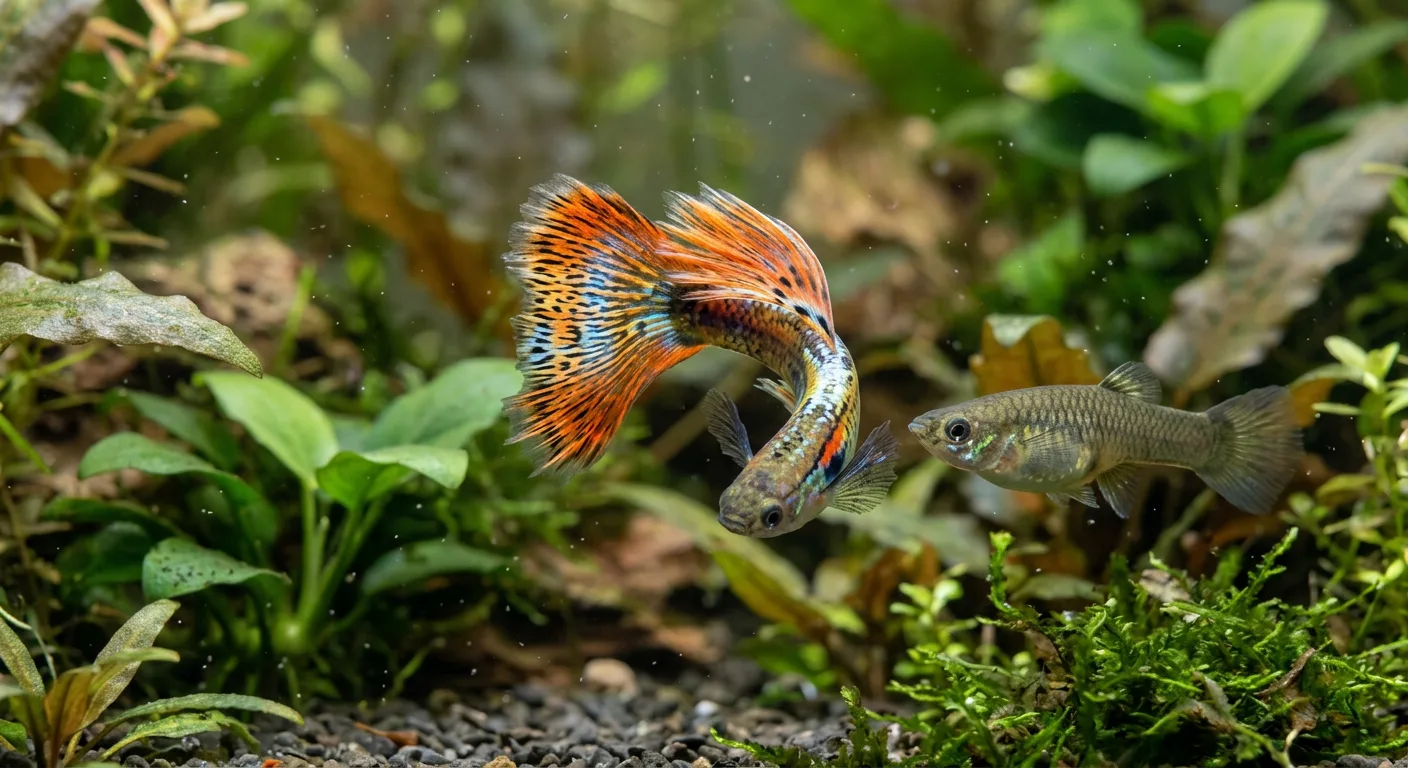
- He displays. The male arches his body into an S shape, flares his fins and quivers in front of the female.
- The female decides. She may swim away, hold position, or slow down and allow him to approach.
- He attempts contact. The male swings the gonopodium forward and touches the female’s vent.
- Sperm transfer happens in a flash. The contact lasts a fraction of a second and the pair separates.
How do guppies mate: quick reference table
| Stage | What you see | Typical timing |
|---|---|---|
| Courtship display | S shaped body, fins spread, quivering | Varies |
| Sneaky attempt | Brief, unsolicited contact without the full display | Brief; duration varies |
| Sperm storage | Nothing visible | Female can store sperm for several months |
| Gestation | Signs vary; appearance cannot confirm pregnancy or timing | About four weeks as a rough estimate; published range is wider |
| Birth | Female drops fry over minutes to hours | Varies by fish and conditions |
So, how do guppies mate in summary? These are general figures. Reproductive timing varies among fish and conditions, so use them as a guide rather than a guarantee.
How do guppies mate? The biology behind guppy mating
The gonopodium explained
How do guppies mate physically? As a male guppy matures, his anal fin gradually transforms into a narrow, tube-like organ called the gonopodium. It is the clearest way to tell males from females; our guide on how to tell male or female guppies shows what to look for. The gonopodium is the male’s intromittent organ and transfers sperm during mating contact; the exact movement and success of a contact are not visible reliably to a keeper.
How do guppies mate once but stay pregnant? Sperm storage explained
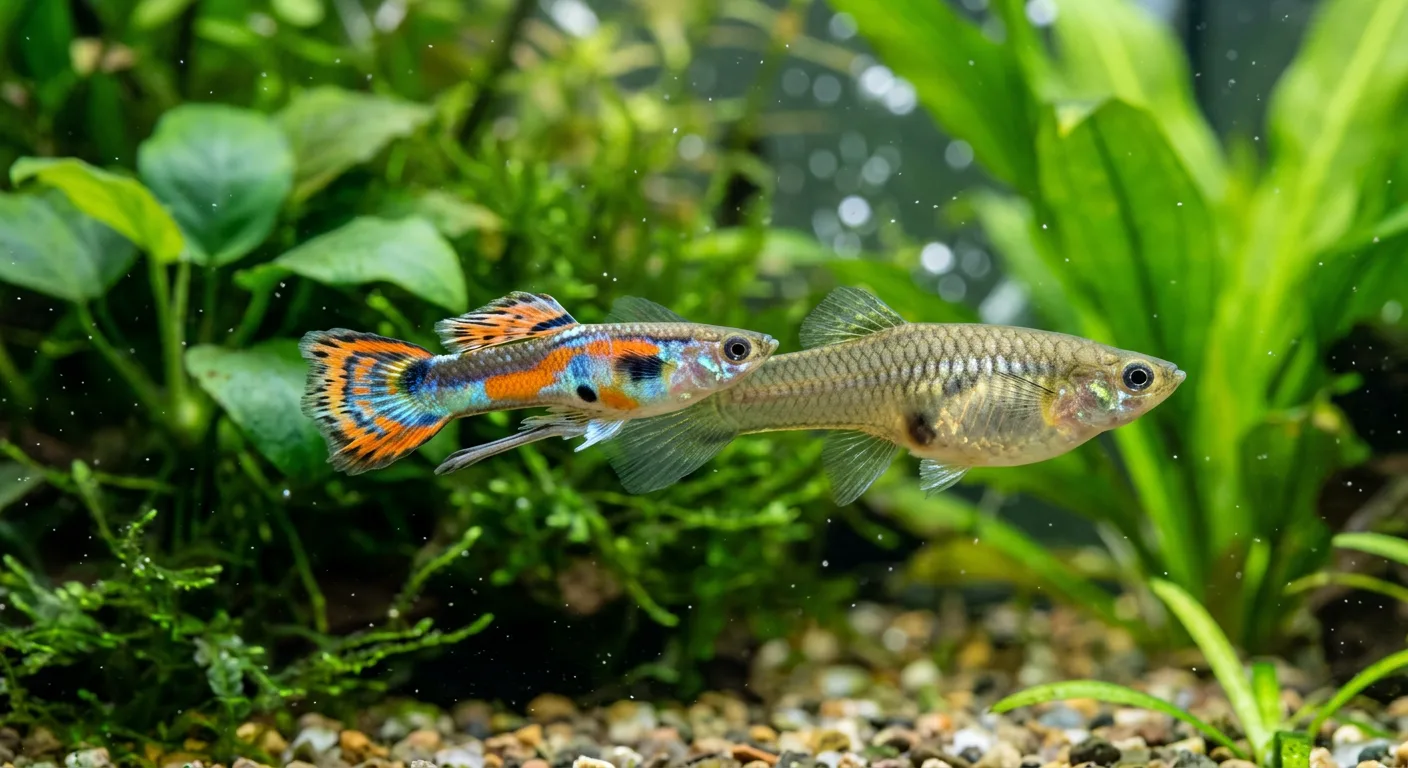
Part of answering how do guppies mate: females can store sperm and use it in later reproductive cycles; studies describe storage lasting several months. An adult female kept alone may therefore produce fry if she was previously exposed to males. Do not assume an adult has never mated unless her history is known. The question of how often this happens is covered in how often do guppies give birth.
Multiple paternity
Published guppy research describes broods with multiple paternity. For strain breeding, keep breeding records and separate females from unwanted males before mating if you need controlled parentage. See how to keep a guppy strain pure.
Age of first mating
FishBase lists male guppies reaching maturity at about two months and females at about three months, but age varies with strain and conditions. Treat these as approximate reference ages rather than a guarantee, and do not plan breeding by age alone. Read when are guppies old enough to breed for the details.
How do guppies mate? Courtship behavior explained
The sigmoid display
How do guppies mate before contact? In courtship displays, males arch their bodies into an S-shaped posture and quiver to show their color patterns to a female. Some studies find female preferences for male coloration or courtship, but results vary among populations and study conditions; no single color or tail type guarantees preference. You can see the variety in our guppy color types and guppy pattern types pages.
Female choice
How do guppies mate on the female’s side? Female guppies can show mate preferences, but the traits associated with preference vary among populations and studies. Visible swimming or avoidance behavior is not a reliable way to confirm that mating was accepted or sperm transfer succeeded.
Sneaky mating attempts
How do guppies mate without courtship? Guppies also make unsolicited mating attempts; research describes males alternating between courtship and forced mating attempts. Repeated pursuit can be stressful in an aquarium, so provide cover, keep an appropriate sex ratio and monitor whether a female can rest and feed. We cover what is normal and what is too much in why are my guppies chasing each other.
Behavior that looks like mating but is not
- Shimmying in place: Often a stress or water quality sign, not courtship. See why is my guppy shimmying.
- Males flaring at each other: Competition between males, usually harmless in a well planted tank.
- Rubbing on decor: Irritation from parasites or poor water, covered in guppy rubbing on decorations.
How do guppies mate, and what are the signs of pregnancy?
The gravid spot
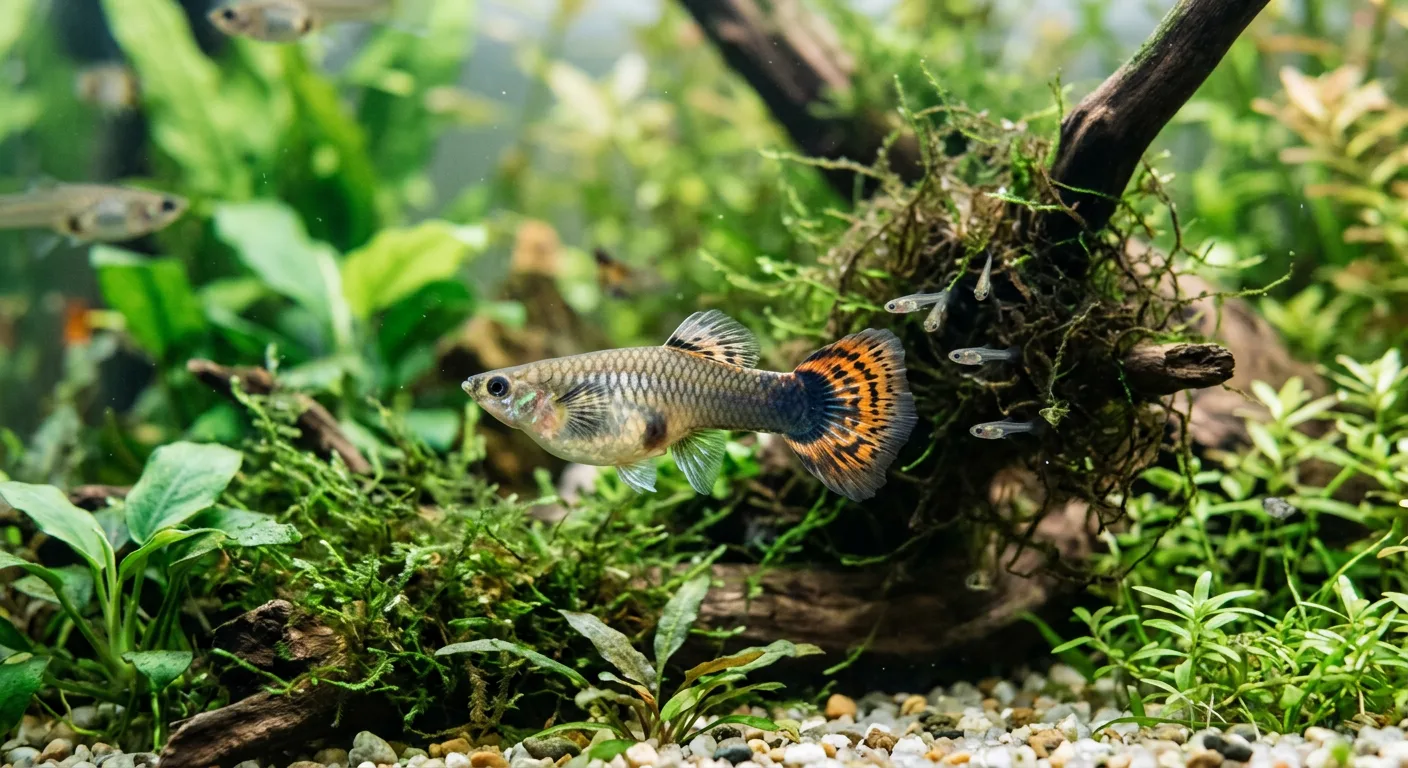
After asking how do guppies mate, keepers ask about pregnancy signs: a dark patch near the vent may be visible in some females, but its appearance varies with fish and coloration. Treat it as a possible clue, not proof of pregnancy or a way to predict the birth date.
Body shape changes
Some females develop a fuller abdomen or a more angular outline during pregnancy, but body shape varies and cannot reliably distinguish pregnancy from body condition or another health problem. Our guide on guppy pregnant or fat gives more context, and signs a guppy is about to give birth covers possible observations; appearance alone does not confirm pregnancy or predict birth.
Timeline after mating
About four weeks is a broad estimate, not a countdown: published research reports gestation ranging from 20 to 65 days in virgin females. Appearance cannot confirm pregnancy or predict a precise birth date. See how long are guppies pregnant for more context, and why is my guppy not giving birth if you are concerned.
| Approximate stage | Possible observations |
|---|---|
| Early | Changes may be subtle or absent. |
| As pregnancy progresses | Some females develop a fuller abdomen or a more visible dark patch; signs vary. |
| Later | An angular outline may occur, but it does not confirm pregnancy or predict birth. |
| Any stage | Changes in appetite or behavior can have other causes; check water and overall health if concerned. |
Why constant mating stresses female guppies
Harassment and its effects
How do guppies mate too often? Males may pursue females repeatedly. OATA recommends keeping two females per male to reduce stress on females and other tank inhabitants. If a fish is persistently chased, monitor feeding, fins and access to cover; the male to female guppy ratio guide covers group planning.
The right ratio
How do guppies mate safely? A common rule of thumb is two to three females for every male. More females spread out the attention. If you cannot manage that, keep males in a separate tank; our male only guppy tank guide and female only guppy tank pages cover both approaches.
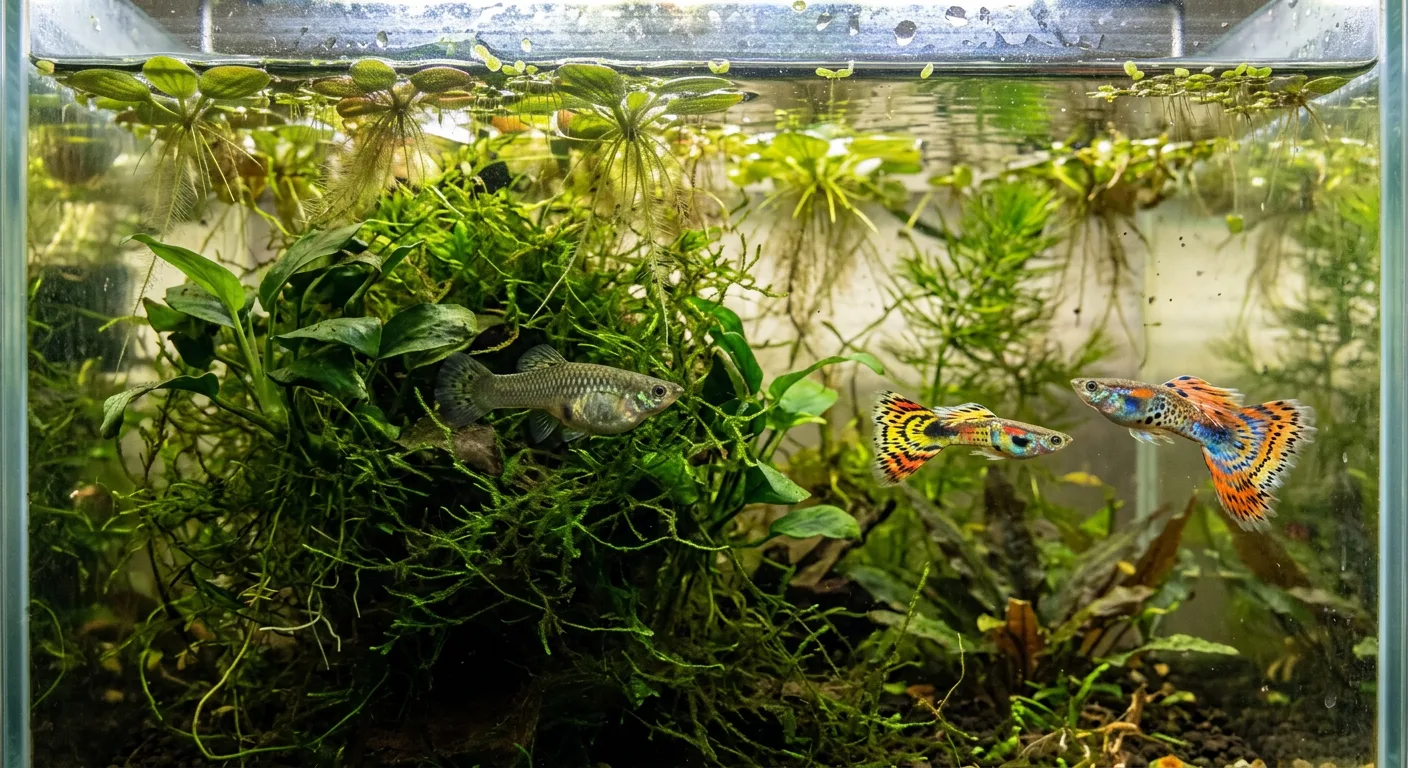
Give females places to escape
Dense plants break up the line of sight, so females can rest. Floating plants, bunches of java moss and tall stem plants all help. See floating plants for guppies and java moss for guppy tanks.
Warning signs of overstressed females
- Constant hiding near the filter or substrate
- Clamped fins and refusing food
- Torn tail or missing scales
- Rapid breathing or hanging at the surface
If you see these, use our list in signs of stress in guppies and remove the most aggressive male for a few days.
How do guppies mate in your tank? Step-by-step management
If you want fry
- Choose healthy, mature fish. Look for active adults with intact fins and good color. Our guide to choosing healthy guppies online helps.
- Start with a trio or small group. One male with two or three females is a safe start. See pair vs trio.
- Set up a breeding tank. Use at least 45 litres (about 12 US gallons), the OATA minimum for a small group, with a sponge filter, a heater and plenty of plants; size up as the group or fry grow. Follow guppy breeding tank setup.
- Keep the water around 76 to 80 °F. This range supports healthy fish and normal gestation. Keep ammonia and nitrite at zero.
- Feed varied, high quality food. Micro pellets, fine flakes and some live or frozen foods support egg development; see live food for guppies.
- Plan ahead for possible fry. Body shape changes vary and do not provide a reliable birth date. Our article on whether guppies need a breeder box weighs the options.
- Protect the fry. Adults will eat them, so use dense cover or move them; see how to separate guppy fry.
If you do not want fry
- Keep sexes apart. Males only or females only tanks avoid breeding entirely, but sex fish early and carefully.
- Remember sperm storage. A female bought from a mixed tank may still give birth for weeks or months.
- Plan for extras. If fry appear, you can raise them, rehome them or use them as part of a bigger tank plan. Our raising guppy fry guide helps with the first option.
- Do not overstock. A tank can fill quickly. See how many guppies per gallon.
Common mistakes
- Too many males: The classic cause of harassed, hiding females.
- Bare tanks with no cover: Females have nowhere to rest.
- Breeding from very young or small females: Raises the risk of stress and weak fry.
- Ignoring inbreeding: Repeated close breeding can lower vigor, as covered in guppy inbreeding.
- Assuming a new female is unmated: Stored sperm can surprise you.
- Letting water quality slide: Pregnant and harassed fish both need clean water.
How do guppies mate best? Water, feeding and tank conditions
Temperature and water parameters
Guppies thrive in stable, moderately hard, near neutral water. A temperature of about 76 to 80 °F is common for breeding groups. Very high temperatures speed up the cycle but can shorten lifespans; very low temperatures slow activity. Our guppy water parameters guide and ideal temperature for guppies explain safe ranges.
| Parameter | Target for breeding groups |
|---|---|
| Temperature | About 76 to 80 °F (24 to 27 °C) |
| pH | About 7.0 to 7.8 |
| Ammonia and nitrite | 0 |
| Nitrate | As low as practical, below about 20 to 40 ppm |
| Water changes | 25 to 30 percent weekly |
Diet
How do guppies mate healthily? Good nutrition makes males brighter and females more resilient. Feed small portions once or twice a day, as in how often to feed guppies, and rotate in the foods listed in best food for guppy color growth.
Lighting and routine
How do guppies mate calmly? A regular day and night cycle keeps fish calmer. Around eight to ten hours of light is common; see guppy tank lighting schedule. Stable routines reduce stress and keep mating behavior normal.
Tank size and filtration
OATA recommends at least 45 litres (about 12 US gallons) for a small group of guppies; increase the aquarium size as the group or expected fry grow. Use a gentle filter such as a sponge filter, which keeps fry from being sucked in; read sponge filter for guppy tank.
How do guppies mate and then give birth? Pregnancy and fry care
Getting ready for birth
How do guppies mate and give birth? In the last week, add extra plants and reduce disturbance. Avoid unnecessary handling or netting, which can stress or injure fish. Provide cover, maintain stable water and follow the normal feeding routine.
Birth
Fry are born one by one or in small groups, curled up at first and then swimming within moments. A first brood may be small, while mature females often drop larger broods; see how many babies do guppies have. Adults may eat fry, which is explained in do guppies eat their babies.
Raising the fry
Feed fry several tiny meals a day using the schedule in guppy fry feeding schedule. Small, frequent water changes help them grow; our guppy growth stages page shows what to expect, and the raising guppy fry guide gives the full plan.
Rest between broods
Stored sperm can contribute to later broods, so fry may continue to appear after a male is removed. If a female is persistently pursued or appears unwell, separate fish and check water quality.
Breeding for color and strain quality
Choosing breeding stock
How do guppies mate for quality? Choose the best males and females for the traits you want, such as color, tail shape and size. Our guide to selective breeding for beginners explains how to set goals. Buying from a seller who ships healthy stock gives you a strong start, and you can browse our breeder trios or premium guppy pairs.
Recording matings
Keep a simple notebook: date females were added, date you first saw a gravid spot, birth date and fry count. This makes it easy to predict the next brood and to spot females that never seem to conceive.
Avoiding inbreeding problems
How do guppies mate without inbreeding? Bring in unrelated stock every few generations and cull weak fry honestly. Bent spines, tiny size and slow growth can be signs of line problems; see bent spine guppy.
How do guppies mate? Quick checklist of essentials
- Understand that guppies mate by internal fertilization using the gonopodium.
- Use about four weeks only as a rough gestation estimate; timing varies widely, and stored sperm may lead to later broods.
- Keep two to three females per male to reduce harassment.
- Add dense plants and floating cover for resting females.
- Hold water around 76 to 80 °F with zero ammonia and nitrite.
- Feed small, varied meals once or twice a day.
- Prepare a plan for fry before the belly squares off.
- Do weekly 25 to 30 percent water changes.
- Separate sexes if you do not want fry, and sex fish early.
Ready to build a breeding group? Browse our male guppies, add a few females from our pairs and trios, and revisit the guppy care guide whenever you need a refresher.
Frequently seen situations: how do guppies mate in practice?
Scenario: a new female gives birth a week after you bought her
She may have been pregnant before purchase or may have stored sperm from an earlier mating. Provide cover, keep water stable and do not assume that a current all-female tank rules out fry.
Scenario: males chase one female all day
A low female-to-male ratio is one possible cause. Check that the tank can support any additional fish; you can instead separate males or adjust the group. Add cover and monitor the female for feeding changes or fin damage.
Scenario: you see mating but no pregnancy
A brief mating attempt does not confirm sperm transfer or pregnancy. Watch for changes over the following weeks, but remember that body shape and a gravid spot are not proof of an exact birth date.
Scenario: you keep only males and one starts acting like a female chaser
Males may display or chase even in a male-only group. Provide adequate space and cover, monitor for injury and do not add a female unless you are prepared to manage fry. See our notes on male only tanks.
FAQ: how do guppies mate?
How do guppies mate?
The male uses his gonopodium to transfer sperm during brief contact. Fertilization is internal; females may store sperm. Birth is often described as roughly four weeks later, but gestation varies widely and this is not a reliable due-date clock.
How do guppies mate and how long does it take?
Mating contact can be brief, while courtship and chasing may last longer. The duration varies, so visible contact alone cannot confirm successful sperm transfer.
How do guppies mate, and how can I tell they mated?
You usually cannot see successful sperm transfer. A darker spot or fuller abdomen may be clues over time, but neither proves mating or pregnancy nor predicts an exact birth date.
How do guppies mate — can a female get pregnant without a male?
Not without prior mating, but she can store sperm from earlier encounters for several months. A previously mated female may produce fry while kept alone.
How do guppies mate and how often?
Males may pursue or attempt to mate with females repeatedly. Females can mate with multiple males. Gestation is often described as about four weeks, but published literature reports wide variation, including 20 to 65 days in virgin females.
How do guppies mate — do they mate with other fish?
Do not infer successful mating or viable hybrid fry from pursuit or brief contact alone. If you are breeding more than one livebearer species, keep the groups separate and verify the parentage of unexpected fry. See can guppies breed with platies and mollies.
How do guppies mate — is it harmful to females?
Repeated pursuit can stress females. OATA recommends two females per male to reduce stress; provide cover and separate fish if one is persistently pursued or cannot feed.
Sources
- Gasparini et al. (2011), PLOS ONE: Male genital morphology and its influence on female mating preferences and paternity success in guppies — internal fertilization, the gonopodium, courtship and unsolicited mating attempts.
- Sato et al. (2021), PLOS ONE: Male coloration affects female gestation period and timing of fertilization in the guppy — notes a typical 25–30 day cycle but considerable variation, including a reported 20–65 day range in virgin females; its introduction also summarizes research on multiple mating and paternity.
- Cardozo et al. (2020), Journal of Evolutionary Biology: Female sperm storage mediates post-copulatory costs and benefits of ejaculate anticipatory plasticity in the guppy — the PubMed abstract reports sperm storage for several months.
- OATA: How to look after guppies and mollies — two females per male as a stress-reduction guideline, plus pregnancy and brood-size guidance.
- FishBase: Poecilia reticulata — compiled life-cycle and maturity notes; age values are approximate reference points.
- Devigili et al. (2015), Nature Communications: Multivariate selection drives concordant patterns of pre- and postcopulatory sexual selection in a livebearing fish — describes guppy courtship as an S-shaped posture and quivering display.
Behind the care guides
Care begins with steady systems
Our guppy guides focus on practical routines: keep water stable, observe fish closely and allow for natural variation.
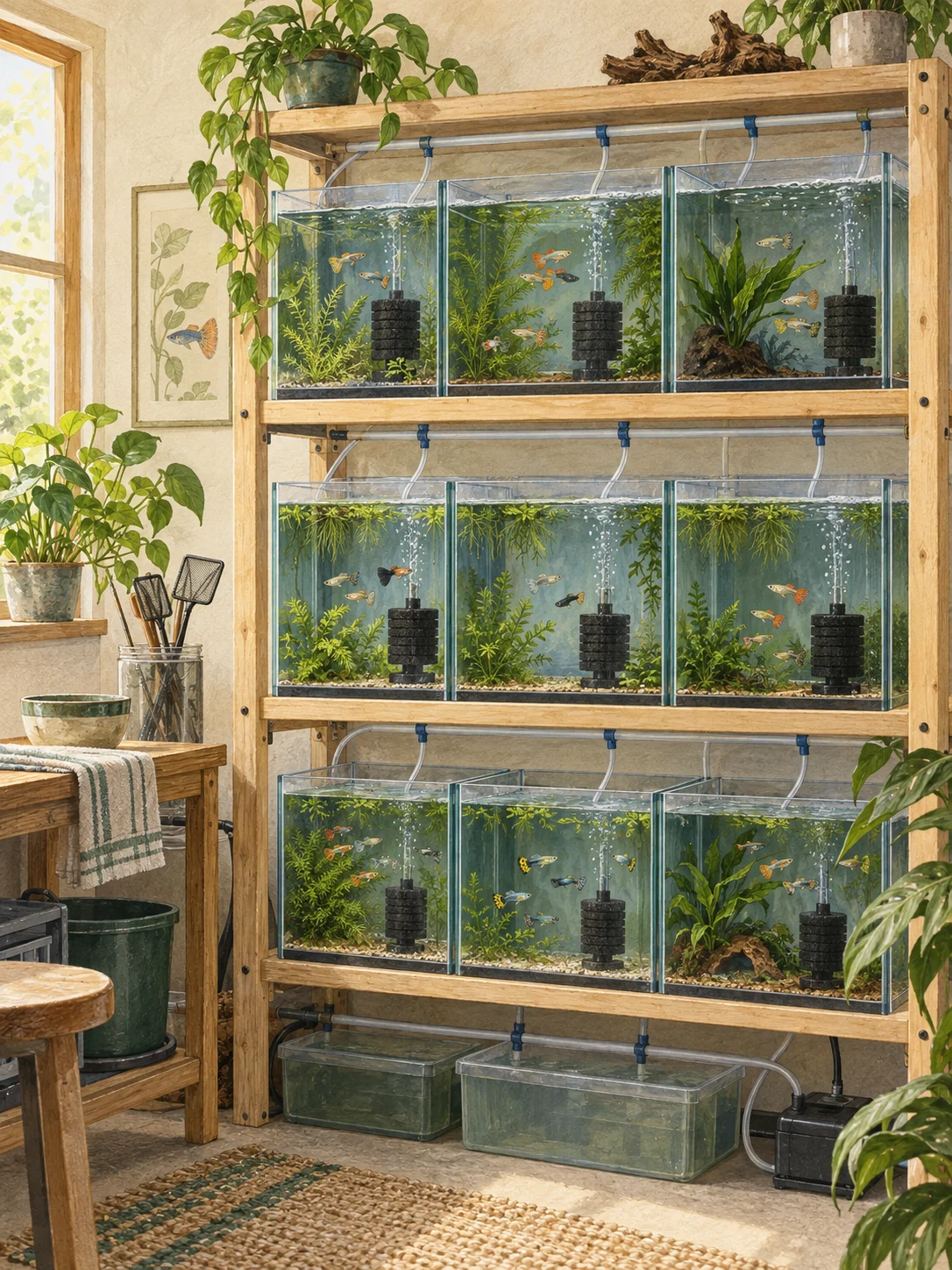
Care systems
Steady water, thoughtful care
Gentle filtration and regular observation support healthy aquarium routines.
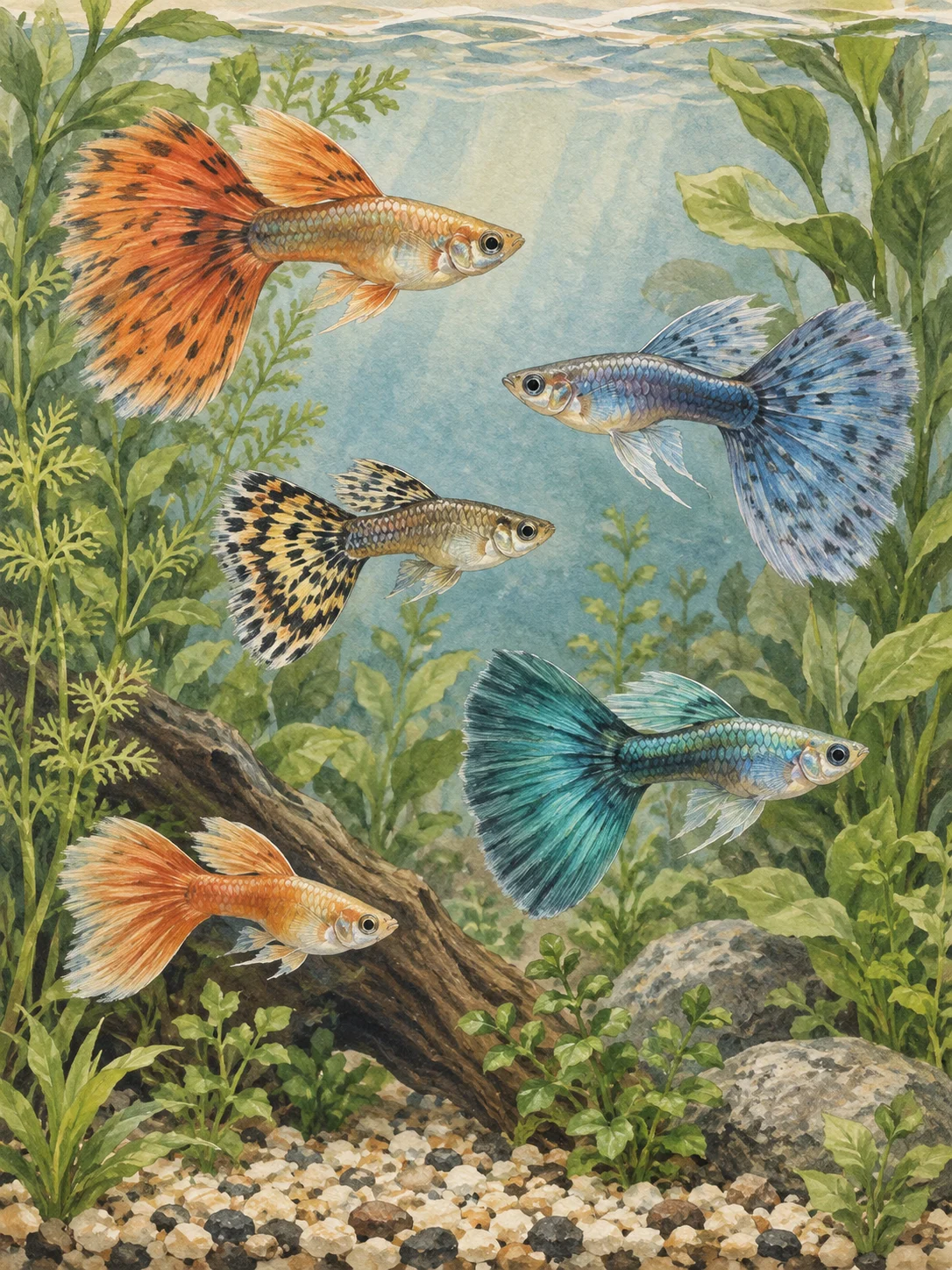
Natural variation
Every guppy is different
Color, size and fin shape vary with strain, age and each individual fish.
Editorial illustrations for context; they do not depict HiGuppy's exact facility or current fish stock.