The HiGuppy Journal
Guppy Fry Growth Chart Day by Day: 90-Day Size and Care Timeline
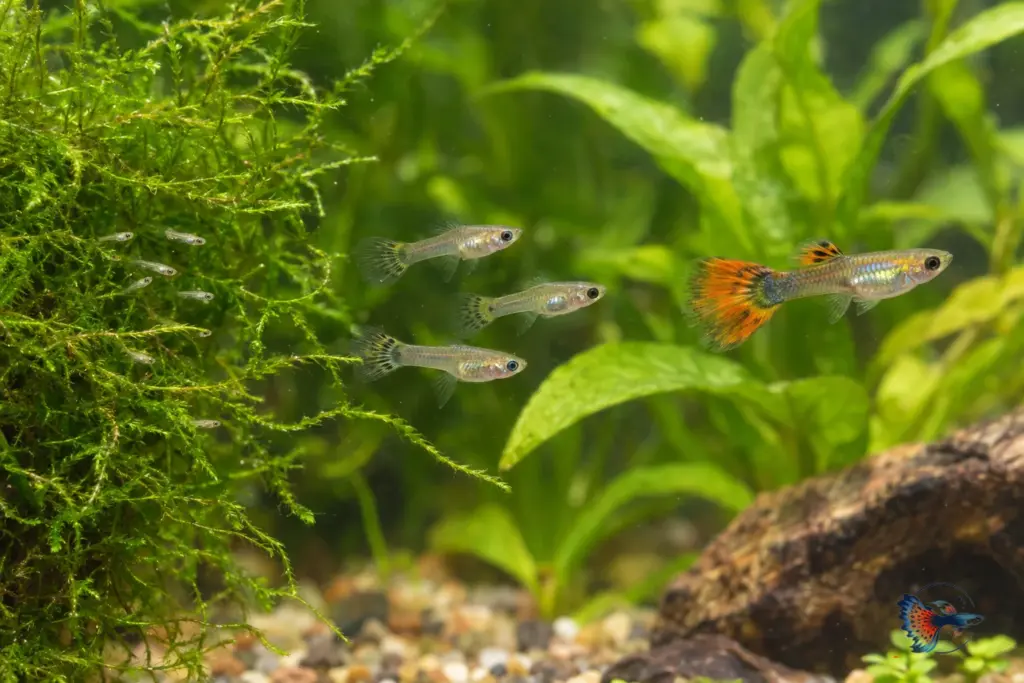
Quick answer: A guppy fry growth chart day by day is a log of what baby guppies look like and need at each age — not a fixed size promise. Newborn fry are roughly 4–7 mm long, about double in size during the first two weeks, reach 15–20 mm around four weeks, and look like small adults by 10–12 weeks. Food, temperature (24–26°C), water quality, crowding and genetics all shift the pace, so use the chart to spot a stalled fry early rather than to grade individual fish.
If you have ever stared into a tank of newborn guppies and wondered whether they are growing fast enough, this guppy fry growth chart is built for you. Instead of one generic “fry stage” label, it walks through what healthy baby guppies typically look like day by day and week by week — how big they should be, when fins and colour appear, when you can sex them, and what to feed and check at each window.
One honesty note before the numbers: there is no universal growth calendar. A stage-based guppy growth guide explains why siblings develop at different speeds, and breeders see the same spread in every brood. The ranges below reflect what most keepers observe in a warm, well-fed fry tank — treat them as signposts on a guppy fry growth chart, not deadlines your fish must hit.
Guppy fry growth chart key facts at a glance
Bookmark these numbers before diving into the day-by-day detail:
- Birth size: newborn fry are about 4–7 mm and swim immediately — guppies are livebearers.
- First fortnight: fry roughly double in length by day 14 on a good feeding routine.
- Sexing window: a female’s gravid spot shows around weeks 3–4; males begin tail colour around weeks 4–6.
- Juvenile look: by days 60–90 most fry look like miniature adults and males start displaying.
- Adult size: males mature around 30–40 mm, females 40–60 mm, depending on strain.
- Feeding rhythm: 3–5 small meals a day in the first month, tapering to 2–3 as juveniles grow.
- Water driver: steady 24–26°C and low nitrate matter more to the guppy fry growth chart than any single food.
Quick-reference guppy fry growth chart
Use this table as the backbone of your guppy fry growth chart day by day log. Compare your brood against the trend, and check the care column before assuming a slow fish is sick.
| Age window | Typical length | What you see | Care action |
|---|---|---|---|
| Days 1–3 | 4–7 mm | Transparent fry hiding near cover; large eyes | Fry-safe filtration, first tiny foods, dim calm tank |
| Days 4–7 | 7–10 mm | Free-swimming, bolder, rounding bellies after meals | 3–4 micro meals daily; small frequent water changes |
| Days 8–14 | 10–13 mm | Body thickens; dorsal and anal fins take shape | Keep food fine; watch leftovers and nitrate |
| Days 15–30 | 13–20 mm | Gravid spot on females; first male tail tint | Start sorting by sex cues; plan the grow-out space |
| Days 31–45 | 18–25 mm | Males colour up; gonopodium develops | Separate sexes if avoiding early breeding |
| Days 46–60 | 22–30 mm | Reliable sexing; strain pattern emerges | Confirm genders; upgrade food size |
| Days 61–90 | 28–40 mm | Miniature adults; males display to females | Decide community move or continued grow-out |
| Day 90+ | 30–60 mm | Adult proportions; females still filling out | Normal adult routine; breeding plan if wanted |
How to read it: a guppy fry growth chart like this tracks ranges, not guarantees. A fry sitting at the bottom of a window is usually fine if it eats and swims well; worry when a fish falls visibly behind its siblings and shows other warning signs.
Setting up the fry tank for steady growth
Before the first entry on your guppy fry growth chart, the nursery setup decides most of the outcome. Fry do best in a dedicated tank rather than a breeder box suspended in the adult aquarium: box water exchange is limited, space is cramped, and fry stall early. A bare-bottom or lightly planted tank of 20–40 litres handles a first brood well; move up to 40–60 litres as the fry pass day 30.
Three features matter most. Filtration should be a gentle sponge filter that cleans without endangering tiny swimmers. Cover — java moss, guppy grass or floating plants — gives newborns somewhere to hide and grazes of infusoria to pick at. And lighting should be modest: fry do not need bright light to grow, and a calm tank feeds better than a glaring one.
Guppy fry growth chart: days 1–3 (newborn week)
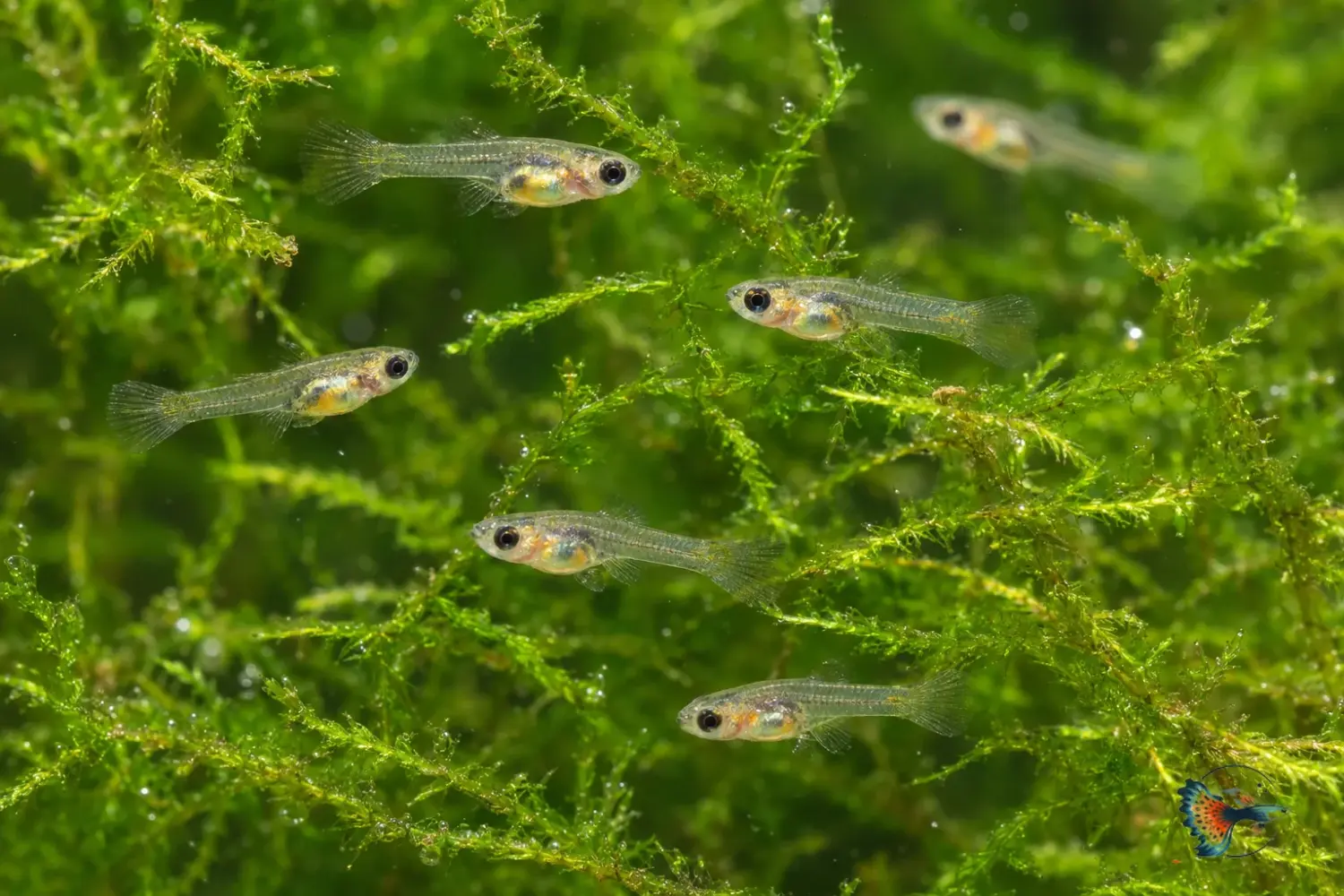
Day one on the guppy fry growth chart starts at birth. Guppies are livebearers, so fry arrive free-swimming at about 4–7 mm — thin, nearly transparent, with oversized dark eyes. For the first 48–72 hours they hug cover: java moss, floating plants, the sponge of the filter, or the top corner of the tank. That hiding instinct is normal, not weakness; in a community tank it is survival, because adult guppies will eat fry they can catch.
Feeding in this window is about particle size more than volume. Fry mouths are tiny, so offer infusoria, microworms, freshly hatched baby brine shrimp, or flakes crushed to dust — our guppy fry feeding schedule maps food sizes to ages. Three to four micro meals a day beat one large feeding, because leftovers rot fast in warm fry water.
Newborn fry also show you their first health signals. Healthy fry rest head-up near cover and dart when startled; fry lying on the bottom or swimming in spirals are struggling. Losses of one or two in the first 72 hours are normal in any brood — a steep daily die-off means check water temperature and ammonia before anything else.
Guppy fry growth chart: days 4–7
By the end of week one, fry on a healthy guppy fry growth chart are 7–10 mm and noticeably braver. They cruise mid-water between meals instead of clinging to moss, and their bellies round visibly after eating. You should see a loose school forming rather than scattered individuals — grouping is confidence.
This is the week where routine pays off. Keep 3–4 small feedings daily, and start the water-change rhythm you will hold for months: small, frequent changes beat rare big ones, because fry water fouls quickly under dense feeding. The guide to water changes for guppy fry covers safe volumes and techniques. Expect the first casualties of weak fry here too — a brood losing one or two fish in week one is common; losing several daily means check water and food size first.
By day 7 the brood’s hierarchy shows. Bolder fry hover at the surface waiting for food while timid ones eat leftovers lower down. If a few fry never reach the feeding zone, offer one meal each day directly above their corner — early competition shapes the spread you will record later on the guppy fry growth chart.
Guppy fry growth chart: days 8–14
Week two is where the guppy fry growth chart gets satisfying: fry hit 10–13 mm and start looking like fish instead of threads. The dorsal and anal fins take on recognisable guppy shape, the tail fan widens, and swimming turns purposeful. Colours are still muted — maybe a grey-gold sheen — but bodies thicken steadily.
Food size can step up slightly: slightly coarser crushed flakes, microworms, and baby brine shrimp remain the staples. Watch the tank floor after feeding — if food sits uneaten after a few minutes, the particles are too big or the portion too generous. Uneaten food is the main water-quality enemy on this part of the guppy fry growth chart, because fouled water slows growth faster than underfeeding does.
Keep an eye on water numbers through week two. Fry tanks run warm and heavily fed, so ammonia and nitrite spikes arrive quietly. Stable parameters — temperature 24–26°C, pH near neutral-to-slightly-hard, nitrate kept low — matter more than any specific supplement. Our guppy water parameters guide lists the safe ranges to hold.
Guppy fry growth chart: days 15–30
The back half of month one (13–20 mm) is when sex begins to show. Females develop the gravid spot — a dark patch above the anal fin where developing eggs sit — usually around weeks 3–4. Males may flash the first tint of tail colour near week 4. Neither cue is reliable alone yet; colour, body shape and fin form work together, and our guide on telling male and female guppy fry apart walks through each marker.
Crowding starts to bite around day 20–30 in a small tank. Fry compete harder for food, and waste output climbs. If the brood is still in a breeder box or a small nursery tank, this is the window to plan the grow-out tank setup — a filtered tank of at least 40–60 litres gives the guppy fry growth chart room to keep trending up instead of stalling at cramped density.
Practise your eye now rather than later. Photograph the brood every few days and compare shots: the fry filling out fastest, the first tail tint, the first gravid spots. These are the observations that turn a size list into a working guppy fry growth chart you can act on.
Guppy fry growth chart: days 31–45
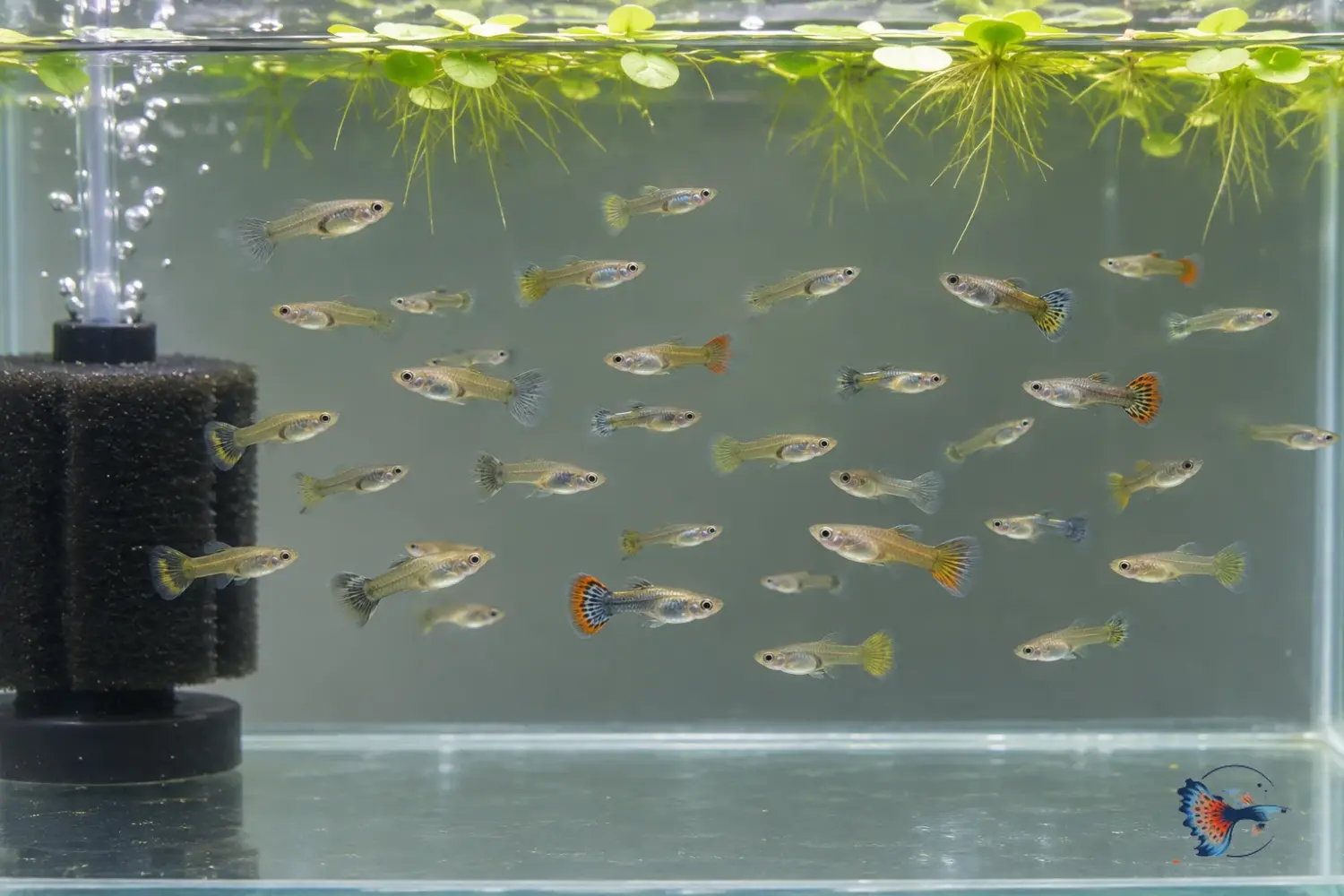
Weeks five and six (18–25 mm) are the colour phase. Males’ tails begin showing the strain’s real pattern — the reds, blues, or snakeskin markings you bought the parents for — while females stay comparatively plain but grow a fuller body. The male gonopodium, the modified anal fin used for breeding, differentiates in this window too.
If you do not want surprise pregnancies, this is separation time. Young females can store sperm and become pregnant shockingly early, and the first-time keeper’s most common regret on any guppy fry growth chart is waiting “one more week” to split sexes. The walkthrough on separating guppy fry without stressing the tank makes the move low-risk. Feeding settles to 2–3 meals a day of juvenile-sized food — crushed flake, fine pellets, and chopped or frozen foods alongside live options.
Watch finnage closely now. Tail shape, dorsal set and fin edges hint at adult quality, and any bent or ragged fins at this age deserve a look at water quality and tank-mate nipping before you write a fish off — clean water repairs a surprising amount of juvenile fin damage.
Guppy fry growth chart: days 46–60
By days 46–60 (22–30 mm) your brood enters reliable-juvenile territory. Sexing is now confident: males carry a slender body, coloured tail and a visible gonopodium; females are deeper-bodied with a clear gravid spot. This is also when strain quality becomes judgeable — tail spread, colour coverage and body proportions hint at which fish are keepers for breeding or sale.
Culling or rehoming decisions often land here on a breeder’s guppy fry growth chart. Keepers select for the traits they want; bent spines, poor fins or washed-out colour mean a fish should not continue a line. If you are raising fry for a community tank instead, the question becomes timing — when guppy fry can join adults safely is mostly about being too big to eat, which most juveniles reach near the one-inch mark.
If you intend to sell or trade juveniles, this is also the documentation window. Buyers ask for age, strain and parent information; keeping your day-by-day log tidy here turns your guppy fry growth chart into a provenance record that lifts the value of every healthy juvenile.
Guppy fry growth chart: days 61–90
Days 61–90 (28–40 mm) close out the chart’s juvenile arc. Juveniles now look like miniature adults: males display to females, flare fins and chase; females grow steadily heavier-bodied. Growth speed usually slows slightly — the fish are converting food into finish quality rather than raw length.
This is also where the differences between guppy strains show clearly. Fancy strains with big finnage, like the ones catalogued on our guppy strains and types page, can take longer to finish their tails than compact wild-type fish, so a “slow” delta-tail juvenile may simply be a large-fin strain still completing its finnage.
Feeding in this final window is about quality over quantity: protein-rich foods support colour depth and fin development, while overfeeding now just fouls water. Two measured meals a day, a stable cleaning rhythm and honest stocking density finish the guppy fry growth chart strong.
After day 90: when fry become adults
Crossing day 90, the guppy fry growth chart effectively ends — the fish are young adults. Males settle near 30–40 mm and reach breeding condition; females continue filling out toward 40–60 mm and may already carry their first brood if sexes were not separated. Care shifts from growth support to adult maintenance: stable water, sensible stocking, and a breeding plan that matches your tank space.
Remember that the adults you are watching will restart the cycle quickly. A female guppy can drop fry every 4–6 weeks, so the day-by-day log you kept becomes a reference for the next brood. Pair this chart with our guppy breeding chart for the gestation and genetics side of the calendar.
What changes the pace of a guppy fry growth chart
Two broods raised side by side can land a full week apart on the chart. Before blaming the fish, check the levers that actually control the pace:
- Temperature: 24–26°C keeps metabolism strong; chronically cool water stalls growth, while heat above ~28°C speeds it at the cost of oxygen and stability.
- Food quality and frequency: protein-rich micro foods (baby brine shrimp, microworms) several times a day drive the fastest healthy gains.
- Water quality: ammonia, nitrite and high nitrate suppress growth; small frequent changes keep the chart on track.
- Stocking density: crowded fry compete for food and grow slower — thin the brood or upgrade tank volume early.
- Genetics and strain: large-fin and show strains mature slower than compact feeder-type guppies.
- Sex: males often colour up and stop gaining length earlier; females put size on longer.
- Health: parasites and chronic stress stall individual fish even in an otherwise fast brood.
Notice that none of these levers is a supplement or gadget. The guppy fry growth chart rewards boring consistency — warm clean water and right-sized food — far more than any product marketed at fry growth.
How to keep your own day-by-day growth log
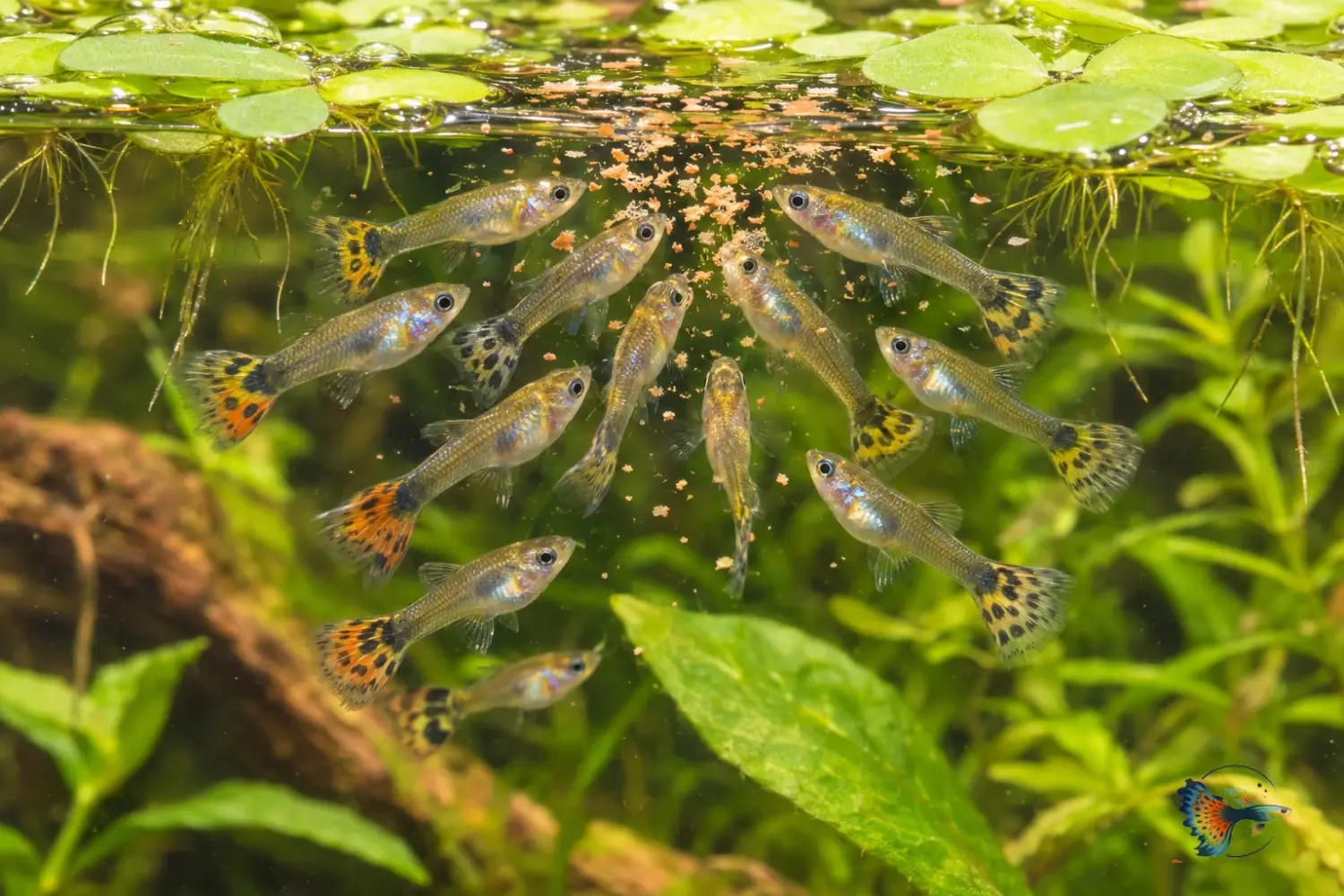
Running a real guppy fry growth chart takes five minutes a day and pays off when a fry stalls:
- Day 0: record birth date (or arrival date), fry count, tank volume and water readings.
- Daily: note appetite, swimming activity, and anything unusual — a clamped fin, a pinched belly, a loner.
- Every 3–4 days: photograph the brood side-on at the same distance against a fixed reference — a tank decal or ruler taped outside the glass — and estimate length.
- Weekly: update your chart table with the size estimate, food types offered and water-change record.
- Flag: any fry tracking a full window behind siblings gets its own watch line in the log.
- Review at day 30, 60 and 90: compare the trend line to this guide, not to single daily blips.
Skip netting or handling fry just to measure them — the stress costs more growth than the data is worth. Photographic estimates through the glass are close enough for a working guppy fry growth chart.
What earns its place in the log is what changes a decision: food offered, water readings, headcount, size estimates, and notes on sexing or separation. Anything you would want to know when asking “has this fry stalled?” belongs on the chart.
Warning signs: stalled fry vs normal spread
One small fry is usually just a small fry. These patterns deserve action:
| Sign | Likely cause | First-line fix |
|---|---|---|
| Whole brood growing slowly | Underfeeding, cool water or crowding | Increase feeding frequency, confirm 24–26°C, thin the brood |
| One fry far behind siblings | Weak genetics or lost competition for food | Target-feed it near the surface; give it its own corner or box |
| Fry growing but listless | Water quality slipping | Test ammonia/nitrite/nitrate; small water change today |
| Pinched belly plus stalled growth | Internal parasites or chronic underfeeding | Isolate, review diet, see the guppy diseases guide |
| Growth stops after tank move | Move stress or parameter shock | Match temperature and hardness; dim lights for 48 hours |
A stalled fish that still eats and swims usually needs space and food access more than medicine. When slow growth pairs with real symptoms — clamped fins, flashing, stringy faeces — troubleshoot the tank first, then the fish.
Frequently asked questions
How fast do guppy fry grow day by day?
On a typical guppy fry growth chart, fry roughly double their birth length inside two weeks — from ~5 mm toward 10–13 mm — then add a few millimetres a week through the juvenile window. There is no fixed daily increment; food, temperature and crowding move the pace more than the calendar does.
How big should guppy fry be at 30 days?
Most fry land between 13 and 20 mm at day 30 on a well-fed guppy fry growth chart. Strain matters — big-fin fancy lines trend smaller at the same age than compact stock. Judge the trend over weeks, not a single measurement.
When do guppy fry get their colour?
Males usually flash first tail colour between weeks 4 and 6, with pattern coverage filling in through days 60–90. Females stay comparatively plain but deepen in body tone. Slow colour on a big-fin strain is normal, not a defect.
When can you sex guppy fry on the growth chart?
The female gravid spot appears around weeks 3–4 and male colour around weeks 4–6; confident sexing lands by days 46–60 when the gonopodium is visible. If early breeding is a risk, separate sexes in the days 31–45 window rather than waiting for certainty.
Why are my guppy fry growing at different speeds?
Because genetics, sex and food access differ inside every brood. A spread of a few millimetres is normal; worry when a fry falls a full chart window behind and shows a pinched belly, hiding or lost appetite — that combination is the real alarm, not size alone.
Does the guppy fry growth chart differ between strains?
Yes — mostly in the finish. Large-fin strains like deltas and halfmoons keep developing finnage after compact strains look finished, so they can seem “behind” on the chart while actually on schedule for their type. Compare like with like.
When can fry leave the grow-out tank for the community tank?
When they are too big to be eaten — usually near 25 mm and 60–90 days on the guppy fry growth chart. Match the community tank’s temperature and water, and keep cover available for the first week while they learn the new territory.
Final Thoughts
A guppy fry growth chart day by day is less about the ruler and more about the rhythm: steady feeding, clean warm water, and a weekly glance at how the brood trends. Learn what normal looks like — the day-14 doubling, the week-4 gravid spots, the day-60 juvenile shape — and you will catch the one stalled fry weeks before a beginner would. Keep the log, trust the trend, and let the chart turn “are they growing?” into a question you can answer at a glance.
For the underlying species biology behind every guppy fry growth chart — growth, habitat and life history — FishBase’s Poecilia reticulata profile remains the standard scientific reference. And when your fry have grown into the fish you want to keep or share, browse the live guppy shop for breeding stock and healthy juveniles raised on exactly this kind of chart.
Behind the care guides
Care begins with steady systems
Our guppy guides focus on practical routines: keep water stable, observe fish closely and allow for natural variation.
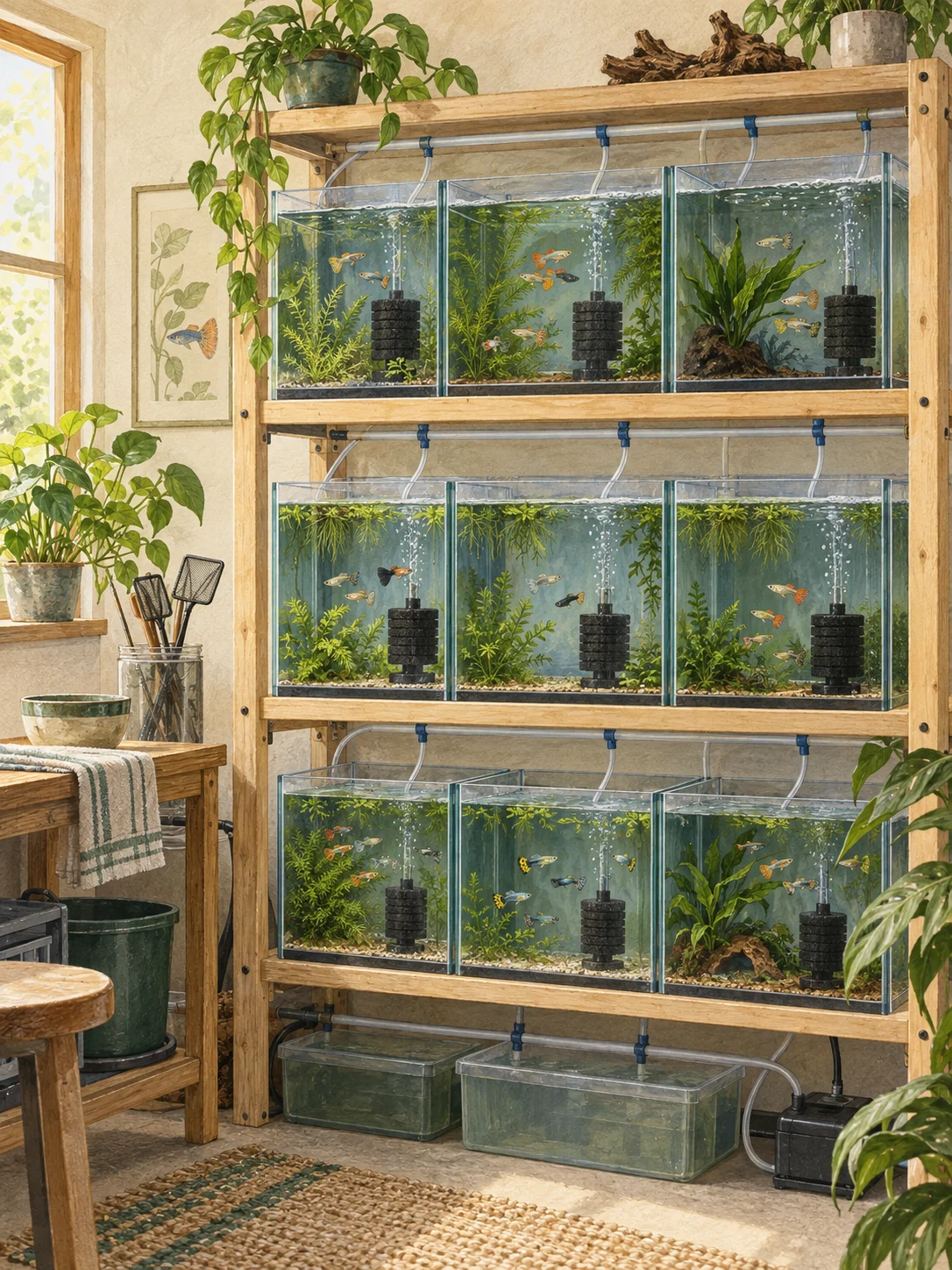
Care systems
Steady water, thoughtful care
Gentle filtration and regular observation support healthy aquarium routines.
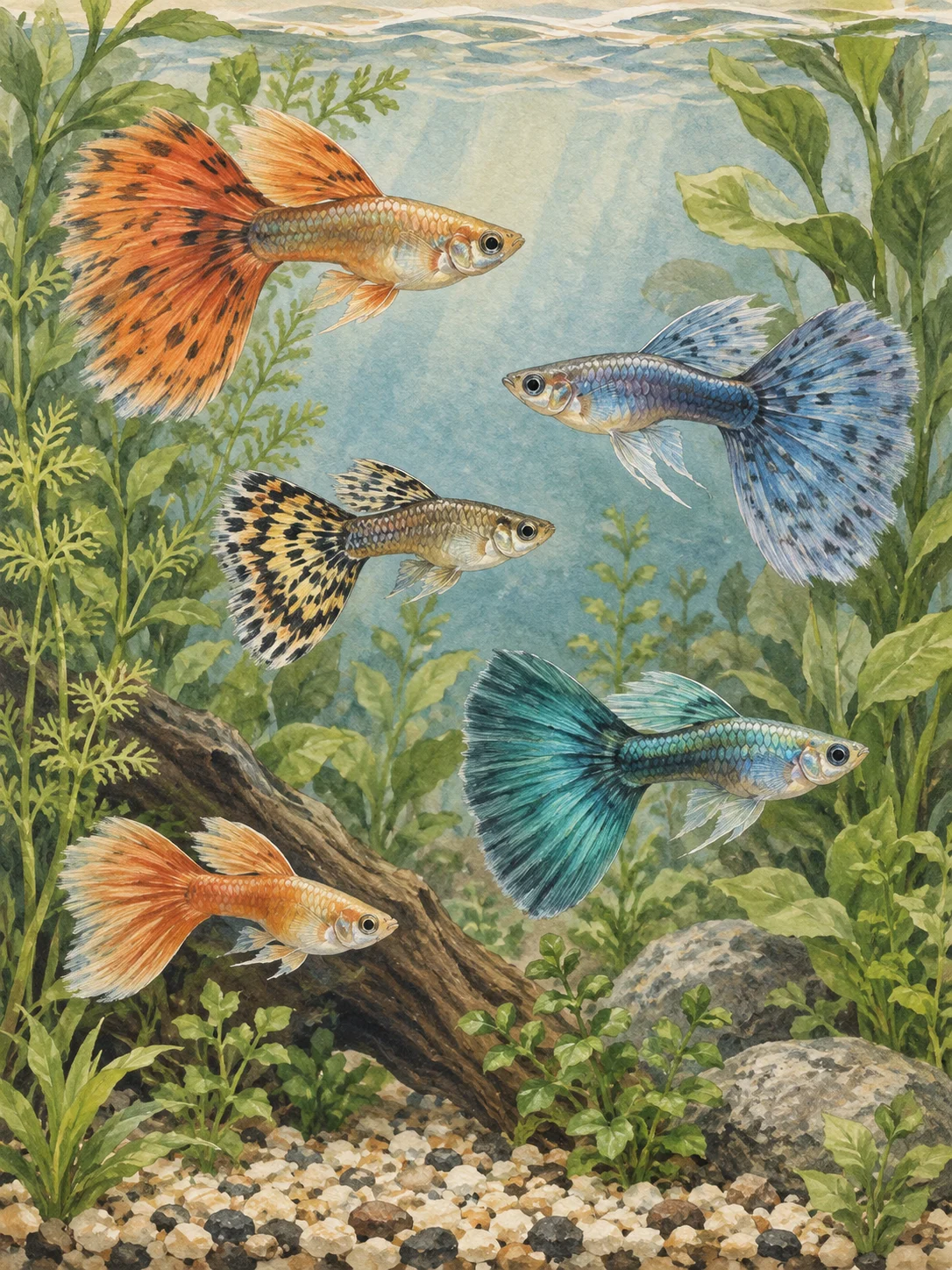
Natural variation
Every guppy is different
Color, size and fin shape vary with strain, age and each individual fish.
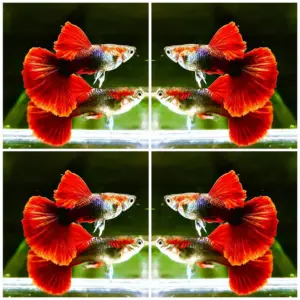
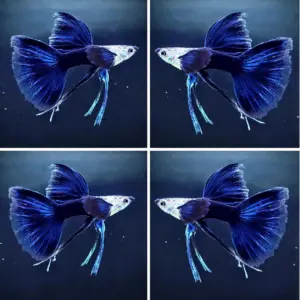
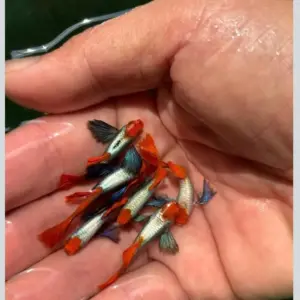
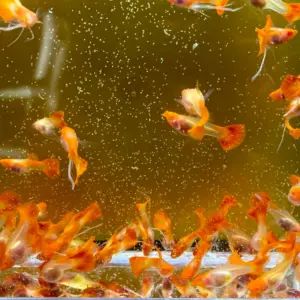
Editorial illustrations for context; they do not depict HiGuppy's exact facility or current fish stock.