The HiGuppy Journal
How Many Guppies Per Gallon? Stocking Chart for Every Tank Size
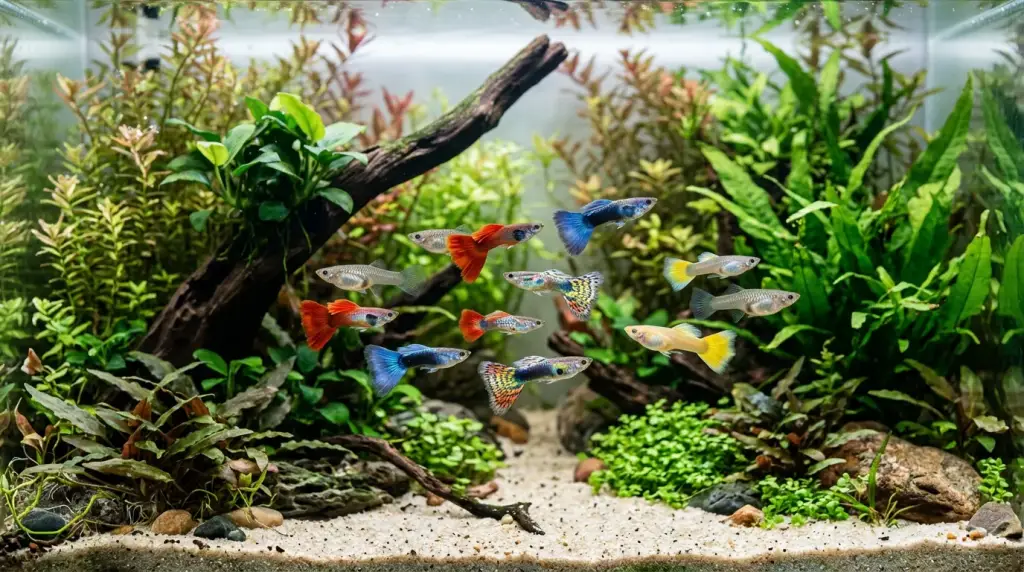
How many guppies per gallon? A practical starting point is about one adult guppy per 2 US gallons (roughly 8 litres) of real water volume, in a cycled tank of at least 12 gallons (45 litres), stocked at one male to two or three females. Start below that number, because guppies breed fast and fry fill spare space quickly.
Stocking is one of the first decisions in good guppy care, and it is easy to get wrong in both directions. Too few guppies and they can become shy; too many and water quality, oxygen and behaviour all suffer. This guide turns the question of how many guppies per gallon into a simple chart for every common tank size, then explains when to stock lighter.
Key takeaways
- Rule of thumb: plan roughly 2 gallons (about 8 litres) per adult guppy as a starting group, not as a maximum to fill.
- Minimum tank: aim for at least 45 litres (about 12 US gallons) for a permanent group; 5 and 10 gallon tanks are tight.
- Sex ratio: keep one male to two or three females, or an all-male group if you do not want fry.
- Count the fry: one mixed group can double or triple in a few months, so leave room or have a grow-out plan.
- Water tests decide: ammonia and nitrite should stay at 0 ppm; if nitrate climbs fast, you are stocked too heavily for your maintenance routine.
Guppy stocking chart: how many guppies per gallon by tank size
Use this guppy stocking chart as a conservative planning guide. The “starting group” column assumes a cycled tank, a sponge or hang-on filter rated for the volume, weekly water changes of 25–30%, and guppies only. Real water volume is usually 10–15% lower than the label once substrate and decor are in.
| Tank size (US gal / litres) | Suitability for guppies | Suggested starting group (adults) | Example mix |
|---|---|---|---|
| 5 gal / 19 L | Not recommended as a permanent home | None long term (hospital or fry tank only) | Temporary use only |
| 10 gal / 38 L | Below the 45 L guideline; experienced keepers only | 3 males at most | 3 males, no females |
| 15 gal / 57 L | Smallest comfortable size | 4–6 | 2 males + 4 females, or 5 males |
| 20 gal long / 76 L | Good beginner tank | 6–9 | 3 males + 6 females |
| 29 gal / 110 L | Very good | 10–14 | 4 males + 9 females |
| 40 gal breeder / 150 L | Excellent, room for fry | 15–20 | 6 males + 12 females |
| 55 gal / 208 L | Excellent show or colony tank | 20–28 | 8 males + 16 females |
| 75 gal / 284 L | Large colony or community | 28–38 | 12 males + 24 females |
Notice that the starting group in this guppy stocking chart sits below “one per gallon”. That gap is deliberate: it absorbs the first broods of fry, bigger adult females, and the odd tank mate such as snails or shrimp.
How many guppies per litre?
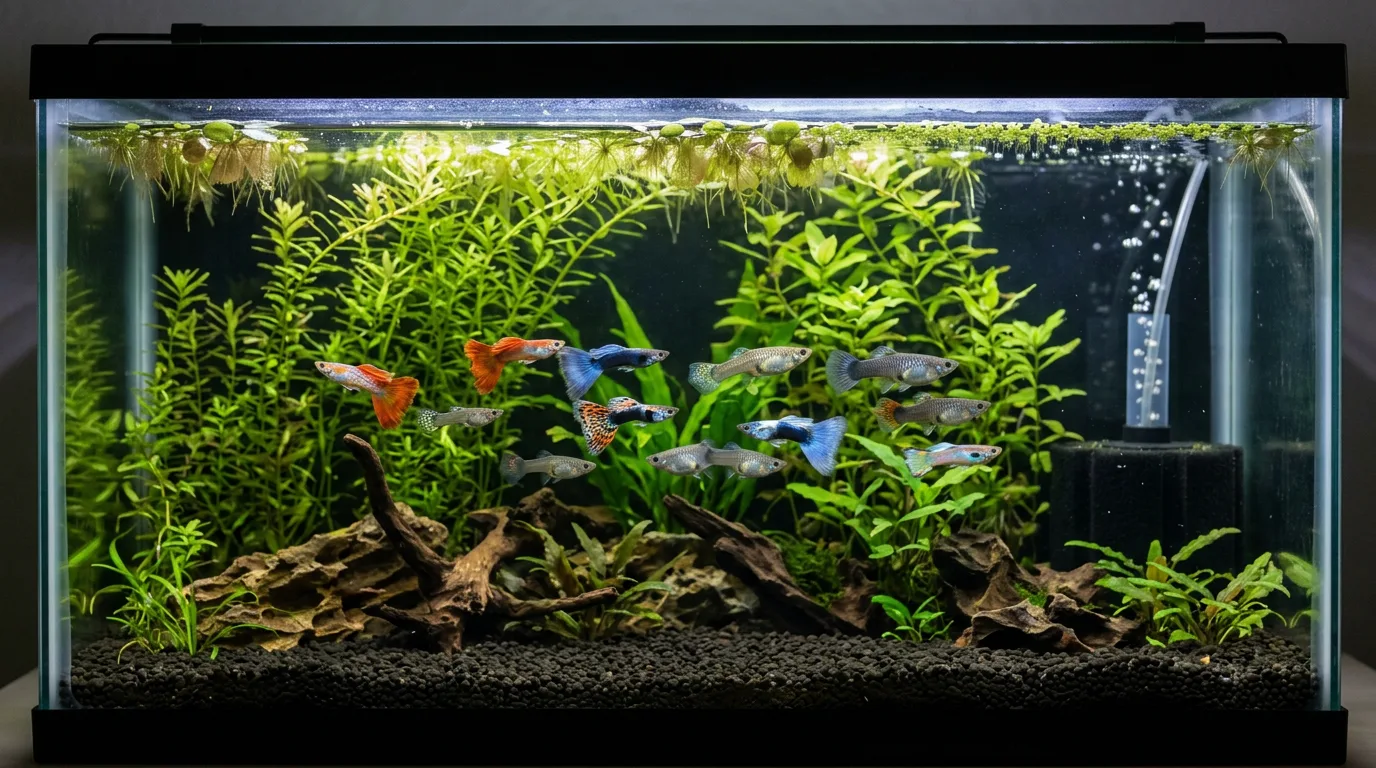
If your tank is labelled in litres, the same guideline works out to about one adult guppy per 7–10 litres, with a minimum tank of 45 litres for a lasting group. A 60 litre tank suits a starting group of about six to eight; a 100 litre tank suits ten to twelve. Watch the gallon unit too: an imperial gallon is about 4.55 litres, while a US gallon is about 3.79 litres, so a “10 gallon” UK tank holds noticeably more water than a US one.
Quick conversions
- 1 US gallon = 3.79 litres; 1 imperial gallon = 4.55 litres.
- 10 US gallons is about 38 litres; 20 US gallons is about 76 litres.
- 45 litres is about 12 US gallons or 10 imperial gallons.
Why the “one inch per gallon” rule falls short
The old one-inch-per-gallon rule says you can keep one inch of adult fish per gallon. A male guppy is about 1.5 inches (3.5 cm) long and a female up to about 2.4 inches (6 cm), so the rule would put roughly one guppy per 1.5–2 gallons. That lines up loosely with our chart, but it ignores three things that matter more:
- Breeding. Guppies are livebearers. A healthy female can drop 20–60 fry every four to five weeks, and she can store sperm for several broods.
- Waste and oxygen. Guppies eat often and produce a lot of waste for their size. Surface area and filtration set the real limit.
- Behaviour. Males chase females constantly. Too few females per male, or too little space and cover, leads to stressed, hiding females.
So treat any per-gallon number as the start of the plan, then adjust for the factors below. Our guppy water parameters guide explains the test results to aim for.
Small tanks: 5, 10 and 20 gallons
5 gallon tank
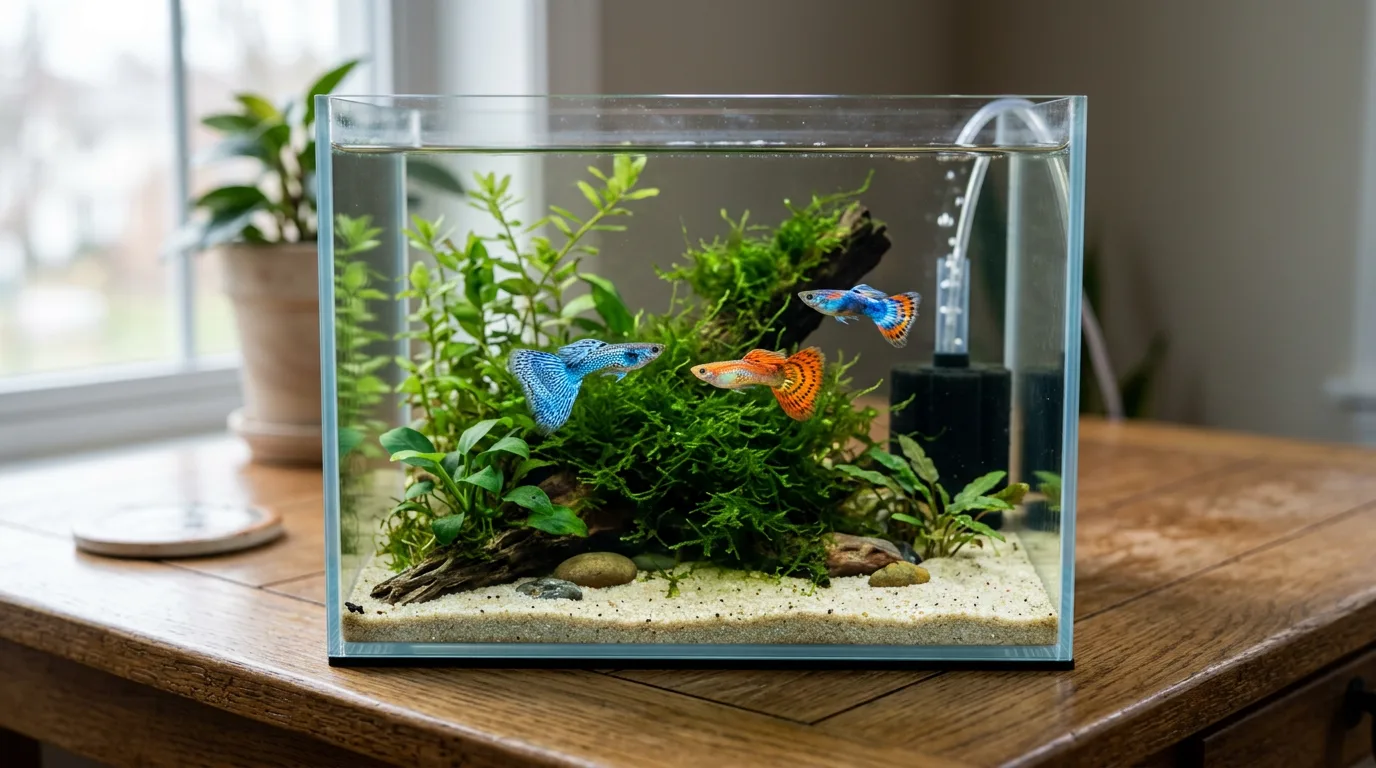
Five gallons (19 litres) swings in temperature and water quality too quickly for a permanent guppy group, even three males. It works as a short-term hospital, quarantine or fry tank. Read the full reasoning in how many guppies in a 5 gallon tank.
10 gallon tank
A 10 US gallon tank holds about 38 litres, still under the 45 litre guideline. If you already own one, a small all-male group with strong filtration and frequent water changes is the safest use; avoid mixed sexes. See how many guppies in a 10 gallon tank for the details.
20 gallon tank
Twenty gallons is where guppy keeping gets comfortable. A long 20 gives more swimming length and surface area than a tall one, which helps oxygen exchange. Our how many guppies in a 20 gallon tank guide covers sex ratios and tank mates at this size.
Larger tanks: 29 to 75 gallons
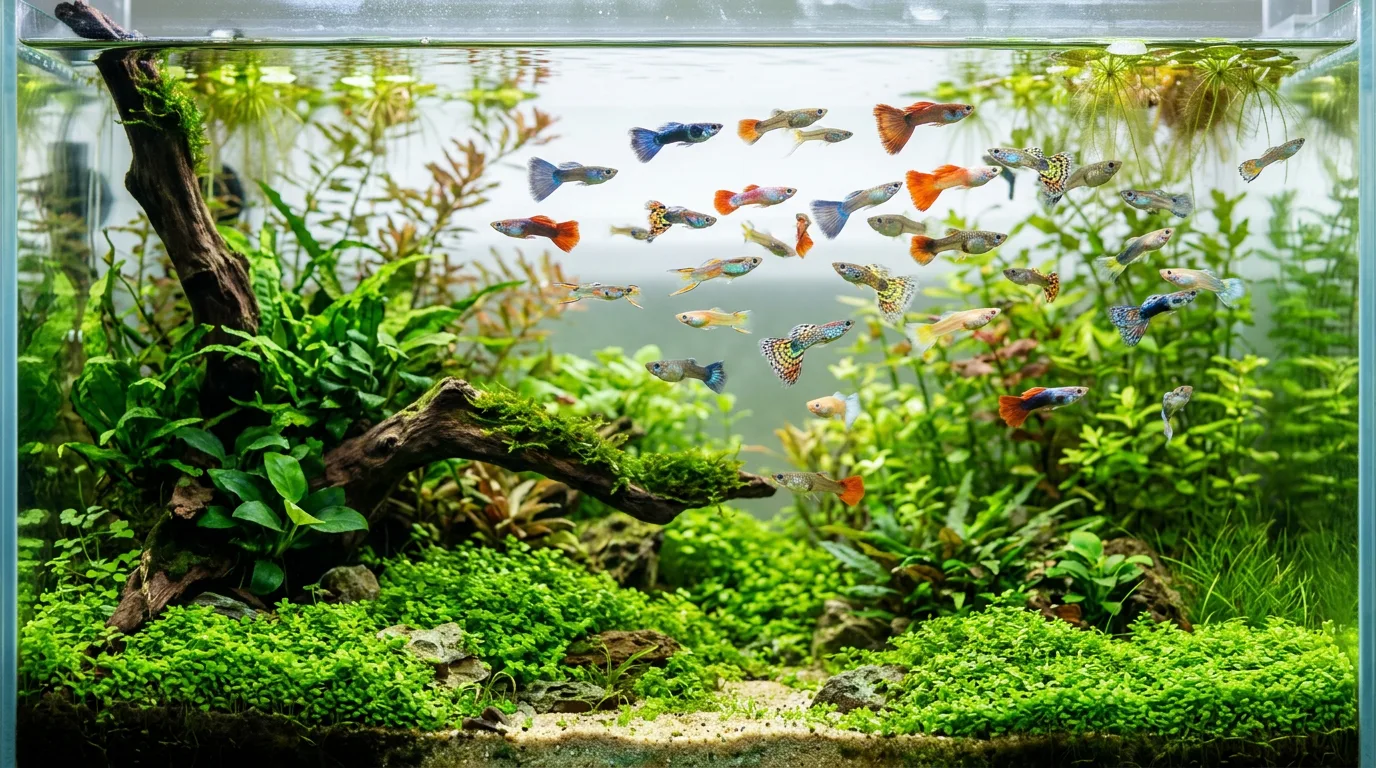
From 29 gallons up, the guppy stocking chart scales almost linearly, and bigger tanks are more forgiving: temperature stays steadier, waste is diluted, and a missed water change matters less. Large tanks are also the best home for a breeding colony because fry can grow up alongside adults when there is dense planting. If you plan a mixed community, subtract space for every other fish and check compatibility first in our best tank mates for guppies list.
Factors that change how many guppies per gallon you can keep
- Male-only or mixed. An all-male tank can sit near the top of the range because no fry arrive. A mixed tank should start near the bottom.
- Filtration. A mature filter rated for at least the tank volume is the minimum. Our guide to the best filter for guppies compares sponge, hang-on-back and canister options.
- Live plants. Plants absorb nitrate and give females and fry cover, but they do not replace water changes.
- Maintenance. If you change 25–30% weekly, you can stock at the middle of the range. If water changes slip, stock lighter.
- Tank shape. Long, low tanks hold more fish comfortably than tall ones of the same volume.
- Tank mates. Corydoras, snails and shrimp add waste too. Count them in your plan.
How to add guppies without overstocking
Knowing how many guppies per gallon your tank can hold is only half the job; how you add them matters too.
- Cycle the tank first, until ammonia and nitrite read 0 ppm and nitrate is present.
- Add the starting group in one or two batches, not one fish at a time over months.
- Test water twice a week for the first month. Nitrate rising above 40 ppm between changes means more water changes or fewer fish.
- Watch behaviour: hiding females, clamped fins or guppies gasping at the surface are early signs of too many fish or too little oxygen.
- Decide on fry before they appear: a grow-out tank, a local store that takes surplus, or an all-male tank.
If this is your first tank, our step-by-step page on how to take care of guppies walks through setup, feeding and water changes in order.
Signs your guppy tank is overstocked
- Ammonia or nitrite shows up at all, or nitrate climbs fast after a water change.
- Cloudy water returns within a day or two of cleaning.
- Guppies hang at the surface or near the filter outlet.
- Constant chasing, torn fins, or females hiding all day.
- Fry are everywhere and adults are always hungry.
The fix is the same in every case: more water changes now, then fewer fish or a bigger tank. According to general guppy biology summarised on Wikipedia’s guppy article, guppies are highly prolific, so an overstocked tank rarely fixes itself.
FAQ
How many guppies per gallon is safe?
Plan about one adult guppy per 2 US gallons (about 8 litres) of real water volume as a starting group. Keep the tank at least 45 litres (about 12 gallons) and stock lighter if you keep males and females together.
Can I keep 1 guppy per gallon?
One per gallon is an upper limit for an all-male tank with strong filtration and frequent water changes. For mixed groups that will breed, it overstocks the tank quickly once fry arrive.
How many guppies should I start with in a 20 gallon tank?
Start with six to nine adults, such as three males and six females, or six to eight males if you do not want fry. Add more only if water tests stay stable for several weeks.
What is the best male to female ratio for guppies?
Keep one male to two or three females. This spreads the males’ attention so no single female is chased constantly. All-male groups also work well and avoid fry.
Do guppy fry count toward stocking?
Yes. Fry grow to adult size in about three months, so each brood adds to the long-term load. Plan a grow-out tank or a way to rehome surplus fish before you keep males and females together.
Behind the care guides
Care begins with steady systems
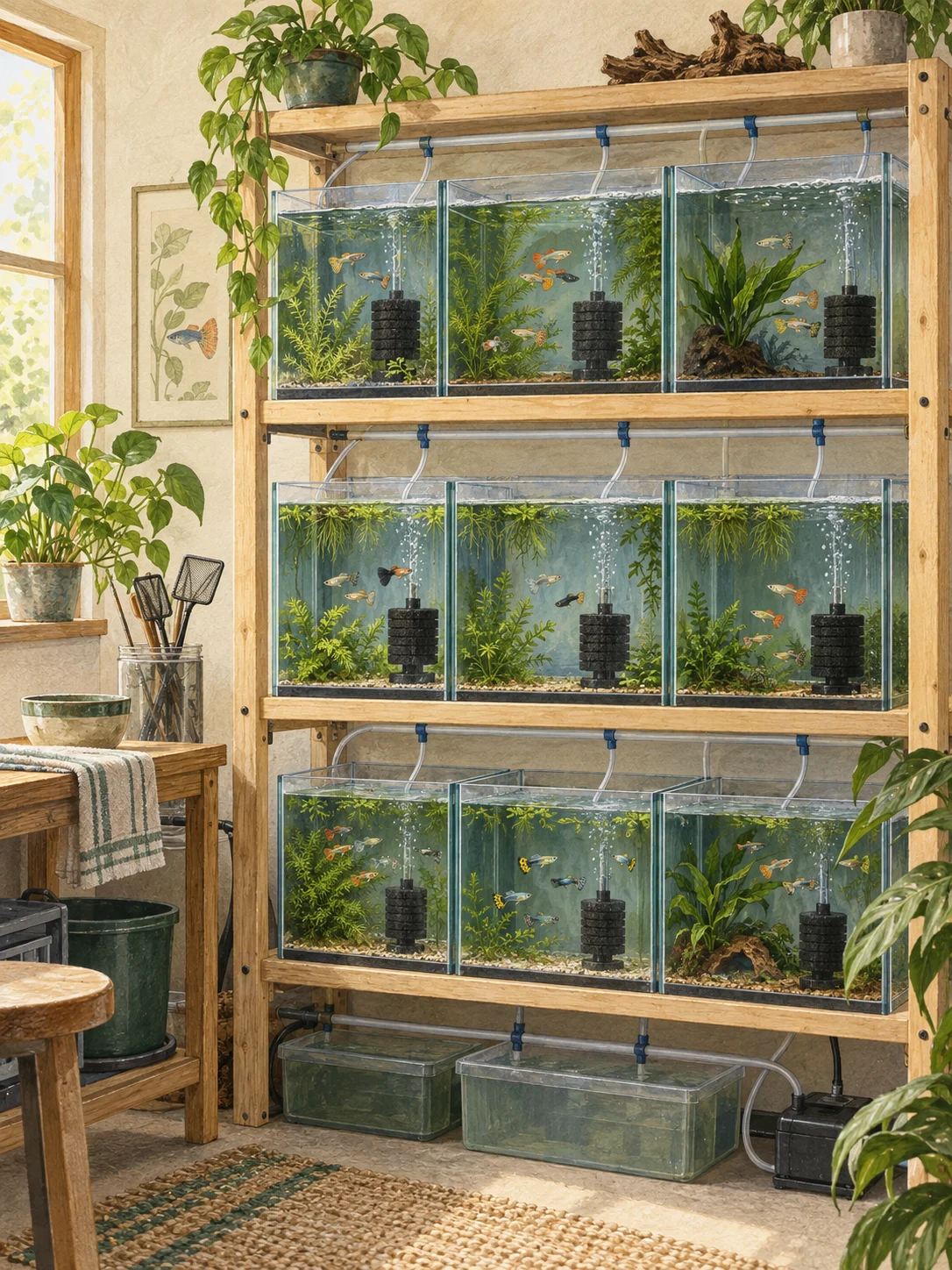
Our guppy guides focus on practical routines: keep water stable, observe fish closely and allow for natural variation.
Care systems
Steady water, thoughtful care
Gentle filtration and regular observation support healthy aquarium routines.
Natural variation
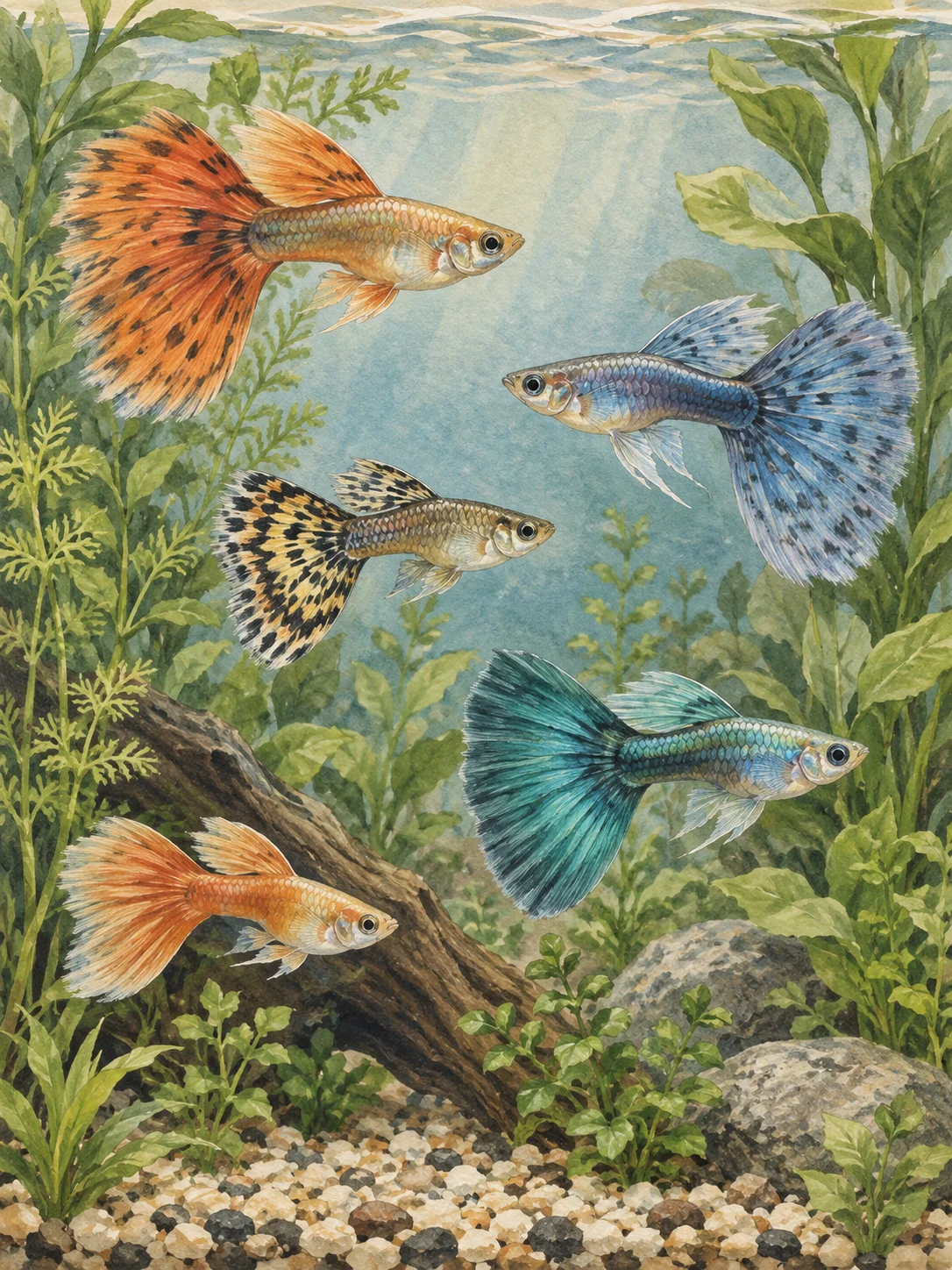
Every guppy is different
Color, size and fin shape vary with strain, age and each individual fish.
Editorial illustrations for context; they do not depict HiGuppy's exact facility or current fish stock.