The HiGuppy Journal
Nitrate in Guppy Tank: Safe Levels and How to Lower It
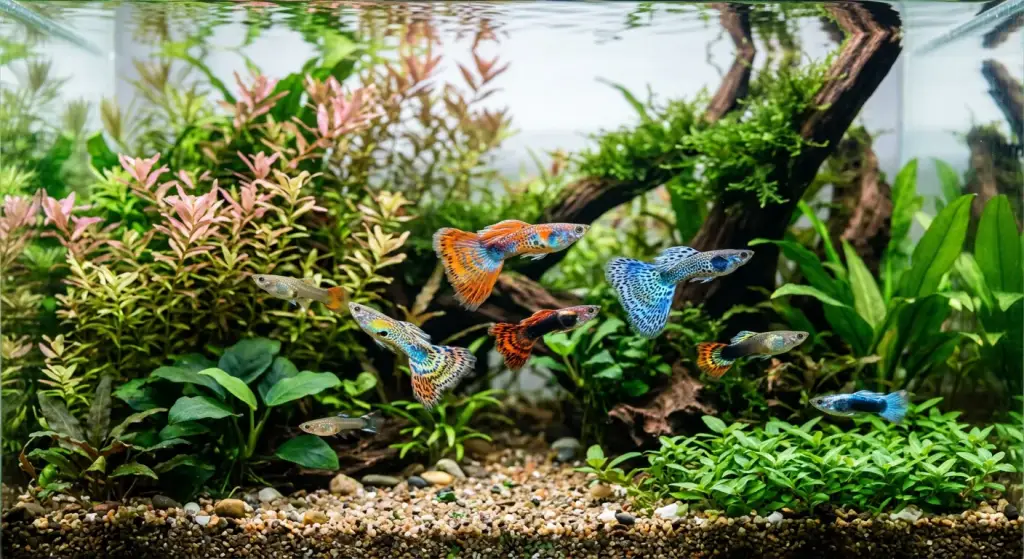
What is a safe level of nitrate in a guppy tank? For most guppies, keeping nitrate below about 20 ppm is a sound target, and anything under 40 ppm is usually tolerated by healthy adults. Nitrate is the end product of the nitrogen cycle, so it builds up slowly and is removed mainly by water changes and plants. Our complete guppy care guide covers the other basics that sit beside water quality.
Nitrate rarely kills guppies overnight the way ammonia or nitrite can, which is exactly why it gets ignored. Fish sit in slowly rising nitrate for weeks and quietly lose color, appetite, fin condition and resistance to disease. Fry and pregnant females feel it first. This guide explains where nitrate comes from, what levels to aim for, how to test properly, and the practical ways to lower it, with step-by-step routines you can start today. Figures are general ranges, so use them as a starting point and watch your own fish.
Nitrate in guppy tank water: the short answer
Every aquarium produces nitrate. Fish waste, leftover food and decaying plant matter release ammonia. Beneficial bacteria convert ammonia to nitrite, and a second group converts nitrite to nitrate. If you want the background, the nitrogen cycle explains the whole chain. Nitrate is far less toxic than the two steps before it, but it does not disappear by itself. In a closed tank it keeps rising until you remove it or something consumes it.
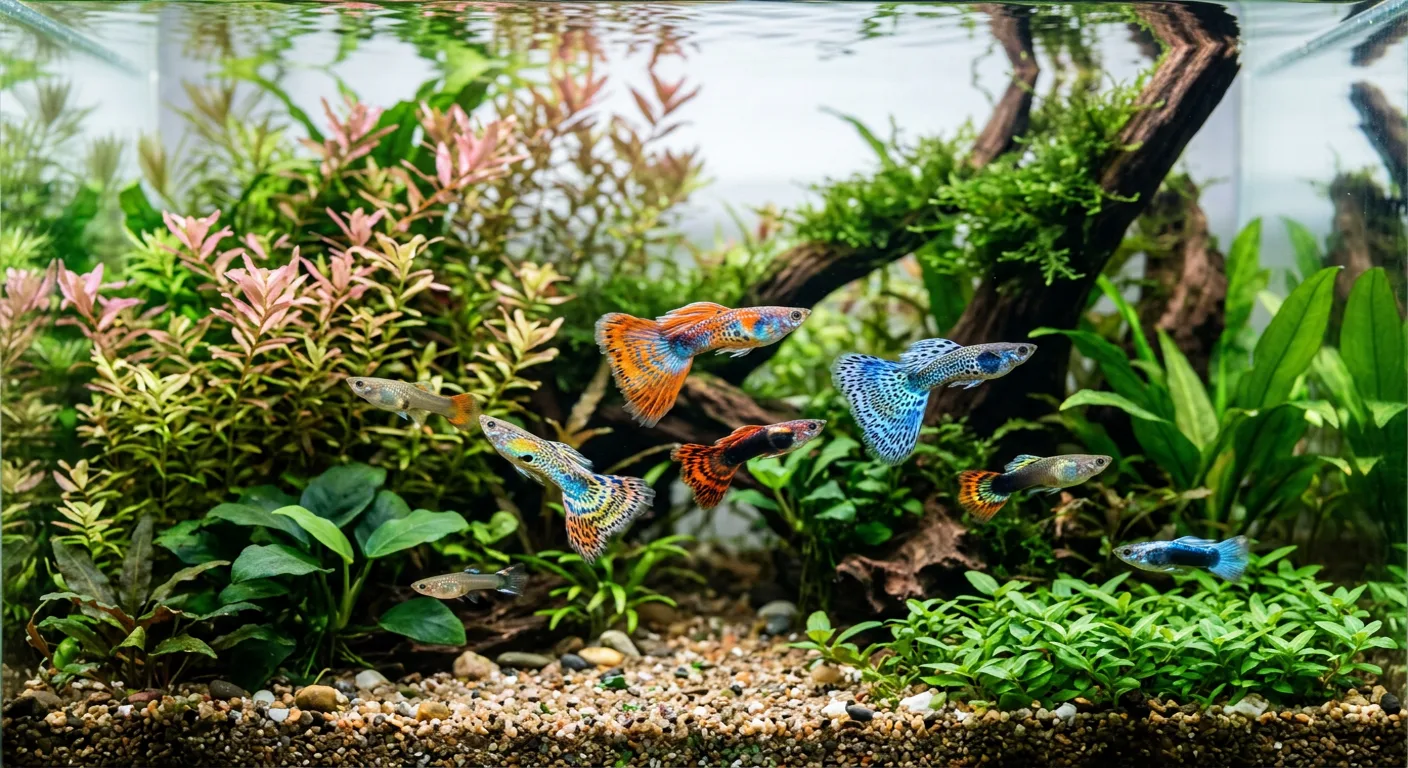
For guppies, a practical goal is nitrate between 5 and 20 ppm, with 40 ppm as a line you try not to cross. Nitrate sensitivity varies between individuals, strains and ages. Heavily line-bred show fish and young fry are generally less forgiving than a hardy feeder-type guppy, so there is no single magic number. The healthiest approach is to know your tank’s baseline and keep it steady.
Why nitrate matters even though it is “the safe one”
Chronic exposure to elevated nitrate is linked in the aquarium hobby to stress, faded color, sluggish behavior, poor breeding results and weaker immune response. Fish under constant low-level stress are more likely to catch fin rot, ich and other infections. Treat nitrate like background noise that slowly wears fish down, not like a one-off emergency.
Nitrate versus ammonia and nitrite
If your test shows ammonia or nitrite above zero, that is the urgent problem, not nitrate. Read our guides on ammonia poisoning in guppies and nitrite poisoning in guppies first, because those need an immediate water change and a fix to the filter or cycle.
| Compound | Target reading | Danger level | Main fix |
|---|---|---|---|
| Ammonia | 0 ppm | Very high, burns gills | Immediate water change, check filter and feeding |
| Nitrite | 0 ppm | Very high, blocks oxygen uptake | Immediate water change, support the cycle |
| Nitrate | Under 20 ppm | Low short term, harmful long term | Regular water changes, plants, lighter feeding |
Safe nitrate levels for guppies
There is no official, universally agreed limit, so treat these as practical bands used by many experienced keepers. Always check the number against how your fish actually look and behave.
| Nitrate reading | What it means | What to do |
|---|---|---|
| 0 to 5 ppm | Very clean, often a heavily planted tank | Fine, but make sure plants are not starving |
| 5 to 20 ppm | Ideal working range for most guppy tanks | Keep your routine |
| 20 to 40 ppm | Acceptable for healthy adults, a warning sign | Increase water changes, review feeding and stocking |
| 40 to 80 ppm | High, stress likely, fry at risk | Do staged water changes over several days |
| Above 80 ppm | Very high, expect illness and color loss | Staged changes, deep clean, fix the cause |
Tap water already contains nitrate
Some municipal and well water arrives with nitrate already in it, sometimes 10 to 20 ppm or more. If your tap reads 20 ppm, a water change can never bring the tank below 20. Test your tap water the same day you test the tank. This one habit explains many “my nitrate will not drop” posts.
Fry, pregnant females and show strains
Newborn fry grow more slowly in high nitrate, and breeders often keep fry tanks lower than the main tank. If you raise fry, see our guides on water changes for guppy fry and the raising guppy fry guide. Aim for the low end of the range there.
How to test nitrate in your guppy tank
You cannot judge nitrate by looking at the water. A crystal clear tank can read 60 ppm. Testing is the only way to know, and the method matters more than most people expect.
Liquid kit versus strips
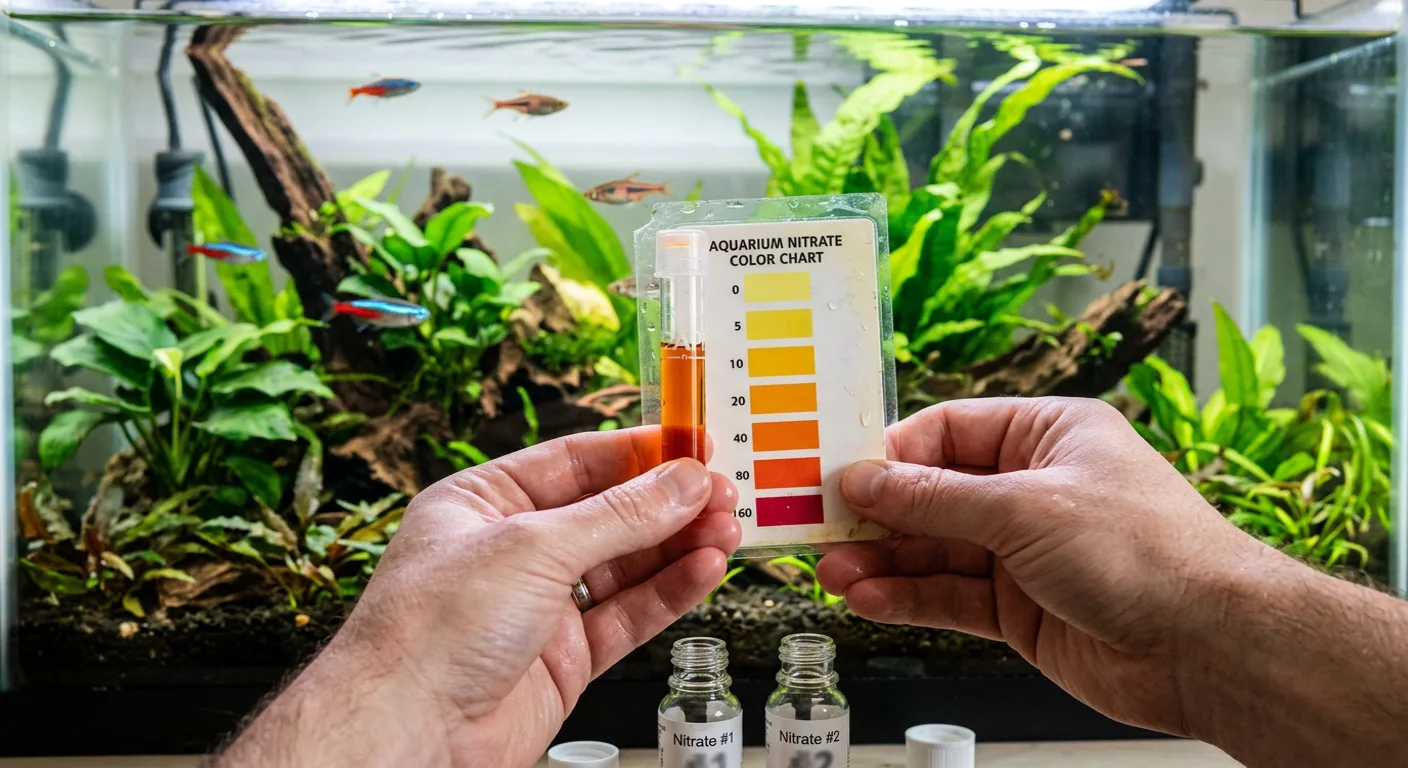
Liquid reagent kits are generally more accurate and cheaper per test than dip strips, which can drift with age and humidity. Strips are fast and fine for a quick glance, but a liquid kit is the better habit for a guppy keeper who wants numbers they can trust.
Step-by-step: reading nitrate correctly
- Rinse the test tube with tank water, not soap.
- Fill to the line with water taken from mid-tank, away from the surface and filter outlet.
- Shake the nitrate reagent bottle number two very hard for at least 30 seconds, because the particles settle and a weak shake gives a false low reading. This is the most common mistake with common liquid kits.
- Add the exact number of drops from the instructions, holding the bottle upright.
- Cap the tube, shake, then wait the full time stated, often about five minutes.
- Compare the color to the card in daylight against a white background.
- Write the result and the date in a log, then test fresh tap water the same way.
How often to test
In a new tank, test every few days for the first month. In a stable tank, test once a week before a water change. That timing matters: testing right before the change shows your worst reading, which is the number you actually want to manage. Check the expiry date on reagents, since old reagents read inaccurately.
Where nitrate in a guppy tank comes from
Understanding the sources tells you which lever to pull. Nitrate production is roughly the sum of how much waste enters the tank, and the speed at which it is removed.
Overfeeding
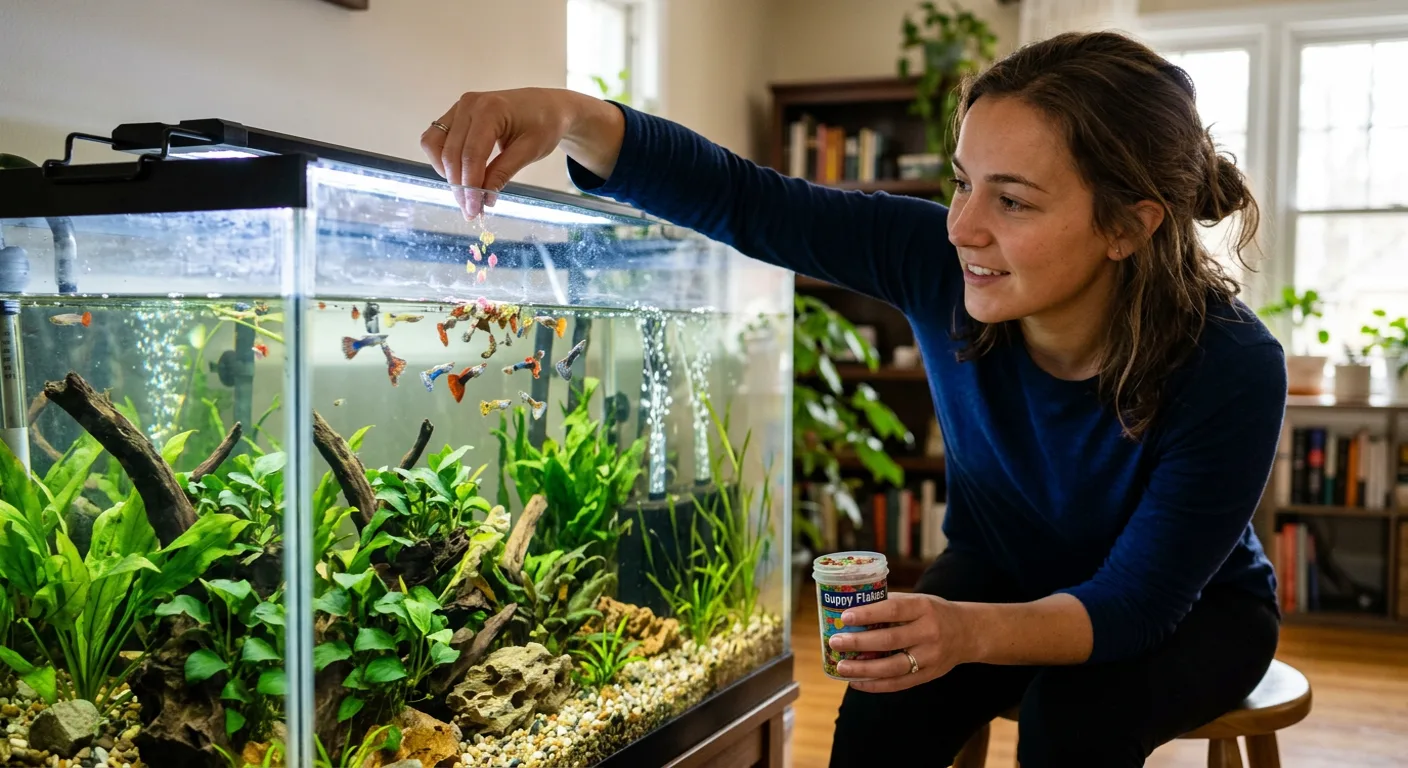
Uneaten food is the biggest hidden source. Guppies have small stomachs and beg constantly, which tempts people to feed more. Anything that reaches the substrate rots and feeds the cycle. Our guide on overfeeding guppies shows how to spot the problem. A good rule is to feed only what the fish finish in about two minutes, once or twice a day.
Too many fish for the tank
Guppies breed fast, and a tank that held six fish in spring can hold thirty by autumn. More fish means more waste. If nitrate climbs month after month despite good habits, check your headcount. Our guide on how many guppies per gallon helps you work out a sensible stocking level.
Dirty filter media and substrate
Mulm trapped in gravel, sponge and filter cartridges keeps decomposing and releasing nutrients. A filter that has not been rinsed in months is a nitrate factory. A gentle rinse in used tank water, never tap water, keeps bacteria alive while removing sludge.
Dead plant matter and dead fish
Decaying leaves and an unnoticed dead fish or snail can spike readings fast. Trim yellowing leaves, and count your fish daily during feeding.
Infrequent water changes
Without water changes nitrate has nowhere to go. This is the single most common cause of high readings, and the one that is easiest to fix. See how often to change guppy tank water for a full schedule.
| Cause | Typical sign | Fix |
|---|---|---|
| Overfeeding | Food on the substrate, cloudy water | Smaller portions, one fasting day a week |
| Overstocking | Rapid nitrate rise after a week | Rehome fish, larger tank, separate males and females |
| Dirty filter | Slow flow, brown sludge | Rinse media in tank water monthly |
| Skipped changes | Steady climb week after week | Weekly water change |
| Tap nitrate | Reading never drops below a floor | Test tap, consider a filter or alternative source |
Signs of high nitrate in guppies
Symptoms are subtle and overlap with other problems, so always confirm with a test. Do not diagnose by behavior alone.
- Fading or dull color, especially on males that used to look vivid.
- Reduced appetite or lazy swimming near the bottom or in a corner.
- Clamped fins or frayed tails that do not heal.
- Slow growth in fry and stunted juveniles.
- Fewer or weaker fry, or females that drop their young early.
- More frequent infections such as fin rot or white spot.
- Persistent green water or algae, because nitrate feeds algae growth.
If several of these appear together, test nitrate along with ammonia, nitrite and pH. Our article on why a guppy is lethargic walks through the other likely causes so you do not blame nitrate for everything.
How to lower nitrate in a guppy tank, step by step
The good news is that nitrate responds well to simple, repeatable habits. Work through these in order.
1. Do water changes the right way
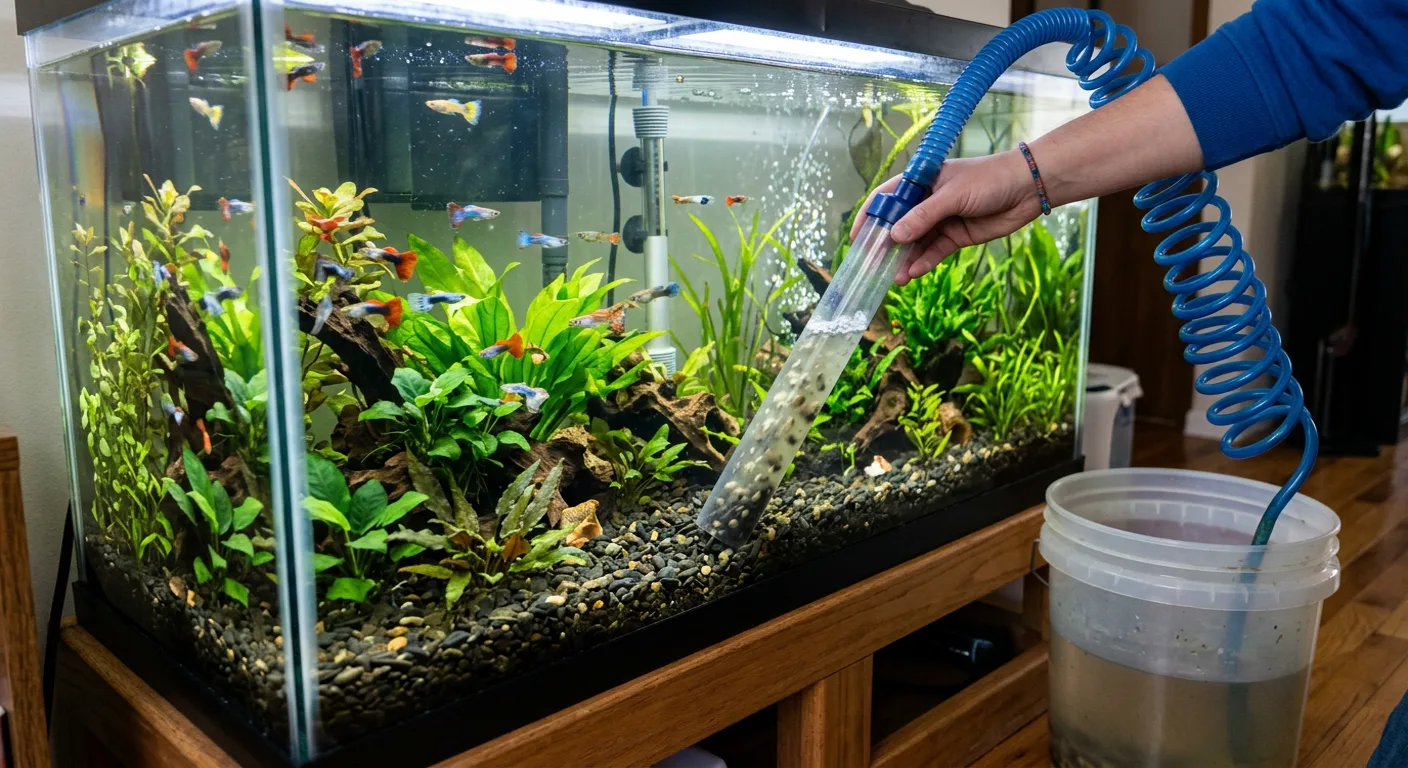
A weekly change of 25 to 30 percent suits most guppy tanks, and a lightly stocked planted tank may need less. If nitrate is already high, do not replace everything at once, because a huge swing in water chemistry shocks fish. Use staged changes instead.
- Test the tank and the tap water and write both numbers down.
- Switch off the heater and filter if the water level will drop below their intakes.
- Vacuum the gravel, working in sections, removing 25 to 30 percent of the water.
- Prepare new water with dechlorinator at a similar temperature, within about one degree, and a similar pH.
- Pour slowly against a plate or your hand so substrate is not blown around.
- Restart equipment and watch the fish for ten minutes.
- Repeat every one or two days until nitrate is in your target range.
2. Staged recovery from very high nitrate
Say a test shows 100 ppm. Dropping to 10 ppm in one change is too abrupt. A 30 percent change on day one, another on day three, and another on day five brings the reading down steadily. Each change should lower the number by roughly a third of what remains, depending on your tap water. Keep temperature and pH matched so the main stress is not the change itself.
3. Feed less and feed better
Cutting food by a quarter often produces a visible drop in nitrate within two weeks. Choose a quality flake or small pellet that is eaten quickly, use a fasting day each week, and remove anything left after two to three minutes. Our comparison of flakes versus pellets for guppies helps you choose food that wastes less.
4. Add fast-growing live plants
Plants absorb nitrate as fertilizer. Fast growers such as hornwort, water sprite, guppy grass, pothos with roots in the water, and floating plants remove the most. Slow plants such as anubias and java fern help less but still contribute.
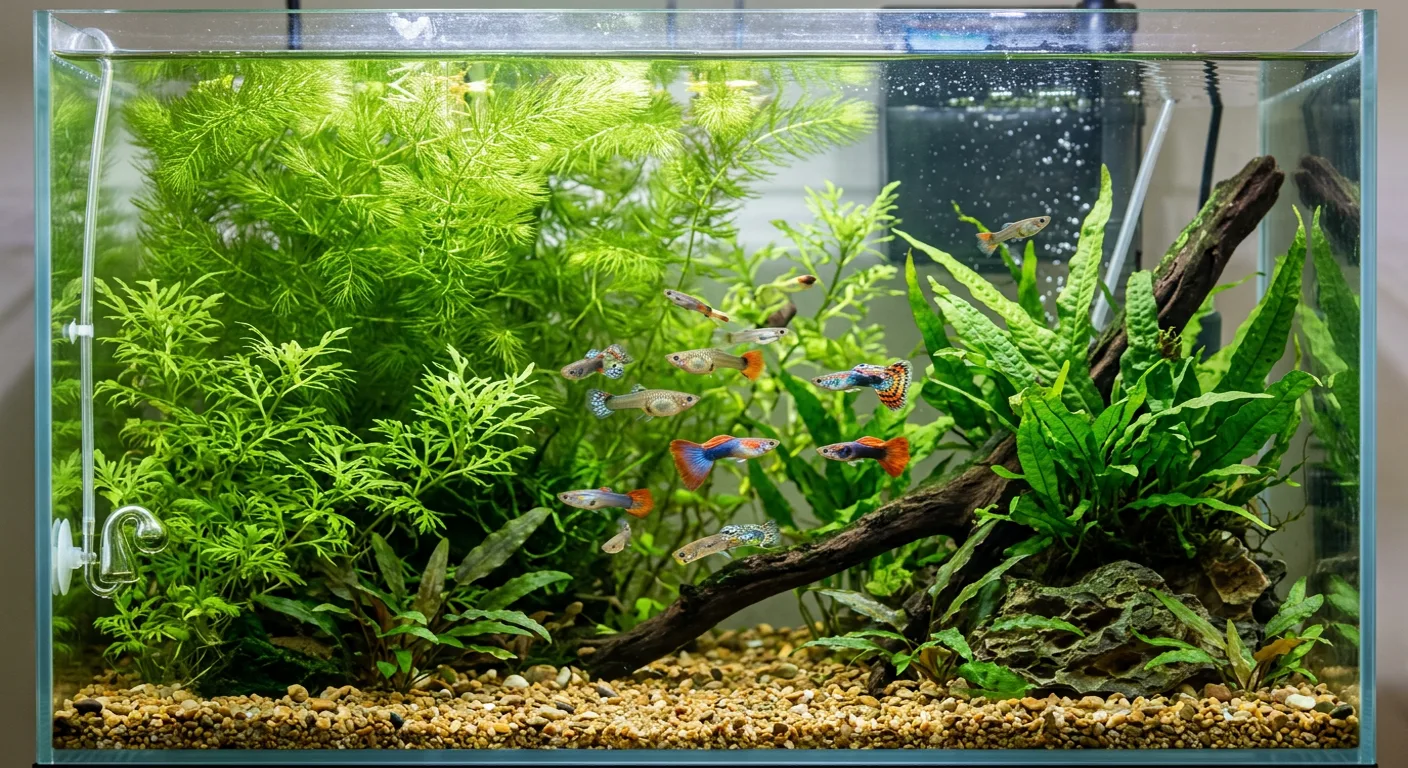
Plants support water changes rather than replace them. For choices and setup, see best live plants for guppies and the planted guppy tank setup guide. Light matters: without enough light plants stall and stop absorbing.
5. Keep the filter clean but not sterile
Once a month, squeeze the sponge or media in a bucket of old tank water until the sludge comes out. Never rinse under the tap, because chlorine kills the bacteria you need. Replace only part of the media at a time.
6. Rehome extra fish
If you are overstocked, no routine will keep nitrate low for long. Separating males and females also stops runaway breeding. Consider a second tank or sell surplus fry to other hobbyists.
7. Consider the tank’s age and bioload
A new tank has fewer plants and less stable bacteria, and a mature tank has a settled rhythm. Allow time and avoid adding many fish at once. The guppy tank cycling checklist shows how to build that foundation.
| Method | Speed | Effort | Notes |
|---|---|---|---|
| Water change | Immediate | Low to medium | Most reliable single fix |
| Feed less | 1 to 2 weeks | Very low | Free and effective |
| Fast-growing plants | 2 to 4 weeks | Low | Needs decent light |
| Clean filter and gravel | Days | Low | Do not sterilize the media |
| Reduce stock | Immediate | Medium | Long-term fix for overstocking |
Common mistakes with nitrate in a guppy tank
These are the errors that show up again and again, and each one is easy to avoid once you know it.
Changing all the water at once
Dumping the tank and refilling shocks fish and wipes out surface bacteria. Smaller, regular changes are safer and cheaper.
Trusting chemical removers blindly
Some products claim to remove nitrate. Results vary, and they do not fix the cause. Use them, if at all, as a short-term bridge and keep doing water changes.
Testing only when something looks wrong
By the time fish look unwell, nitrate has often been high for weeks. Weekly testing catches the slow climb early.
Forgetting the tap water
If the source water has nitrate, you will chase a number you cannot reach. Test it first.
Using an under-shaken reagent
A badly shaken nitrate reagent reads falsely low, giving false comfort. Shake it hard, every time.
A weekly nitrate routine you can copy
A simple, repeatable week beats occasional heroic cleanups. Here is a routine for a typical guppy tank, which you can adapt. The related guppy tank maintenance schedule gives a longer plan.
- Daily: feed small portions, remove uneaten food, count fish.
- Weekly: test nitrate, then change 25 to 30 percent of the water and vacuum a third of the gravel.
- Monthly: rinse filter media in tank water and trim plants.
- Every season: re-check stock numbers and test the tap water again.
A realistic example
Imagine a 10 gallon tank with twelve guppies and a tap reading of 5 ppm. The keeper changes water every two weeks and nitrate sits near 60 ppm. Moving to a weekly 30 percent change, cutting food by a quarter and adding a bunch of hornwort typically brings the reading toward 15 to 25 ppm within a month. Exact results vary with stocking and plants, but the pattern is consistent.
Tips for beginners
Buy a liquid test kit before you buy decorations. Keep a notebook with dates and readings. Do not chase zero; a small, steady amount of nitrate is normal and fine.
Tips for experienced keepers
Track nitrate per tank rather than guessing, and use a lower target in breeding and fry tanks. Consider a dedicated planted refugium or a floating-plant layer in heavy-stock setups, and re-test after any change in food brand, since a richer food can raise waste noticeably.
Buying healthy guppies that thrive in good water
Clean water is half the story, and healthy stock is the other half. Fish raised in well-managed water usually adapt more easily. If you are building a new group, our live guppies are shipped from Vietnam and you can browse premium guppy pairs or male guppies. Read our water parameters guide before they arrive so your tank is ready.
Nitrate checklist
- Test tap water and tank water with a liquid kit.
- Aim for 5 to 20 ppm and stay below 40 ppm.
- Do a 25 to 30 percent water change weekly.
- Use staged changes if nitrate is very high.
- Feed small amounts and remove leftovers.
- Add fast-growing plants and give them light.
- Rinse filter media in tank water monthly.
- Do not overstock, and rehome extra fry.
- Check ammonia and nitrite first if fish look ill.
- Keep a log so you can see trends.
Keep going with our guppy care guide for the full picture of a healthy tank.
FAQ
What is a safe nitrate level for guppies?
Most keepers aim for 5 to 20 ppm and try not to go above 40 ppm. Healthy adults often tolerate the upper end, while fry and show strains do better lower. Stability matters as much as the exact number.
Can high nitrate kill guppies?
Very high nitrate can, especially over time and in weak or young fish. More often it causes stress, color loss and illness first. If readings are far above 80 ppm, begin staged water changes right away.
How fast can I lower nitrate?
Lower it gradually over several days using repeated 25 to 30 percent water changes. A sudden drop can shock fish. Plants and lighter feeding then keep it down.
Why is my nitrate still high after a water change?
Your tap water may already contain nitrate, or the reagent was not shaken enough. A dirty filter, overstocking or overfeeding can also refill the tank quickly. Test tap water and review those causes.
Do live plants remove nitrate?
Yes, plants absorb nitrate as nutrient, especially fast growers such as hornwort and floating plants. They help but do not replace water changes. They also need adequate light to work well.
How often should I test nitrate?
Test weekly in an established tank, ideally just before the water change. In a new tank test every few days. More testing helps whenever you change stock or food.
Is zero nitrate better for guppies?
Not necessarily. A small amount is normal and harmless, and a heavily planted tank may read close to zero without trouble. The goal is a low, steady level rather than a perfect zero.
Behind the care guides
Care begins with steady systems
Our guppy guides focus on practical routines: keep water stable, observe fish closely and allow for natural variation.

Care systems
Steady water, thoughtful care
Gentle filtration and regular observation support healthy aquarium routines.

Natural variation
Every guppy is different
Color, size and fin shape vary with strain, age and each individual fish.
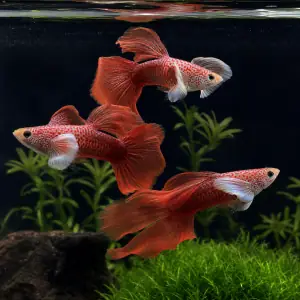
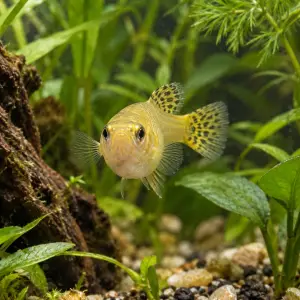
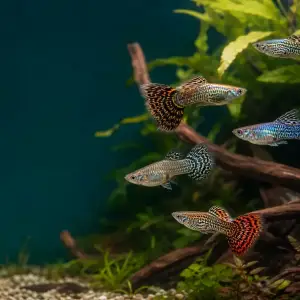
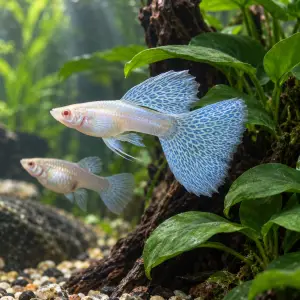
Editorial illustrations for context; they do not depict HiGuppy's exact facility or current fish stock.