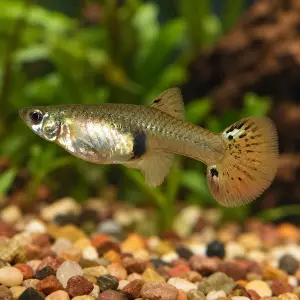
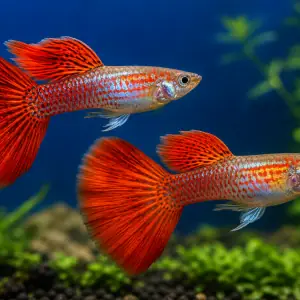
The HiGuppy Journal
Half Black Guppy: Strain Guide, Care and Breeding
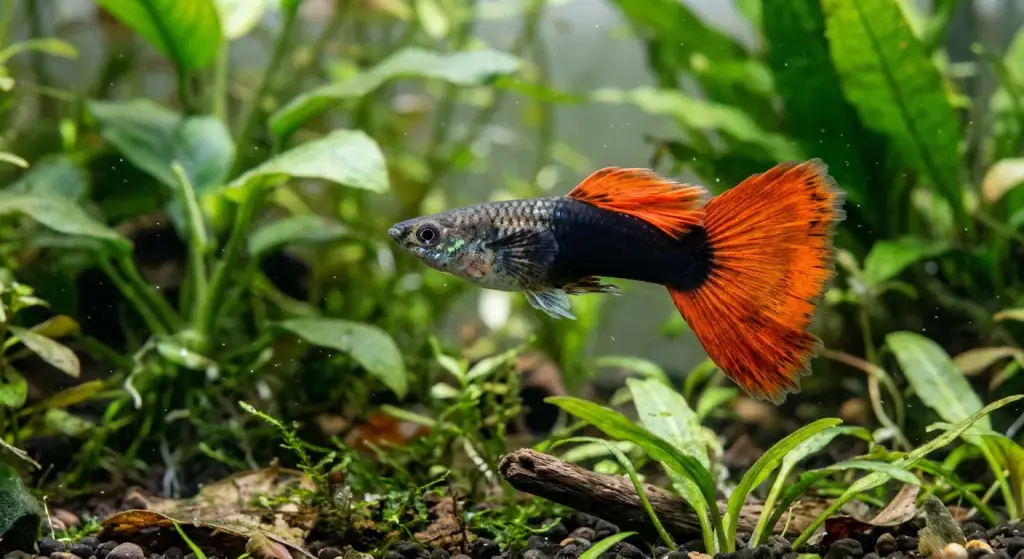
What is a half black guppy? A half black guppy is a selectively bred fancy guppy (Poecilia reticulata) with a darker rear body and a lighter front, often paired with a red, blue, yellow or other colored tail. The same pattern family is frequently sold as Tuxedo. Some lines show very dark, clean coverage while others have a softer boundary. Care follows normal guppy needs: stable hard-water conditions, a cycled tank and varied feeding. Breeding for a specific pattern requires records and selection; the name alone cannot guarantee every fry matches.
Half Black and Tuxedo are often overlapping names for the dark-rear-body guppy pattern, not two inherently separate species or genetic categories. A seller may reserve ‘half black’ for especially even, opaque rear-body coverage and use ‘tuxedo’ more broadly, but usage varies by line and breeder. Compare the actual fish and the seller’s terminology rather than assuming the label alone establishes a formal standard. See our Tuxedo guppy guide for additional examples.
What a half black guppy looks like
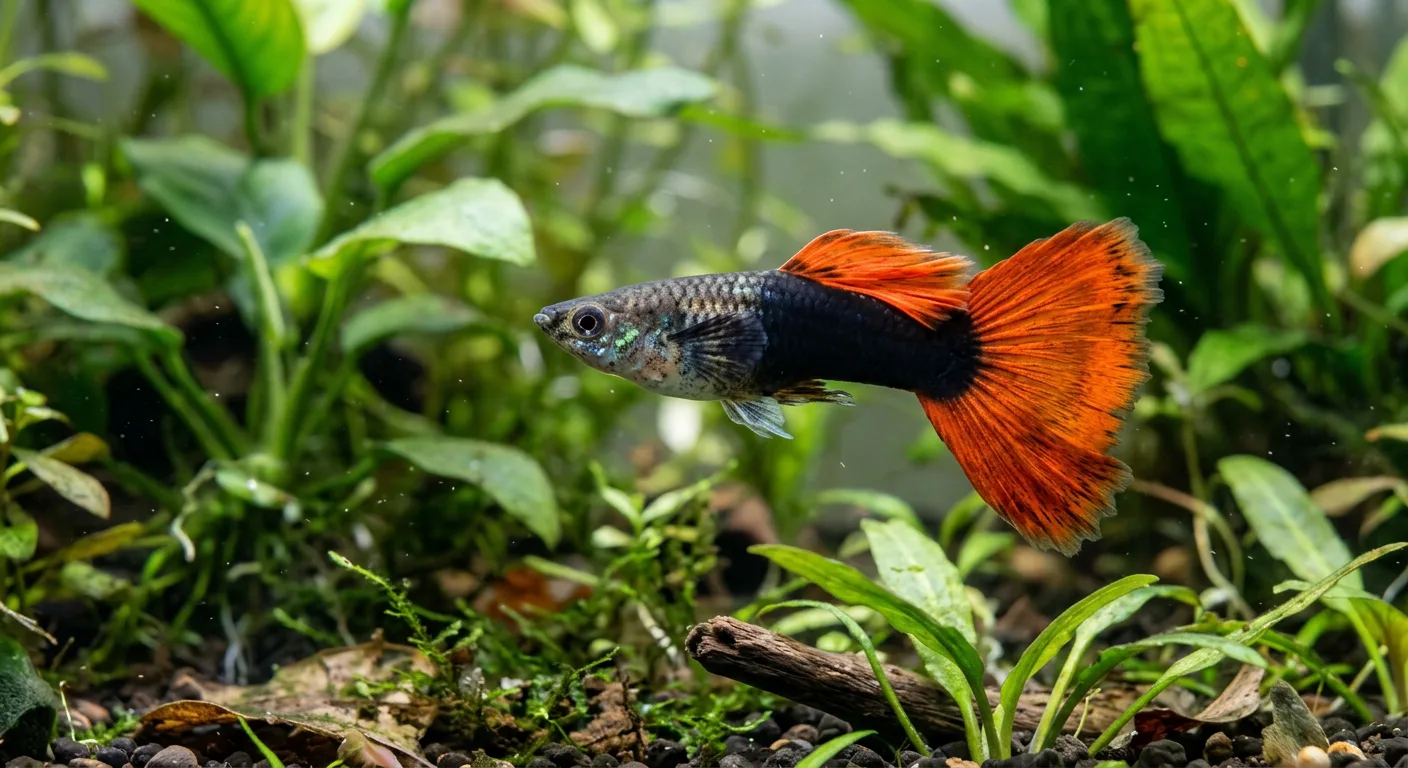
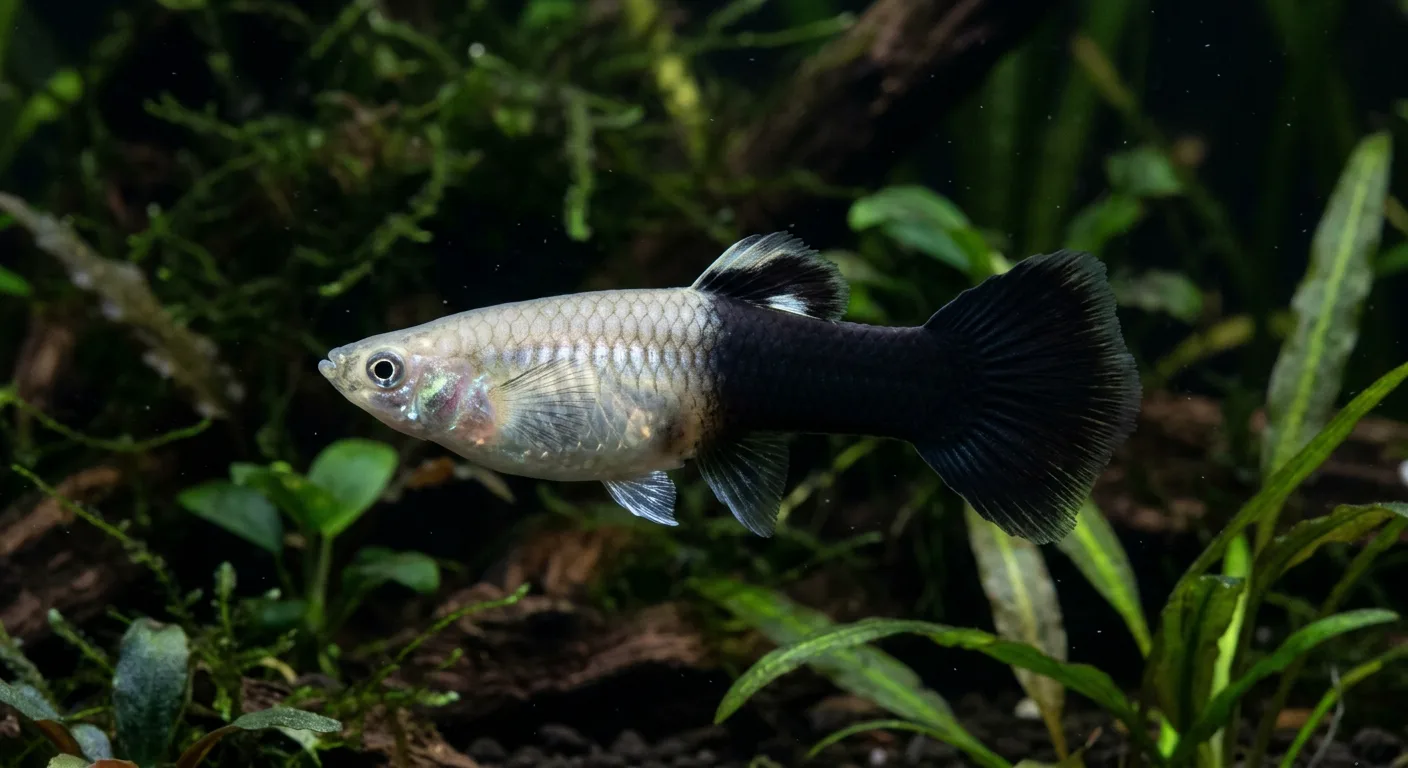
Look at an adult from the side: the caudal peduncle and much of the rear body are dark, while the head and forward body are lighter. A strong display line often has a sharp boundary and even dark coverage, but the exact amount of black can vary with breeding line, sex and age. The tail can be red, blue, yellow or another color; it does not define the half-black body pattern. Judge body posture and swimming condition before comparing pattern quality.
The key traits to look for
- Dark rear-body region: check coverage and contrast against the seller’s described line; show-quality selection favors even pigment, but variation is normal.
- Clean dividing line: a fairly straight, sharp border rather than a fuzzy gradient.
- Tail color: solid and bright, often red, blue, yellow, green or a mix.
- Body shape: a sturdy, torpedo-like body with a straight spine.
- Fin carriage: the tail should be held open and not clamped.
Males versus females
As with many fancy guppies, adult males often show brighter, larger tails and a conspicuous dark rear-body patch; females are often larger and may show a subtler version of the pattern. Adult size varies by stock, age and fin shape, so avoid treating one exact length as a quality standard. Healthy breeding females matter as much as colorful males; assess body shape and feeding behavior in both. See our female guppy care guide.
Half black guppy color varieties
The name describes the body, so the tail color decides the variety. Names vary by breeder, but you will commonly see the following.
| Variety | Tail color | What to look for | Best for |
|---|---|---|---|
| Half black red | Red | Strong red with no black spotting in the tail | Beginners, high contrast |
| Half black blue | Blue | Even blue, sometimes with a metallic sheen | Display tanks |
| Half black yellow | Yellow | Clean yellow against the black block | Bright planted tanks |
| Half black green | Green | Deep green with sharp contrast | Collectors |
| Half black mixed | Two or more colors | Balanced pattern, not messy | Variety lovers |
Because colors can look different under different lights, judge a fish in natural light or a neutral white light before deciding that it is the shade you want. If you are interested in general color terms, our guppy color types article explains the vocabulary.
Half black guppy care: the basics
Half Black is a color-pattern label, not a guarantee of health or hardiness. Like other fancy guppies, these fish can thrive in a cycled aquarium with consistent water, moderate flow and adequate room. Some heavily line-bred stocks may be less robust, which makes buying active, well-conditioned fish more important than choosing the darkest individual.
Tank size and setup
A 10 gallon tank is a reasonable minimum for a small group, and 20 gallons or more is much easier to keep stable. Use a gentle filter, because males with large tails struggle in strong current. A sponge filter is a good fit; see our sponge filter guide. Add live plants and a few hiding spots so females can rest, and keep the lid on, since guppies can jump.
Water parameters
For everyday care, many guppy keepers use 24–26°C (75–79°F), pH about 7.2–8.0 and GH around 8–15 dGH. The published species profile permits a broader 17–28°C, pH 7.0–8.5 and GH 8–30 dGH; use these as a reference range, not a reason to swing the tank suddenly. Check source-water GH and pH before buying. Keep ammonia and nitrite at 0 ppm, track nitrate and keep the biological filter established. See our guppy water parameters guide.
| Parameter | Practical adult tank target | What to check |
|---|---|---|
| Temperature | 24–26°C (75–79°F) | Stable temperature; published wider species range 17–28°C |
| pH | About 7.2–8.0 | General species range 7.0–8.5; avoid sudden correction |
| General hardness (GH) | About 8–15 dGH | General species range 8–30 dGH; check actual tap water |
| Ammonia / nitrite | 0 ppm | Any detectable reading calls for prompt water testing and corrective care |
| Nitrate | Keep low; under about 20 ppm when feasible | Adjust water changes to measured buildup and stocking |
A simple weekly routine
- Test ammonia, nitrite and nitrate once a week.
- Change about 20 to 30 percent of the water with dechlorinated, temperature-matched water.
- Check filter flow; gently rinse clogged reusable media in removed aquarium water as needed, without replacing all biological media at once.
- Trim dead plant leaves and remove uneaten food.
- Look at every fish for clamped fins, spots, torn tails or swelling.
Our guppy tank maintenance schedule turns this into a calendar.
Feeding for deep black and bright color
The rear-body pigment and tail color are primarily inherited. A suitable, varied diet supports healthy growth and color expression, but no special food turns a genetically light fish into a reliably solid-black line. Use an appropriately sized quality flake or micro-pellet as a staple and offer occasional daphnia or brine shrimp. Feed small amounts once or twice a day and remove uneaten food; do not add extra meals simply to make the black look deeper. Our overfeeding guide explains why excess food is risky.
Foods that help
- Micro pellets and good flakes for steady nutrition.
- Frozen daphnia and brine shrimp for variety and fiber.
- Live baby brine shrimp for fry and conditioning breeders.
Common feeding mistakes
The most common problem is feeding more than the fish and filter can handle. Uneaten flakes and pellets decompose, raising waste levels and causing unstable water conditions. Use small portions, observe whether every fish eats and vary the staple foods occasionally. Do not treat a guppy’s frequent begging as a sign that it needs more food.
Tank mates and stocking
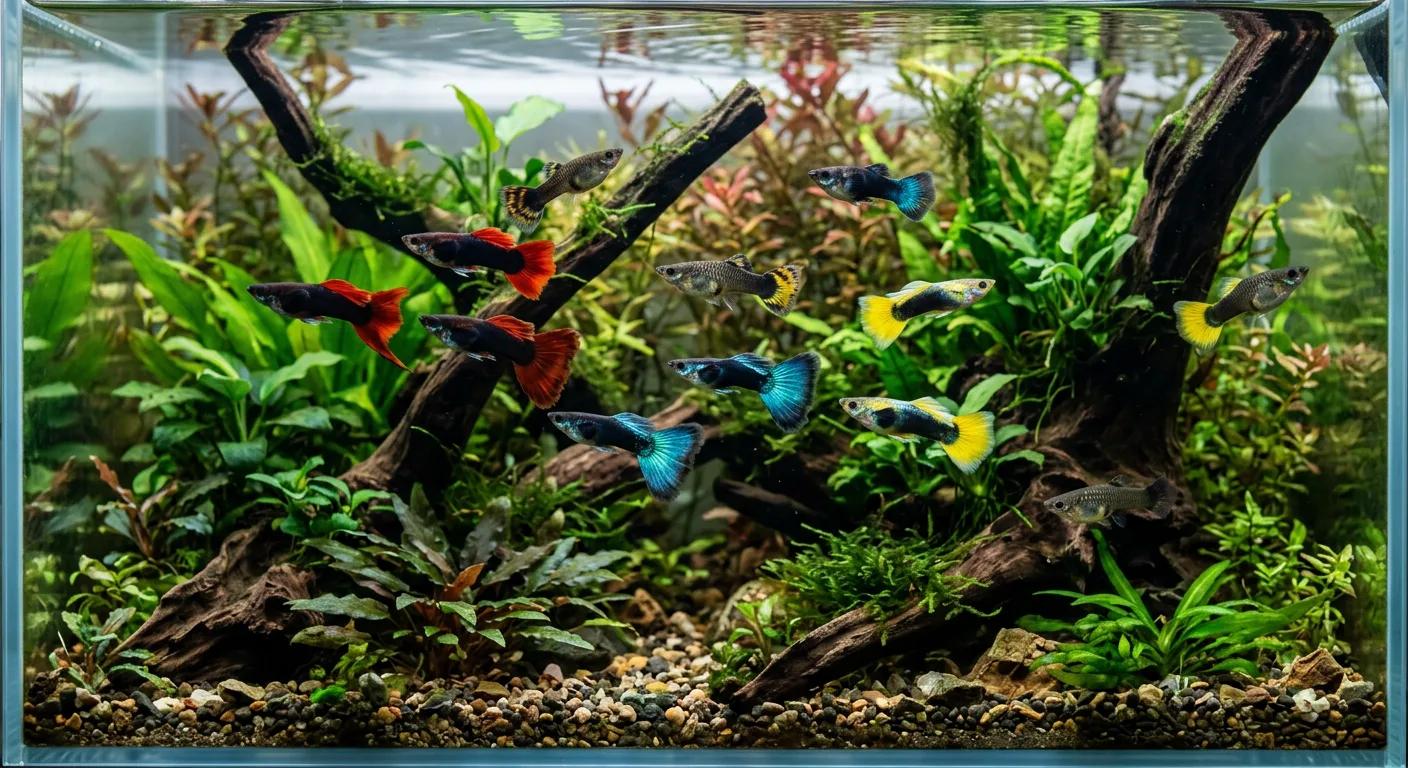
Half Black guppies are generally peaceful, but their long tails can attract attention from fin-nipping tankmates. Choose companions by tank size, temperature, GH, temperament and feeding needs—not by species name alone. Small peaceful fish, snails and some shrimp may work in suitable setups; adult guppies can eat tiny fry and young shrimp. Avoid known fin-nippers and predators. See our guppy tank-mate guide for options.
For a breeding group, many keepers start with at least two females per male to reduce pressure on individual females. Even this does not guarantee an absence of chasing. Male-only groups can avoid unwanted fry but still require monitoring for aggression and fin damage. Do not add females automatically to solve bullying if that would overcrowd your aquarium. See the guppy sex-ratio guide.
How many to keep
| Aquarium | Conservative starting example | Planning note |
|---|---|---|
| 10 US gallons (38 L) | 3–4 adult males | Small species-only display; not a breeding colony |
| 20 US gallons (76 L) | 5–6 adults initially | Allows some additional space, but fry and filtration must be planned |
| 30 US gallons (114 L) | 8–10 adults initially | Review swimming room, water tests and capacity for offspring |
These are starting examples, not maximum stocking formulas or promises: tank dimensions, sex ratio, plants, filtration, other species and the number of fry change safe capacity. Add fish gradually only after the aquarium is fully cycled.
Breeding half black guppies
Breeding for a consistent Half Black pattern means selecting healthy parents with the desired rear-body coverage and tail color, and keeping each breeding line separate. Two Half Black parents do not guarantee identical-looking offspring; color traits can involve several interacting factors. Keep pairing records and examples of each generation. A cross to another guppy line may introduce useful variation, but it also makes the next generation less predictable.
Step-by-step selection
- Start with a healthy trio or pair of half black guppies from a reliable source.
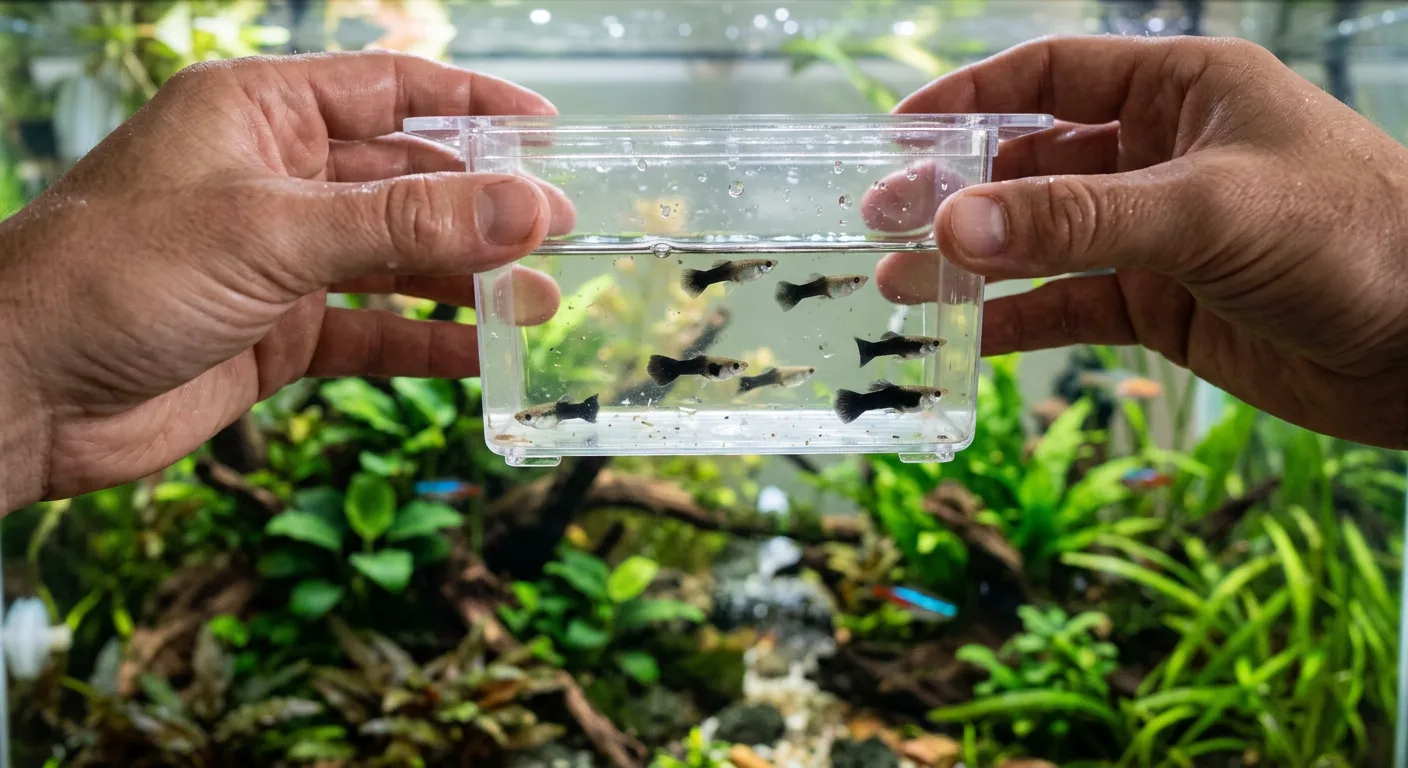
- Set up a separate breeding tank, or use a breeder box for short periods only.
- Allow the female to give birth in a mature, low-stress setup; gestation is often roughly 4–6 weeks, varying with conditions.
- Raise fry with frequent small feedings and clean water.
- As fry mature and the pattern becomes visible over weeks to months, compare body health, coverage and tail shape without selecting too early.
- Choose healthy fish with the desired features as breeders and responsibly rehome healthy non-breeding fish; never release aquarium fish into waterways.
Our how to breed guppies article and the guide to keeping a guppy strain pure cover the fundamentals.
Avoiding inbreeding problems
Repeated close breeding can reduce vigor in some lines, even if the color pattern becomes more consistent. Track parentage, avoid deliberately breeding fish with spinal problems or persistent weakness, and introduce compatible unrelated stock when appropriate. Do not assume an unrelated fish will improve every trait automatically. Read our guppy inbreeding guide before line breeding.
Common problems with half black guppies
Most issues are the same as for any guppy. The ones that are specific to this look are about pattern and health, and they are easier to catch early.
| Problem | Likely cause | What to do |
|---|---|---|
| Black looks patchy or faded | Genetics, stress or poor water | Test water, improve diet, select better breeders |
| Tail clamped | Stress, illness or cold water | Check parameters and look for disease |
| Frayed tail edges | Fin nipping or fin rot | Remove nippers; see our fin rot guide |
| Small or stunted males | Overcrowding or inbreeding | Give more space and add unrelated stock |
| New spots or unusual marks | Possible parasite, injury or another cause | Check water, isolate if appropriate and identify the cause before choosing treatment |
If a fish looks unwell, check water parameters first and observe breathing, swimming and appetite. Symptoms may have several causes; do not assume one diagnosis from a damaged fin or spot. See our fin health and clamped fins guides for general warning signs.
How to buy half black guppies
Ask for a recent, clear side-view video and check active swimming, straight body shape, normal feeding and intact fins. Compare dark coverage and tail color under neutral light, but prioritize condition over a perfect pattern. Check whether a listing image depicts the exact fish, a representative example or an editorial illustration; appearance alone cannot certify health or lineage. For breeding, request parentage and fish count/sex confirmation; our pair-versus-trio guide may help. Browse male guppies or premium guppy pairs when the water and setup are ready.
When your fish arrive
- Read the supplier’s arrival instructions and inspect the unopened bag; if appropriate, float the sealed standard bag about 10–15 minutes to match temperature.
- For fish shipped a long distance, avoid prolonged drip acclimation in opened shipping water: ammonia can become more toxic as carbon dioxide escapes. Follow the shipper’s protocol and prepare the receiving tank before opening.
- Transfer fish gently to a prepared quarantine aquarium when possible; discard transport water instead of pouring it into the tank.
- Keep lights dim for the first day and feed lightly.
- Quarantine if you already keep other fish.
Use the acclimation guide and the first-hours checklist alongside the instructions supplied with your fish. Short local transport and long sealed shipment may need different handling; Aquarium Co-Op explains why.
Half black vs similar guppy strains
New keepers often confuse half blacks with other dark-bodied strains. The differences are subtle, and breeders sometimes disagree on names, so use this table as a practical guide rather than a rule.
| Label | Typical body look | Tail | Key distinction |
|---|---|---|---|
| Half Black | Dark rear body with a lighter front, sometimes a sharp boundary | Red, blue, yellow or other | Often used interchangeably with Tuxedo, sometimes reserved for cleaner dark coverage |
| Tuxedo | Same broad dark-rear-body pattern family | Many colors and fin types | Trade naming overlaps with Half Black; ask which exact line is shown |
| Full Black | Dark pigment across most or all of body | Often black or very dark | Lacks an obviously lighter front half |
| Snakeskin / Cobra | Reticulated or rosette-like body markings | Varies | Pattern is not necessarily a solid black rear block; see our snakeskin guide |
Lighting, plants and the look of your fish
Choosing a light
Black bodies and bright tails look best under a neutral white light of moderate intensity. A light that is too harsh washes out the contrast and encourages algae, while one that is too dim makes the black look flat. Eight hours a day on a timer is a safe starting point; see our guppy tank lighting schedule.
Background and plants
A dark substrate and green plants make the tail colors pop and help males feel secure. Floating plants and java moss give females and fry cover. Try our guides to best live plants for guppies and floating plants. Avoid sharp decorations that can tear long tails.
Mistakes that ruin a half black line
- Mixing strains in one breeding tank. Females store sperm, so a single mating with another strain can affect several broods.
- Using every fish as a breeder. Select for health and desired traits; responsibly rehome healthy fish not chosen for breeding, and never release them into the wild.
- Overcrowding. Stunted males rarely develop their full black and tail.
- Skipping quarantine. One sick new fish can undo months of work.
- Chasing perfection too fast. Make one improvement per generation, such as a sharper line or a brighter tail.
A short notebook of which pairs produced which fry makes selection much easier and keeps your line records honest.
Behavior and daily routine
Half Black guppies behave like other fancy guppies: active, social fish that spend much of their time swimming and foraging. Males may display and chase females. If one fish is persistently harassed, provide cover, assess the group, and separate an aggressor if necessary; adding females is not automatically safe in an already full tank. Look for normal breathing and fin posture, and give each fish room to reach food.
Young males can develop body contrast and stronger fin colors as they mature, at different rates depending on the line. Wait until fish are sufficiently mature to evaluate their pattern, and avoid selecting only for the darkest body at the expense of normal swimming and body shape.
Half black guppy checklist
- Pick fish with a deep, even black rear half and a sharp dividing line.
- Use a tank of at least 10 gallons, preferably 20.
- Keep the temperature steady in the mid to upper 70s F and ammonia and nitrite at zero.
- Change 20 to 30 percent of the water weekly.
- Feed small portions of varied food.
- Keep breeding lines identified, track parentage and select healthy breeders; same-pattern parents do not guarantee identical fry.
- Monitor line vigor and consider compatible unrelated stock when justified, with quarantine and records.
For everyday aquarium maintenance, see the HiGuppy care hub. For independently published species care ranges and reproduction information, consult Seriously Fish: Poecilia reticulata.
References and care notes
Care ranges and general reproduction behavior are based on the published Poecilia reticulata species profile. Shipping-bag guidance is supported by Aquarium Co-Op’s acclimation notes. Half Black and Tuxedo are trade and breeder pattern terms; exact appearances and heredity should be verified with the fish and breeder line offered, not assumed from a name.
FAQ
What is a half black guppy?
A Half Black guppy is a selectively bred guppy with a darker rear body and usually a lighter front, often with a contrasting colored tail. The name commonly overlaps with Tuxedo; the boundary and coverage vary by line.
Are Half Black and Tuxedo guppies the same?
Often, yes: hobbyists and sellers use both labels for a dark-rear-body pattern. Some breeders distinguish especially clean Half Black lines from broader Tuxedo styles, but there is no universal separation. Compare the actual fish and line description.
Are half black guppies hard to keep?
They need the same basic care as other guppies: a cycled tank, stable moderately hard water, gentle flow, appropriate food and regular observation. A color label alone does not guarantee health or hardiness.
Will half black guppies breed true?
Not always. Even Half Black parents can produce offspring with variable black coverage, tails and body colors. Document your actual line, use verified breeding history and select healthy parents; a trade name alone is not a genetic guarantee.
How big do half black guppies get?
Sizes vary with sex, age and breeding line. Females are often larger than males; long-finned males can look larger than their body length suggests. Check the expected adult size from the supplier instead of assuming an exact measurement for every strain.
What do half black guppies eat?
They eat quality flakes and micro pellets, with frozen or live foods such as daphnia and brine shrimp as regular extras. Feed small amounts once or twice a day.
Can half black guppies live with other guppies?
Yes, but they will interbreed with other guppy strains if females are present. If you want to keep the half black line pure, keep it separate or use only males in mixed groups.
Why is my half black guppy losing its black color?
Apparent fading can be affected by lighting, age or stress, and some pigment variation is genetic. Check water quality and behavior first. If color loss comes with clamped fins, poor appetite or unusual breathing, investigate possible illness rather than assuming a dietary issue.
Behind the care guides
Care begins with steady systems
Our guppy guides focus on practical routines: keep water stable, observe fish closely and allow for natural variation.

Care systems
Steady water, thoughtful care
Gentle filtration and regular observation support healthy aquarium routines.

Natural variation
Every guppy is different
Color, size and fin shape vary with strain, age and each individual fish.
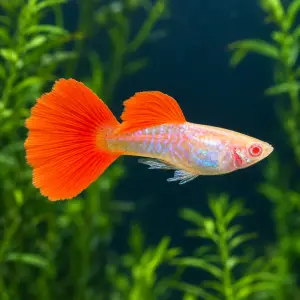
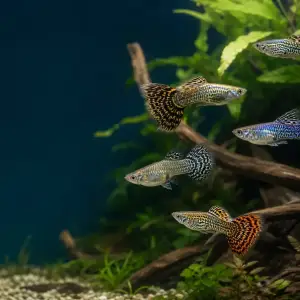
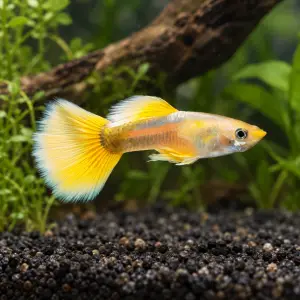
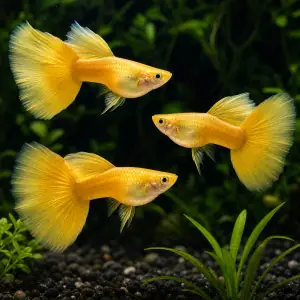
Editorial illustrations for context; they do not depict HiGuppy's exact facility or current fish stock.