The HiGuppy Journal
Dragon Guppies: Care, Colors and Buying Guide
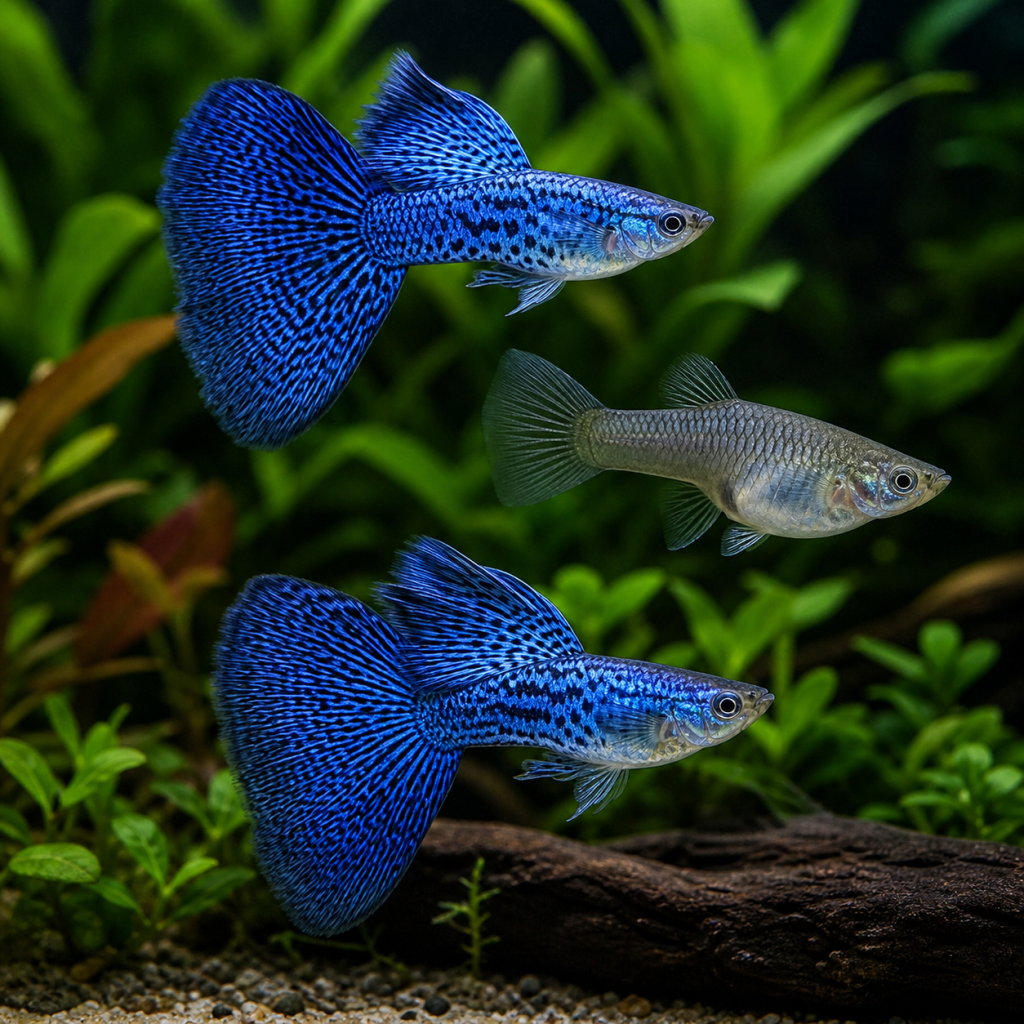
Dragon guppies are selectively bred fancy guppies (Poecilia reticulata) valued for bold, often metallic-looking scale patterns and contrasting tails. ‘Dragon’ is a trade description, not a separate species or one universally fixed gene. Red, Blue, Green and Purple Dragon names may refer to quite different lines. Care is the same as for other fancy guppies: a cycled aquarium, stable moderately hard water, gentle filtration and a varied diet. Check the actual fish—not just its color label—before buying.
What does Dragon describe?
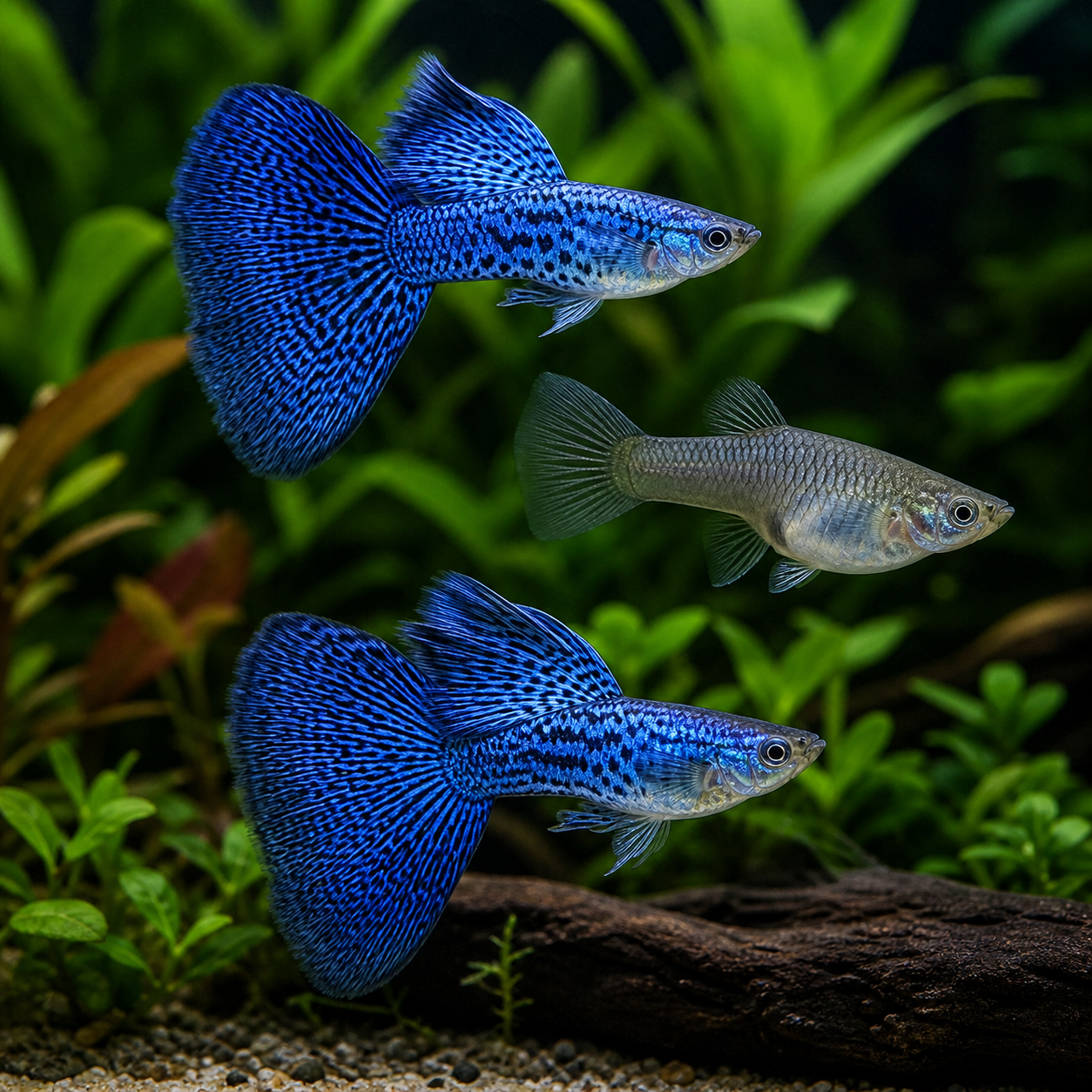
Breeders often use Dragon for a conspicuous reflective or scale-edged pattern across the body, sometimes paired with a sharply contrasting tail. The armored appearance is a visual pattern, not extra protective scales. Dragon fish may also be labeled mosaic, cobra, tuxedo, halfmoon or dumbo depending on the other visible traits. There is no guarantee that two breeders mean exactly the same thing by the name. Ask to see a full side view, dorsal fin and tail, and compare the description to what is actually shown.
Compare a clear side view with a moving view of the whole fish. A close-up of one patch can make a feature seem more dominant than it is at ordinary viewing distance. Write down what is visible in the current media rather than assuming a name defines every marking. The pattern guide helps distinguish broad pattern terms.
Compare color labels without treating them as different care recipes
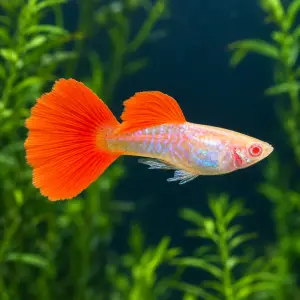
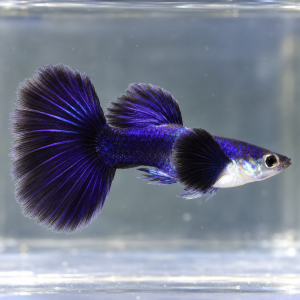
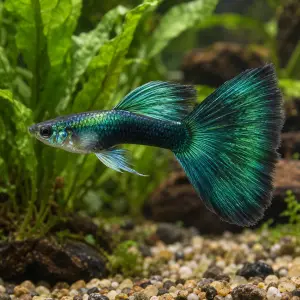
HiGuppy has listed Red Dragon Halfmoon, Blue Dragon Indo Breeder Trio, Green Dragon Indo Breeding Pair and Purple Dragon Breeder Trio. These names show how the Dragon term appears with different colors and purchasing formats. They are examples to inspect, not a current-stock promise or a ranking.
Compare the body, tail and dorsal fin separately under neutral light. Red, blue, green and purple labels describe appearance, not different water requirements or proven purity. Lighting, camera white balance and age can change the apparent hue; ask for a recent, unfiltered swimming video when color matters. If a listing combines Dragon with Half Black or Tuxedo, note that the latter describes a dark rear-body pattern, not an alternative species.
Separate Dragon from the fin and body words
Dumbo Ear points to enlarged pectoral fins. Ribbon refers to elongated fin traits. Halfmoon is a tail-form description whose actual expression should be checked in suitable media. A listing can combine these terms with Dragon, and two Dragon-labeled offerings may consequently look very different while sharing the same broad pattern word.
Read a complete name such as Red Dragon Short Glassbelly Ribbon in parts, then ask the seller to explain anything unclear. Do not infer that every individual has every desired feature to the same degree. For a named red-line profile, use the existing Red Dragon care guide; this guide helps compare the wider family of names.
Judge condition independently of the pattern
A patterned body can distract from a thin abdomen, damaged fin or difficult swimming. Request a video that shows normal movement, turning and access to food. Ask about approximate age, confirmed sexes and current feeding. Images provide useful observations but cannot certify disease-free fish, breeding performance or a show award.
Check whether a gallery is exact-stock photography, a representative example or an AI illustration. Several current HiGuppy Dragon product references are explicitly labeled representative AI images. They can introduce a listing’s intended style, but they cannot document the condition or anatomy of fish allocated to your order. Keep those distinctions when comparing two offers.
Dragon guppy care: water, tank size and feeding
Dragon guppies need no special mineral additive or color-enhancing chemical. The ranges below are general guppy-care guidance, not rules that only apply to Dragon fish. A stable aquarium that suits the actual fish is better than chasing a perfect-looking number.
- Temperature: about 24–26°C (75–79°F) is a useful everyday target; the species is reported across a wider 17–28°C range.
- Water chemistry: pH 7.0–8.5 and general hardness (GH) 8–30 dGH are published species ranges. Many keepers choose a steadier middle target such as pH 7.2–8.0 and GH 8–15 dGH; measure your tap water before adjusting it.
- Tank size: a mature 10 US gallon (38 L) aquarium can house a small adult group when appropriately maintained; a 20 gallon (76 L) setup gives beginners and long-finned fish more room. Allow additional space for breeding and fry.
- Water quality: fully cycle the filter; ammonia and nitrite should read 0 ppm. Monitor nitrate and aim to keep it low (often below about 20 ppm); change roughly 20–30% weekly and adjust to actual test results.
- Food and flow: offer small portions of suitable flakes or micro-pellets once or twice daily, with occasional daphnia or brine shrimp. Avoid strong current that makes large-tailed males struggle; include plants and swimming space.
Use a test kit for pH, GH, ammonia, nitrite and nitrate. For detailed setup help, read the HiGuppy care guide. Avoid treating darkening colors or shinier scales as proof of better health.
Care and breeding plans before buying
Prepare a cycled aquarium with stable suitable water, dependable filtration, swimming space and safe cover. Use the guppy care guide for routine setup and maintenance. Choose peaceful companions, protect delicate fins from sharp decorations and confirm that food reaches every fish. Avoid changing conditions simply to intensify the appearance of a photograph.
If you plan to breed Dragon guppies, ask how closely the parents and previous fry resemble one another. Record the parent fish, pairing dates, offspring traits and any new fish introduced to the line. Guppy females can store sperm from earlier mating, so a female kept with other males may produce fry of uncertain parentage; controlled pairings require verified breeding history. Do not promise that every fry will inherit identical metallic scales, tail color or fin shape. Prioritize healthy swimming, straight body structure and appropriate tail size over extreme appearance, and plan enough grow-out space.
Practical Dragon buying checklist
- Record the complete name, color, fin traits and offered format.
- Ask what Dragon means for this particular breeder line.
- Check image status and request current swimming footage.
- Confirm fish count, sexes, maturity and accepted foods.
- Ask for line history when breeding claims matter.
- Measure pH and GH, check the nitrogen cycle and plan space for any fry before the order arrives.
FAQ
Is every Dragon guppy a Red Dragon?
No. Listings use Dragon alongside several color labels. Compare the complete name and current media rather than using Dragon as a synonym for red.
Does Grade A mean a show winner?
A grade needs the seller’s definition. Request documented results if an award is claimed; a retail grade alone does not establish one.
Can different Dragon colors share a display tank?
Suitable healthy guppies can be considered together under ordinary stocking and compatibility checks. Mixed-sex groups can breed, so keep breeding projects separate when parentage matters.
What tank size do Dragon guppies need?
A cycled 10-gallon (38 L) tank can hold a small, carefully stocked adult group, but a 20-gallon (76 L) aquarium gives more room and easier maintenance. Breeding pairs or trios need space for growing fry and a separate plan if numbers rise.
What pH, hardness and temperature suit Dragon guppies?
A practical target is about 24–26°C (75–79°F), pH 7.2–8.0 and GH 8–15 dGH. Published general guppy ranges are broader (pH 7.0–8.5 and GH 8–30 dGH). Keep water stable, and check ammonia and nitrite remain at 0.
Do Dragon guppies always breed true?
No. ‘Dragon’ alone does not identify a single predictable inheritance pattern. Offspring can vary in metallic-looking scale effect, body color and tail. Ask the breeder for documented examples from the same line and record pairings if consistency matters.
Are Dragon guppies harder to care for than ordinary guppies?
Their basic care is the same species care. Large tails and heavily line-bred fish can be more vulnerable to fin damage, poor swimming in strong currents or reduced vigor, so check fish condition and choose healthy breeding stock.
References and care sources
For species-level temperature, pH, GH, behavior and breeding biology, consult Seriously Fish: Poecilia reticulata. For arrival decisions, use HiGuppy’s guppy care guide and the seller’s actual shipping instructions. Dragon is a variable hobby trade label; none of these references proves the identity or condition of individual fish pictured in a listing.
Behind the care guides
Care begins with steady systems
Our guppy guides focus on practical routines: keep water stable, observe fish closely and allow for natural variation.

Care systems
Steady water, thoughtful care
Gentle filtration and regular observation support healthy aquarium routines.

Natural variation
Every guppy is different
Color, size and fin shape vary with strain, age and each individual fish.
Editorial illustrations for context; they do not depict HiGuppy's exact facility or current fish stock.