The HiGuppy Journal
How Many Guppies in a 30 Gallon Tank? Stocking Guide
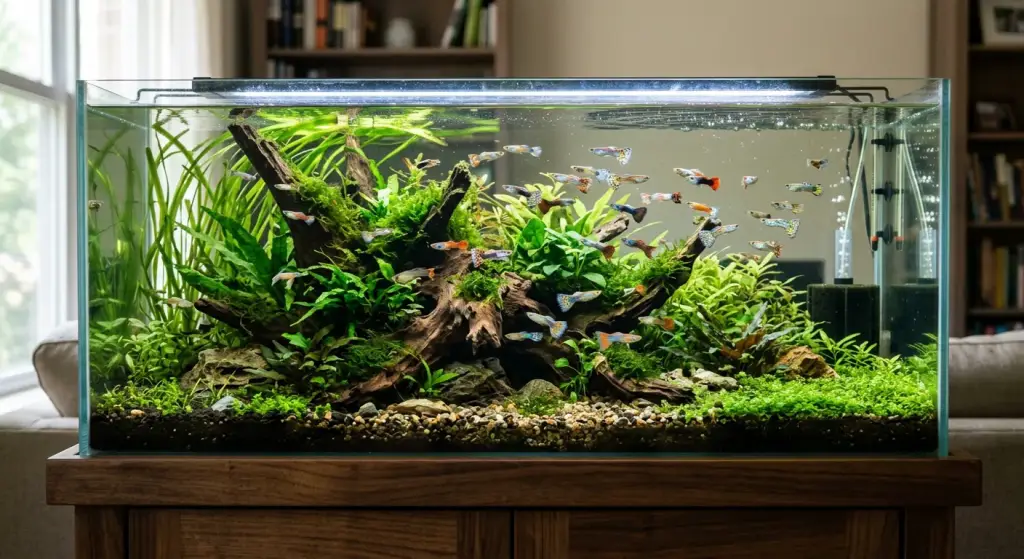
How many guppies in a 30 gallon tank? A standard 30 gallon tank with a good filter, regular water changes and live plants comfortably holds about 15 to 20 adult guppies. A conservative beginner stocking is 10 to 12 fish, and experienced keepers with heavy filtration sometimes go to about 25 to 30, accepting more work. These are hobby guidelines, not guarantees. This article builds on our complete guppy care guide and explains exactly how to choose a number that fits your tank.
The old “one inch of fish per gallon” rule gives a rough ceiling, and adult guppies are small: males are commonly around 1 to 1.5 inches (2.5 to 4 cm) and females around 2 to 2.5 inches (5 to 6 cm) in body length. But guppies breed constantly, so the number you buy on day one is rarely the number you will have six months later. Planning for that growth is the real skill, and it is what separates a thriving tank from one that crashes.
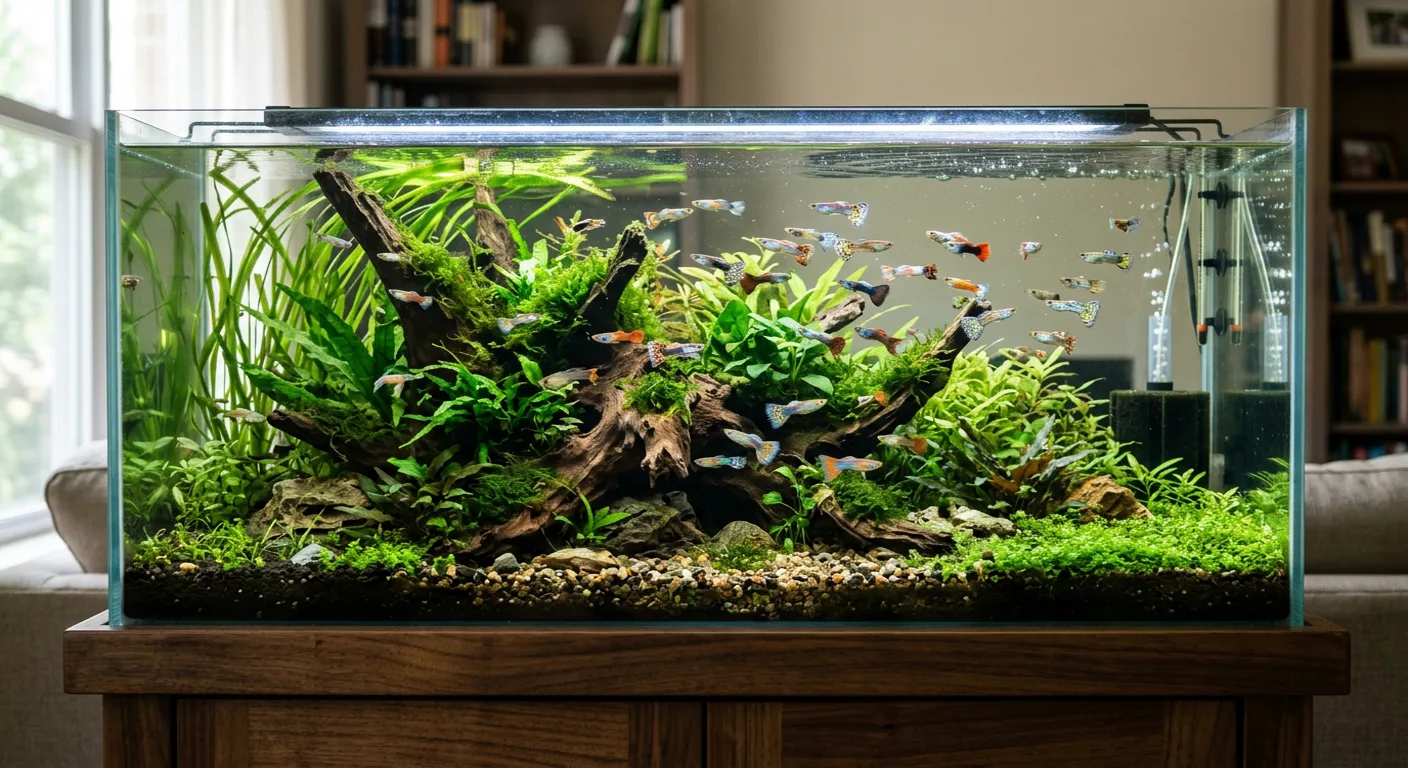
How many guppies in a 30 gallon tank: the quick numbers
The right count depends on your experience, your filtration and whether the tank is planted. Use the table below as a starting point, then adjust after you have watched your own water test results for a few weeks.
| Stocking level | Adult guppies | Best for | Maintenance |
|---|---|---|---|
| Light | 8 to 12 | First-time keepers, breeding-free setups | Weekly 20 to 25% water change |
| Moderate | 15 to 20 | Most hobbyists with a planted tank | Weekly 25 to 30% water change |
| Heavy | 25 to 30 | Experienced keepers, strong filtration | Two changes a week, frequent testing |
If you only remember one thing, remember this: stock at the moderate level or below on day one, and let the biological filter prove itself before adding more fish.
Why the answer is a range, not one number
A 30 gallon tank is labeled by its volume, but the water you actually keep is less once you subtract substrate, rock and driftwood. Footprint matters too. A standard 30 gallon is often 36 inches long, which gives more surface area for oxygen exchange than a taller, narrower tank of the same volume. Surface area, filter strength and your feeding habits all change how many fish the water can handle.
Tank dimensions that help guppies
Guppies are active mid-water and upper-water swimmers. A longer tank gives them room to cruise, and a tight-fitting lid stops jumpers. If you are choosing a tank for guppies, a 30 gallon long is generally easier to stock than a tall 30 because of the larger surface area.
The bioload: what really limits your guppy count
Every fish produces ammonia through its gills and waste. Beneficial bacteria in your filter and substrate convert ammonia to nitrite and then to nitrate. Your stocking limit is the point where that bacterial colony can no longer keep up. This is called the bioload, and it is why two identical tanks can safely hold different numbers of guppies.
Factors that raise the bioload
- Overfeeding. Uneaten food rots and adds ammonia. See our guide on overfeeding guppies.
- Females and fry. Females are larger than males and produce more waste, and fry add to the load as they grow.
- Warm water. Higher temperature speeds up metabolism, so fish eat and excrete more while holding less oxygen.
- A young filter. A tank that has not finished cycling cannot handle a full stocking load.
Factors that lower the bioload
- Live plants. Fast-growing plants absorb ammonia and nitrate. See best live plants for guppies.
- Strong biological filtration. Oversized filters and extra media give bacteria more surface to live on.
- Consistent water changes. They keep nitrate low and replace depleted minerals.
- Light feeding. Small portions once or twice a day.
Step by step: how to stock your 30 gallon tank
Stocking a tank is a process, not a single shopping trip. Follow these steps and you will avoid the most common beginner crashes.
- Cycle the tank first. Run the filter and add an ammonia source until ammonia and nitrite both read 0 and nitrate appears. Our guppy tank cycling checklist walks through it. This often takes several weeks.
- Heat and stabilize. Guppies are commonly kept around 74 to 82 F (23 to 28 C). Choose a steady temperature in that range and avoid swings.
- Add plants. Plant the tank before the fish. Floating plants and java moss give cover for fry and females.
- Buy a small first group. Start with 6 to 8 guppies, mostly females with a few males.
- Quarantine newcomers. Use a separate small tank for new fish where possible, as described in quarantine new guppy fish.
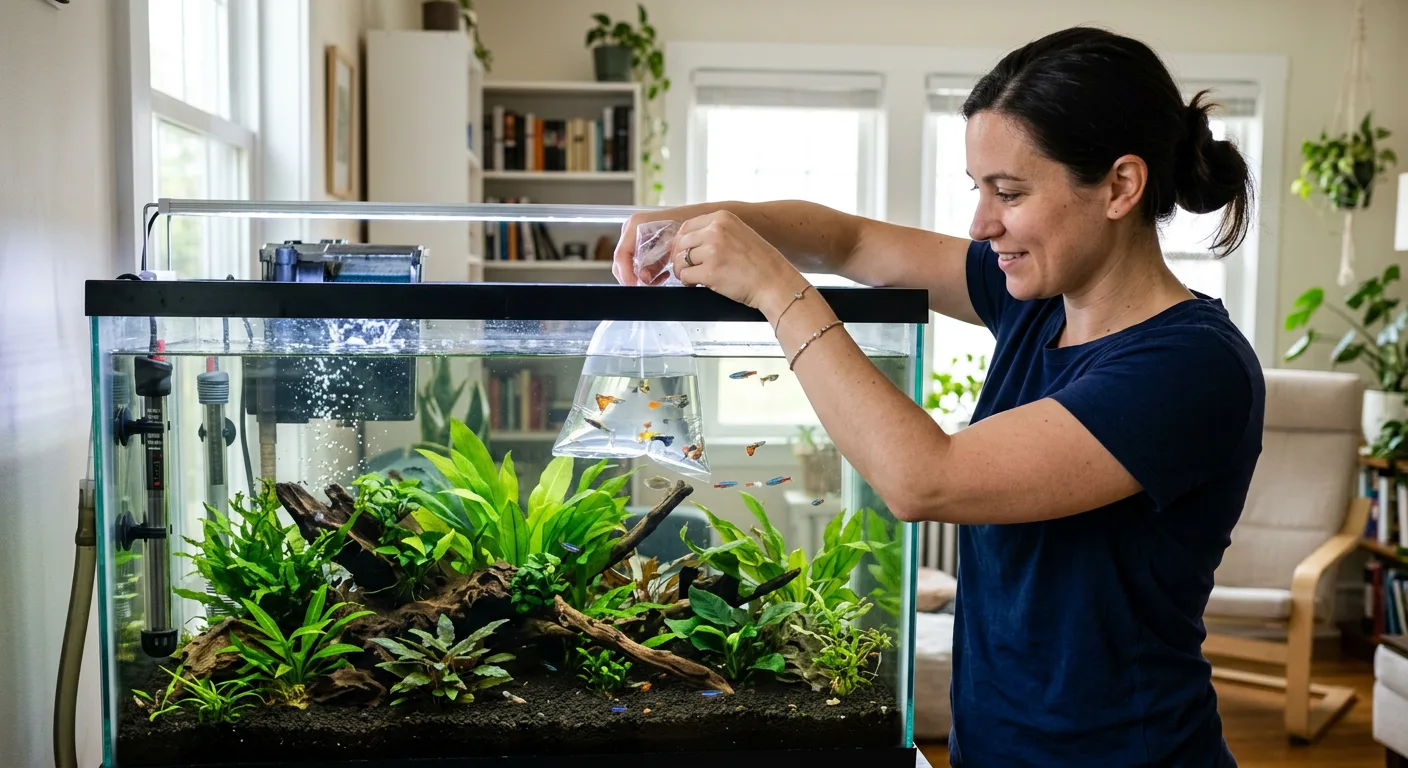
- Acclimate slowly. Float the bag, then drip or add small amounts of tank water over 30 to 60 minutes. See how to acclimate guppies.
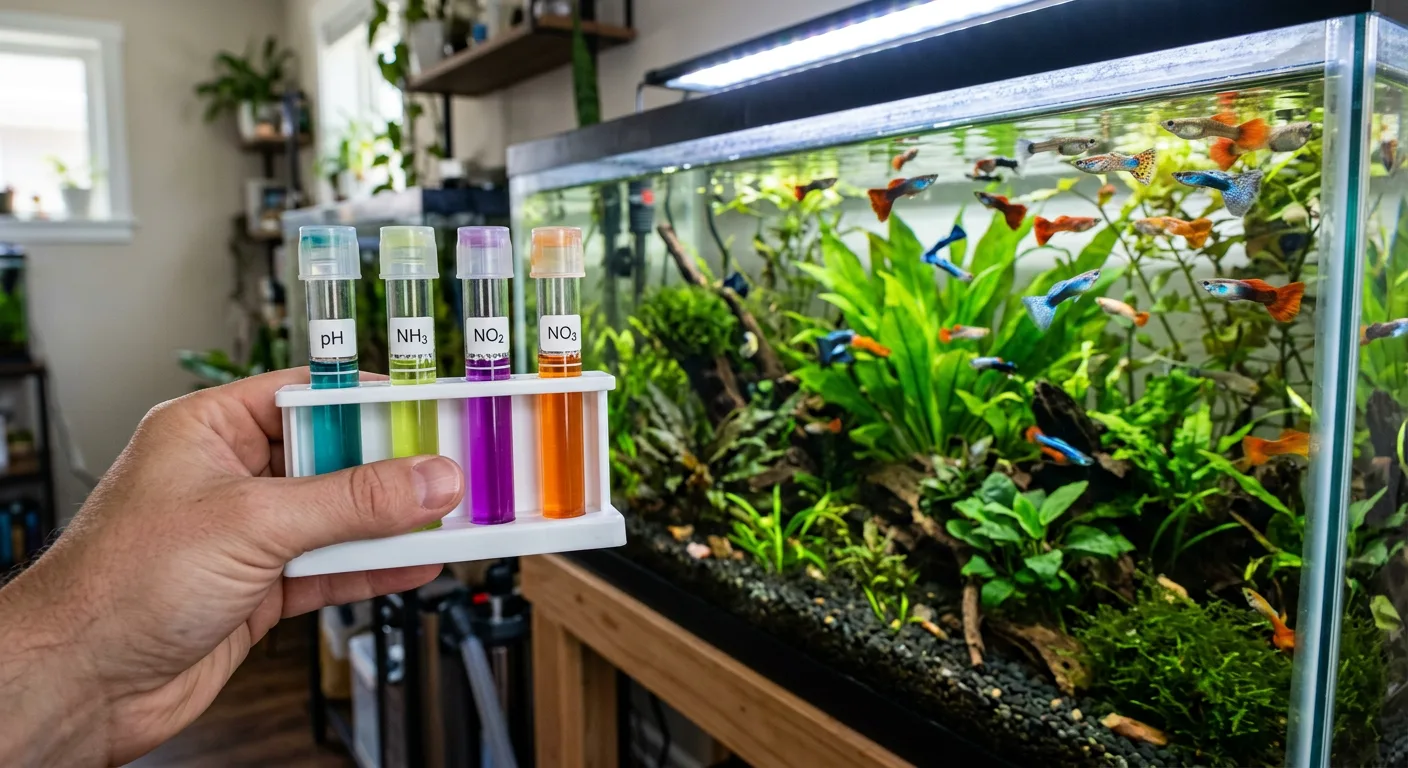
- Test for two weeks. Check ammonia, nitrite and nitrate every two or three days. If ammonia or nitrite rises above 0, do a water change and wait before adding more fish.
- Add the next group. Once water stays stable, add another 4 to 6 fish. Repeat until you reach your target.
Why you should not buy everything at once
Adding a full stocking of guppies to a tank that has only just finished cycling overwhelms the bacteria. Ammonia spikes, fish gasp at the surface and losses follow. Adding in two or three batches lets the bacterial colony grow in step with the bioload.
A worked example
Say you set up a planted 30 gallon long with a sponge filter, a heater and floating plants, and the tank has cycled for five weeks. In week one you add 2 males and 5 females. In week three, after clean tests, you add 2 more males and 5 more females. By week six you have 14 fish, and nitrate sits near 10 ppm before each weekly change. That is a healthy pace. If a female then gives birth, you can decide whether to rehome the fry or leave the colony to settle at around 18 adults. Asking how many guppies in a 30 gallon tank is really asking how fast your filter, plants and routine can grow.
Male to female ratio in a 30 gallon tank
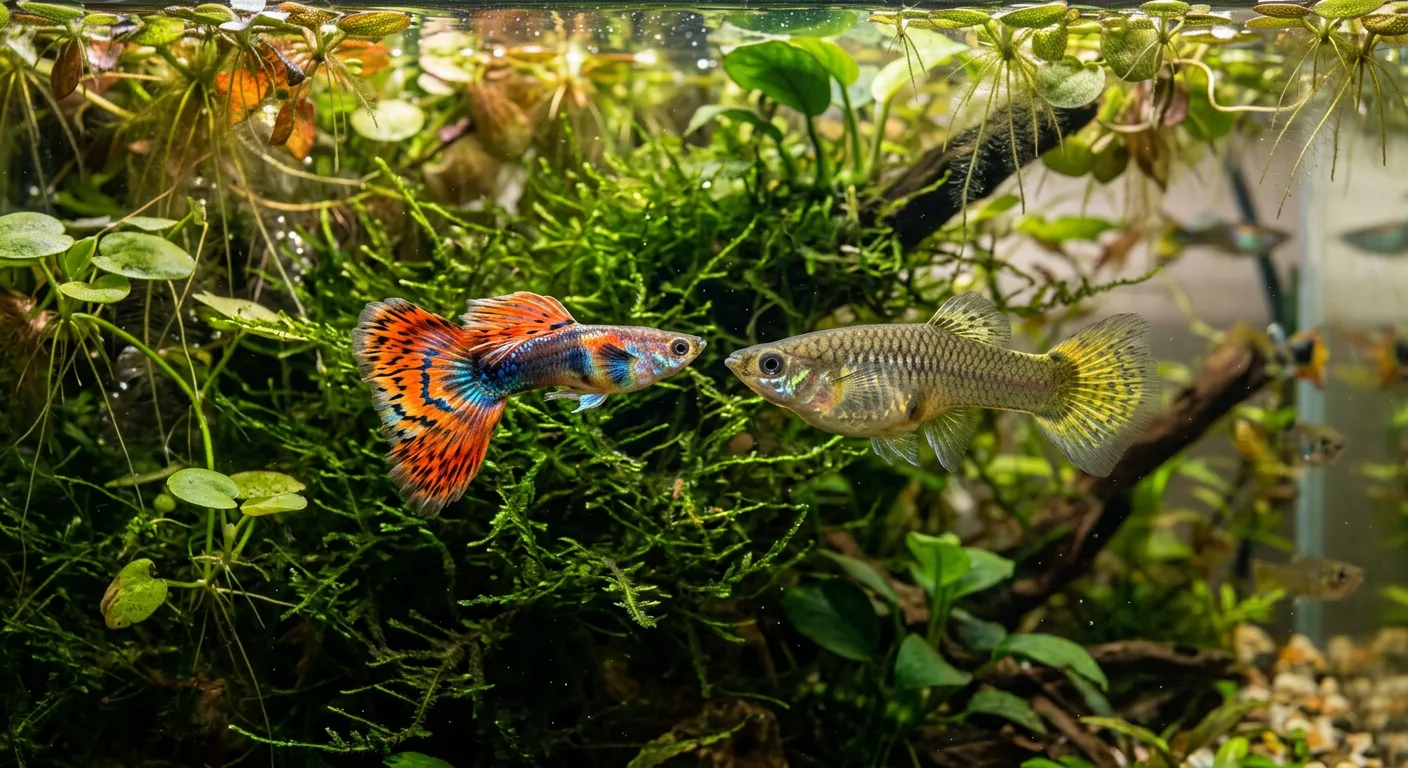
Males constantly court females, and a tank with too many males wears the females out. A common recommendation is two to three females per male. In a 30 gallon moderate stocking of about 16 fish, that could mean 4 males and 12 females, or 5 males and 11 females. More detail is in our male to female guppy ratio guide.
| Total guppies | Males | Females | Notes |
|---|---|---|---|
| 10 | 3 | 7 | Calm, easy, still breeds |
| 16 | 4 to 5 | 11 to 12 | Balanced, needs good plant cover |
| 20 | 5 to 6 | 14 to 15 | Expect fry; plan ahead |
Male-only and female-only options
If you do not want fry, keep males only. A male-only 30 gallon can hold slightly more guppies because males are smaller, and colors are usually brighter. Read the male-only guppy tank guide for the trade-offs, including occasional sparring. A female-only tank is calmer but less colorful.
Planning for fry: the part most people forget
Female guppies are livebearers and can store sperm, so a single pregnant female can start a population. Gestation is typically around 21 to 30 days, and broods vary widely in size from a handful to dozens. In a community tank with lots of hiding spots, many fry get eaten, which naturally limits population. In a plant-heavy tank with a few cover spots, more survive.
Options for controlling population
- Keep males only. The simplest approach.
- Rehome extras. Offer surplus fry to local fish stores or hobbyists.
- Add a separate grow-out tank. A small tank lets you raise selected fry. See how to separate guppy fry.
- Allow natural predation. Compatible tank mates may eat some fry, though this is unpredictable.
If you are planning to breed on purpose, a 30 gallon is a great grow-out and breeding colony size. Just stock fewer adults initially so the fry have room.
Filtration and equipment for a 30 gallon guppy tank
Good equipment lets you stock confidently. You do not need expensive gear, but you do need reliable gear.
Filter choices
Aim for a filter rated for 30 to 50 gallons, and choose one with gentle output. Guppies, especially long-tailed males, struggle in strong currents. Sponge filters are popular because they are gentle, cheap and safe for fry. Our guide to the sponge filter for a guppy tank explains setup, and the best filter for guppies compares other types.
Heater and thermometer
A 100 to 150 watt adjustable heater is a typical choice for a 30 gallon in a cool room, but check the manufacturer’s guidance. Use a separate thermometer to confirm the real water temperature. For more, see do guppies need a heater.
Lighting, lid and substrate
A moderate light on a 6 to 8 hour schedule supports plants without feeding algae. A lid prevents jumping. Fine gravel or sand works well, and soil capped with gravel suits heavily planted tanks.
| Equipment | Suggested spec for 30 gallons | Why it matters |
|---|---|---|
| Filter | Rated 30 to 50 gallons, gentle flow | Biological capacity without battering fish |
| Heater | Adjustable, about 100 to 150 W | Stable temperature around 74 to 82 F |
| Test kit | Liquid ammonia, nitrite, nitrate, pH | Shows when you can safely add fish |
| Lid | Tight-fitting | Guppies jump |
| Plants | Floating plants, java moss, stem plants | Absorb nutrients and shelter fry |
Water parameters to hold when stocked
As you add fish, keep these general targets. Guppies tolerate a range, but stability matters more than hitting a perfect number. Details are in the guppy water parameters guide.
| Parameter | Target | Action if off |
|---|---|---|
| Ammonia | 0 ppm | Water change, reduce feeding |
| Nitrite | 0 ppm | Water change, check filter |
| Nitrate | Under about 20 to 40 ppm | Water change, add plants |
| pH | Roughly 7.0 to 8.0 | Avoid sudden changes |
| Hardness | Moderately hard preferred | Use remineralized water if very soft |
| Temperature | About 74 to 82 F | Adjust heater slowly |
Water change routine
For a moderately stocked 30 gallon, a weekly change of roughly 25 to 30 percent, about 7 to 9 gallons, is a common routine. Treat tap water with a dechlorinator and match temperature. Use a gravel vacuum on part of the substrate each time. See how often to change guppy tank water for a deeper schedule.
Signs your 30 gallon tank is overstocked
Your fish and your test kit will tell you when you have pushed too far. Watch for these warning signs:
- Ammonia or nitrite readings above 0 despite a mature filter
- Nitrate climbing back above 40 ppm within a few days of a water change
- Fish gasping at the surface, especially in the morning
- Frequent chasing, fin nipping or visible stress
- Cloudy water or constant algae blooms
- Faded colors and clamped fins, covered in guppy clamped fins
How to fix overstocking
- Test the water and do an immediate 30 to 50 percent water change if ammonia or nitrite is detected.
- Cut feeding to a tiny amount once a day for a few days.
- Rehome or move fish into a second tank until the numbers fall.
- Add more plants and upgrade the filter media.
- Switch to more frequent smaller water changes until stable.
Can you add tank mates to a 30 gallon guppy tank?
Yes, but every tank mate counts toward the bioload. If you want a community, reduce the guppy count. For example, a group of 10 guppies with 6 corydoras is a common idea, because corydoras live low in the tank. See can guppies live with corydoras and the roundup of best tank mates for guppies. Avoid fin-nippers and large aggressive fish.
Example community plans
| Plan | Guppies | Other fish |
|---|---|---|
| Guppy-focused | 15 to 18 | A few nerite snails or shrimp |
| Light community | 8 to 10 | 6 small corydoras |
| Breeding colony | 12 (3 males, 9 females) | None, heavy plants |
Common mistakes when stocking guppies
Buying on the first day
The most common mistake is adding a dozen fish to an uncycled tank. Patience protects your investment.
Ignoring the ratio
Too many males leads to harassed females, torn fins and stress. Keep more females than males.
Overfeeding to keep fish “happy”
Guppies will beg constantly. Feed only what they eat in about one to two minutes, once or twice a day.
Skipping testing
You cannot judge water quality by eye. A liquid test kit is the cheapest insurance in the hobby.
Mixing in sick fish
Adding a new fish without quarantine can introduce parasites to the whole tank.
Tips for beginners and long-time keepers
For beginners
- Start at 8 to 10 guppies and grow slowly.
- Choose healthy, active fish, as outlined in how to choose healthy guppy fish online.
- Write down your water change dates and test results.
For experienced keepers
- Run two filters for redundancy and extra media volume.
- Use a grow-out tank so the display never exceeds its limit.
- Cull and rehome selectively to keep a strain strong, as in how to keep a guppy strain pure.
Where to get healthy guppies for your 30 gallon
Quality matters as much as quantity. Healthy, well-conditioned fish settle in faster and stress your bioload less. You can browse premium guppy pairs or breeder trios to build a balanced group, or look at male guppies for a colorful male-only tank. For an overview of the species, see the Wikipedia guppy page.
Quick checklist: stocking a 30 gallon guppy tank
- Tank fully cycled: ammonia 0, nitrite 0
- Filter rated for 30 to 50 gallons with gentle flow
- Heater set to a stable 74 to 82 F
- Plants and cover added before fish
- First group of 6 to 8 guppies, mostly females
- Quarantine and slow acclimation for new fish
- Test water every few days for two weeks
- Target 15 to 20 adults, fewer with tank mates
- Weekly 25 to 30 percent water change
- Plan for fry before they appear
Keep this checklist alongside the guppies per gallon guide and the smaller-tank versions for 20 gallons if you ever split your stock. When in doubt, understock. A lightly stocked, stable tank gives you healthier fish, brighter colors and far less work than a crowded one. For every other detail of keeping them well, return to our guppy care pillar page.
FAQ
How many guppies can I put in a 30 gallon tank to start?
Start with 6 to 8 guppies once the tank is cycled. Wait two weeks, test your water, then add more in small groups. This lets your filter bacteria grow with the bioload.
Can I keep 30 guppies in a 30 gallon tank?
It is possible only with strong filtration, many plants and very frequent water changes. Most hobbyists find 15 to 20 more sustainable, especially because guppies breed quickly and numbers rise.
How many male and female guppies should I get?
Aim for about two to three females for every male. For a 16 guppy tank that is roughly 4 to 5 males and 11 to 12 females, which spreads out male attention.
Will my guppies overpopulate a 30 gallon tank?
They can. Females can give birth every month or so under good conditions. Keep males only, rehome extras or use a separate grow-out tank to control numbers.
Do live plants let me keep more guppies?
Plants help by absorbing ammonia and nitrate and by sheltering fry, so they allow some extra margin. They do not replace filtration or water changes, so still stock gradually.
Can I mix guppies with other fish in a 30 gallon?
Yes, with peaceful species such as corydoras or snails. Reduce the guppy count to make room for the other fish, and avoid fin-nippers that target long guppy tails.
How often should I change water in a stocked 30 gallon?
Weekly changes of about 25 to 30 percent suit a moderately stocked tank. Heavier stocking may need two changes per week, guided by your nitrate readings.
Behind the care guides
Care begins with steady systems
Our guppy guides focus on practical routines: keep water stable, observe fish closely and allow for natural variation.

Care systems
Steady water, thoughtful care
Gentle filtration and regular observation support healthy aquarium routines.

Natural variation
Every guppy is different
Color, size and fin shape vary with strain, age and each individual fish.
Editorial illustrations for context; they do not depict HiGuppy's exact facility or current fish stock.