The HiGuppy Journal
Do Guppies Need a Breeder Box? Pros, Cons and Better Options
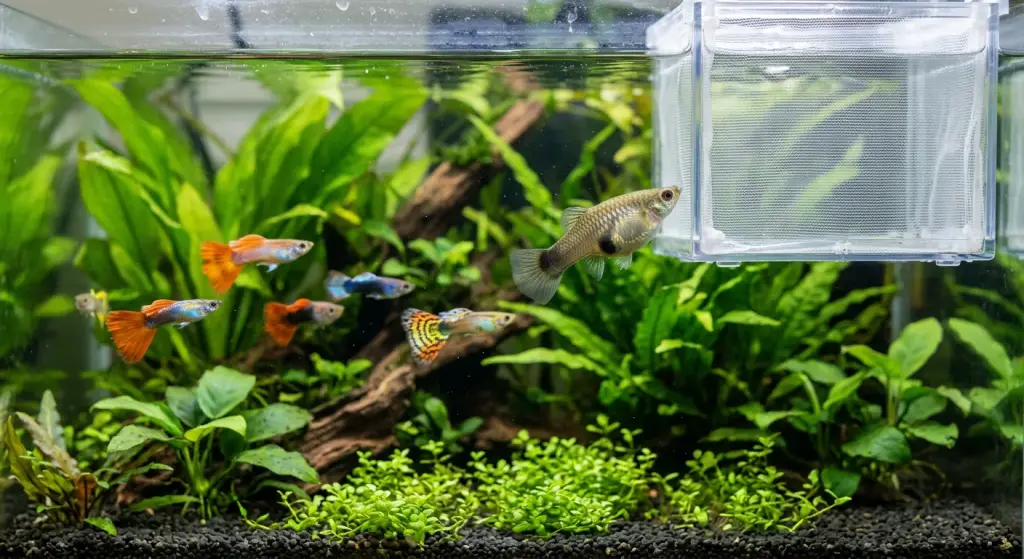
Do guppies need a breeder box? No, not strictly. A breeder box is an optional tool that keeps newborn fry away from hungry adults, but a tank with dense plants, a calm routine and quick fry removal can do the same job with less stress on the mother. If you use a box, use it briefly and with the right timing. Our complete guppy care guide covers the basics that apply to every setup in this article.
Many beginners buy a breeder box the day they spot a round female, then wonder why she looks exhausted or why the fry still vanish. This guide explains what a breeder box does, when it helps, when it hurts, how to use one step by step, and which alternatives work just as well. Treat every number as a general range and adjust it for your own fish and tank.
Do guppies need a breeder box? The short version
To answer “do guppies need a breeder box” honestly, it helps to separate two jobs. The first job is protecting fry in the first hours of life. The second is giving the mother a quiet place to deliver. A box only really handles the first job, and it can make the second one worse if the female is crowded into a small space.
What a breeder box actually is
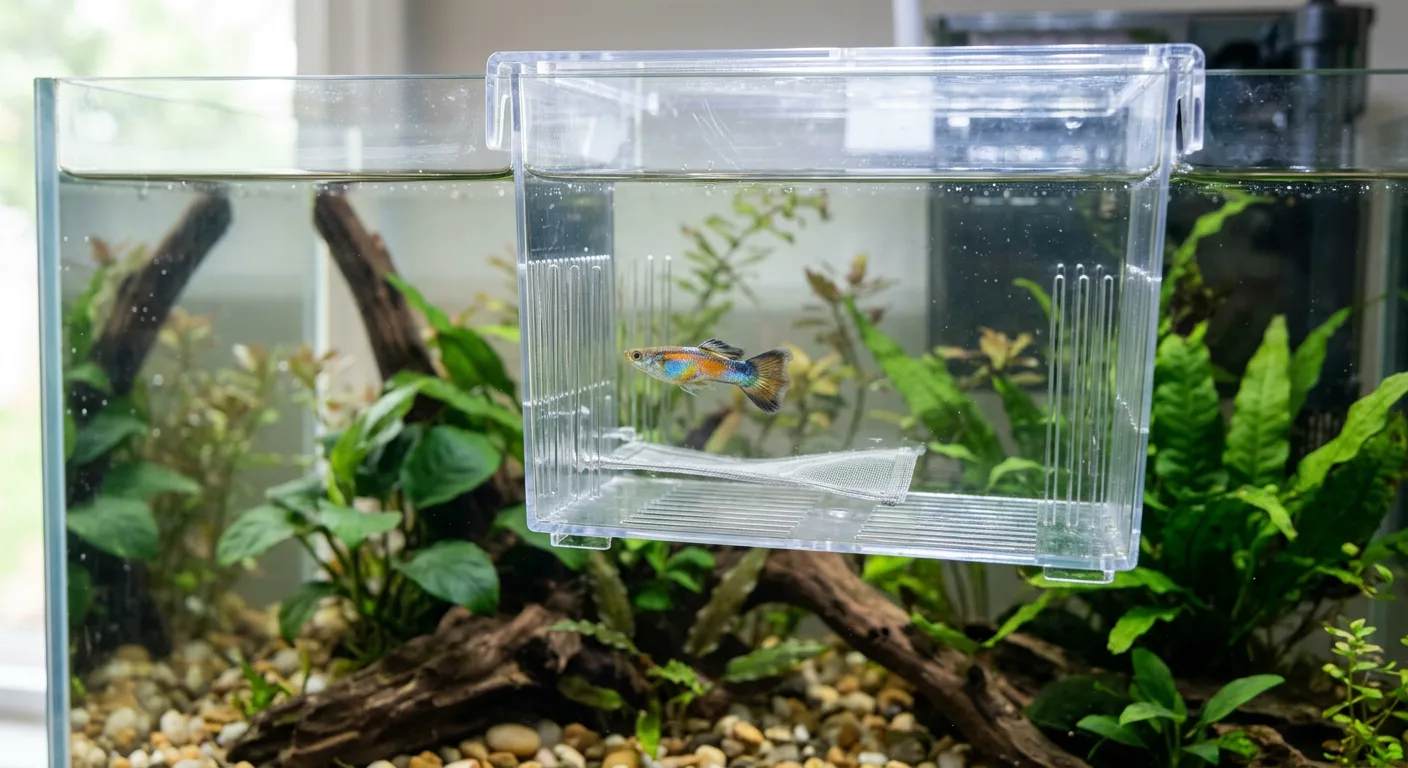
A breeder box (also called a breeding trap or birthing box) is a small plastic or mesh compartment that hangs inside the tank or sits on the glass. Most designs have a slotted floor or a V-shaped slot so newborn fry can drop through into a separate section while the mother stays in the upper part. The water is the same tank water, so there is no separate heater or filter to run.
Why guppies are different from egg-laying fish
Guppies are livebearers, so the female gives birth to free-swimming fry rather than laying eggs. You can read the general background on guppies on Wikipedia. Newborns can swim and hide right away, but they are small enough to be eaten, and adults do sometimes eat them. That is why the question of a box comes up so often. For the cannibalism side of the story, see do guppies eat their babies.
Quick decision guide
| Your situation | Breeder box useful? | Better option |
|---|---|---|
| Heavily planted tank, few adults | Usually not needed | Dense moss and floating plants |
| Bare or sparse community tank | Maybe, for the birth only | Add plants first, then a box if needed |
| You want to save every fry | Helpful short term | Dedicated birthing tank |
| Female looks very stressed | No | Separate tank or calm tank with cover |
| Wholesale or breeding project | Rarely at scale | Breeding tank setup with spawning mops |
How guppy birth works and why timing matters
Understanding the birth process makes it easier to decide whether a box helps. Guppy gestation typically runs about 21 to 30 days, and it can be shorter or longer depending on temperature, age and stress. Our guide to guppy pregnancy stages and gestation goes deeper on the timeline.
Signs a female is close to giving birth
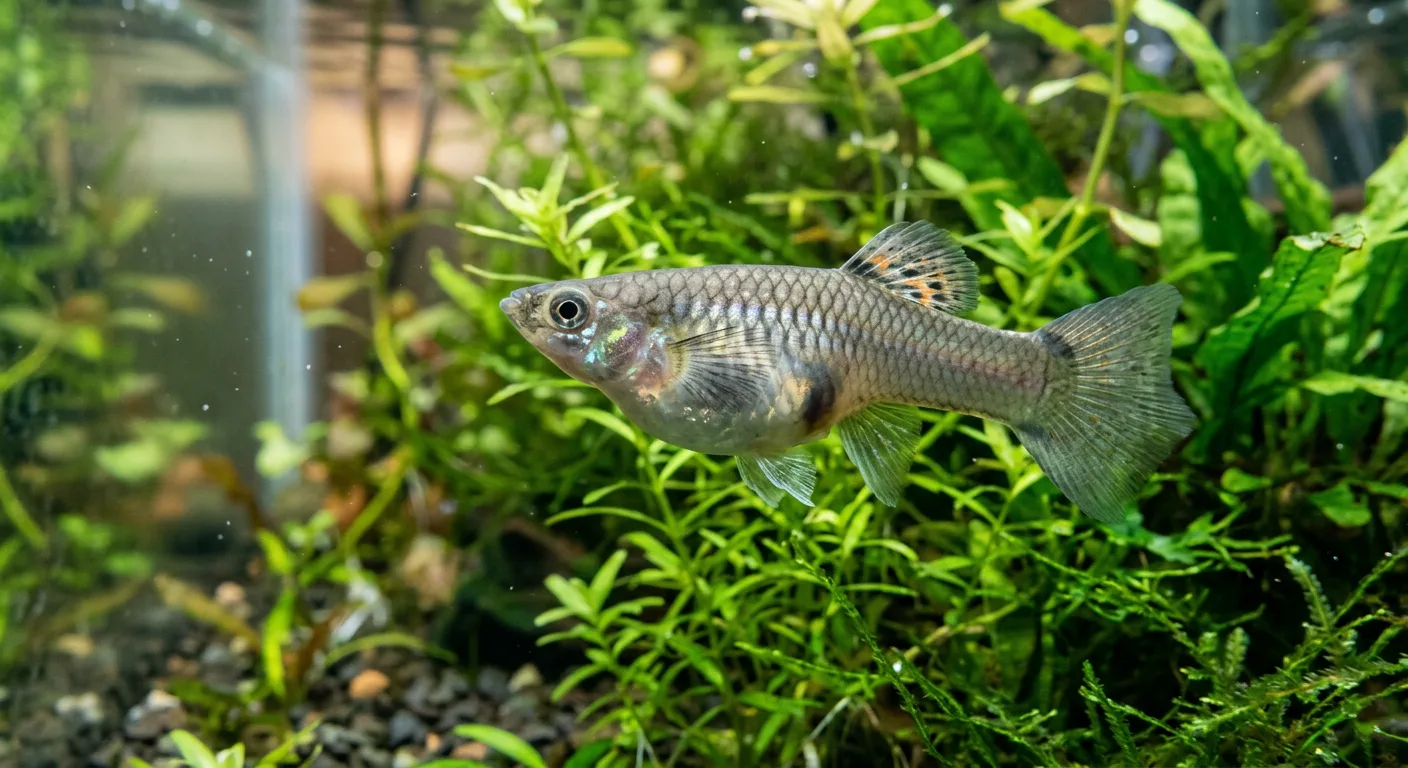
Watch for a squared-off, boxy belly, a dark and enlarged gravid spot near the vent, hiding behavior, and sometimes rapid gill movement or shaking. Some females become less interested in food. None of these signs is a precise countdown, so treat them as a window of a few days rather than a clock. Our article on the signs a guppy is about to give birth lists them in detail.
What labor looks like
A female may drop fry in small batches over several hours, and sometimes over a day or more. Fry are born curled and quickly straighten out, then head for cover or the surface. A typical brood can range from a handful to several dozen, depending on the female’s size and age. If birth stalls for a long time, see why is my guppy not giving birth.
Why moving a female too early backfires
Netting a pregnant female and placing her in a small box is stressful. Stress can delay labor, and in some cases females have been reported to drop fry early or not at all when handled roughly. Because the dates are never certain, putting a female in a box weeks early means she spends a long time in a cramped space with little exercise and poor water flow. If you do use a box, wait until the clear late-stage signs appear.
Pros and cons of using a breeder box
A breeder box is neither good nor bad on its own. It is a tool with a narrow use. The table below compares the main trade-offs.
| Factor | Advantages | Drawbacks |
|---|---|---|
| Fry survival | Separates fry from adults right away | Fry can be trapped in poor flow or injured on slots |
| Female welfare | Quiet, contained place to deliver | Small space can raise stress and ammonia exposure |
| Cost and setup | Cheap and needs no extra equipment | Cheap models may have sharp edges or tiny slots |
| Water quality | Shares tank water | Low circulation inside the box |
| Convenience | Easy to watch the female | Needs daily attention and a timer in your head |
When a breeder box helps
- You have a sparse tank and many hungry adults or tank mates.
- You are watching a female that shows clear late-stage signs and can check often.
- You want a temporary holding spot for fry you found mixed with adults.
- You are keeping an eye on one valuable line and want to count the brood.
When a breeder box hurts
- The box is used for days or weeks, so the female sits in a cramped space.
- The tank is small and the box takes up a big share of the swimming room.
- The water in the box is stale because flow is poor.
- The slots are too narrow, so fry get stuck, or too wide, so the female reaches them.
A word on box size
Guppy females are small, but they still need room to turn. Choose a box that lets her swim a full body length in each direction without touching the sides. If she cannot turn easily, the box is too small. A small mesh box is generally better than a solid one because water moves through it more freely.
How to use a breeder box the right way
If you decide a box fits your tank, the way you use it matters more than the box itself. Follow these steps to keep the female calm and the fry safe.
Step-by-step use
- Wait for clear signs. Use the box only when the female looks boxy with a dark gravid spot and is hiding or restless.
- Check water first. Test ammonia and nitrite (both should read zero) and make sure the temperature matches the main tank. Our guppy water parameters guide lists the usual ranges.
- Add cover. Put a small piece of plastic plant or moss inside the upper section so she has somewhere to hide.
- Move her gently. Use a cup or container rather than a net where you can, and lower her in slowly to avoid shock.
- Dim the light. Keep the area quiet and avoid tapping the glass.
- Check twice a day. Look for fry in the lower section without disturbing her.
- Remove her after birth. As soon as she finishes, or after 24 to 48 hours at most if nothing happens, return her to the main tank.
- Move the fry. Transfer the fry to a nursery as described below.
How long is too long?
Most keepers who use boxes aim for the shortest possible stay. A common rule of thumb is no more than a day or two. If nothing happens in that time, return her to the main tank with plenty of cover and try again later when new signs appear. Do not use the box as a long-term home.
Feeding in the box
Offer a small pinch of food once a day, and remove leftovers after a few minutes. Overfeeding fouls the small volume quickly. Our article on guppy fry feeding schedule covers what to give once the fry arrive.
Better alternatives to a breeder box
For many keepers, the best answer to “do guppies need a breeder box” is to build a tank where one is rarely necessary. These alternatives usually give better results.
Dense plants and floating cover
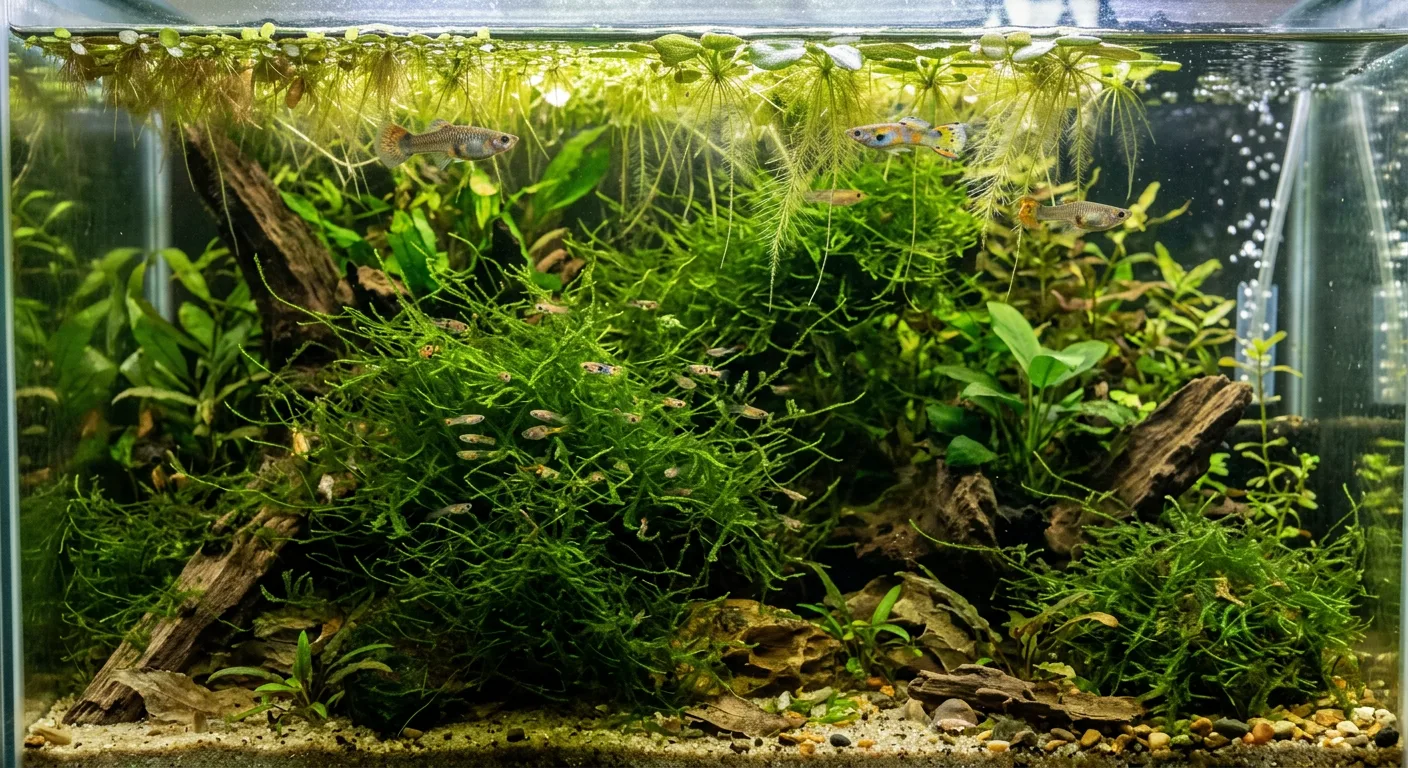
Java moss, hornwort, guppy grass and floating plants give fry thousands of places to hide. Fry tend to head up toward the surface, so floating cover is especially valuable. A well-planted tank can see a good share of fry survive with no special equipment at all. See our list of best live plants for guppies for easy options.
A dedicated birthing tank
A small 5 to 10 gallon tank with a sponge filter, a heater, a handful of plants and a lid works well as a birthing tank. It gives the female far more room than a box, and you can leave her there for several days without stress. After birth, move her back and keep the fry in the same tank. Our guppy breeding tank setup guide shows the full layout.
Spawning mops and moss balls
Yarn spawning mops are cheap and easy to move. Fry slip into the strands and hide, and you can lift the mop into a nursery container. This also lets you collect fry without chasing them with a net.
Removing fry quickly
If you do not want to move the female at all, check the tank often during the expected window and scoop out fry with a small cup. Do this gently and keep them at the same temperature as the main tank. A quick check at morning and evening feeding catches most newborns.
Comparison of methods
| Method | Cost | Female stress | Fry survival | Effort |
|---|---|---|---|---|
| Breeder box | Low | Medium to high | Good at first | Medium |
| Dense plants only | Low | Low | Moderate | Low |
| Birthing tank | Medium | Low | High | Medium |
| Spawning mop | Low | Low | Moderate to good | Low |
| Quick removal by hand | None | Low | Good if you watch closely | High |
Caring for fry after birth
Whatever method you choose, the first weeks decide how many fry grow up. This is where good routine matters more than any box.
The first 24 hours
Fry do not need food in the first several hours because they still carry some yolk reserves, but most keepers begin feeding small amounts within a day. Keep water clean and temperature steady, ideally in the mid to upper 70s Fahrenheit (about 24 to 26°C). A gentle sponge filter is safer than a strong power filter that can suck fry in.
Feeding plan
- Offer tiny amounts several times a day rather than one big meal.
- Good options include crushed flakes, powdered fry food, baby brine shrimp and microworms.
- Remove uneaten food after a few minutes.
Water changes
Small, frequent changes are safer for fry than large ones. A 10 to 20 percent change several times a week is a common approach, using treated water at the same temperature. Our guide to water changes for guppy fry explains the routine in more detail.
Separating fry later
Fry that are too small to fit in an adult’s mouth are safer, but size varies. Keeping them apart until they are clearly larger reduces losses. For the details, read how to separate guppy fry and when can guppy fry join adults.
Common mistakes with breeder boxes
Most box problems come from a few repeated errors. Check this list against your routine.
Putting the female in too early
Because guppy due dates are never exact, an early move means days of confinement. Wait for the clear late signs instead.
Leaving her in after birth
A female that stays in a box after delivering is still stressed and can start eating the fry above or below the slots if the design allows. Remove her promptly.
Using a box in a tiny tank
In a 5 gallon tank, a box takes up a large share of the volume and can restrict water flow. In that case a plant-based approach is safer.
Ignoring water quality
Because boxes limit circulation, waste builds up quickly. Test water often and keep up with changes. If you see signs of ammonia stress, read about ammonia poisoning in guppies.
Choosing a box with rough edges
Run a finger along the inside before use. Sharp seams can tear delicate fins and scales. Replace any damaged box.
Tips for beginners and experienced keepers
For beginners
- Start with plants first. A moss clump and a few floating plants cost little and help a lot.
- Keep a small container or net ready so you can move fry quickly if you spot them.
- Do not try to catch every fry. Even a few survivors from a brood can fill a tank quickly.
For experienced keepers
- Use a birthing tank for high-value lines so you can track each brood.
- Rotate females in and out of a small tank to keep records of brood size and timing.
- Consider a selective breeding plan instead of letting all fry grow; see selective breeding guppies for beginners.
Planning for population growth
One female can produce many broods in her life, so plan what you will do with the fry. Some hobbyists keep the best, give some away and sell the rest. If you are starting a line, you can browse healthy breeding stock in our breeder trios or pick up a ready-made group from our guppy fry packs.
Breeder box checklist
- Female shows boxy belly, dark gravid spot, or hiding behavior.
- Ammonia and nitrite read zero and temperature matches the main tank.
- Box is big enough for her to turn easily, with smooth edges.
- Plastic plant or moss added inside for cover.
- Light dimmed and area kept quiet.
- Checked twice a day, no longer than a day or two total.
- Female returned to the tank as soon as birth ends.
- Fry moved to a nursery with gentle filtration and small, frequent meals.
When in doubt, put plants first and the box last. For the full picture of caring for livebearers, return to our guppy care resource any time.
FAQ
Do guppies need a breeder box to give birth?
No. Guppies give birth fine in a normal tank, and many do so with no special equipment. A box only helps protect fry from adults, and a planted tank or a birthing tank can do that job more gently.
When should I put a pregnant guppy in a breeder box?
Only when clear late signs appear, such as a boxy belly, a dark gravid spot and hiding or restlessness. Moving her weeks early means a long stay in a cramped space, which adds stress without a clear benefit.
How long can a guppy stay in a breeder box?
Keep it as short as possible, ideally a day or two at most. If she has not given birth in that time, return her to the main tank with cover and try again when new signs show.
Can a breeder box stress a guppy?
Yes. A small, crowded or poorly flowing box can raise stress, which may delay labor and weaken the female. Use a box with enough room, smooth edges and some cover inside, and watch her behavior closely.
What is a good alternative to a breeder box for guppies?
Dense live plants such as java moss and floating plants, a small birthing tank with a sponge filter, or yarn spawning mops all work well. Many keepers prefer a birthing tank because it gives the female much more room.
Will guppy fry survive without a breeder box?
Some will, especially in a heavily planted tank with few adults. Survival is usually higher if you add cover and remove fry quickly, so do not expect every fry to survive without help.
Should I feed the female in a breeder box?
Yes, but lightly. Offer a small pinch once a day and remove leftovers after a few minutes so the small volume of water stays clean.
Behind the care guides
Care begins with steady systems
Our guppy guides focus on practical routines: keep water stable, observe fish closely and allow for natural variation.

Care systems
Steady water, thoughtful care
Gentle filtration and regular observation support healthy aquarium routines.

Natural variation
Every guppy is different
Color, size and fin shape vary with strain, age and each individual fish.
Editorial illustrations for context; they do not depict HiGuppy's exact facility or current fish stock.