Guppy Care Article
Guppy Tank Maintenance Schedule: Daily, Weekly & Monthly Checklist
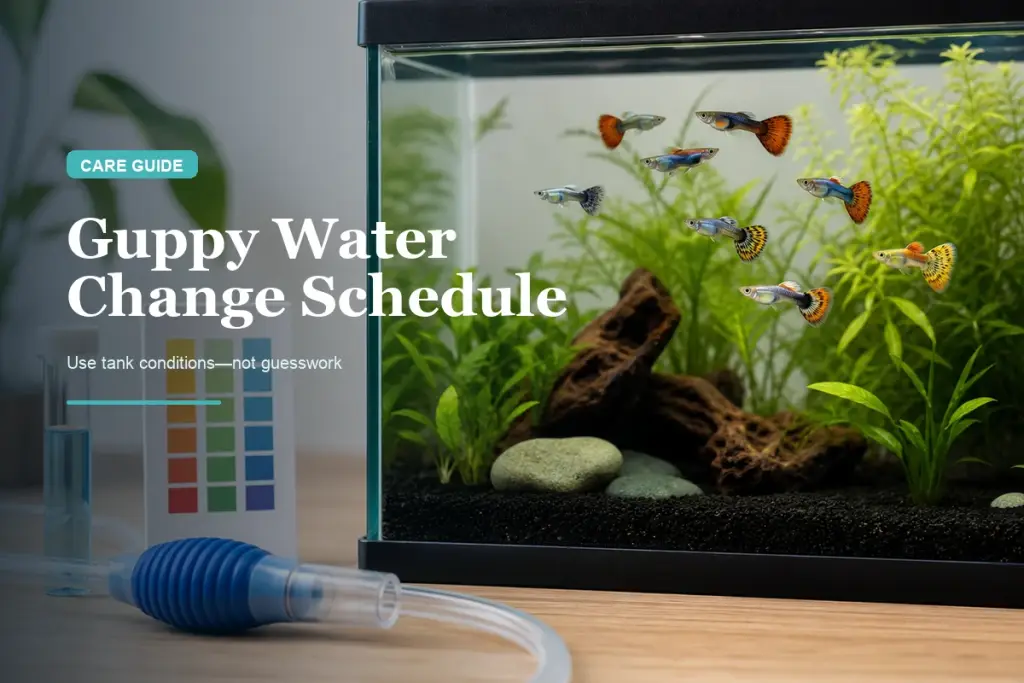
Quick answer: A practical guppy tank maintenance schedule is built around daily observation, weekly water-quality and cleaning tasks, and monthly equipment review. The exact frequency should follow your tank’s test results, stocking, feeding, plant growth, and filter performance—not a rigid calendar.
Guppy Tank Maintenance Schedule at a Glance
| Frequency | Main tasks | What you are checking |
|---|---|---|
| Daily | Observe fish, feed carefully, confirm equipment is running | Appetite, breathing, fin position, temperature, filter flow |
| Weekly | Test water, perform an appropriate partial water change, remove debris, clean viewing glass as needed | Ammonia/nitrite risk, nitrate trend, waste buildup, stability |
| Monthly | Inspect filter media and equipment, trim plants, review stocking and maintenance notes | Reduced flow, clogged media, crowding, hidden maintenance drift |
| As needed | Respond to spills, overfeeding, dead livestock, unusual behavior, equipment failure or abnormal test results | Anything that can change water quality faster than the normal schedule |
The goal is not to make the aquarium look sterile. The goal is to keep the system stable, observable and easy to correct. If you are still establishing the aquarium, start with the guppy tank setup checklist before buying and the guppy water parameters guide.
Daily Guppy Tank Maintenance: About 2–5 Minutes
1. Look at the fish before you touch the tank
Use the first minute as a health check. Healthy guppies are usually alert, balanced and interested in their surroundings. Watch for a fish that suddenly isolates, clamps its fins, loses balance, breathes unusually fast or ignores food. Behavior changes often appear before the aquarium looks dirty.
If several fish change behavior at the same time, check water and equipment before assuming disease. The troubleshooting cluster includes guides for surface gasping, clamped fins and ammonia problems.
2. Feed small portions and watch who actually eats
Feeding time is part of maintenance because uneaten food becomes waste. Give an amount the group can finish promptly, then adjust for the actual number and size of fish. If food repeatedly reaches the substrate or sits in corners, reduce the portion and review the overfeeding guppies guide.
3. Confirm filter, heater and surface movement
Make sure the filter is flowing normally and the heater has not failed or become unplugged. A sudden drop in filter flow can indicate a clogged intake or media. If you are deciding how much filtration the tank needs, see do guppies need a filter?
Weekly Maintenance: Water, Waste and Trend Checks
For many established guppy tanks, the weekly routine is where most hands-on work happens. Avoid treating a fixed percentage as universal. The right water-change amount depends on test results, stocking, feeding, plant mass and source-water chemistry. Use the dedicated guppy water change schedule to set the actual interval and amount for your aquarium.
- Test water: track ammonia and nitrite risk, nitrate trend, pH stability and any parameter that has caused trouble in your system.
- Perform a partial water change: condition replacement water correctly and avoid creating unnecessary temperature or chemistry swings.
- Siphon visible waste: focus on debris pockets rather than aggressively stripping every surface.
- Clean the viewing glass: remove algae where it interferes with observation; some algae elsewhere is not automatically an emergency.
- Inspect plants: remove decaying leaves and thin growth if it blocks circulation or swimming space.
How to Clean Without Crashing the Biofilter
A common beginner mistake is doing several disruptive tasks at once: replacing all filter media, deep-cleaning the substrate, scrubbing every surface and changing a large volume of water on the same day. Biological filtration depends on established microbial communities on filter media and other wet surfaces. Maintenance should preserve that stability while removing excess waste.
Rinse reusable filter sponges or media when flow drops or debris accumulates, using tank water you have removed during maintenance when practical. Do not replace all biological media simply because it looks brown. If media is physically falling apart, replace it gradually according to the filter manufacturer’s instructions.
Monthly Guppy Tank Maintenance
- Inspect the filter intake, air line, sponge, impeller area and heater for obvious wear or blockage.
- Review whether the tank has become more crowded, especially if fry are growing.
- Trim and reposition plants so fish still have open swimming space. See best live plants for guppies.
- Check substrate depth and debris pockets rather than automatically replacing substrate. Compare options in the guppy substrate guide.
- Look back at your water-test notes. A slow trend is easier to correct than a sudden crisis.
When Your Tank Needs More Frequent Maintenance
Increase monitoring or maintenance when the biological load changes. Common examples include adding fish, raising a large group of fry, feeding more heavily, losing plant mass, treating illness in a separate system, or noticing reduced filter flow. A tank can also need more attention after a power outage or equipment failure.
Cloudy water, repeated detectable ammonia or nitrite, rising nitrate, persistent uneaten food or fish showing respiratory stress are reasons to investigate the cause rather than simply cleaning more aggressively.
Maintenance Mistakes to Avoid
- Cleaning by appearance only: clear water can still have poor chemistry.
- Replacing all filter media at once: this can reduce biological filtration capacity.
- Overfeeding after a water change: clean-looking water does not mean the tank can process unlimited waste.
- Letting stocking creep upward: guppies reproduce quickly, so maintenance demand can change month to month.
- Using soap or household cleaners on aquarium equipment: use aquarium-safe cleaning methods and dedicated tools.
- Chasing perfect numbers: stable, appropriate water is usually more important than forcing frequent large chemistry changes.
A Simple Maintenance Log Helps
You do not need a complicated spreadsheet. Record the date, water-test results, approximate water-change amount, filter work, livestock changes and anything unusual. After a few weeks, the log shows how quickly your own tank changes and makes the schedule more accurate than generic advice.
Preparing for New Guppies?
Do not use delivery day as the deadline for finishing maintenance. The aquarium should already be stable, filtered and tested before new fish arrive. Review the pre-purchase tank checklist, and only when the system is ready, you can browse the HiGuppy shop.
FAQ: Guppy Tank Maintenance
How often should I clean a guppy tank?
Most established tanks benefit from a consistent weekly maintenance check, but the actual water-change and cleaning frequency should follow water tests, stocking, feeding and filtration rather than a fixed rule.
Should I clean the filter every week?
Not automatically. Inspect flow regularly and clean reusable media when it becomes clogged or flow declines. Avoid replacing all biological media at once.
Do I need to vacuum the whole substrate every week?
No. Remove visible waste and work in sections when needed. Heavily planted, lightly stocked and bare-bottom systems can have very different cleaning needs.
Why does my guppy tank get dirty so quickly?
Common reasons include overfeeding, increasing stocking, growing fry, weak or clogged filtration, dead plant material and a maintenance schedule that no longer matches the tank’s biological load.
Further reading: University of Florida IFAS notes that aquarium filtration and responsible feeding help control ammonia and water-quality deterioration, while Merck Veterinary Manual emphasizes routine water-quality monitoring and established biofiltration in aquarium fish management.
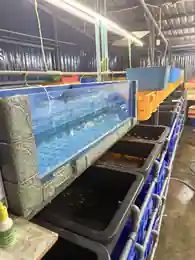
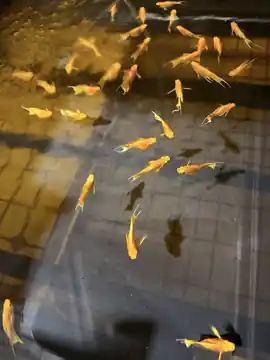
Real HiGuppy photographs
Inside the facility behind our guppy guides
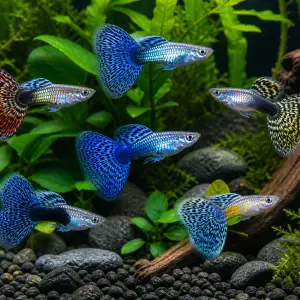
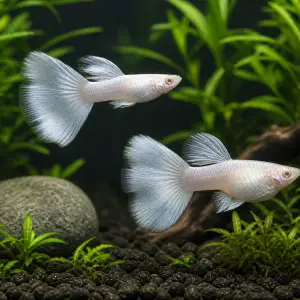
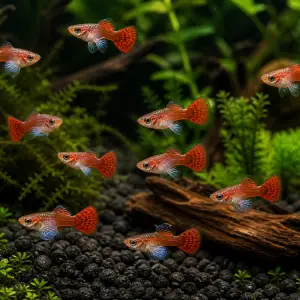
These photographs show real HiGuppy holding, breeding and observation work. They document our facility and fish stock; they are not presented as the exact individual fish or strain discussed on every page.