The HiGuppy Journal
Can Guppies Breed With Platies? Myths, Facts and Tank Tips
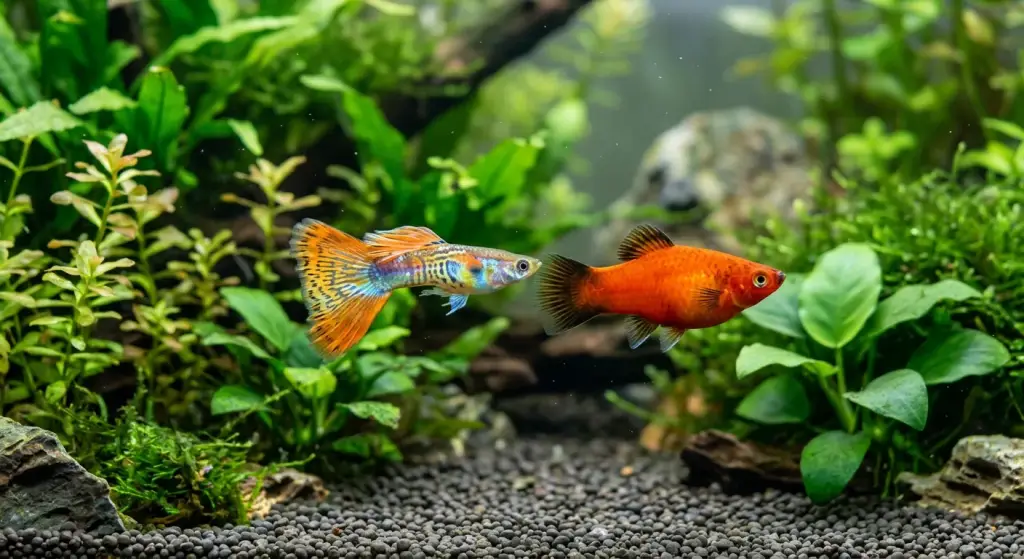
Can guppies breed with platies? No, not in any way that produces real hybrid babies. Guppies and platies belong to the same family of livebearers, so males of one will often try to mate with females of the other, but they sit in different genera and in practice do not produce viable hybrid offspring. Any fry you find in a mixed tank came from a guppy mother and a guppy father, or from a platy mother and a platy father. This article belongs to our complete guppy care guide and explains why the myth persists, what actually happens, and how to manage a mixed tank.
If you have both fish in one tank and suddenly see a brood of tiny fry, it is natural to wonder who the parents are. Online forums are full of “guppy-platy hybrid” stories, and some of them are convincing until you look closely. Below you will get a clear answer, the biology behind it, a method to work out who the parents were, and practical advice for keeping both species together without a population explosion.
Can guppies breed with platies? The short answer
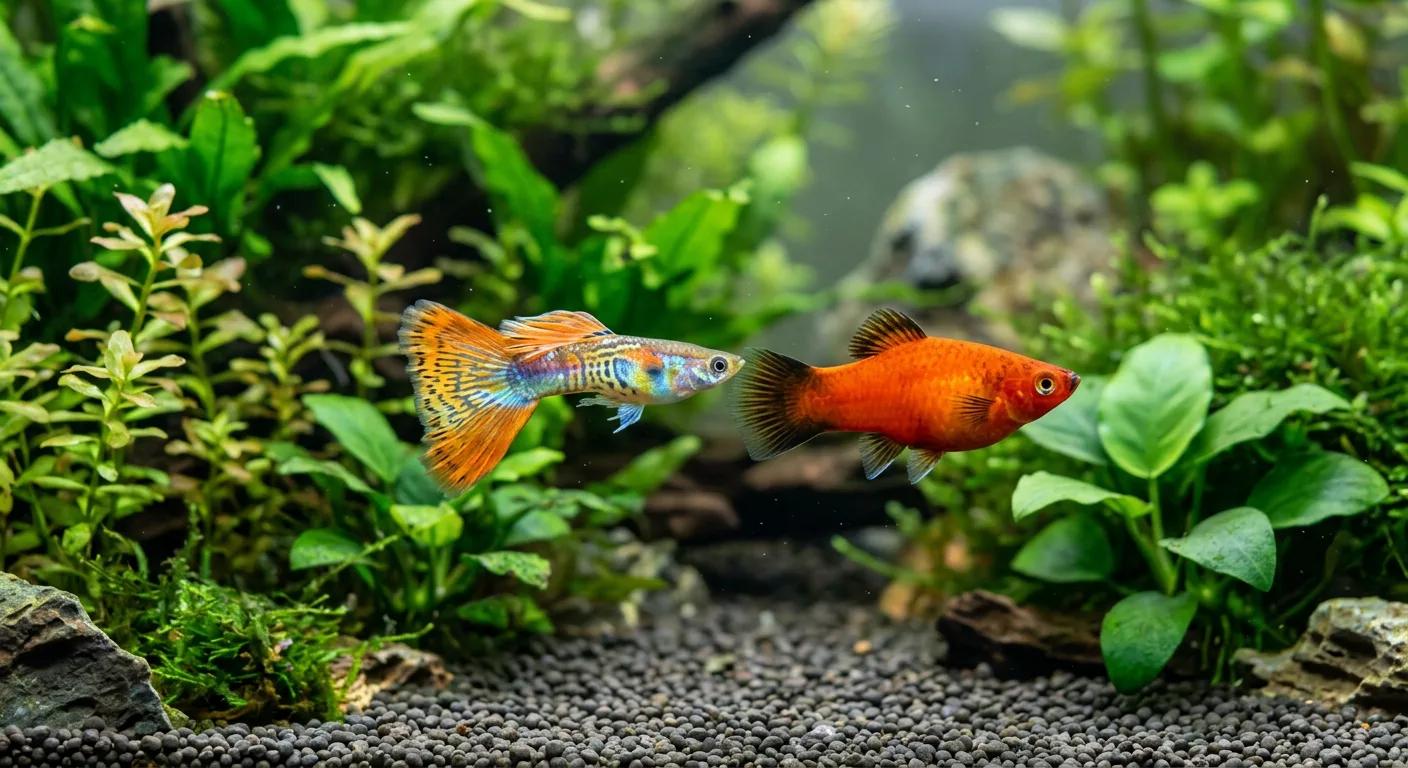
The short answer is no. Guppies (Poecilia reticulata) and common platies (Xiphophorus maculatus) are both livebearers from the family Poeciliidae, which is why they look like cousins and live well together. But they belong to different genera, and that gap is large enough that cross-breeding does not produce healthy, viable young under normal aquarium conditions. Hobbyists who report “guplies” or “guppy-platy crosses” have nearly always misidentified ordinary guppy or platy fry.
Same family, different genus
Think of it like a dog and a fox. They are related and share traits, but they are not close enough to interbreed. Guppies, mollies, endlers and mosquitofish share the genus Poecilia, while platies and swordtails sit in the genus Xiphophorus. Inside a genus, hybrids are sometimes possible, which is why we cover guppy and endler crosses separately. Across genera, the odds fall away.
Why people still believe in hybrids
- Mating behavior is real. A male guppy will chase and attempt to mate with a female platy, and the reverse happens too. That looks like breeding, but attempted mating is not fertilization.
- Stored sperm confuses things. Female guppies and platies can store sperm for months, so a brood can appear long after you separated the sexes.
- Look-alike fry. Baby guppies and baby platies are both small, transparent-brown livebearer fry that are hard to tell apart in the first weeks.
- Odd color patterns. Fancy guppies and platies both show mixed colors, so an unusual fish gets mistaken for a hybrid.
Guppies vs platies: key differences
Understanding how the two fish differ makes the biology easier to see. The table lists typical figures; individuals and strains vary.
| Feature | Guppy | Common platy |
|---|---|---|
| Genus | Poecilia | Xiphophorus |
| Adult size | Males about 1 to 1.5 in (2.5 to 4 cm), females about 2 to 2.5 in (5 to 6 cm) | About 2 to 3 in (5 to 7.5 cm) |
| Body shape | Slim, with large fan or delta tail in males | Stocky, deep body with small rounded tail |
| Typical temperature | 74 to 82 °F (23 to 28 °C) | 70 to 80 °F (21 to 27 °C) |
| Typical pH | 6.8 to 7.8 | 7.0 to 8.2 |
| Gestation | About 21 to 30 days | About 24 to 35 days |
| Brood size | Often 20 to 60 fry, sometimes more | Often 20 to 50 fry |
| Temperament | Peaceful, males flashy and busy | Peaceful, slightly sturdier |
Why the differences matter for breeding
Differences in body size, reproductive anatomy and chromosome makeup are what keep species separate. A male guppy has a gonopodium sized for guppy females, and a platy female is larger and shaped differently. Even if a mating attempt succeeds mechanically, the genetic mismatch means eggs are not fertilized or do not develop. That is why careful breeders find no hybrids when they test the idea in controlled setups.
Can they live together anyway?
Yes. They make good tank mates because they share peaceful temperaments, similar water and similar food. We cover that side in can guppies live with platies. Just remember that both species breed readily and quickly, so a mixed tank can turn crowded within a few months if you do not plan ahead.
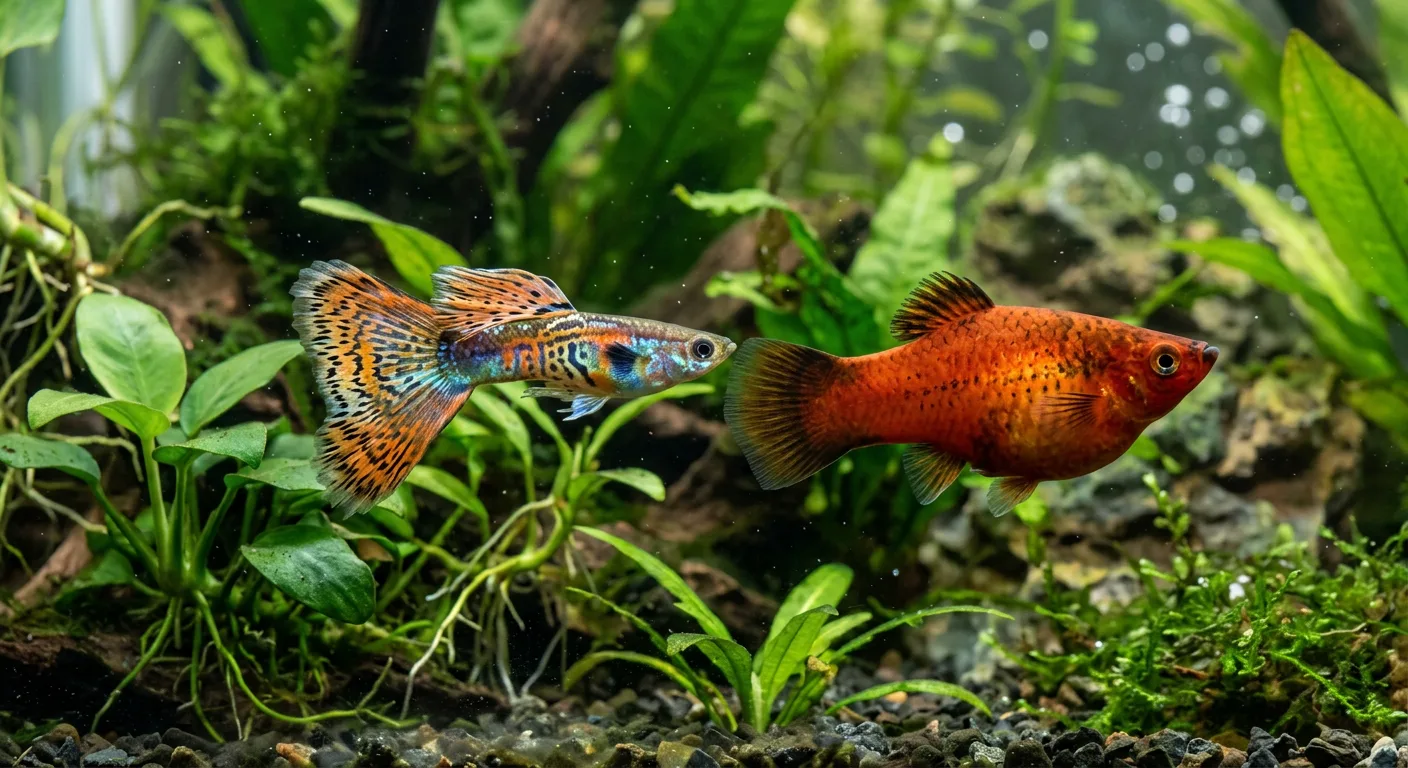
What happens when a male guppy chases a female platy?
It looks alarming, but it is mostly harmless in moderation. Male livebearers have a strong drive and will chase any female-shaped fish that moves. Platies are bigger than guppy females, so a male guppy is unlikely to injure one, but constant pursuit still stresses her.
Signs of too much chasing
- A female hiding behind decor or at the surface corner for hours.
- Torn fins, scales missing or small scratches on her sides.
- Clamped fins, pale color or loss of appetite.
- Males flaring and swimming in tight circles around one fish.
How to reduce the harassment
- Count the sexes. Aim for at least two or three females to each male across the tank.
- Add plants and break up lines of sight with driftwood and rocks.
- Increase the tank size if you can, since space spreads out attention.
- Remove the most persistent male for a few days to calm the group.
- Check water quality, because stressed fish react more strongly to harassment.
Our guide to the male to female guppy ratio explains the numbers in more depth.
How to tell who the parents of your fry are
If you have both species and a batch of fry, you can usually work out the parents with a little observation. Start from the mother, because livebearers give birth to the young she carries.
Step-by-step identification
- Find the pregnant female. Look for a boxy belly and a dark gravid spot near the vent. Guppies and platies show this spot differently, and our guide to a guppy pregnant or fat helps you spot it.
- Note her species. A guppy mother gives guppy-type fry, and a platy mother gives platy-type fry.
- Isolate her to give birth. Move her to a separate container or heavily planted tank so you know which fry belong to her.
- Watch the fry for two to four weeks. Guppy fry grow slim bodies and develop color on the tail first. Platy fry stay stocky with a rounder tail.
- Wait for adult traits. By two to three months, fins and body shape make species obvious.
What about fry that look “in between”?
An in-between look is almost always a guppy with a plain, short tail or a platy with a slim build, plus the way young fish change shape as they grow. Another common cause is the mix of genes in feeder-type or heavily crossbred strains. If you want fish with predictable looks, start from clearly named stock, as we explain in our guide to keeping a guppy strain pure.
Real crosses you can make
If you want to experiment with crossbreeding, choose fish within the same genus. Some crosses are possible, while others are not. The table gives a quick overview based on what hobbyists and breeders commonly report; treat the results as general guidance.
| Pairing | Same genus? | Viable offspring? | Notes |
|---|---|---|---|
| Guppy x guppy | Yes | Yes | Standard breeding |
| Guppy x endler | Yes | Yes, fertile | Common in hobby, see our endler guide |
| Guppy x molly | Yes | Rare | Reports are mixed, see our molly guide |
| Guppy x platy | No | No known viable hybrids | Mating attempts only |
| Platy x swordtail | Yes | Yes | Common and well documented |
If you are curious about the closest realistic option, read about whether guppies can breed with mollies. For anyone planning to breed guppies on purpose, our walkthrough on how to breed guppies is the better place to start, and our warning about guppy inbreeding will help you avoid weak lines.
Managing a mixed guppy and platy tank
Because both species give birth often, a mixed tank will fill up unless you manage it. Here is a practical plan.
Choose the right tank size
A 20 gallon tank is a realistic minimum for a small group of each. A 30 gallon gives more room as fry appear. As a rough guide, keep the combined adults to about one fish per gallon and add fewer if the tank is not heavily filtered.
Set shared water targets
Both species do well at about 76 to 79 °F (24 to 26 °C) and pH 7.0 to 7.6, with ammonia and nitrite at zero and nitrate kept low. Platies prefer slightly harder, more alkaline water than guppies, so aim for the middle. Keep water changes regular, roughly 20 to 30 percent each week, and avoid sudden swings.
Feed both fairly
Offer a quality flake or micro pellet once or twice a day and rotate frozen foods. Platies eat more plant matter, so add blanched vegetables now and then. Do not overfeed, since fouled water hurts fry and adults alike.
Plan for fry from day one
Adults of both species eat fry. Use dense plants, floating cover or a separate tank so some young survive. See our guide on how to separate guppy fry and the one on floating plants for guppies.
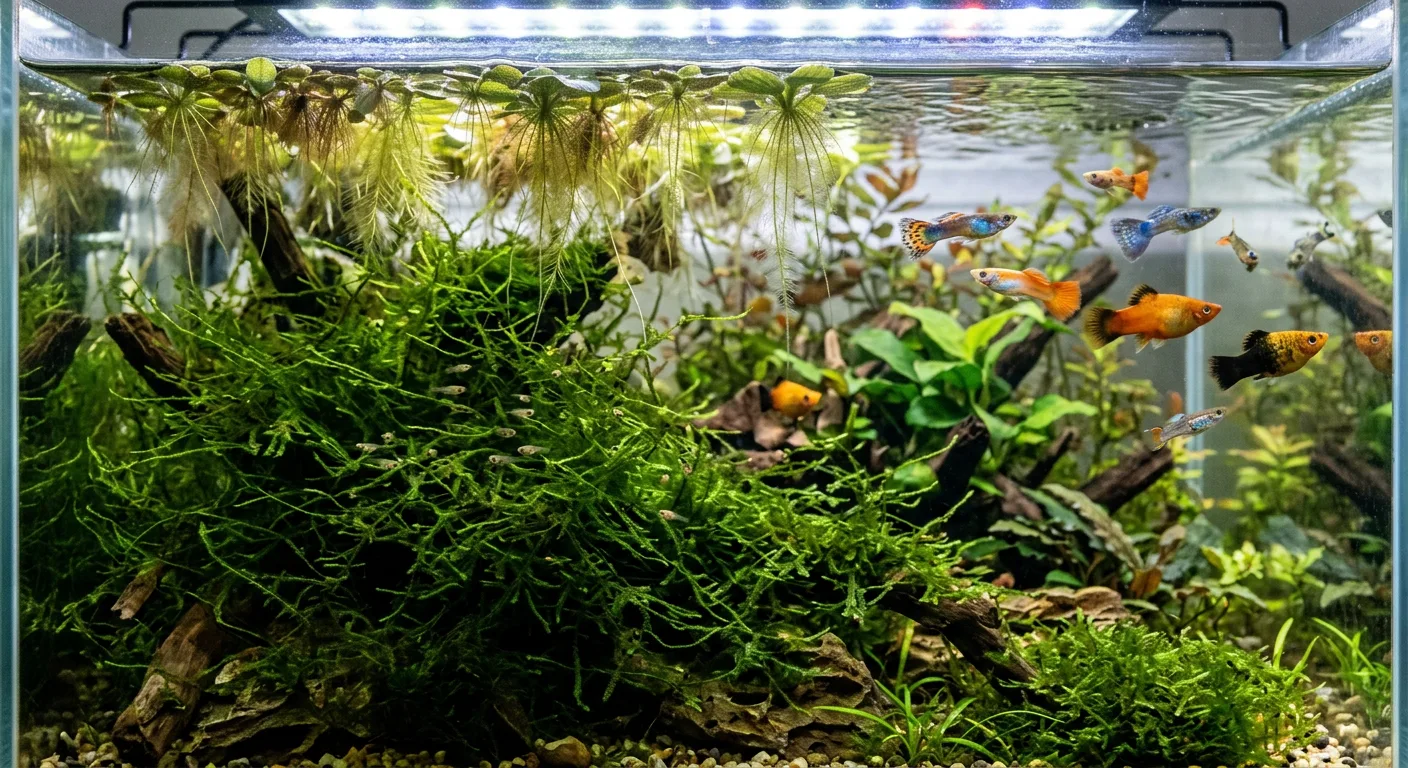
Raising fry from a mixed tank
Whether the babies are guppies or platies, the early weeks follow the same basic rules. Give them space, food and clean water, and sort them by species as they grow.
Week-by-week basics
- Days 1 to 7: Feed tiny amounts several times a day, such as crushed flake, powdered fry food or baby brine shrimp.
- Weeks 2 to 4: Move to finely crushed flake and continue small, frequent meals.
- Weeks 4 to 8: Reduce feeding frequency and start sorting by body shape and size.
- Months 2 to 3: Sexes become obvious, so separate males from females if you do not want more broods.
Use a grow-out tank
A small separate tank lets fry grow without competition. Our guide to a guppy fry grow-out tank shows the setup, and the broader raising guppy fry guide covers feeding and water changes.
Water changes for babies
Small, frequent changes of dechlorinated water at the same temperature keep fry growing steadily. Avoid strong filter flow, which can suck up tiny fish, and cover intakes with a sponge.
Common mistakes and how to fix them
| Mistake | Why it causes problems | Better approach |
|---|---|---|
| Assuming odd fry are hybrids | Leads to wrong breeding plans | Identify the mother and isolate her |
| Too many males | Constant chasing and stress | Keep two to three females per male |
| No fry cover | Adults eat most young | Add dense plants or a breeder setup |
| Overstocking from broods | Poor water and disease | Rehome extras and test water weekly |
| Ignoring different water needs | Chronic stress for one species | Aim for a shared middle range |
For beginners
Keep it simple: one species per tank, or a mixed tank with a clear plan for fry. Buy healthy, clearly labeled fish and avoid mixing random strains.
For experienced keepers
If you want to keep strain quality, house guppies and platies separately for breeding, then mix them only in a display tank. This protects your lines and avoids accidental confusion over fry.
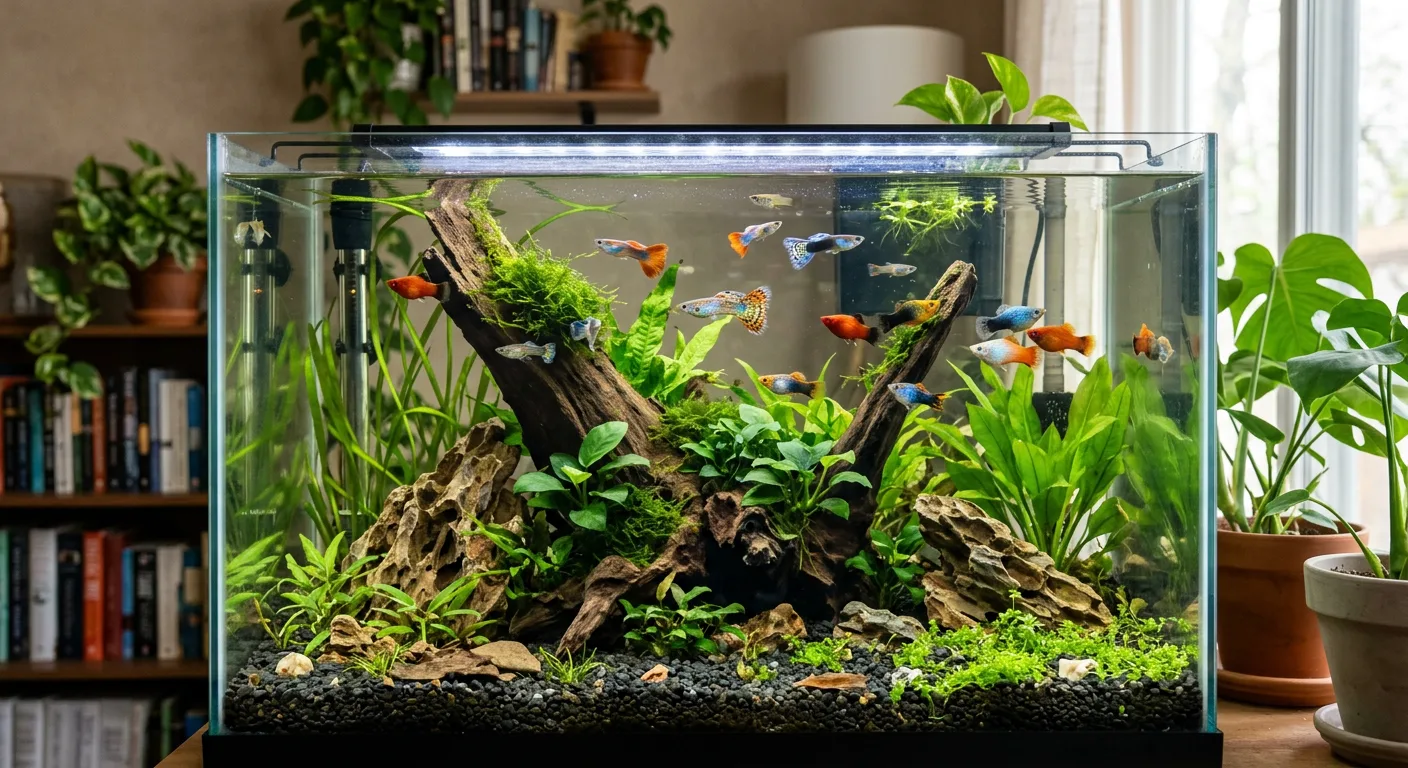
Why sperm storage fools so many keepers
Female guppies and platies can keep sperm from one mating and use it to fertilize several broods over a period of months. This is the single biggest source of “mystery fry” stories. You buy a female that already mated at the store, put her in your tank, and weeks later she delivers a brood even though no male was ever present.
What this means in practice
- A newly bought female may deliver babies one or two broods after you bring her home, sired by a male you never saw.
- Separating the sexes does not stop births immediately, so wait a couple of months before concluding that a cross happened.
- If a platy female gives birth, the fry are platies sired by a platy male, even when a guppy male was the only male in the tank at the time.
- Tracking births in a notebook, with dates and which female was isolated, makes the picture clear very quickly.
A simple test you can run
If you really want proof, isolate a single virgin female of one species with a male of the other in a separate tank for several months. Virgin females are hard to obtain unless you raise fry yourself and separate them before they mature at roughly two to three months. Hobbyists who run this kind of controlled test do not report hybrid fry, which matches what the biology predicts.
When to call it a different problem
Sometimes a keeper asks about breeding because something else seems off, such as a bloated female, a fish hiding in a corner, or a sudden drop in numbers. Not every swollen belly is a pregnancy. Dropsy, constipation and internal parasites can all look similar, so check for raised scales, white stringy waste or loss of appetite before assuming a brood is coming. If the fish seems unwell, move it to a hospital tank and review water quality first.
Quick checklist
- Remember that guppies and platies do not produce viable hybrids.
- Identify the mother before deciding what fry are.
- Keep two to three females per male to reduce chasing.
- Use a tank of at least 20 gallons for a mixed group.
- Target 76 to 79 °F and pH 7.0 to 7.6.
- Provide dense plants and floating cover for fry.
- Do weekly 20 to 30 percent water changes.
- Plan how you will rehome extra fish.
If you want healthy fish to start with, browse our premium guppy pairs or breeder trios. For deeper background on the species, see Guppy on Wikipedia, and return to our guppy care hub for more guides. Breeding questions about breeding setups are covered in our guppy breeding tank setup.
FAQ
Can guppies breed with platies and have babies?
No viable hybrids are known. Males may try to mate across species, but fry that appear in a mixed tank come from guppy or platy parents. Check which female gave birth to know for sure.
Why is my male guppy chasing my female platy?
Male livebearers chase any female-shaped fish because of strong mating instinct. It is usually harmless, but too many males cause stress. Add females, plants and hiding spots to spread out the attention.
What is a guppy-platy hybrid called?
There is no confirmed hybrid, so there is no real name. Terms like guplie or plaguppy appear online, but they describe misidentified fish rather than true crosses. Look at the mother and the fry to confirm.
Can guppies breed with mollies or endlers instead?
Guppies can cross with endlers and fertile offspring are common. Molly crosses are rare and reports vary. Both are in the same genus as guppies, which is what makes crossing possible.
How can I stop my guppies and platies from overpopulating?
Keep mostly one sex, rehome extra fish or separate males and females. Fewer females means fewer broods. Dense plants without a breeder box will still let some fry survive, so decide in advance how many you can keep.
Is it safe to keep guppies and platies together?
Yes, they are peaceful and share similar needs. Choose a 20 gallon tank or larger, watch the sex ratio and keep water steady. Plan for fry because both species breed often.
Do platies eat guppy fry?
Yes, adult platies and guppies will eat tiny fry if they can catch them. Dense plants and a separate grow-out tank help the babies survive. Feeding adults well reduces but does not remove the behavior.
Behind the care guides
Care begins with steady systems
Our guppy guides focus on practical routines: keep water stable, observe fish closely and allow for natural variation.

Care systems
Steady water, thoughtful care
Gentle filtration and regular observation support healthy aquarium routines.

Natural variation
Every guppy is different
Color, size and fin shape vary with strain, age and each individual fish.
Editorial illustrations for context; they do not depict HiGuppy's exact facility or current fish stock.