The HiGuppy Journal
Do Guppies Need an Air Pump? Oxygen, Surface Movement & When It Helps
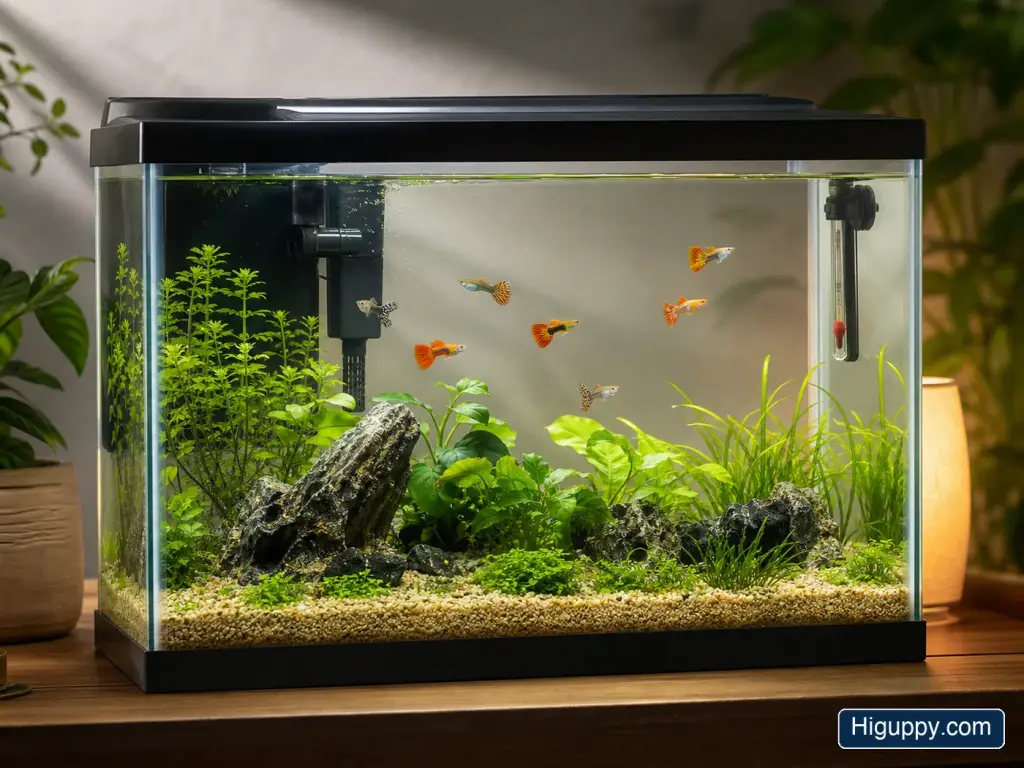
Quick answer: Do guppies need an air pump? Not always. If a functioning filter creates steady surface movement, a separate pump may not be needed; a study of standard pet-fish aquariums found oxygen uptake from the air changed with water flow and exposed surface area (Mieske & Hetz study abstract; Oklahoma State Extension).
An air pump does not replace a cycled aquarium or water-quality checks. If fish gulp at the surface or breathe abnormally, check the filter and water, and measure dissolved oxygen if possible; these signs can have other causes (MSD Veterinary Manual; University of Illinois Veterinary Medicine).
How oxygen gets into a guppy tank
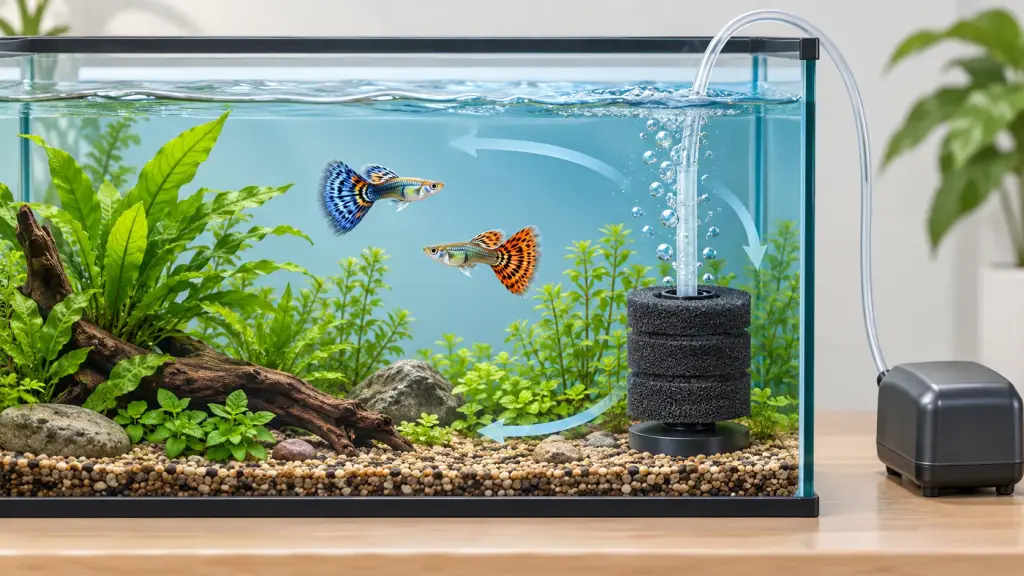
Most gas exchange happens where aquarium water meets the air. Surface movement continually exposes water to the atmosphere and supports oxygen transfer. An air stone’s bubbles also move water and disturb the surface; the effect depends on its placement and the rest of the system. Oklahoma State Extension describes return water breaking surface tension in an aquaponics system; its operating ranges apply to that system, not to home guppy tanks (Oklahoma State Extension).
A filter outlet that creates a steady ripple may provide enough surface movement in some setups, but the right flow depends on the tank, filter and fish. Observe whether guppies can swim comfortably; no single flow setup is right for every aquarium.
When guppies usually do not need a separate air pump
- The filter produces a consistent surface ripple.
- The tank is appropriately stocked rather than crowded.
- Water temperature is stable and within a suitable guppy range.
- Fish are active and breathing normally.
- There are no stagnant zones and circulation reaches the full tank.
If those conditions are met, adding more bubbles may provide little practical benefit. For a complete setup overview, see our Guppy Tank Setup Guide.
When an air pump is especially helpful
Warm water
Warm water holds less dissolved oxygen than cooler water, and warm-water fish may have higher oxygen demand (USGS; UF/IFAS). A warm-room or heater reading is a reason to confirm temperature and water conditions, not proof that every tank needs a second pump when its existing aeration is adequate.
Breeding and fry tanks
Air-driven sponge filters combine water movement with filtration and are used in some breeding and fry-holding setups. Product designs and flow differ; one model’s intended use is not a guarantee that every filter is suitable for every fry tank. Check the intake and follow the model’s instructions (Aquarium Co-Op fine sponge-filter example). See our Guppy Breeding Tank Setup for a practical layout.
Hospital or quarantine tanks
Quarantine tanks need filtration, aeration and monitoring suited to their actual setup. Treatment directions are product-specific: some labels call for increased aeration, but that is not a universal rule. Follow the exact product label and fish-veterinary advice; Merck’s home-quarantine example includes a sponge filter and aeration pump (Merck Veterinary Manual; one specific Maracyn Oxy label).
Heavily stocked tanks
A higher fish load can increase oxygen use and waste-management demand, depending on the fish and system. Aeration may support gas exchange, but it does not make overstocking safe. Correct stocking, filtration and maintenance rather than relying on bubbles as a substitute (Mieske & Hetz study abstract).
Signs your guppy tank may need more aeration
- Several fish repeatedly gather at the surface and breathe rapidly.
- Guppies appear more distressed during warm periods.
- The filter outlet has little or no surface movement.
- Fish become lethargic while the tank is crowded or under treatment.
- A power interruption or clogged filter has reduced circulation.
Surface piping can occur with low dissolved oxygen, but it can also reflect high nitrite or gill disease; it does not diagnose the cause. Check dissolved oxygen and water conditions, including nitrite, and verify filter operation. If abnormal breathing persists or several fish are affected, seek fish-veterinary advice (MSD Veterinary Manual; University of Illinois Veterinary Medicine). If this is happening now, use our Guppy Gasping at the Surface guide and check the tank rather than assuming bubbles alone will solve it.
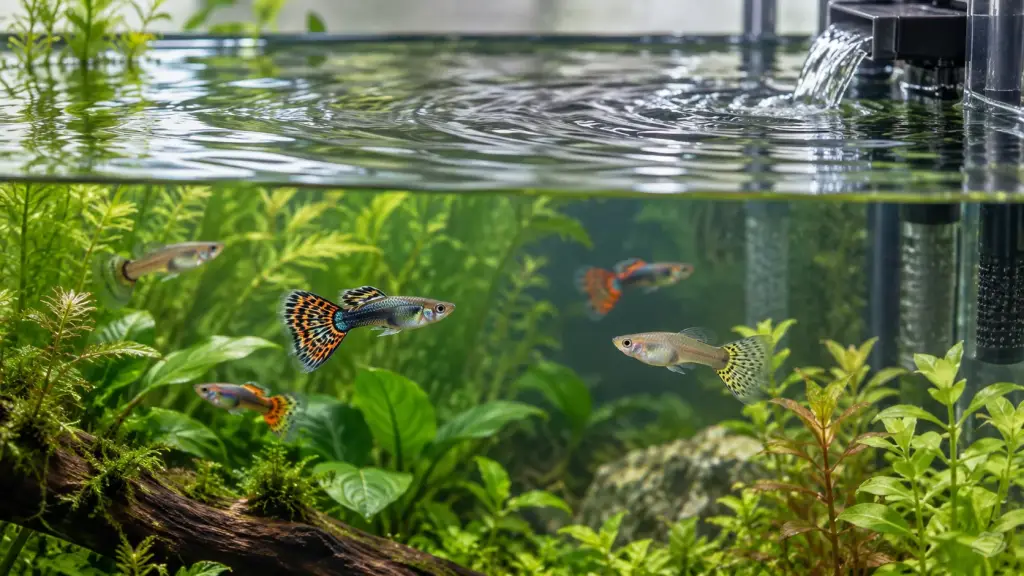
Air pump vs filter: they do different jobs
An air pump supplies air to an air stone or air-driven filter. A filter moves water through media that captures debris and supports beneficial bacteria; some filter returns also create surface movement. The pump and filter can work together, but one device should not be assumed to do both jobs.
| Tank setup | What to know |
|---|---|
| Filter return makes a gentle surface ripple | The filter is circulating water and disturbing the surface. A separate pump may not be necessary if water conditions, stocking, temperature and fish behavior are also appropriate. |
| Air-driven sponge filter | The pump drives water through the sponge. Keep it running, or replace it with a suitable established filter before changing the setup. |
| Little surface movement or unusual breathing | Check filter flow and water conditions. Adjust the return or add aeration as appropriate; surface gasping can have several causes, so do not assume oxygen is the only issue. |
| Air pump with no filter | It can add aeration and water movement, but it is not itself a mechanical or biological filter. See Do Guppies Need a Filter? if you are choosing filtration. |
For a filter comparison, see Best Filter for Guppies. The University of Illinois Veterinary Medicine fish-care guide recommends monitoring dissolved oxygen along with other water conditions. Bubbles or equipment alone do not confirm water quality.
How much airflow is enough?
Aim for useful surface movement without a current that constantly pushes fish around. Use the equipment’s airflow control, if it has one, or reposition the outlet; observe whether fish can swim and rest comfortably. No one bubble count or pump size fits every aquarium (Aquarium Co-Op air-pump guide).
OATA’s guppy and molly care sheet recommends a gentle current for guppies. For young fry, inspect the intake and watch their swimming; no single flow rule applies across tanks (OATA guppy care sheet).
Do live plants replace an air pump?
Live plants can add oxygen through photosynthesis while lit, then use oxygen through respiration in darkness. That light-and-dark cycle does not show whether a particular home aquarium has adequate surface movement; observe the setup and measure dissolved oxygen if there is concern (UF/IFAS dissolved-oxygen guidance). For plant choices, see Best Planted Tank Setup for Guppies.
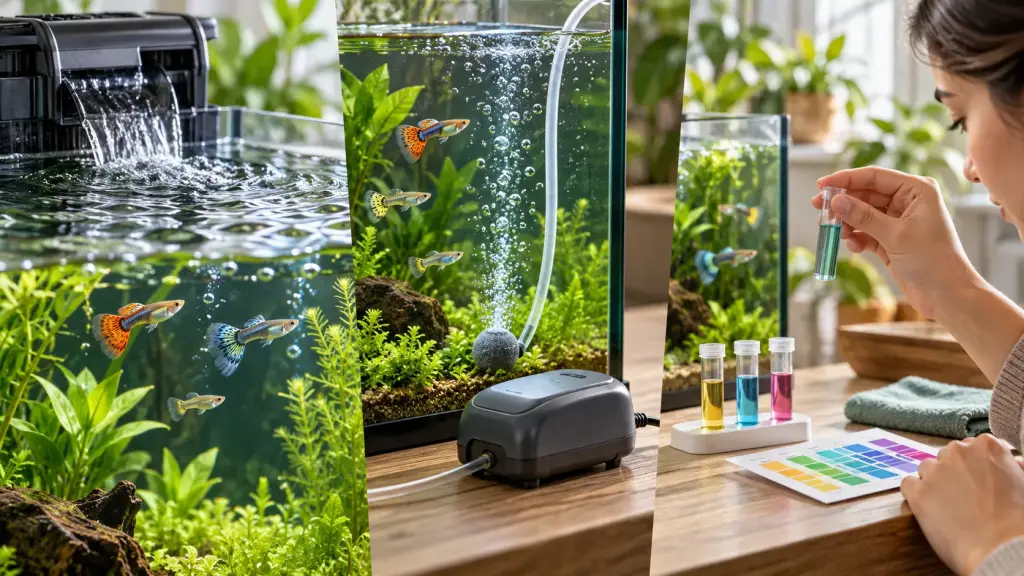
Do Guppies Need an Air Pump? Decision Checklist
- Look for visible surface movement.
- Confirm the filter is running at normal flow.
- Check stocking level and temperature.
- Watch breathing and swimming behavior.
- Test ammonia and nitrite if fish show distress.
- If surface movement is inadequate or low dissolved oxygen is suspected, add appropriate aeration while checking water and filter conditions; do not treat bubbles as diagnosis or cure.
FAQ
Can guppies live without bubbles?
Yes. Guppies can be kept without visible bubbles when filtration and circulation provide suitable conditions, but the presence or absence of bubbles is not a dissolved-oxygen test. Measure and investigate water conditions if fish behave abnormally (University of Illinois Veterinary Medicine).
Should an air pump run all night?
If an air pump powers an air-driven sponge filter, switching it off also stops that filter; keep it running according to its model instructions except during maintenance. A supplemental air stone may or may not be needed overnight depending on the tank; use water-condition evidence and equipment instructions, not a universal rule (University of Illinois Veterinary Medicine).
Can too much aeration hurt guppies?
Bubbles do not reveal whether oxygen is adequate or the current suits the fish. If fish are pushed around or struggle to hold position, reduce or redirect flow and check the equipment. Follow model instructions; no universal bubble count fits every setup.
Does an air pump replace water changes?
No. Aeration improves gas exchange but does not remove nitrate, dissolved waste, or debris. Maintain regular testing and partial water changes using the Guppy Water Change Guide.
Once the aquarium is stable and fully prepared, you can browse available guppies. Prepare the tank before delivery rather than adding equipment after the fish arrive.
Behind the care guides
Care begins with steady systems
Our guppy guides focus on practical routines: keep water stable, observe fish closely and allow for natural variation.

Care systems
Steady water, thoughtful care
Gentle filtration and regular observation support healthy aquarium routines.

Natural variation
Every guppy is different
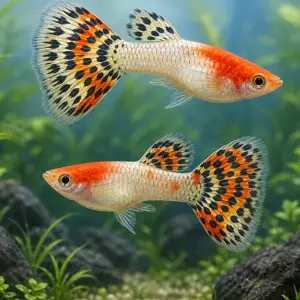
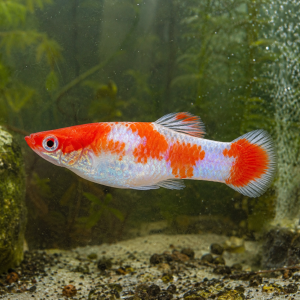
Color, size and fin shape vary with strain, age and each individual fish.
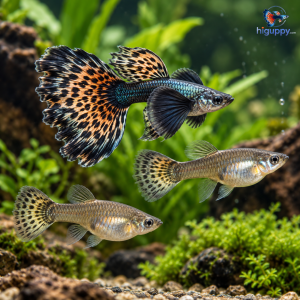
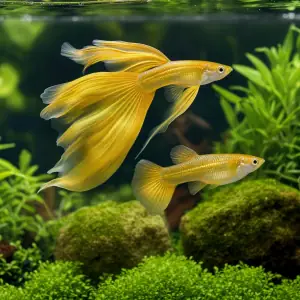
Editorial illustrations for context; they do not depict HiGuppy's exact facility or current fish stock.