PREPARE BEFORE YOUR FISH ARRIVE
Guppy tank setup, step by step.
Build a stable aquarium that is easy to maintain. Start with space and dependable equipment, establish biological filtration, and check the water before planning your first group of guppies.
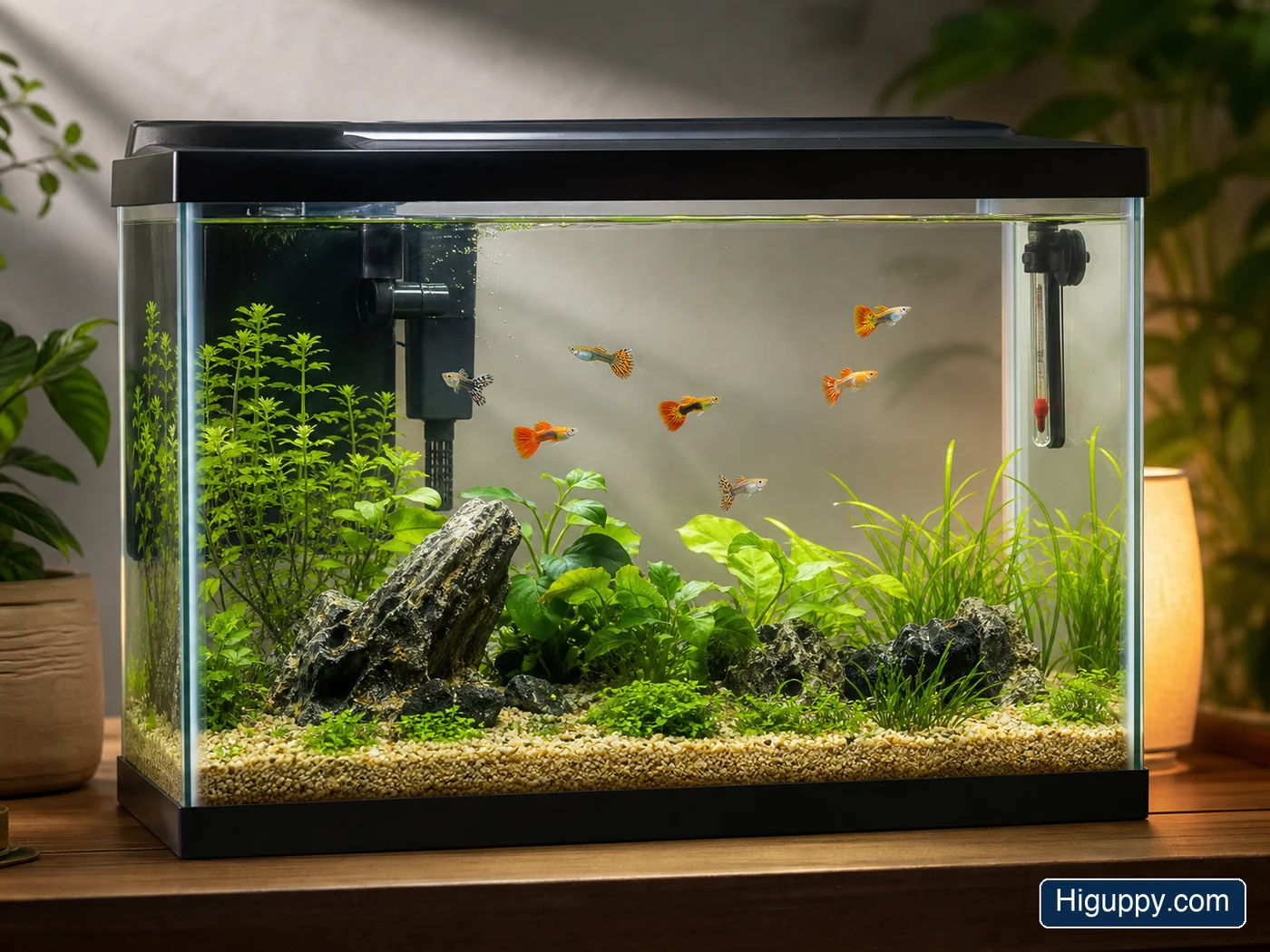
Choose space for the adult group.
OATA recommends at least 45 litres (about 12 US gallons) for a small group of guppies or smaller livebearers. Treat that as a starting reference, not a fixed fish allowance. A larger, longer aquarium gives more room for swimming, cover and future growth. Read the OATA care reference.
- Plan around adult size, aquarium footprint, filtration and the time you can spend on maintenance.
- Leave space for the whole group to feed without one fish being constantly chased into hiding.
- Account for future fry before choosing a mixed-sex group.
- Keep quarantine capacity separate from the display tank; a divider in shared water is not a separate system.
A simple, dependable equipment list.
Filter & gentle flow
Choose biological filtration suited to the planned aquarium. Keep circulation gentle enough for long fins, and guard intakes wherever fry may be present.
Temperature control
Use a suitable heater when room conditions cannot maintain the chosen temperature, and verify it with a separate thermometer.
Lid, light & cover
Fit a secure lid with safe cable openings. Provide a regular light-and-dark cycle, suitable planting and enough open swimming space.
Tests & maintenance tools
Have water conditioner, ammonia/nitrite/nitrate/pH tests, a thermometer, and a dedicated bucket and siphon. Add hardness tests when planning your water source.
Confirm the cycle before adding guppies.
Assemble the empty aquarium
Install the filter, heater, thermometer and layout. Fill with suitable treated water and check for leaks and dependable circulation.
Use a fishless cycling plan
With no fish present, use a purpose-made aquarium maturation product and its instructions. Do not dose ammonia into an aquarium that already contains fish.
Test and record the process
Track ammonia, nitrite and nitrate while the filter establishes. Keep biological media wet and oxygenated; a running pump alone does not establish the cycle.
Verify processing, not elapsed days
Confirm that the filter processes the input specified by your fishless-cycling method and returns ammonia and nitrite to zero before stocking.
Prepare for the first group
Check nitrate, temperature and source-water compatibility. Make an appropriate conditioned partial water change when needed, then retest.
Stock gradually and keep testing
Do not assume a newly cycled filter can support an unlimited group. Monitor readings and feeding after each addition.
There is no guaranteed finish date. A zero reading in fresh water without an ammonia source does not demonstrate processing capacity. OATA explains filter maturation; Merck describes fishless cycling and new-tank syndrome.
Leave cover and a clear swimming route.
Smooth, stable décor
Avoid sharp edges, rough plastic plants and narrow trapping gaps. Secure rocks and taller ornaments so maintenance cannot dislodge them.
Plant with maintenance in mind
Plants and visual breaks are useful, but keep enough room to inspect fish, feed the group and reach the substrate with a siphon.
Protect small fish
Check filter intakes and siphons before fry or small juveniles enter the system. Inspect around equipment whenever the water level changes.
Plan the group before choosing the fish.
No litres-per-fish shortcut accounts for every aquarium. Consider adult size, sex, temperament, flow, cover, feeding and maintenance together. Ask for advice on your intended group rather than copying the density of a shop display.
- A male-only display can simplify population control, but still needs space and observation for chasing.
- Females previously kept with males may produce fry after separation. Make a practical grow-out or rehoming plan.
- Do not rely on a sex ratio alone to prevent stress. A fish that cannot rest or reach food needs the setup reviewed.
- Quarantine arrivals in an independent system with separate equipment. Move no water, fish or tools back to healthy systems without appropriate precautions.
See breeder-stock planning and quarantine and observation for the next decisions.
Check the aquarium before the arrival window.
- Confirm stable temperature and water readings in the receiving aquarium; check that all equipment runs normally.
- Prepare your quarantine arrangement and dedicated net, bucket and observation record.
- Finish maintenance ahead of the arrival window rather than dismantling the aquarium as fish arrive.
- Follow tracking and arrange prompt receipt. The shipping policy explains the route and responsibilities.
- Follow the current acclimation guide and any written shipment instructions. Do not improvise a fixed timing rule for every bag.
- For a delivery concern, use the live-arrival policy; this care guide does not create additional coverage.
Choose a routine you can keep.
Check fish, temperature and equipment daily. Test more frequently while the aquarium is new or after stocking, feeding or equipment changes. Record results so you can spot a trend rather than react to one number.
Use conditioned partial water changes matched to the aquarium’s needs. Restore filter flow gently without replacing all established biological media at once. Feed small, appropriate portions and remove visible leftovers. Unusual breathing, appetite or swimming calls for water checks and further investigation, not automatic medication.
Guppy tank setup FAQ.
Is a 10-gallon aquarium the target for every guppy group?
No. OATA gives at least 45 litres as a small-group starting reference, and actual group size, adult size, sex, filtration and maintenance may require more. Choose the aquarium for the intended fish rather than filling a minimum volume to capacity.
How do I know the aquarium has cycled?
Use a documented fishless-cycling method and testing to verify that the biological filter processes its specified ammonia input. Clear water, a running filter or a fixed number of days is not enough by itself.
Can I use old tank water to cycle a new filter?
Old water alone is not evidence that a new filter is established. Any transfer of established media needs careful source and biosecurity consideration, and the new aquarium still needs testing before stocking.
Are live plants essential?
They can provide cover and use nutrients, but suitable smooth artificial cover can also be used. Plants do not replace biological filtration, testing or a maintenance plan.
Does a quarantine aquarium need its own filter?
It needs safe biological filtration, oxygenation, stable temperature and testing. Shared water with the display defeats separation, and a new empty container is not automatically safe for fish.
Should I buy the fish while the tank is still cycling?
Plan the equipment and cycling first. Arrange purchase and receipt only once the aquarium is demonstrably ready, with a quarantine and maintenance plan in place.
References and next steps.
This is general aquarium-planning guidance, not an individual veterinary assessment. The existing HiGuppy setup content was reorganized and checked against the references below; no stock or shipping guarantee is implied.
- OATA: guppy and molly care
- OATA: freshwater aquarium setup
- Merck Veterinary Manual: aquarium management
Ready to review your plan? Have the aquarium volume, proposed group and current water readings ready.
Content reviewed: September 12, 2026.