TEST, UNDERSTAND, THEN ADJUST
Guppy water parameters, made clear.
Read temperature, pH, hardness and nitrogen tests together. Use a reference range to plan suitable water—not as a reason to make sudden changes to an established aquarium.
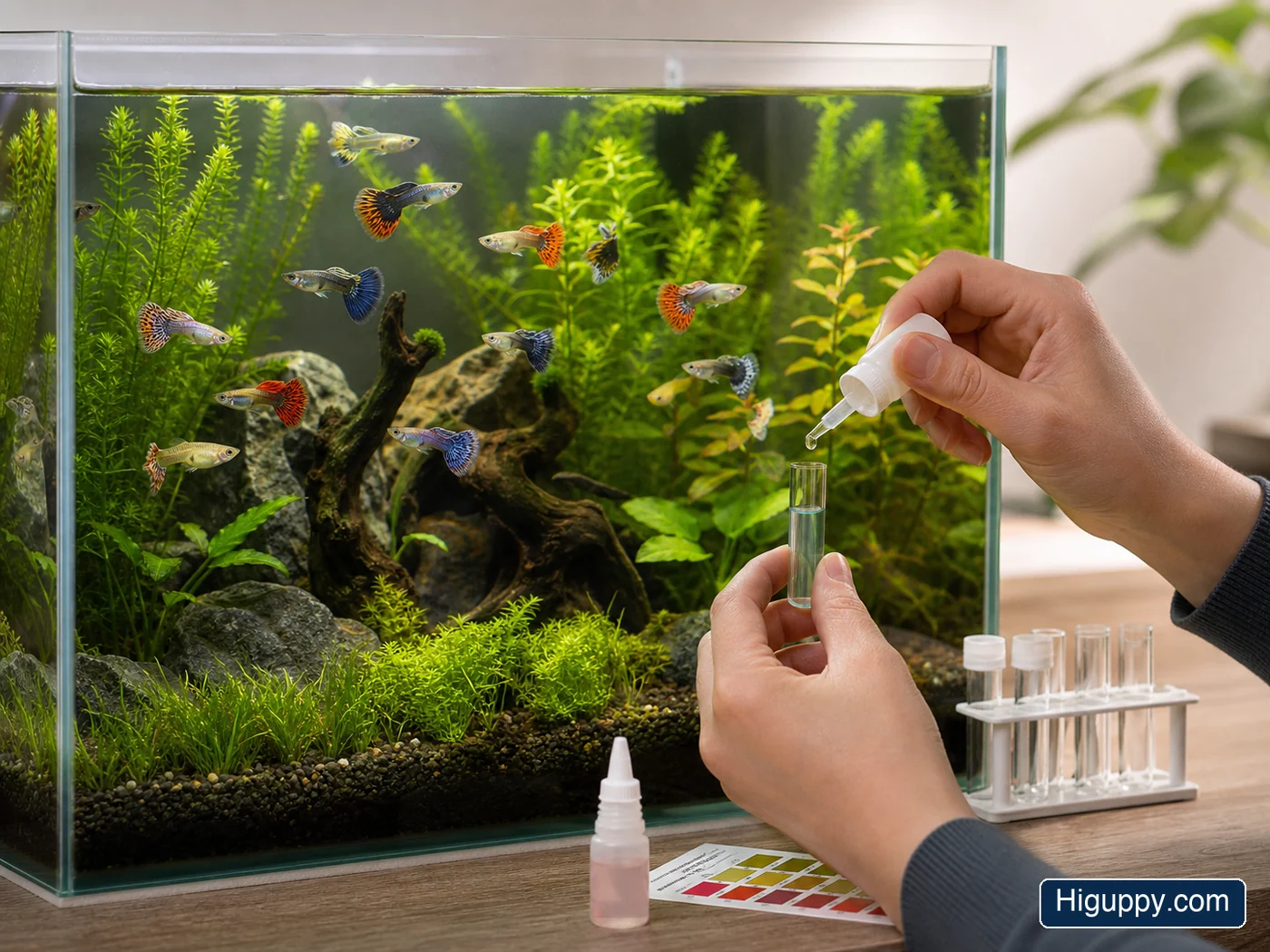
An attributed reference, not a guarantee.
The values below are from OATA’s guppy and molly care sheet. They describe general care conditions, not every strain, breeding system or medical situation.
- Temperature
- 20–28°C
68–82°F. This is a broad OATA care range, not a daily fluctuation target. Choose stable conditions suitable for the fish and tankmates.
- pH
- 7.0–8.0
OATA’s guppy and molly reference range. Consider source water and acclimation history before making a correction.
- Ammonia
- 0 mg/L
Investigate a detected reading. Check which ammonia form your kit reports rather than assuming every kit measures free ammonia.
- Nitrite
- 0 mg/L
A detected result needs investigation of filtration, stocking, feeding and recent maintenance.
- General hardness (GH)
- 8–18°dH
OATA’s reference for hardness. Record the test’s unit; degrees of hardness and mg/L are not interchangeable numbers.
- Carbonate hardness (KH)
- 5–15°dKH
OATA’s reference for buffering. Read KH alongside pH and the aquarium’s history.
- Nitrate
- No more than 20 mg/L above source water
This OATA comparison is not a universal absolute ceiling. Test both waters and aim to prevent sustained accumulation; already-high source nitrate needs separate review.
Compare trends before changing the water.
Readings are most useful alongside fish behaviour, feeding, stocking, maintenance and equipment performance. A source-water change or a recently cleaned filter can explain more than one isolated colour on a test chart.
- Compare replacement-water temperature and chemistry with the aquarium before routine maintenance.
- Change stocking and food input gradually; do not assume clear water means spare biological capacity.
- Avoid adding several pH, hardness or treatment products at once. Record anything already added.
- Use the acclimation guide for receiving fish; this chart is not a bag-opening or acclimation timetable.
A filter must process waste, not just move water.
A developing biological filter converts ammonia through nitrite to nitrate. A zero reading in new water with no ammonia input is not proof that the aquarium is ready to accept livestock.
- Before fish arrive, follow a documented fishless-cycling method and verify processing with tests.
- Never add a cycling ammonia source to a tank that already contains fish.
- Keep established media wet and oxygenated, and avoid replacing all biological media together.
- After stocking or filter work, test more frequently and review any detectable ammonia or nitrite.
The Tank Setup Guide explains preparation and readiness. Merck’s aquarium management reference covers biological filtration and new-tank syndrome.
Make each test repeatable.
Follow the kit instructions
Use the stated water volume, mixing and reading time. Check storage, expiry and the manufacturer’s guidance on known interferences.
Write down the exact reading
Record numbers and units, not only “good” or “high”. Note temperature and any conditioner, medication or additive used.
Compare source and aquarium
Check both when the supply changes or a result is unexpected. A clean bucket is not evidence that incoming water has suitable chemistry.
Respond and retest
Link the result to fish behaviour and recent changes. Record corrective actions and verify their effect rather than assuming one change solved the cause.
Test more frequently in a new aquarium, after additions or filter disruption, during equipment problems and whenever fish behave unusually. Maintain a consistent log for an established aquarium.
Check a detected ammonia or nitrite result promptly.
Reduce exposure while identifying the source. Check circulation and oxygenation, recent feeding, dead livestock, trapped waste and filter disruption. Use properly conditioned, temperature-compatible replacement water when a partial water change is indicated, then retest.
- Identify what the kit measures. Total ammonia nitrogen (TAN) includes ionized and un-ionized forms; the more toxic un-ionized fraction depends on pH and temperature.
- Do not raise pH quickly in an aquarium with accumulated ammonia. A pH correction can change ammonia toxicity.
- Review feeding to reduce incoming waste, but do not apply a blanket fasting rule to fry or compromised fish.
- Stop adding fish until the system is stable. Seek qualified fish-health help for severe distress, rapid losses or a result you cannot interpret.
UF/IFAS explains ammonia forms and test interpretation. The Water Change Guide and Disease Signs Guide support the next checks.
pH, GH and KH describe different things.
pH describes acidity or alkalinity. GH describes general hardness, principally calcium and magnesium. KH, as measured by common aquarium kits, describes carbonate buffering or alkalinity. One result cannot substitute for the others.
Low buffering can make a system more vulnerable to pH movement as acids accumulate. Source water, biological activity, substrate and other materials can influence the readings. Establish the cause before using a product, and measure the effect rather than dosing by guesswork.
Know the water before it reaches the fish.
- Check whether the supply uses chlorine or chloramine and choose treatment intended for that disinfectant. Standing water overnight is not a reliable chloramine-removal plan.
- Compare pH, temperature and hardness. Municipal, well, stored, softened and reverse-osmosis waters are not automatically equivalent.
- Do not assume household water-softener output or pure reverse-osmosis water is suitable without a planned mineral profile.
- Prepare water in dedicated clean containers, away from cleaners and aerosols. Follow conditioner and remineralizer instructions, with testing to confirm the result.
Guppy water parameter FAQ.
Are these the only water values in which guppies can live?
No. These are an attributed general-care reference, not a guarantee or a reason for sudden changes. Source, acclimation history, livestock and the rate of change also matter. Investigate unsafe compounds rather than accepting them because other readings fit the chart.
Does a clear aquarium mean the water is safe?
No. Dissolved ammonia and nitrite need testing; water clarity cannot demonstrate biological processing or exclude contamination.
Does every ammonia kit measure the same thing?
No. Check the kit’s stated measurement and units. Many tests report total ammonia, while free-ammonia risk also depends on pH and temperature. Follow the kit guidance on conditioner and medication interference.
Should I raise a low pH immediately?
First check the aquarium history, KH, ammonia and source water. Rapid pH changes can stress fish and can increase the more toxic ammonia fraction where ammonia has accumulated.
Is 40 mg/L nitrate always an emergency or always safe?
Neither label is justified by that number alone. Compare source water, trend, duration and the livestock. OATA’s reference is expressed relative to source water; do not use it to excuse an already-high incoming concentration.
What should I send when asking for help?
Send aquarium volume, livestock, temperature, actual test numbers and units, kit type, source-water results, recent changes and clear observations of fish behaviour. For severe distress, seek qualified help promptly.
Sources and related guides.
General aquarium husbandry information, not a veterinary diagnosis or an individual treatment plan. Reference values and explanations were checked against the sources below.
- OATA: guppy and molly water-quality reference
- UF/IFAS: ammonia in aquatic systems
- Merck Veterinary Manual: aquarium management
Build a record before a problem appears. Test consistently and keep maintenance and feeding notes alongside the numbers.
Content reviewed: September 12, 2026.