ROUTINE AQUARIUM MAINTENANCE
Guppy water changes: use the tank, not the calendar, to set the routine.
Regular partial water changes help remove dissolved waste, replenish water and give you a reason to inspect the aquarium. The useful amount and cadence depend on test results, stocking, feeding, plants, filtration and source water—not one percentage that fits every guppy tank.
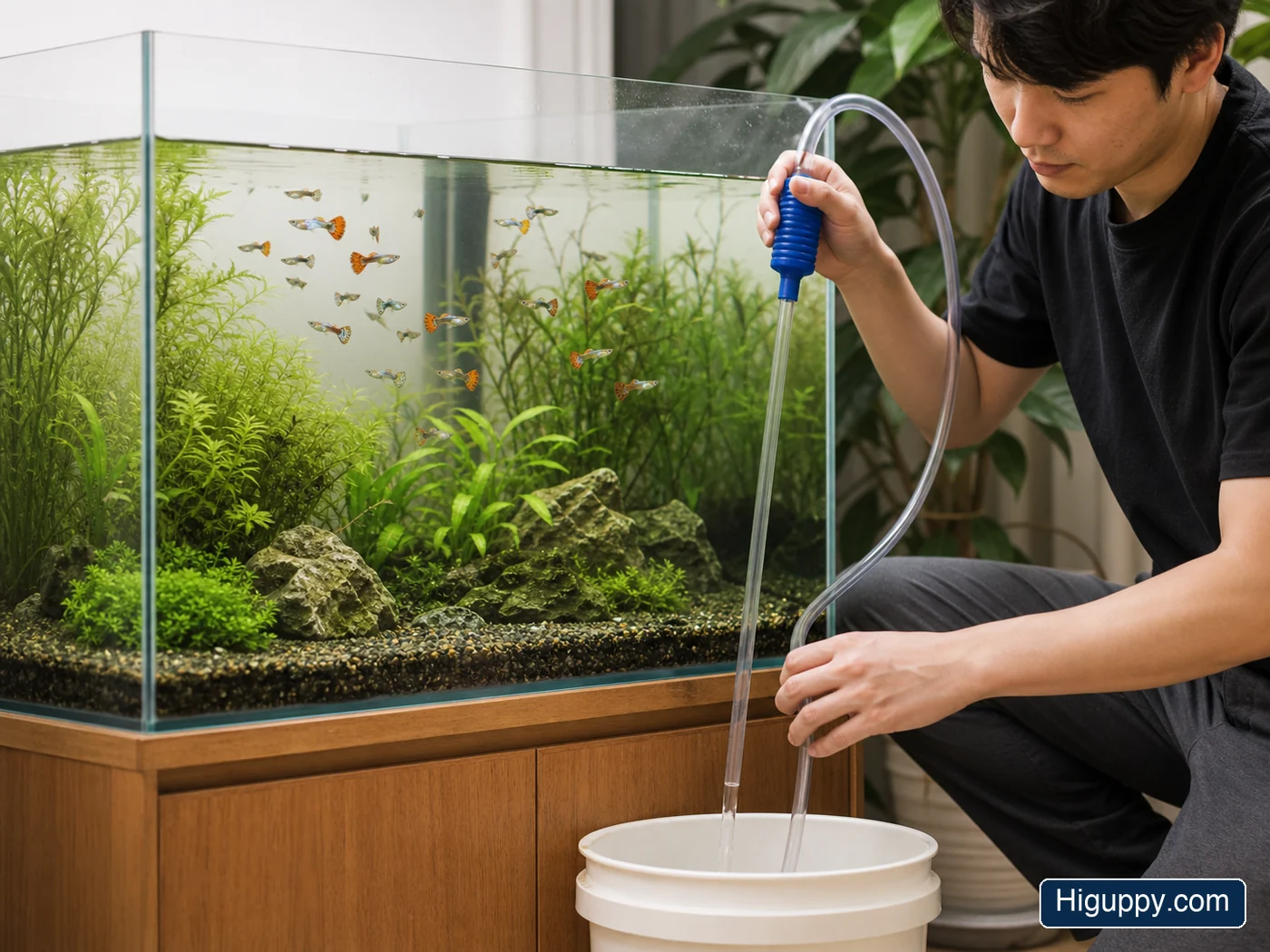
Use a repeatable partial-change routine, then adjust it from real measurements and tank conditions. Treat chlorine or chloramine as required, keep replacement temperature and chemistry reasonably close, preserve biological media, and retest after corrective maintenance.
BUILD THE ROUTINE
How often should guppy water be changed?
There is no universal schedule that fits every aquarium. Start with a consistent partial-change routine, then adjust it using the trend in ammonia, nitrite, nitrate and other relevant measurements together with fish load, feeding, plant growth, filtration and source-water stability.
Established display tank
Use a repeatable partial routine and review the trend in waste, water tests and visible debris. A stable tank may need a different cadence from a heavily stocked or heavily fed tank.
Fry grow-out tank
Frequent feeding and dense stocking can increase waste quickly. Smaller changes more often may be easier to control than waiting for a large correction.
New or unstable tank
Test frequently. Detectable ammonia or nitrite should trigger corrective action rather than waiting for the next calendar maintenance day.
Use the trend, not one number
Compare current readings with recent readings and the aquarium’s normal pattern. A log is more useful than chasing one ideal percentage.
A percentage is a tool, not a rule. The safer routine is the one that keeps water conditions stable while controlling waste without repeatedly shocking the system.
BEFORE REMOVING WATER
Prepare replacement water before the aquarium is disturbed.
- Use a dedicated aquarium bucket, hose or container that has not been exposed to soap, cleaners or household chemicals.
- Treat chlorine or chloramine with an appropriate conditioner when the source water requires it.
- Bring replacement water reasonably close to the aquarium temperature before adding it.
- Know whether source-water pH, GH or KH differs substantially from the aquarium, especially for a larger change.
- Measure salt, remineralizer or other routine additives instead of estimating by eye.
- Keep prepared water away from metal contamination, aerosols, sprays and dirty surfaces.
The larger the corrective change, the more important source-water treatment, temperature and chemistry differences become. Avoid creating a second problem while correcting the first.
ROUTINE PROCESS
A six-step water-change workflow keeps the maintenance predictable.
- 01
Prepare tools and replacement water
Set out conditioner, siphon, bucket, towel and prepared replacement water before starting.
- 02
Protect equipment
Turn off heaters, pumps or filters that could run dry when the water level drops.
- 03
Siphon gradually
Remove the planned volume while collecting visible debris from selected areas instead of dismantling the whole tank.
- 04
Add water gently
Refill slowly enough to limit abrupt temperature change and unnecessary disturbance to fish, plants and substrate.
- 05
Restart and verify equipment
Restore filtration, heat and aeration, then confirm normal flow, water level and equipment operation.
- 06
Observe the fish
Check breathing, swimming, posture and temperature after the disturbance and investigate any sudden change.
REMOVE WASTE GENTLY
Clean what needs cleaning without turning routine maintenance into a full reset.
Work in selected substrate areas
Remove visible debris while avoiding deep disruption of every section at the same time, especially around established plant roots.
Protect small livestock
Move the siphon carefully around fry, shrimp, snails and small fish. Use an intake guard when livestock could enter the hose.
Remove obvious organic waste
Dead leaves, trapped food and visible debris are useful targets. Routine maintenance does not require every surface to look sterile.
Skip household cleaners
Do not use soap or household cleaning products on aquarium décor or equipment that will return to the system.
PRESERVE BIOLOGICAL PROCESSING
Restore filter flow without removing the biological capacity you depend on.
Reusable mechanical or biological media can be cleaned when debris restricts flow, but the goal is circulation—not sterilization. Established biological media should stay wet and should not all be replaced at once.
- Rinse reusable media gently in removed aquarium water or otherwise follow the filter manufacturer’s safe-maintenance instructions.
- Avoid untreated chlorinated water on established biological media.
- Do not replace every sponge, cartridge or biomedia component simultaneously.
- Check impellers, tubing, air lines and intakes when flow falls.
- Stagger major filter work and deep substrate cleaning when practical.
A clear-looking filter is not the goal by itself. Stable biological processing of waste is more important than making every sponge or surface look new.
WHEN TO ACT NOW
Emergency water changes are for dilution and stabilization—not for guessing.
A prompt partial change can help when ammonia or nitrite is detected, a contaminant enters the aquarium, an additive is overdosed, equipment failure creates unsafe conditions, or several fish show distress that points to a water-quality event.
Dilute the unsafe condition
Use prepared replacement water to reduce the concentration of the identified or strongly suspected problem.
Increase oxygenation
Restore surface movement, aeration and filter operation when low oxygen or equipment failure may be involved.
Remove the source when possible
Correct the failed equipment, contaminated input, excess additive or other root cause so the problem does not immediately return.
Retest and reassess
One change may dilute a problem without solving it. Continue testing and seek qualified help for poisoning, severe distress or rapid losses.
A corrective change may need to be larger than your routine change, but “larger” is not automatically “safer.” Source-water treatment, temperature and chemistry differences matter more as the change size increases.
FINAL CHECKS
Before walking away, verify both the aquarium and the equipment.
- Filter, air pump, heater and circulation have restarted normally.
- The heater is fully submerged as intended by its manufacturer and not exposed by the lower water level.
- Temperature remains reasonably close to the pre-change value.
- No fish, fry, shrimp or snails were trapped in the siphon, bucket or equipment.
- Plants, rocks and décor remain stable.
- Fish return to normal breathing, posture and swimming after the disturbance.
- If the change was corrective, the relevant test result is moving in the intended direction.
Record the date, approximate amount changed and the important test results. A simple log turns maintenance into evidence instead of guesswork.
AVOIDABLE ERRORS
Most water-change problems come from abrupt change or doing too much at once.
Untreated replacement water
Chlorine or chloramine can harm fish and biological filtration. Use an appropriate conditioner when the source water requires it.
Large temperature or chemistry swing
Major temperature, pH, GH or KH differences can create avoidable stress, especially during a larger change.
Replacing all filter media
Removing all established media during the same session can remove biological capacity the tank relies on.
Waiting for the calendar
If ammonia or nitrite is present, correct the situation now instead of waiting for the next scheduled maintenance day.
COMMON QUESTIONS
Guppy water change FAQ
Should I remove guppies during a routine water change?
Usually no. Moving fish adds handling stress. Work slowly, protect them from the siphon and leave enough water for normal swimming while the change is underway.
What percentage of water should I change?
There is no universal percentage for every tank. Use a consistent partial-change routine, then adjust it from measured water trends, stocking, feeding, filtration, source water and aquarium stability.
Can I change 100% of the water?
A total change is rarely appropriate for routine maintenance because it can create large environmental changes. Specific contamination, a managed tank move or another unusual situation may require a different plan.
Why are guppies stressed after a water change?
Temperature, disinfectant exposure, pH, hardness, flow or physical disturbance may have changed too quickly. Review the source water, conditioner use and refill method.
Should I clean the filter every week?
Use flow, visible debris and manufacturer guidance rather than a rigid weekly rule. Avoid unnecessary disruption of established biological media.
Do planted guppy tanks still need water changes?
Usually yes. Plants can use nutrients, but they do not automatically replace source-water management, mineral balance, waste control or routine inspection.
RELATED GUIDANCE
Use water changes as one part of a stable care system.
Water Parameters Guide
Use actual measurements to understand what the aquarium is doing before changing the routine.
Guppy Care Guide
Connect maintenance with filtration, feeding, stocking and daily observation.
Feeding Guide
Feeding rate affects waste load and can change how much maintenance a tank needs.
Disease Signs Guide
Use water-quality checks before assuming a sick-looking guppy needs medication.
Make maintenance predictable, not dramatic.
Prepare replacement water, change only what the aquarium needs, protect the biological filter and keep simple records so the routine can be adjusted from evidence.
Last reviewed: September 12, 2026. This guide provides general aquarium-maintenance guidance. Unusual source water, contamination, toxic exposure or severe fish distress may require a more specific response.