The HiGuppy Journal
Guppy Pattern Types: Mosaic, Grass, Cobra, Koi & More Explained
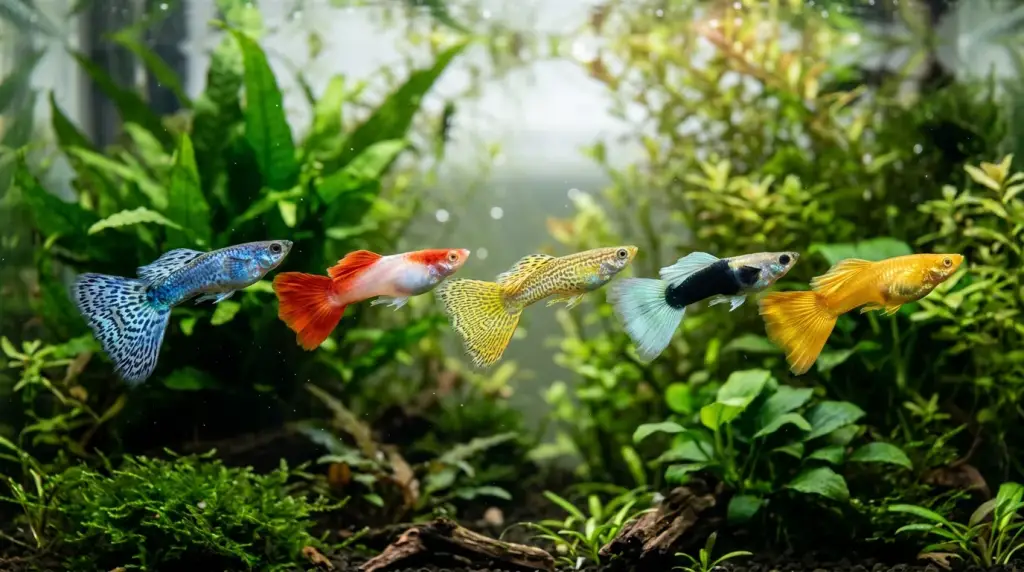
The main guppy pattern types are mosaic, grass, lace and snakeskin, cobra, tuxedo (half-black), koi, dragon, leopard, and solid colors such as full gold and platinum, plus pigment traits like albino and metallic lines like Blue Topaz. Tail patterns sit inside the fins; body patterns cover the flank. Most strain names combine both.
- Read a guppy name in layers: base color + body pattern + tail pattern + fin shape (for example, “blue tuxedo mosaic delta”).
- Tail patterns are mostly mosaic, grass, lace and leopard; they differ in the size and connection of the markings.
- Body patterns include snakeskin, cobra, tuxedo, koi and dragon; solid and metallic lines show little or no pattern.
- Males show patterns best. Females often carry pattern genes while looking much plainer.
- Inheritance varies: snakeskin is classically Y-linked, half-black is often X-linked, and gold and albino are autosomal recessive.
- For beginners, mosaic, grass and tuxedo lines are forgiving and easy to recognize.
How Guppy Strain Names Work
Guppy strain names look chaotic until you realize they are built from separate traits. A single fish can be blue in base color, tuxedo on the body, mosaic in the tail and delta in fin shape, all at once. Breeders and shops string those traits together, which is why you will see names like “Japan Blue Mosaic” or “Yellow Cobra Tuxedo.”
When you sort guppy colors and patterns, it helps to ask four questions in order:
- Base color: What is the main color? Red, blue, yellow, gold, white and so on.
- Body pattern: Is the flank plain, netted, barred, or split into dark and light halves?
- Tail pattern: Is the tail solid, finely dotted, web-like, or covered in connected blotches?
- Special traits: Are the eyes red (albino)? Does the body flash metallic or platinum?
Keep in mind that naming is not standardized across every farm and country. The same fish might be sold under two names, and terms like “dragon” or “koi” mean slightly different things to different breeders. Our guppy strains and types hub lays out the broader categories, including fin shapes.
Guppy Tail Pattern Types
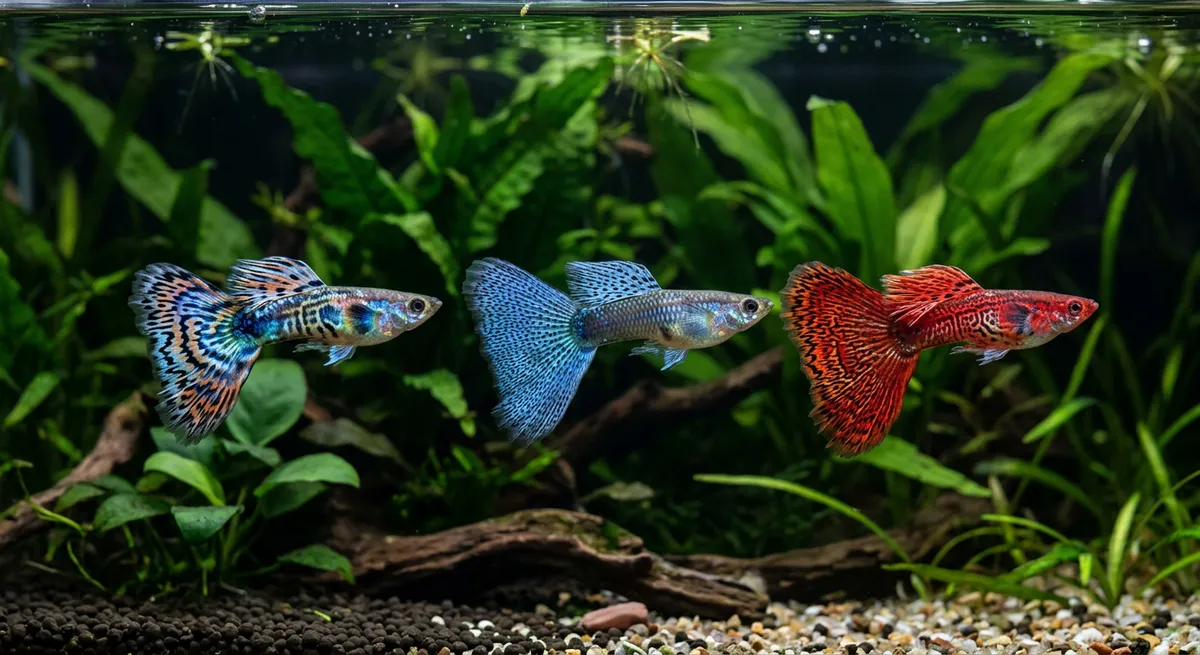
Tail patterns are the easiest place to start because the caudal fin is the biggest canvas on a male guppy. The four classic tail patterns differ mainly in how big the markings are and whether they join up.
Mosaic
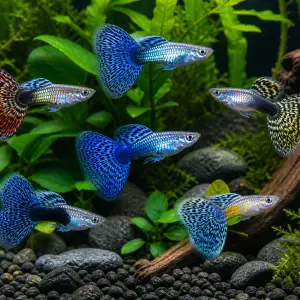
A mosaic tail is covered in irregular, connected dark markings over a bright base color, a bit like stained glass or cracked tile. The pattern tends to be bolder toward the base of the tail and more open toward the edge. Research on the closely related “variegated” tail pattern found that no two offspring, even from the same parents, carried an identical pattern, so expect every mosaic male to be unique. Blue and red are the classic colors; see our Blue Mosaic guppy guide for a closer look.
Grass
A grass tail is covered in many tiny, separate dots that breeders compare to scattered grass seeds. Grass looks like fine texture rather than a bold design. Compared with mosaic, the marks are smaller and mostly not connected. The Blue Grass guppy strain guide shows the look in a cool palette.
Lace
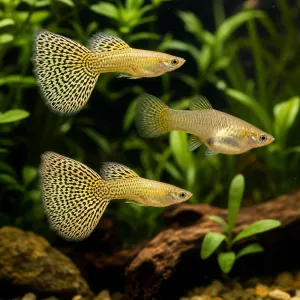
Lace is a fine, web-like or netted pattern, usually on a paler ground. It is closely tied to snakeskin genetics, and lace tails are most often paired with a snakeskin body. Think of lace as the delicate, small-scale version of the snakeskin network. The Red Lace guppy guide covers one popular color form.
Leopard
Leopard tails carry larger, more distinct round spots than grass, sometimes forming uneven lines. Some breeders also use “leopard” for spotted body patterns or for half-black lines with spotted tails, so check the photo rather than relying on the name alone.
Guppy Body Pattern Types
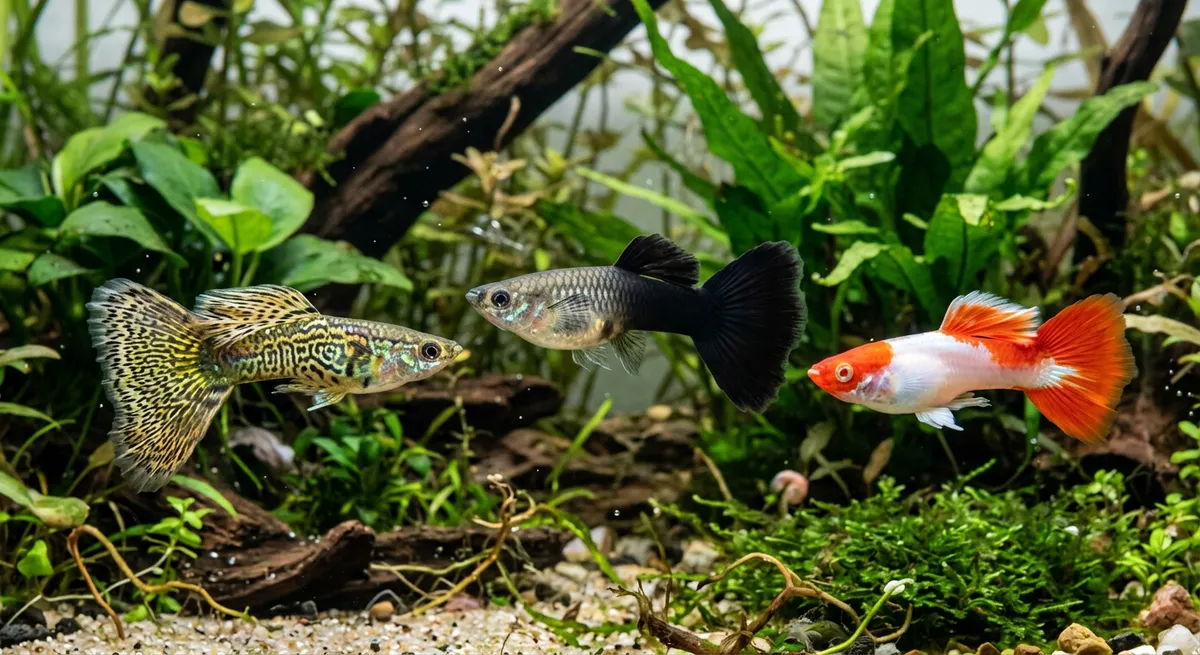
Body patterns describe what covers the flank and the rear half of the fish. These are the names that most strongly shape a guppy’s overall look in the tank.
Snakeskin
Snakeskin guppies have a chain-like or rosette pattern across the body that resembles reptile scales. Show guidelines from the Guppy Associates International Chicago describe a snakeskin male as one with an unbroken rosette pattern covering at least 60% of the body. The pattern is usually carried into the tail as lace or a variegated design.
Cobra and King Cobra
Cobra patterns combine rosettes with vertical barring along the body, giving a bolder, more striped look than classic snakeskin. Many hobbyists use “cobra” and “snakeskin” almost interchangeably, but cobra usually means coarser, more contrasting markings. “King cobra” is a trade name for showy cobra-pattern lines, typically with a large patterned tail. Read more in our King Cobra guppy guide.
Tuxedo (Half-Black)
Tuxedo guppies have a dark rear half and a lighter front half, as if wearing a jacket. In show terms, a half-black fish has dark coloration from the dorsal fin back to the peduncle covering at least 50% of that area. Unlike many patterns, tuxedo shows clearly in females too, which makes it one of the easiest patterns to identify and breed. It pairs well with almost any tail color. Our Tuxedo guppy strain guide goes deeper.
Koi
“Koi” is a trade name, not one fixed pattern. The most familiar koi guppies have a pale or white body with red or orange on the head, shoulders or tail, echoing koi carp coloring. Some lines add black patches or metallic areas. Koi guppies are ordinary Poecilia reticulata and are not related to koi carp. See the Koi guppy strain guide for identification tips.
Dragon
“Dragon” usually refers to strong body patterning or a heavy scale effect paired with a contrasting, often solid tail. Usage varies between farms, so a Red Dragon from one breeder may not match another’s. The Red Dragon guppy guide explains what to look for in that line.
Solid, Metallic, and Albino Guppies
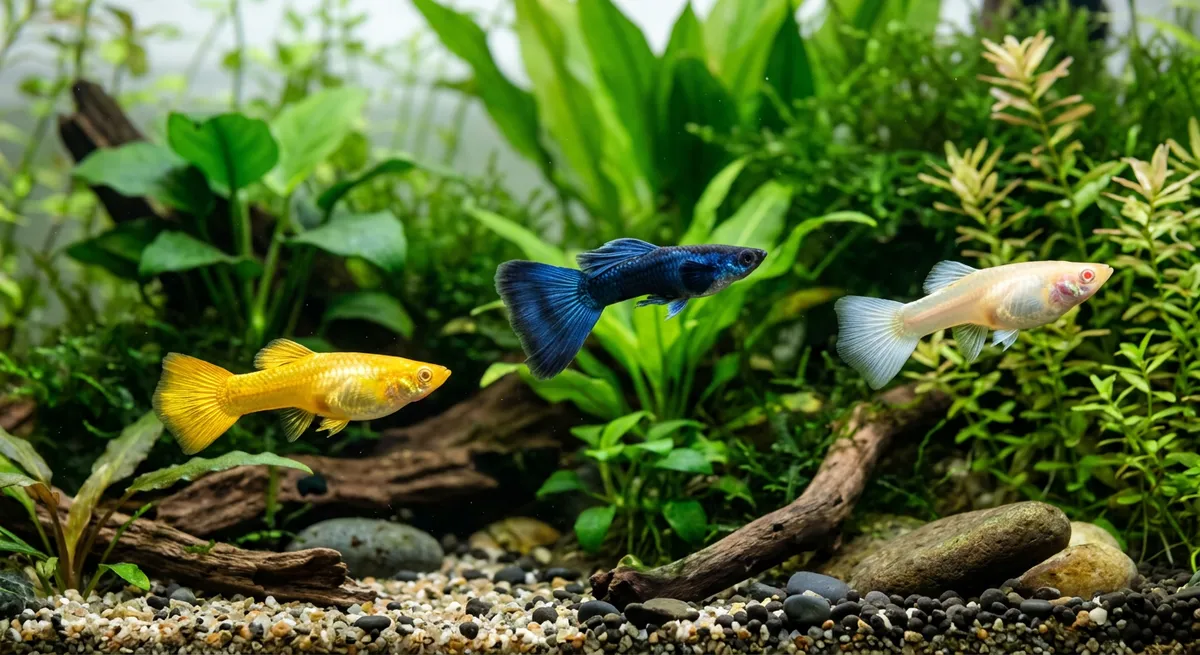
Some of the most popular types of guppies are defined by color or pigment rather than a pattern. These traits can also sit underneath a pattern, which is how you get combinations like “albino mosaic” or “platinum tuxedo.”
Full Gold and Platinum
“Full” lines are selected for broad, even color across body and fins. Full gold shows warm yellow-gold coverage; platinum shows a bright, reflective white to pale yellow sheen. Platinum is a reflective color usually inherited through the male line, while gold body color is an autosomal recessive trait. Show standards define a gold fish as having at least 25% yellow-gold color in the body.
Metallic and Blue Topaz
Metallic guppies carry reflective color cells that make the body flash under light. Breeders describe several metallic genes, including one autosomal recessive metallic blue (often called Störzbach metal) and the mostly Y-linked Moscow and platinum colors. “Blue Topaz” is a trade name for a metallic blue line; see the Blue Topaz guppy guide for what that strain looks like.
Albino
An albino guppy is defined by red or pink eyes, whatever its body color. Albinism is autosomal recessive and sits at the same position in every albino strain, so crossing two albino strains gives albino fry. Albino fish are more light-sensitive, so softer lighting and plenty of plants are a kind choice. Read the albino guppy strain guide for care notes.
Guppy Pattern Types Compared
| Pattern | What it looks like | Where on the body | Beginner-friendly? |
|---|---|---|---|
| Mosaic | Irregular, connected dark markings over a bright color | Tail (and dorsal) | Yes |
| Grass | Many tiny separate dots, like grass seeds | Tail (and dorsal) | Yes |
| Lace | Fine, web-like netting | Tail, often with snakeskin body | Yes, moderate |
| Leopard | Larger, distinct round spots | Tail, sometimes body | Yes |
| Snakeskin | Chain-like rosettes resembling reptile scales | Body and tail | Moderate |
| Cobra / King Cobra | Rosettes plus vertical bars, bold contrast | Body and tail | Moderate |
| Tuxedo (half-black) | Dark rear half, lighter front half | Rear body | Yes |
| Koi | Pale body with red-orange head, shoulders or tail | Head, body and tail | Yes |
| Dragon | Heavy body pattern or scale effect, contrasting tail | Body | Moderate |
| Full gold / platinum | Even solid or reflective color | Whole fish | Moderate |
| Metallic (e.g. Blue Topaz) | Reflective, flashing sheen | Body, sometimes fins | Moderate |
| Albino | Red or pink eyes, lighter body tones | Eyes and overall pigment | Moderate; prefers softer light |
How to Tell Guppy Patterns Apart
Most identification mistakes come from looking only at the tail or only at the body. Use these quick checks on an adult male in good light:
- Mosaic vs grass: Are the tail marks connected into blotches (mosaic) or separate pinpoint dots (grass)?
- Grass vs leopard: Leopard spots are noticeably larger and fewer.
- Lace vs mosaic: Lace is a fine, even net; mosaic is irregular and heavier.
- Snakeskin vs cobra: Snakeskin is a tighter chain network; cobra adds bolder vertical bars.
- Tuxedo vs full black: Tuxedo stops roughly at the dorsal fin, leaving the front of the body lighter.
- Albino vs pale-bodied: Check the eyes. A white fish with black eyes is not albino.
Also give fish time after shipping. Stress, darkness and temperature changes can mute color for days, so judge a pattern once the fish has settled in.
How Guppy Patterns Are Inherited
Guppies have 23 pairs of chromosomes, including one pair of sex chromosomes. Many genes behind male ornamentation are carried on the Y chromosome and passed from father to sons, as summarized in the Wikipedia guppy article. In practice, patterns fall into three rough groups:
- Y-linked traits usually pass from father to sons only. Classic snakeskin body and tail patterns are controlled by two closely linked genes on the Y chromosome, Ssb and Sst, according to genetic crossing studies. Rare crossovers can move such genes to the X chromosome, which is why some snakeskin lines pass the pattern through the mother.
- X-linked traits can come from either parent. Half-black is often X-linked, though some strains carry it on the Y.
- Autosomal recessive traits like gold and albino only show when a fish gets a copy from both parents. Cross a gold with a non-gold and the first generation looks non-gold; breed those siblings together and roughly a quarter of the next generation shows gold.
The practical takeaway: a plain-looking female can still carry her line’s pattern genes, which is why buying matched males and females from the same strain matters if you plan to breed.
How to Choose a Guppy Pattern
Start with what you want from the tank, then match the pattern to it:
- Want color from across the room? Solid or koi lines read clearly at a distance.
- Love detail up close? Grass, lace and snakeskin reward a close look.
- First time breeding? Mosaic, grass and tuxedo are forgiving, and tuxedo shows clearly in females, which makes selection easier.
- Planning a mixed community? Combine contrasting body patterns, such as tuxedo with koi or snakeskin, so each fish stands out.
- Keeping a line pure? Avoid mixing strains in the same breeding tank, or the next generation will blend patterns unpredictably.
Whatever you choose, health comes before pattern. Pick active fish with open fins, clear eyes and a balanced body. If you want to start a line, a matched breeder trio gives you one male and two females from the same strain, or browse every current listing in the HiGuppy shop.
FAQ
What are the main guppy pattern types?
The main tail patterns are mosaic, grass, lace and leopard. The main body patterns are snakeskin, cobra, tuxedo (half-black), koi and dragon. Solid colors like full gold and platinum, metallic lines and albino are defined by color or pigment rather than pattern.
What is the difference between mosaic and grass guppies?
Both are tail patterns. Mosaic tails have larger, irregular markings that connect into blotches. Grass tails are covered in many tiny, separate dots that look like scattered seeds.
Do female guppies show patterns?
Usually less than males. Many pattern genes, such as classic snakeskin, are Y-linked and show only in males, and females have fewer of certain color cells. Tuxedo, gold and albino traits do show clearly in females.
Are snakeskin and cobra guppies the same?
They are closely related and the names often overlap. Snakeskin usually means a tighter chain-like rosette pattern, while cobra adds bolder vertical bars. Both cover the body and usually extend into the tail.
Which guppy pattern is best for beginners?
Mosaic, grass and tuxedo guppies are good first choices. They are widely bred, easy to recognize, and tuxedo shows clearly in females, which makes breeding and selection simpler.
Behind the care guides
Care begins with steady systems
Our guppy guides focus on practical routines: keep water stable, observe fish closely and allow for natural variation.

Care systems
Steady water, thoughtful care
Gentle filtration and regular observation support healthy aquarium routines.
Natural variation
Every guppy is different
Color, size and fin shape vary with strain, age and each individual fish.
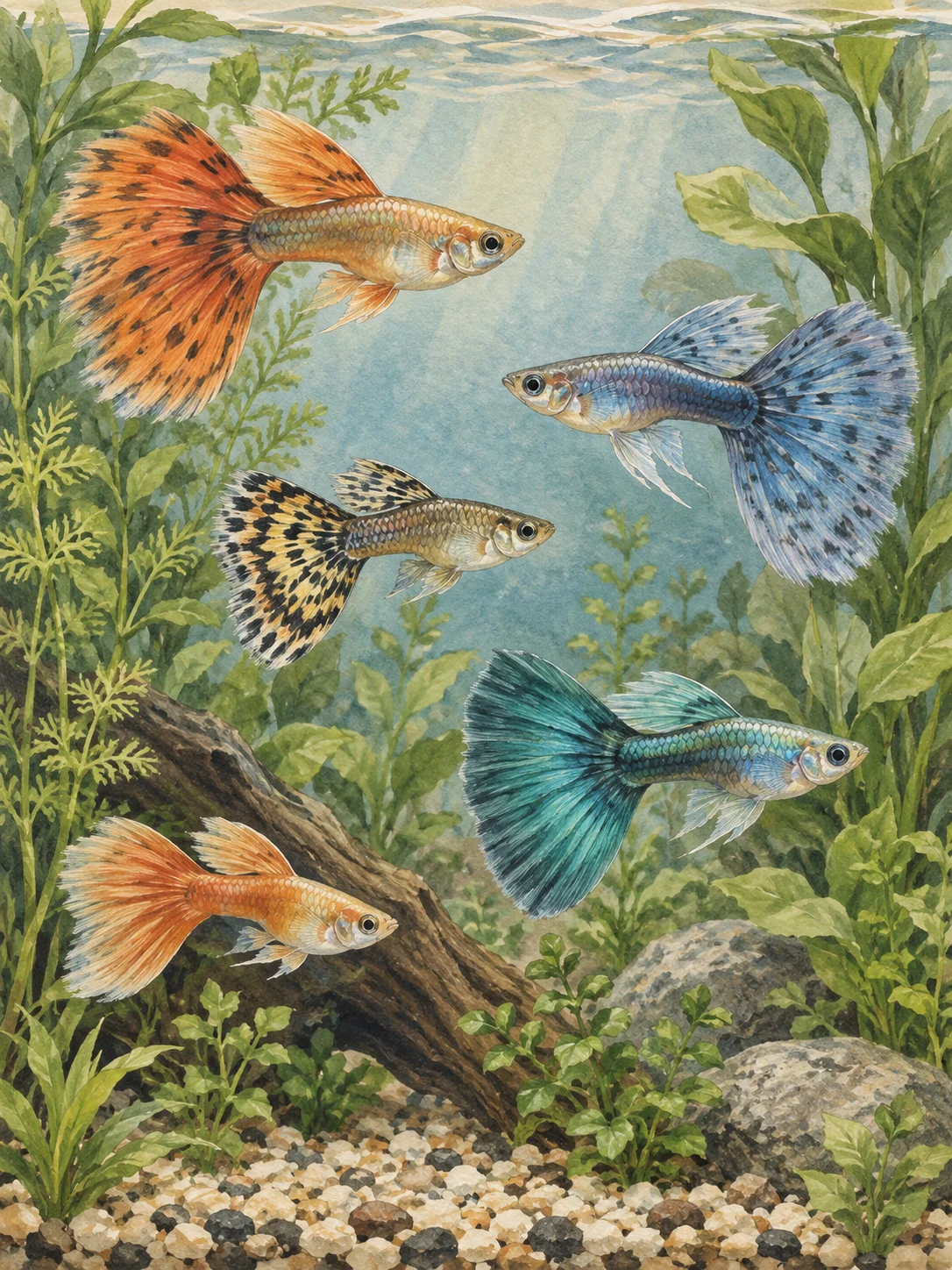
Editorial illustrations for context; they do not depict HiGuppy's exact facility or current fish stock.