The HiGuppy Journal
How Many Guppies Per Gallon? Stocking Chart for Every Tank Size
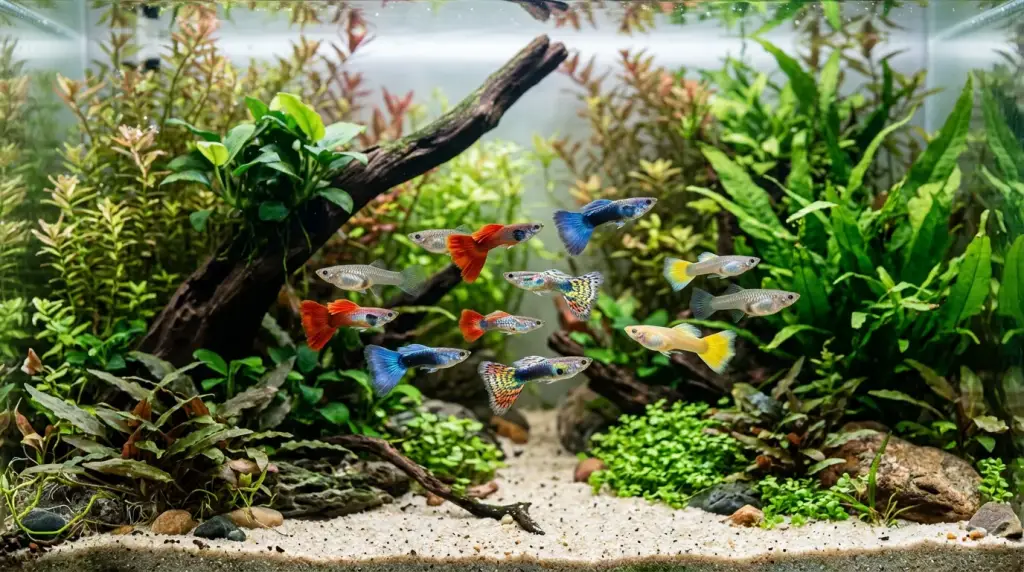
How many guppies per gallon? There is no universal safe number of guppies per US gallon. For a permanent small group, OATA suggests at least 45 litres (about 12 US gallons), but actual capacity also depends on usable water volume, footprint, adult size and sex, oxygen, a mature filter, tank mates, feeding and future fry. Begin with a modest group and increase only when repeated water tests and behavior support the added load.
Stocking is one of the first decisions in good guppy care, and it is easy to get wrong in both directions. Too few guppies and they can become shy; too many and water quality, oxygen and behaviour all suffer. This guide turns the question of how many guppies per gallon into a simple chart for every common tank size, then explains when to stock lighter.
Key takeaways
- Planning rule: no fixed gallons-per-fish ratio guarantees capacity; check usable water, swimming footprint, fish size/sex, mature filtration, oxygen, tank mates and future fry.
- Minimum tank: aim for at least 45 litres (about 12 US gallons) for a permanent group; 5 and 10 gallon tanks are tight.
- Sex ratio: keep one male to two or three females, or an all-male group if you do not want fry.
- Count the fry: one mixed group can double or triple in a few months, so leave room or have a grow-out plan.
- Water tests decide: ammonia and nitrite should stay at 0 ppm in an established tank. If repeated tests show nitrate rising quickly, compare the tank result with source-water nitrate and review feeding, stocking, filter maturity and maintenance; nitrate trends alone do not prove overcrowding.
- Per-gallon reality: there is no single honest answer to how many guppies per gallon — the chart gives illustrative groups and your water tests make the final call.
Guppy stocking chart: how many guppies per gallon by tank size
Use this guppy stocking chart as a conservative planning guide. The “starting group” column assumes a cycled tank, a sponge or hang-on filter rated for the volume, weekly water changes of 25–30%, and guppies only. Real water volume is usually 10–15% lower than the label once substrate and decor are in.
| Tank size (US gal / litres) | Suitability for guppies | Illustrative adult group (not a proven safe limit) | Example mix |
|---|---|---|---|
| 5 gal / 19 L | Not recommended as a permanent home | None long term (hospital or fry tank only) | Temporary use only |
| 10 gal / 38 L | Below the 45 L guideline; experienced keepers only | No general permanent-group count below 45 L | Assess actual volume, filtration, fish history and an upgrade |
| 15 gal / 57 L | Smallest comfortable size | 4–6 | 2 males + 4 females, or 5 males |
| 20 gal long / 76 L | Good beginner tank | 6–9 | 3 males + 6 females |
| 29 gal / 110 L | Very good | 10–14 | 4 males + 9 females |
| 40 gal breeder / 150 L | Excellent, room for fry | 15–20 | 6 males + 12 females |
| 55 gal / 208 L | Excellent show or colony tank | 20–28 | 8 males + 16 females |
| 75 gal / 284 L | Large colony or community | 28–38 | 12 males + 24 females |
The groups in this guppy stocking chart are illustrative planning examples, not scientifically validated stocking limits. Account for adult females, fry from breeding, other livestock and how much biological filtration and swimming space the particular tank provides.
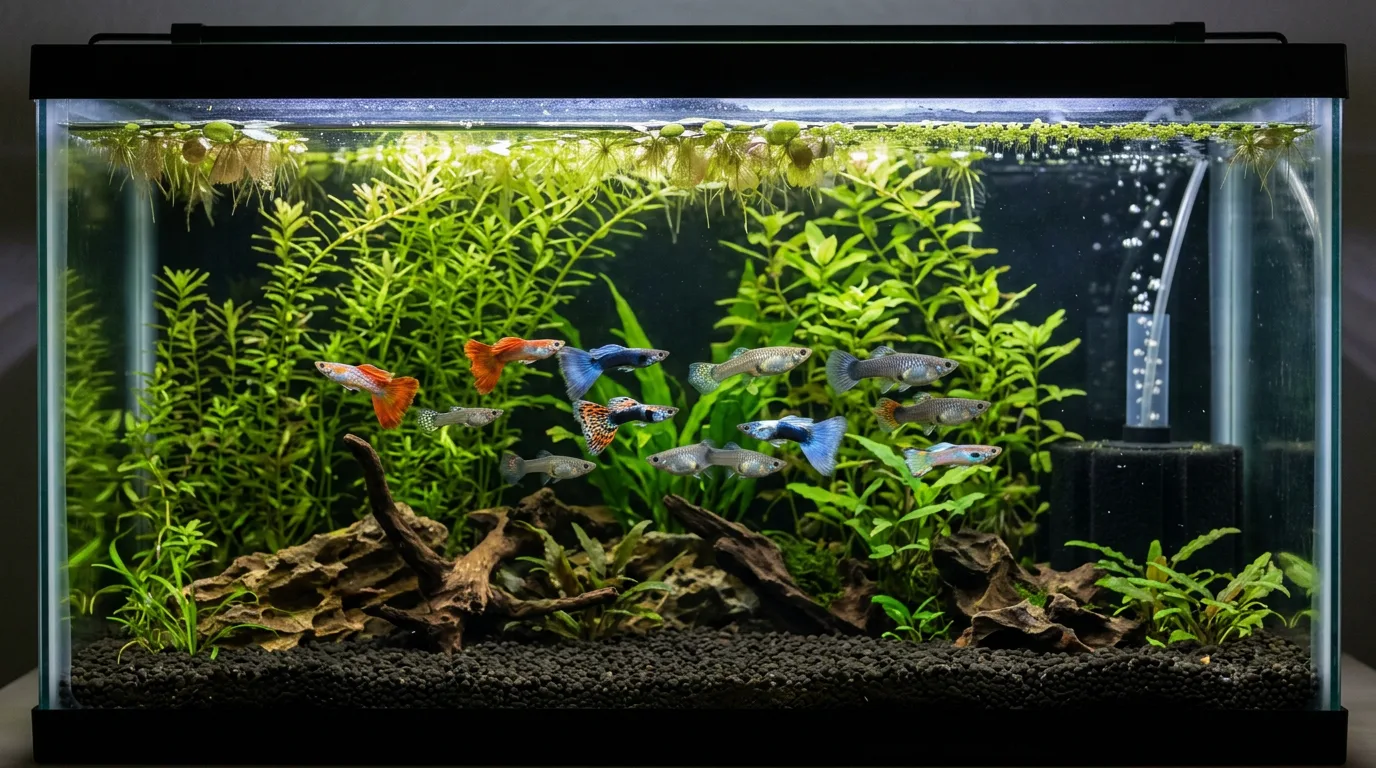
How many guppies per litre?
How many guppies per gallon has a litre cousin with the same answer: use real water volume and tank footprint rather than a fixed fish-per-litre rule. OATA advises an aquarium of at least 45 litres for a small group of smaller guppies; larger or breeding groups generally need more space and processing capacity. The chart examples are conditional and may need to be reduced for other fish, oxygen, filter history or fry. An imperial gallon is about 4.55 litres and a US gallon about 3.79 litres: 10 US gallons are about 38 litres, while 10 imperial gallons are about 45.5 litres. Either label alone does not prove a stocking level is appropriate.
Quick conversions
- 1 US gallon = 3.79 litres; 1 imperial gallon = 4.55 litres.
- 10 US gallons is about 38 litres; 20 US gallons is about 76 litres.
- 45 litres is about 12 US gallons or 10 imperial gallons.
Why the “one inch per gallon” rule falls short
The old one-inch-per-gallon rule says you can keep one inch of adult fish per gallon. A male guppy is about 1.5 inches (3.5 cm) long and a female up to about 2.4 inches (6 cm), so the rule would put roughly one guppy per 1.5–2 gallons. That lines up loosely with our chart, but it ignores three things that matter more:
- Breeding. Guppies are livebearers. A healthy female can drop 20–60 fry every four to five weeks, and she can store sperm for several broods.
- Waste and oxygen. Guppies eat often and produce a lot of waste for their size. Surface area and filtration set the real limit.
- Behaviour. Males chase females constantly. Too few females per male, or too little space and cover, leads to stressed, hiding females.
So the honest answer to how many guppies per gallon is always “it depends”: treat any per-gallon number as the start of the plan, then adjust for the factors below. Our guppy water parameters guide explains the test results to aim for.
Small tanks: 5, 10 and 20 gallons
5 gallon tank
At this size, how many guppies per gallon stops being the right question: five gallons (19 litres) swings in temperature and water quality too quickly for a permanent guppy group, even three males. It works as a short-term hospital, quarantine or fry tank. Read the full reasoning in how many guppies in a 5 gallon tank.
10 gallon tank
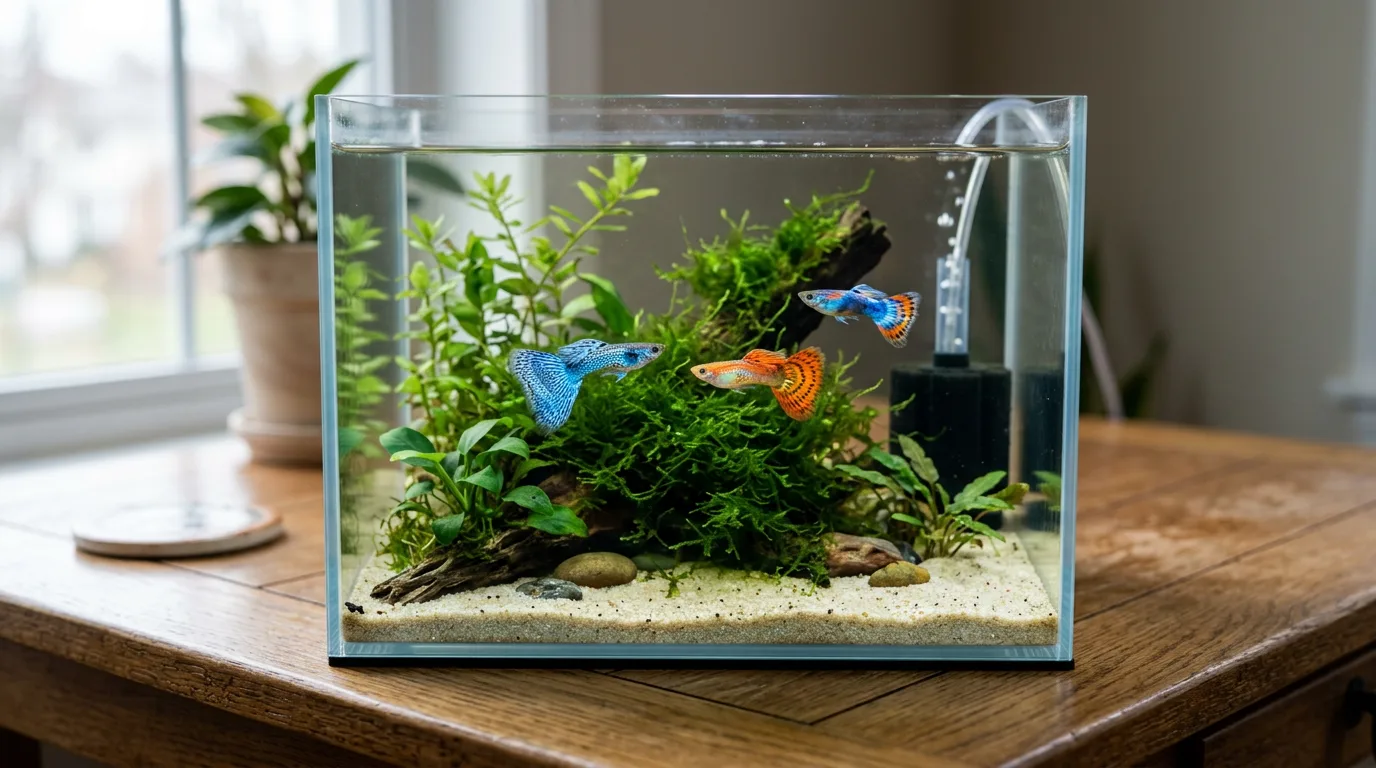
How many guppies per gallon fits at 10 gallons? A 10 US gallon tank holds about 38 litres, still under the 45 litre guideline. For a planned permanent group, a larger tank is generally more appropriate. If you already keep guppies in a smaller established tank, assess actual fish condition, filtration, oxygen and waste load with experienced guidance rather than assuming a fixed group size is safe; plan enough space if fry are possible. See how many guppies in a 10 gallon tank for the details.
20 gallon tank
Twenty gallons is where the how many guppies per gallon question finally gets comfortable answers. A long 20 gives more swimming length and surface area than a tall one, which helps oxygen exchange. Our how many guppies in a 20 gallon tank guide covers sex ratios and tank mates at this size.
Larger tanks: 29 to 75 gallons
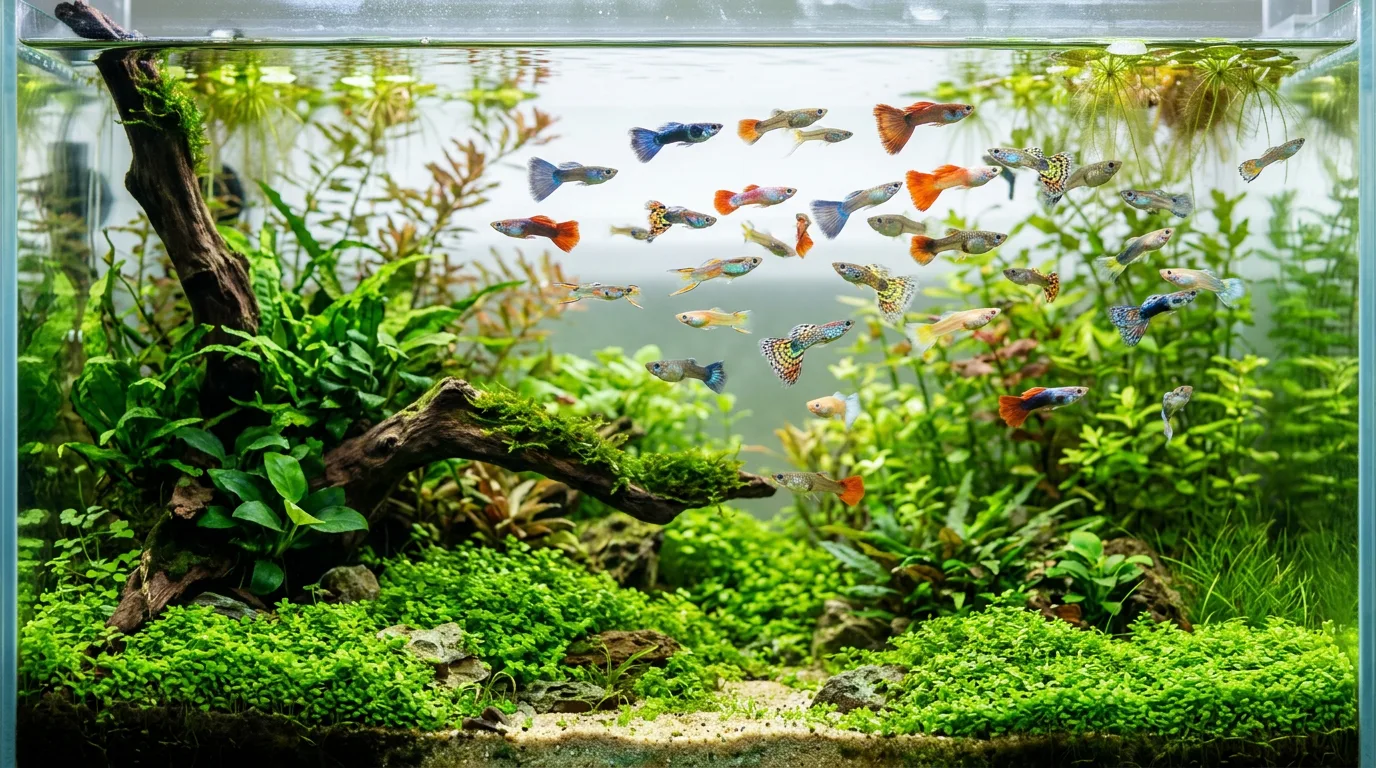
Larger tanks can offer more swimming space and stable conditions, but the answer to how many guppies per gallon does not scale linearly with a gallon label. Consider actual water volume, footprint, adult size/sex, mature biological filtration, oxygen, tank mates, feeding and future fry. Large tanks are also the best home for a breeding colony because fry can grow up alongside adults when there is dense planting. If you plan a mixed community, subtract space for every other fish and check compatibility first in our best tank mates for guppies list.
Factors that change how many guppies per gallon you can keep
- Male-only or mixed. An all-male tank can sit near the top of the range because no fry arrive. A mixed tank should start near the bottom.
- Filtration. A mature filter rated for at least the tank volume is the minimum. Our guide to the best filter for guppies compares sponge, hang-on-back and canister options.
- Live plants. Plants absorb nitrate and give females and fry cover, but they do not replace water changes.
- Maintenance. OATA recommends at least a 25% partial water change weekly, but this does not validate any fixed stocking count or chart row. Adjust actual husbandry to test trends, source-water nitrate, filter maturity, fish behaviour and the livestock present.
- Tank shape. Long, low tanks hold more fish comfortably than tall ones of the same volume.
- Tank mates. Corydoras, snails and shrimp add waste too. Count them in your plan.
How to add guppies without overstocking
Knowing how many guppies per gallon your tank can hold is only half the job; how you add them matters too.
- Before adding fish, confirm that an established biological filter can process the planned waste load using repeated ammonia and nitrite tests and documented maturation; a single zero reading in unused new water does not establish a mature cycle.
- Introduce fish gradually in small stages and retest as feeding and waste load increase; do not fill an illustrative chart row all at once.
- Test water repeatedly during stocking changes. Compare aquarium nitrate with measured normal source tap-water nitrate: OATA advises no more than 20 mg/L nitrate above source water as a maintenance guideline, not a universal fish-toxicity threshold. Reassess waste load and safe water-change practice when levels rise.
- Watch behaviour: hiding females, clamped fins or guppies gasping at the surface are early signs of too many fish or too little oxygen.
- Decide on fry before they appear: a grow-out tank, a local store that takes surplus, or an all-male tank.
If this is your first tank, our step-by-step page on how to take care of guppies walks through setup, feeding and water changes in order.
Signs your guppy tank is overstocked
- Ammonia or nitrite shows up at all, or nitrate climbs fast after a water change.
- Cloudy water returns within a day or two of cleaning.
- Guppies hang at the surface or near the filter outlet.
- Constant chasing, torn fins, or females hiding all day.
- Fry are everywhere and adults are always hungry.
Whatever pushed you past a sensible how many guppies per gallon figure, the fix is the same in every case: more water changes now, then fewer fish or a bigger tank. According to general guppy biology summarised on Wikipedia’s guppy article, guppies are highly prolific, so an overstocked tank rarely fixes itself.
So, how many guppies per gallon? Start with the conservative groups in the chart, add fish gradually, and let repeated water tests make the final call.
FAQ
How many guppies per gallon is safe?
There is no honest fixed answer to how many guppies per gallon: no fish-per-US-gallon formula is a reliable safety limit. OATA recommends at least 45 litres (about 12 US gallons) for a small group, and the safe plan for an actual aquarium depends on adult size and sex, usable volume, swimming room, mature filtration, oxygen, other livestock and fry. Add gradually and use repeated water tests and observation rather than the gallon label alone.
Can I keep 1 guppy per gallon?
Asking how many guppies per gallon often becomes “is one per gallon OK?” One guppy per US gallon is not a validated upper safety limit even for an all-male tank. A well-maintained established aquarium still needs enough swimming room, oxygen and biological processing for the specific fish and feeding load; breeding groups add fry and require further capacity. Do not use a fixed per-gallon ratio as a guarantee.
How many guppies should I start with in a 20 gallon tank?
For the how many guppies per gallon question at this size: in a 20 US gallon tank (about 76 L), a chart example of six to nine adults is illustrative, not a universal safe starting count. Choose a group based on actual usable volume and footprint, adult size and sex, mature filtration, oxygen, other livestock and future fry. Introduce fish gradually and repeat ammonia, nitrite and source-relative nitrate tests after increasing feeding or stock; adjust the group if water quality or fish behaviour indicates strain.
What is the best male to female ratio for guppies?
Whatever your answer to how many guppies per gallon, keep one male to two or three females. This spreads the males’ attention so no single female is chased constantly. All-male groups also work well and avoid fry.
Do guppy fry count toward stocking?
Yes — any how many guppies per gallon plan must count fry. Fry grow to adult size in about three months, so each brood adds to the long-term load. Plan a grow-out tank or a way to rehome surplus fish before you keep males and females together.
Behind the care guides
Care begins with steady systems
Our guppy guides focus on practical routines: keep water stable, observe fish closely and allow for natural variation.
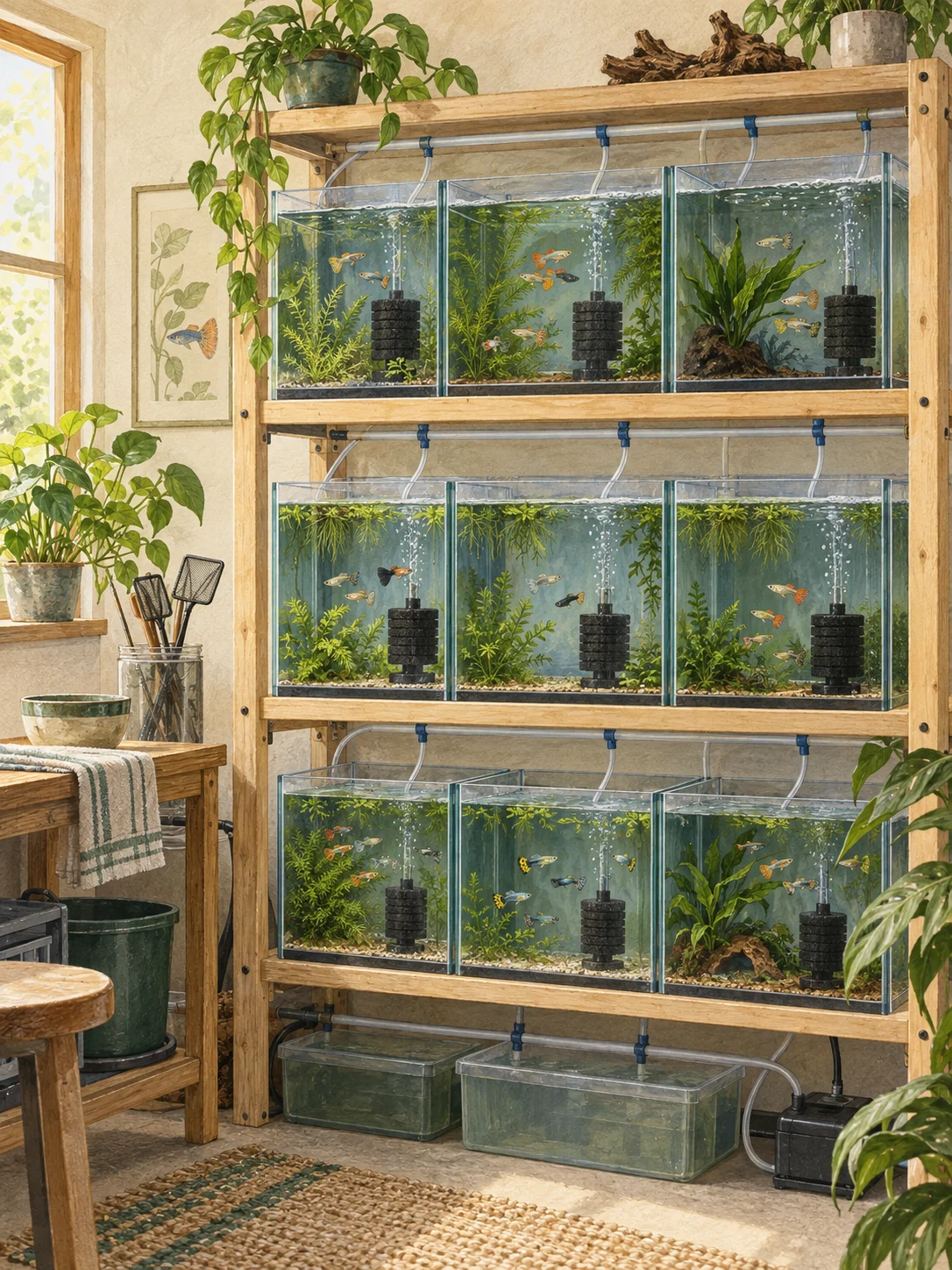
Care systems
Steady water, thoughtful care
Gentle filtration and regular observation support healthy aquarium routines.
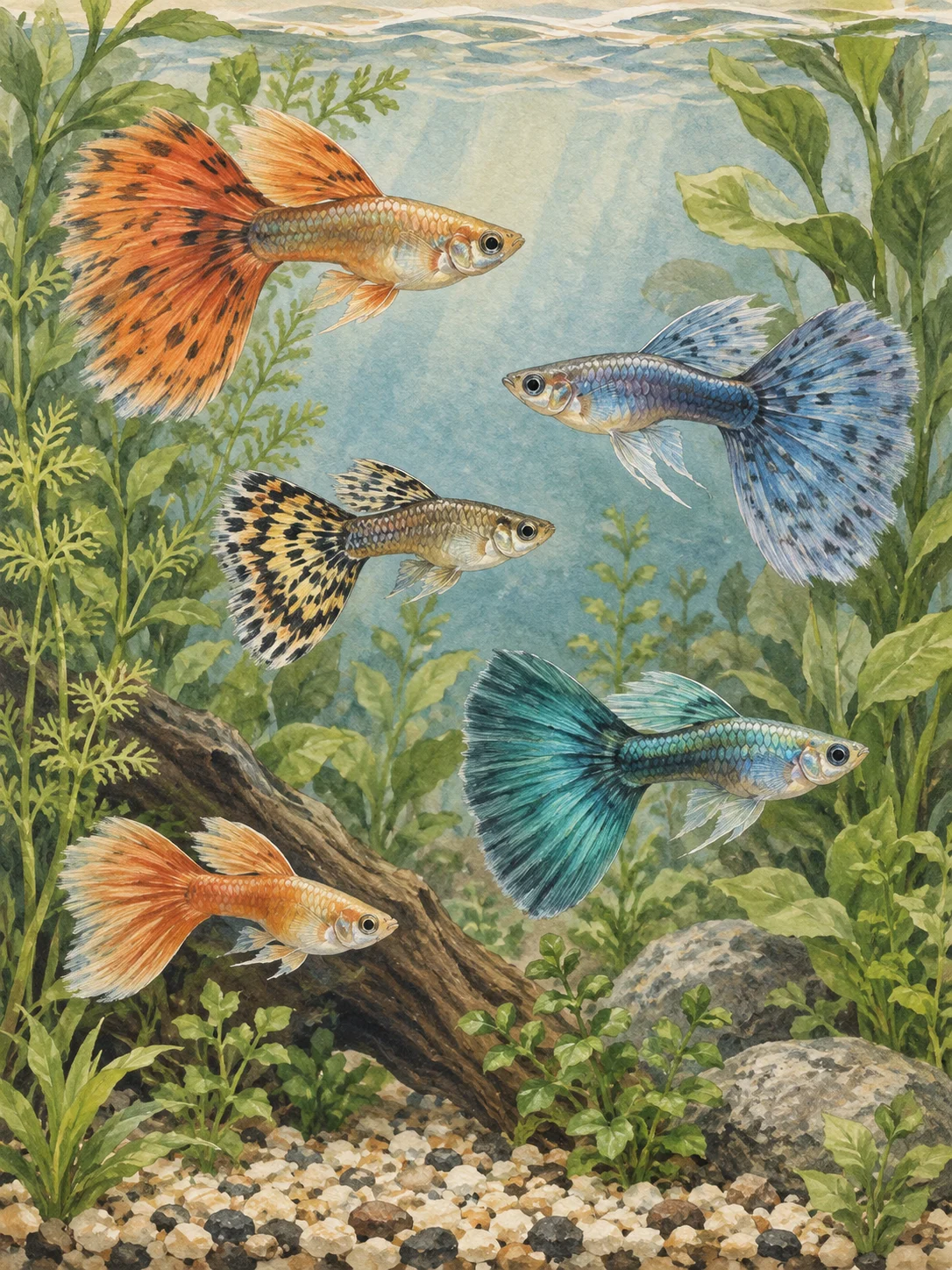
Natural variation
Every guppy is different
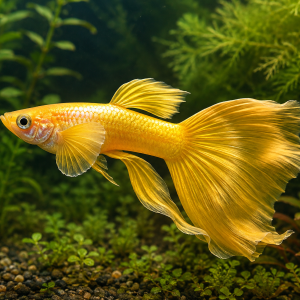
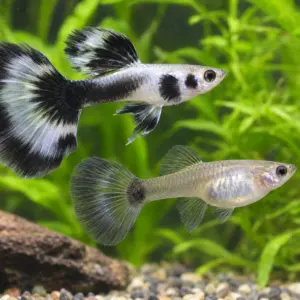
Color, size and fin shape vary with strain, age and each individual fish.
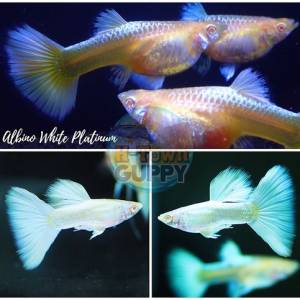
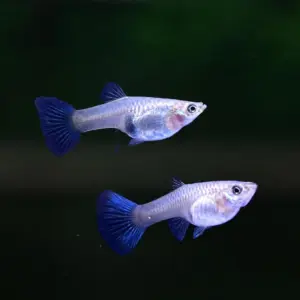
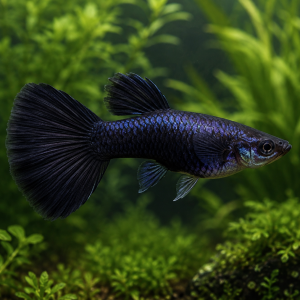
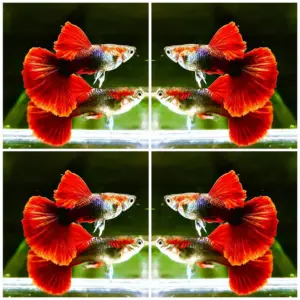
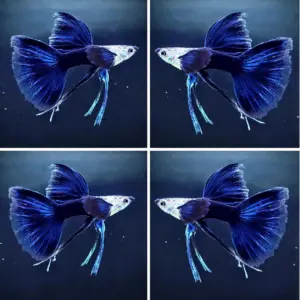
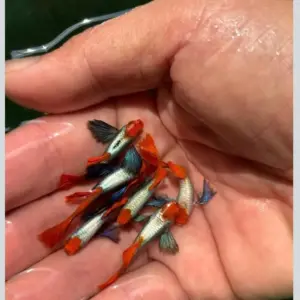
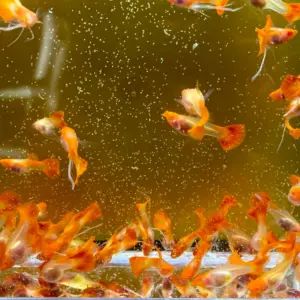
Editorial illustrations for context; they do not depict HiGuppy's exact facility or current fish stock.