The HiGuppy Journal
Guppy Tail Types: A Visual Guide to Every Tail Shape
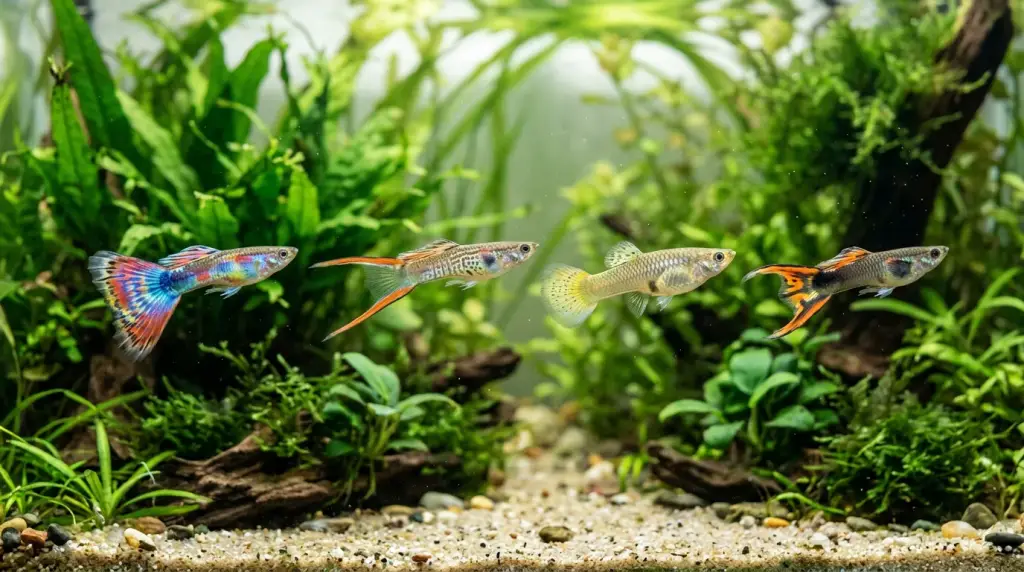
Guppy tail types are the standard shapes of a male guppy’s caudal fin. Breeders group them into broad tails (delta/triangle, fantail, veiltail, flagtail), sword tails (double sword, top sword, bottom sword, lyretail) and short tails (roundtail, spade, spear, pintail). Double-tail, ribbon, swallow and dumbo ear describe other fin traits that combine with these shapes.
Key takeaways
- Show standards define each tail by its outline, angle and length relative to the body, so the names mean something specific.
- Broad tails such as delta and veiltail look dramatic but are the most exposed to nipping, tears and strong current.
- Sword and short tails are compact, swim easily and usually suit busier community tanks better.
- “Double tail”, “ribbon”, “swallow” and “dumbo ear” are fin traits, not tail shapes, and can appear on top of a tail shape.
- Choose by tank setup and tank mates first, then by look. Gentle flow and peaceful company matter more than any tail label.
How guppy tail types are classified
The tail (caudal fin) is the most obvious difference between fancy male guppies, so breeders standardised it decades ago. The European standard maintained by the International Congress for Guppy High-Breeding (IKGH), the International High-Breed Standard, sorts guppy tail shapes into three categories and judges each one against precise proportions. The 2023 version also added a halfmoon tail to the broad-tail group. In the US, the International Fancy Guppy Association (IFGA) judges mainly delta, veil and sword classes, with roundtails added more recently.
Two points help when reading shop listings. First, tail shape is separate from colour and pattern, so a “Blue Grass Delta” and a “Blue Grass Double Sword” share a colour line but not a tail. Our overview of guppy strains and types explains how those naming layers fit together. Second, these standards describe males. Females have much shorter tails, which is one of the easy ways to tell male and female guppies apart.
Broad tails: delta, fantail, veiltail and flagtail
Delta (triangle) tail
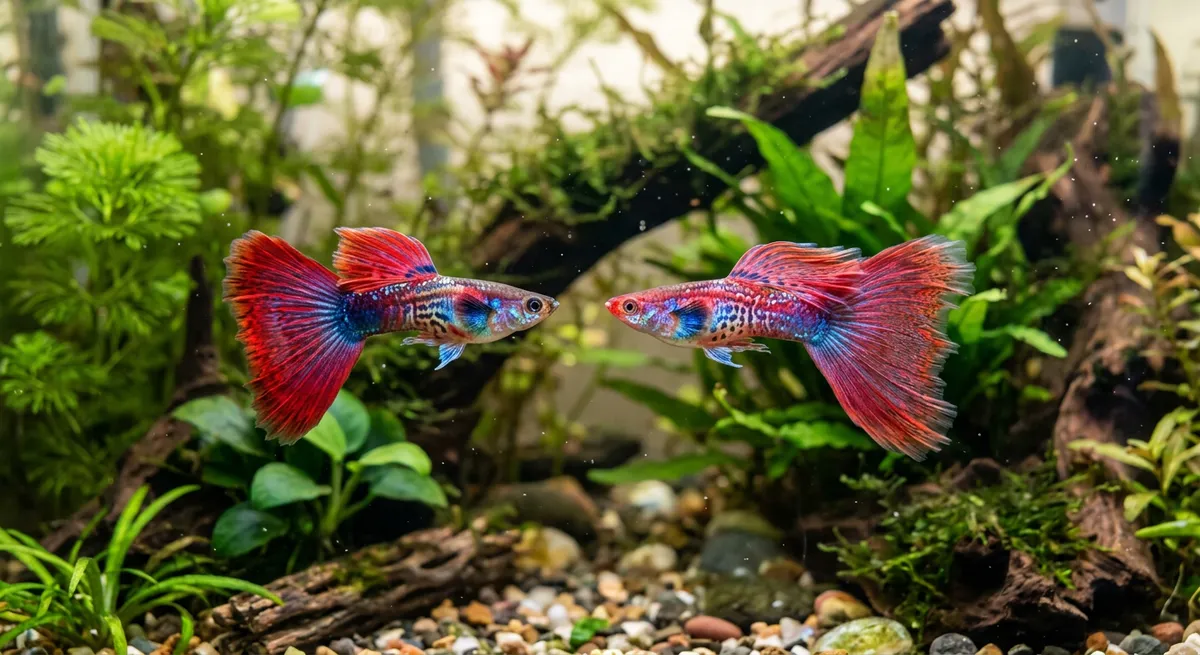
The delta tail guppy is the classic fancy guppy. Under the IKGH standard the caudal fin forms a triangle spreading at about 70 degrees, with straight edges and an ideal length of 8/10 of the body length. The IFGA delta class accepts spreads of roughly 55–75 degrees. Many of the most popular colour lines, from Japan Blue to Moscow, are bred in delta form. It is also the most demanding shape to keep perfect, because that much fin surface is easy to split.
Fantail
A fantail is a broad tail with gently curved upper and lower edges, widest at about three-quarters of its length, with a slightly concave rear edge. It looks like a softer, rounder delta. Fantails are less common in show circles today, but many shop fish described as “fancy” sit somewhere between fan and delta.
Veiltail
The veiltail is a narrower triangle of about 45 degrees (the IFGA veil class runs 40–50 degrees), but long: ideally as long as the body itself. It is the historical forerunner of the delta. That length is its weak point, as long trailing fins are slow and are the first thing a fin-nipper targets.
Flagtail (scarf tail)
The flagtail is rectangular rather than triangular: about 8/10 of the body length long and 4/10 wide, with a rounded start. It is rare in the hobby and mostly kept by specialist breeders.
Sword tails: double sword, top sword, bottom sword and lyretail
Double sword
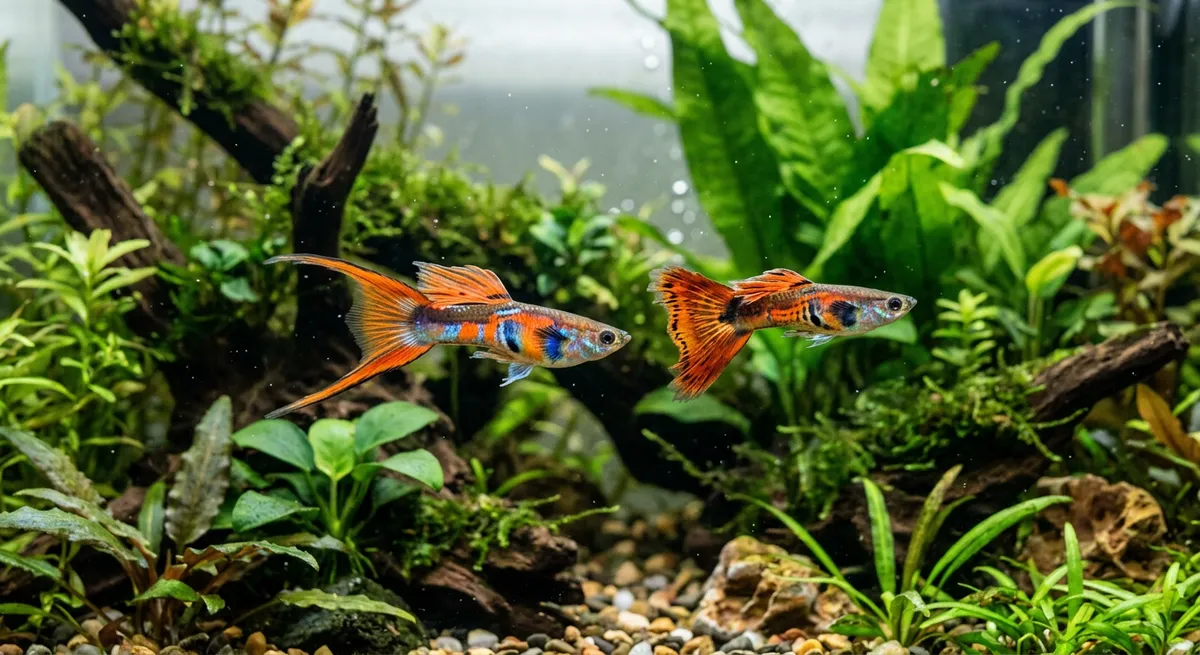
The double sword guppy has a small oval tail base with two long, sword-like extensions from the top and bottom fin rays. The standard calls for swords as long as the body, spreading at an angle of 30 degrees or more, with the centre portion no longer than 4/10 of body length and often clear. It is one of the most popular sword shapes, and European breeders often recommend it to beginners because the compact base is easy to keep in good condition.
Top sword and bottom sword
These have a single sword: a top sword extends from the upper rays and a bottom sword from the lower rays, each roughly as long as the body. Bottom swords are often confused with double swords in shops, so look at both edges of the tail before you buy.
Lyretail
The lyretail looks like a double sword, but the outer rays are shorter (about 8/10 of body length) and curve outward at the tips like the arms of a lyre. Shops sometimes use “lyretail” loosely for any double-sworded male, so check photos if the exact shape matters to you.
Short tails: roundtail, spade, spear and pintail
Roundtail
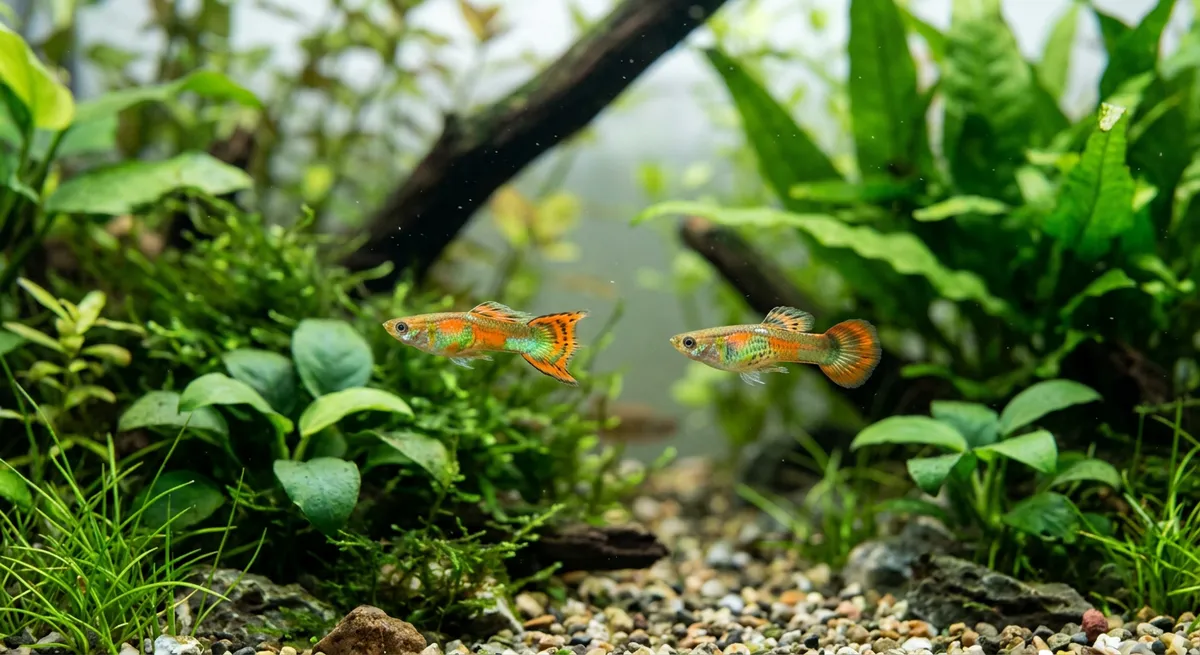
The roundtail guppy has a small circular caudal fin with a diameter of about half the body length. It looks closest to wild guppies and is a hardy, active swimmer. It is gaining ground in European shows in a widening range of colours.
Spade (cofer) tail
A spade tail looks like a garden spade: the edges flare out, then run parallel, with a length of about half the body. It is closely related to the roundtail, and some shows judge the two together.
Spear (spearhead) tail
Shaped like a spear tip, this tail reaches about 8/10 of body length. It is rarely seen outside shows.
Pintail (needle tail)
The pintail has a small round base with the middle rays extended into a single point that can match the body length. It is another rare, specialist form.
Fin traits that change the look: double tail, ribbon, swallow and dumbo ear
Double tail
“Double tail” or “split tail” describes a caudal fin that develops as two distinct lobes with a gap between them, rather than one continuous fan. It is not the same as a double sword, where the tail base is continuous and only the edge rays are extended. Breeders use the trait in lines such as the Silverado Double Tail breeding pair. Day-to-day care is the same as for any guppy, but keep an eye on fin edges as you would with any long-finned fish.
Ribbon and swallow
The ribbon guppy carries a fin-elongation trait that lengthens the anal fin (the gonopodium in males), the pelvic fins and often the dorsal fin. The caudal shape itself is largely unaffected. Swallow guppies have elongation across more fins and a characteristically uneven, “cut” looking tail edge, which is normal for the trait and not fin damage. Neither is part of the IKGH tail standard.
The key practical point is breeding. In her article Breeding Guppies: Genetic Pitfalls and Successes, aquarist Diana Walstad describes swallowtail males whose elongated gonopodium made them unable to inseminate females, so breeders keep these lines going with males that do not carry the elongated fin. If you want to breed ribbon or swallow lines, ask the seller how the line is maintained.
Dumbo ear (big ear)
Dumbo ear guppies have enlarged pectoral fins, the paired fins behind the gills, not a special tail. The trait can be combined with almost any tail shape and colour. Our Dumbo Ear guppy strain profile covers how to assess them, and the Dumbo Red Tail guppy guide shows one popular combination of big ears and a coloured tail.
Guppy tail types compared
| Tail type | Shape | Typical fish | Care notes |
|---|---|---|---|
| Delta (triangle) | Broad triangle, about 70°, 8/10 body length | Japan Blue, Moscow, many fancy shop males | Most fin area; keep flow gentle and avoid nippers |
| Fantail | Broad, curved edges, slightly concave rear | General “fancy” males | Similar to delta |
| Veiltail | Narrow triangle, about 45°, up to body length | Older and long-finned lines | Long, slow fins; most vulnerable to nipping |
| Flagtail | Rectangle, 8/10 long by 4/10 wide | Specialist show lines | Moderate fin area; rarely sold |
| Halfmoon | Semicircle spreading 180° | Newer broad-tail show lines | Very large fin; calm tank needed |
| Double sword | Oval base plus top and bottom swords | Japan Blue swords, multicolour lines | Compact and agile; good for beginners |
| Top / bottom sword | Oval base plus one sword | Show sword lines | Hardy; check which edge carries the sword |
| Lyretail | Round base, outward-curving tips | Often sold alongside double swords | Hardy; tips can fray in rough company |
| Roundtail | Circle, about half body length | Wild-type and European show lines | Very hardy, active swimmer |
| Spade / spear / pintail | Spade, spear tip or round base with central pin | Rare show lines | Short fins; easy to keep in good shape |
| Double tail | Caudal split into two lobes | Silverado Double Tail and similar lines | Normal guppy care; watch fin edges |
| Ribbon / swallow | Elongated anal, pelvic and often dorsal fins | Ribbon colour lines | Long fins snag easily; some males cannot breed |
| Dumbo ear | Enlarged pectoral fins on any tail | Dumbo Red Tail, Dumbo Koi | Check swimming and food access |
Care implications by tail type
Fin nipping and tank mates
Big, slow fins draw attention. Delta, veil, halfmoon and ribbon males are the first to be picked on by fin-nippers and by bossy guppies of their own kind. Choose calm companions from our list of the best tank mates for guppies, and learn the early signs of bullying in guppies so you can act before fins are shredded. Sword and short-tailed males cope far better in a busy community tank.
Fin damage versus fin rot
A torn fin from a snag or a nip usually has a clean split and regrows in clean water. Edges that turn ragged, discoloured or keep receding point to something more serious, so compare what you see with our guide to guppy fin rot. Remember that a swallow guppy’s uneven tail edge is normal for that trait. Fins held tight against the body are a separate stress signal, covered in our article on guppy clamped fins. Smooth decor and live plants reduce snags for every tail type.
Water flow
Broad and long tails act like sails. In strong current, delta, veil and ribbon males tire quickly and may hide in corners. Gentle filtration suits them best, which is why many guppy keepers use a sponge filter for a guppy tank. If a male struggles to hold position or reach food, diffuse or redirect the outlet. Sword and roundtail males handle moderate flow more easily.
How to choose a guppy tail type
- For a first tank or a busy community: double sword, lyretail or roundtail males. They are compact, active and forgiving.
- For a calm, guppy-only display: delta, fantail or halfmoon males give the most colour per fish, as long as flow is gentle.
- For breeding: buy matched pairs or trios from one line, since tail shape is inherited in complex ways. Walstad found that crossing double swords with deltas gave all-delta sons in the first generation, with sword tails reappearing in the next. Ask before buying ribbon or swallow lines.
- For something unusual: dumbo ear and double-tail males add a second feature on top of the tail shape.
Ready to compare? Browse our male guppies for sale and check each listing’s photos for the tail shape you want, since fin development varies between individual fish.
Frequently asked questions
What is the most common guppy tail type?
The delta (triangle) tail is the most common and popular fancy guppy tail, followed by double sword. Many shop males labelled simply “fancy” have delta or fan-shaped tails.
What is the difference between a delta tail and a veiltail guppy?
Both are triangular. A delta spreads wider, at about 70 degrees and 8/10 of body length, while a veiltail is narrower, at about 45 degrees, but can be as long as the body.
Is a double tail guppy the same as a double sword guppy?
No. A double sword has one continuous tail with long extensions on the top and bottom edges. A double tail has a caudal fin that forms two separate lobes.
Can ribbon guppies breed?
Ribbon and swallow females usually breed normally, but males with a fully elongated gonopodium may be unable to inseminate females. Breeders keep these lines going with males that do not show the elongated fin.
Which guppy tail type is hardiest?
Short tails such as the roundtail and sword tails such as the double sword are generally the most robust, because their compact fins are less prone to nipping, tearing and strain from water flow.
Behind the care guides
Care begins with steady systems
Our guppy guides focus on practical routines: keep water stable, observe fish closely and allow for natural variation.

Care systems
Steady water, thoughtful care
Gentle filtration and regular observation support healthy aquarium routines.
Natural variation
Every guppy is different
Color, size and fin shape vary with strain, age and each individual fish.
Editorial illustrations for context; they do not depict HiGuppy's exact facility or current fish stock.