The HiGuppy Journal
Guppy Types: A Visual Identification Field Guide
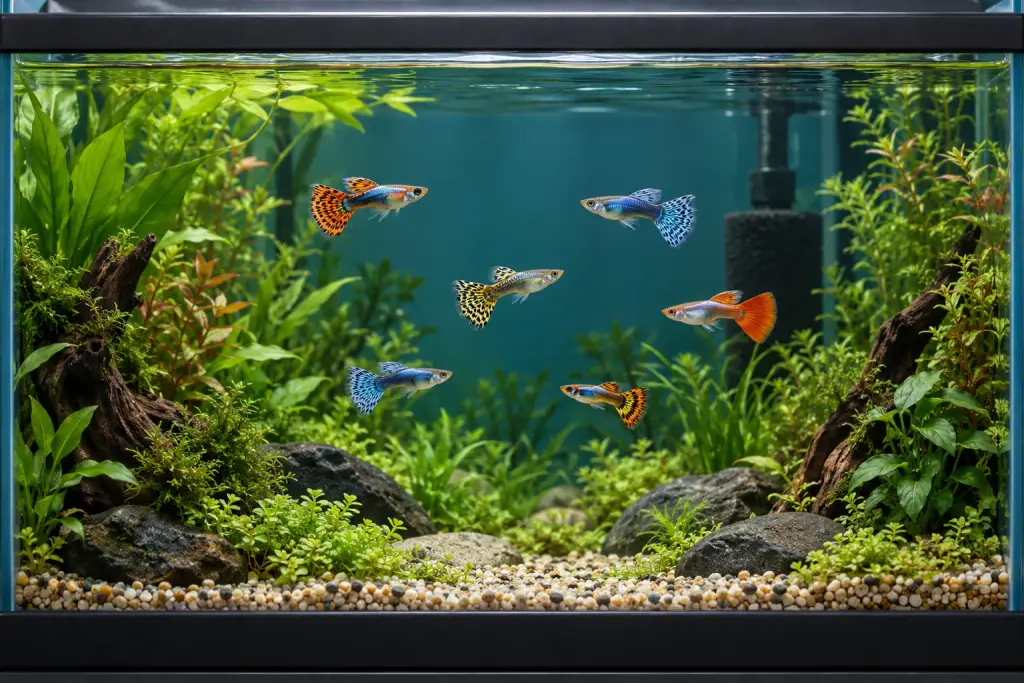
Quick answer: Guppy types describe combinations of tail shape, body pattern, color, fin traits and breeder lines, not separate species for every name. A guppy can have a delta tail, snakeskin pattern and Dumbo pectoral fins at the same time. To identify a fish accurately, record each trait separately and compare current photographs with the seller’s actual listing rather than trusting one label.
What Does Guppy Types Mean?
In aquarium shops and breeder listings, guppy types usually describe an appearance or a line of fish bred to produce particular traits. Some names refer to a visible feature, such as a tail shape; others describe a pattern, color, or named strain. These categories can overlap, and sellers may use slightly different names for similar-looking fish.
| Label in a listing | What it describes | What to ask |
|---|---|---|
| Delta tail | Tail outline | Is the fish mature, and is the photo representative? |
| Snakeskin | Body or fin markings | Which markings are typical of this line? |
| Red | Color | Does the photo show the individual fish or an example? |
| Moscow | A named breeding line | What traits and parentage does the breeder document? |
These labels describe different aspects of a fish and can appear together. They do not, by themselves, establish health or guarantee how offspring will look.
Species versus varieties
Most fish sold simply as guppies are fancy varieties of Poecilia reticulata. They are not separate species just because they have different colors or fins. Endler’s livebearers are closely related but are generally identified as Poecilia wingei; they are not just another color variety of the common guppy.
How guppy traits overlap
Because guppy types combine traits, think of a guppy’s description as a combination rather than a single category. For example, a fish might have a mosaic pattern, a red tail, and a delta-shaped fin. A breeder may also give that combination a strain name. For a closer look at markings, see our guide to guppy pattern types.
Popular Guppy Types by Tail Shape
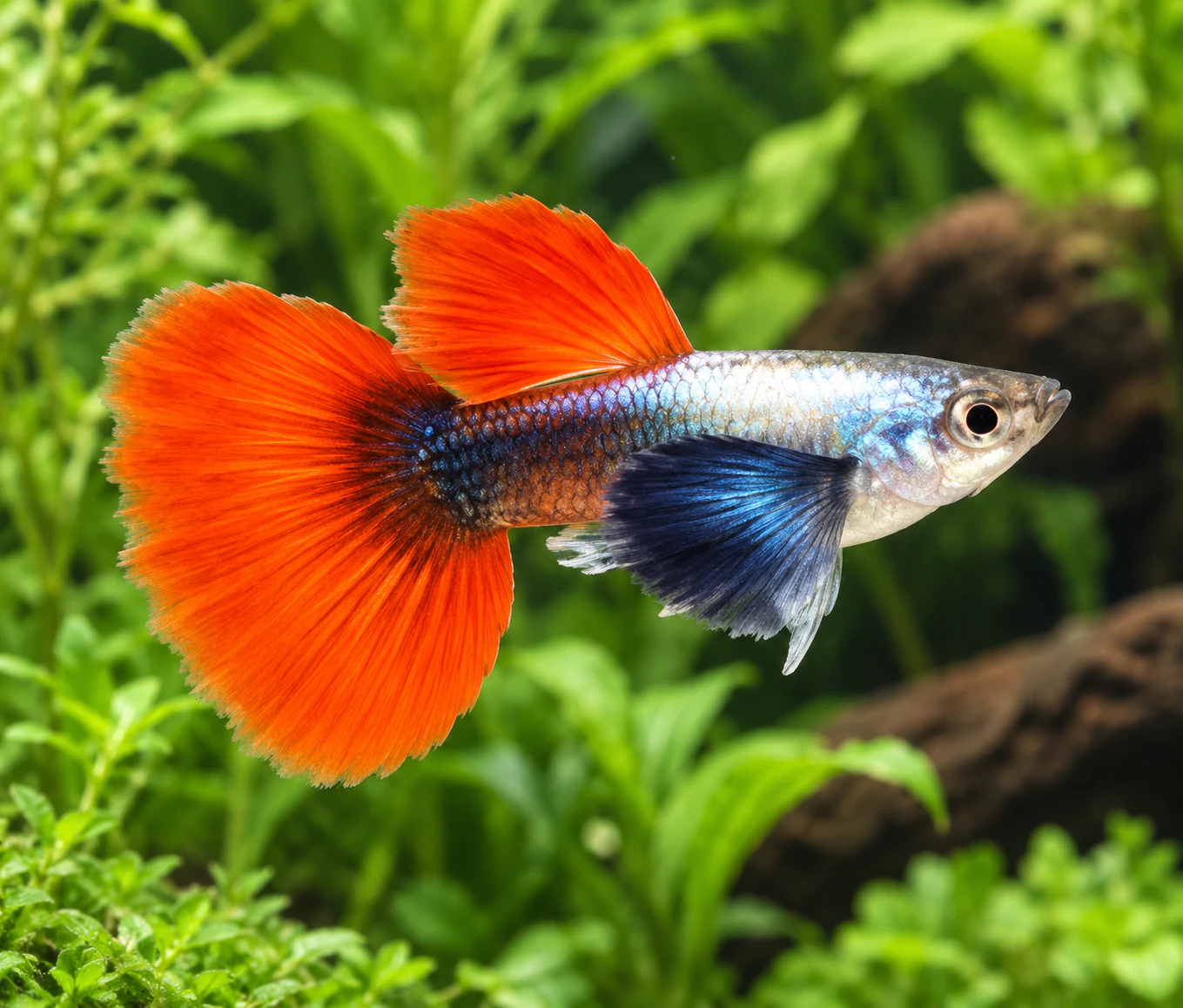
Tail-shape guppy types are among the easiest labels to recognize. The outline and length of the tail can vary between individual fish, and naming conventions are not perfectly consistent across sellers. Use these descriptions as a practical guide, not a guarantee of a standardized shape. Compare more examples in our guppy tail types guide.
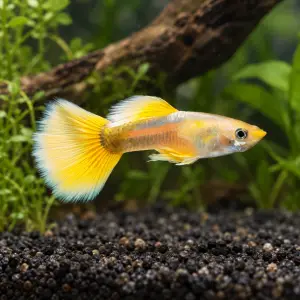
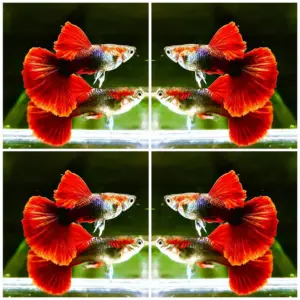
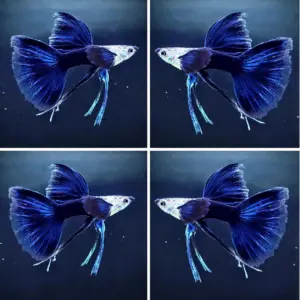
- Fan or delta tail: A broad tail that opens outward. Delta tails are often described as having a more triangular outline, while fan tails may look more rounded.
- Veiltail: Long, flowing tail fins that hang or trail behind the fish. The exact outline can vary.
- Halfmoon: A wide, fan-like tail with a deep spread that resembles a half circle when fully extended. The label is used for fish with varying degrees of tail spread.
- Flagtail: A tail with a relatively tall, rectangular or flag-like outline.
- Roundtail: A compact, rounded tail rather than a wide, sharply angled one.
- Spadetail: A tail that narrows toward the body and widens into a shape resembling a spade.
- Lyretail: A tail with elongated upper and lower edges that create a forked look.
- Double swordtail: The upper and lower tail rays extend into two sword-like points.
- Top swordtail or bottom swordtail: One edge of the tail extends into a sword-like point while the opposite edge remains shorter.
- Spear or needle tail: A narrow, pointed tail with a more tapered appearance.
Some guppy types are named more consistently than others, and a young guppy may not yet show its adult tail shape. When buying, look at the fish itself and the breeder’s photos, rather than relying only on a variety name.
Common Guppy Types by Pattern
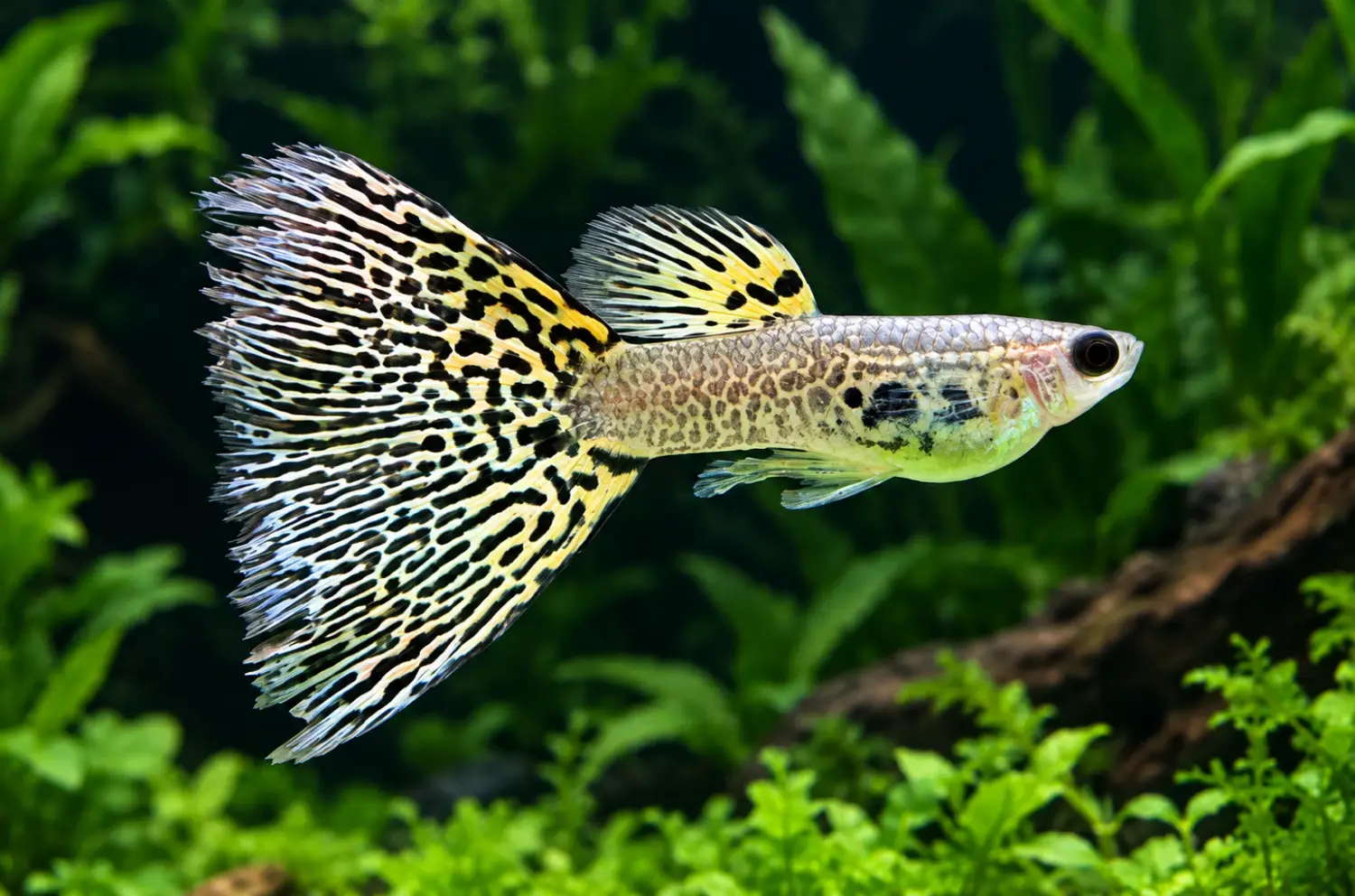
Pattern-based guppy types describe how markings are distributed across the body and fins. It is separate from color: two guppies can share a pattern name but have very different colors.
Snakeskin, cobra, and lace
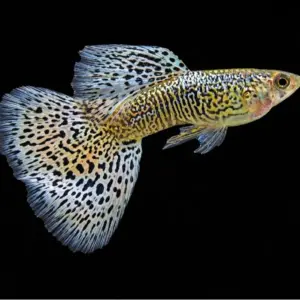
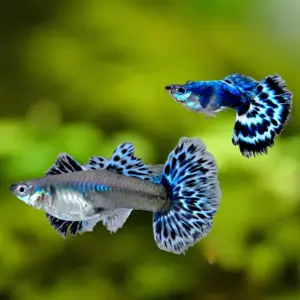
Among pattern guppy types, Snakeskin guppies have a network of lines or reticulated markings on the body and sometimes the tail. Cobra is a label often used for related-looking patterned fish, though naming varies among breeders. Lace usually describes fine, delicate-looking markings, particularly on the fins. These terms can overlap in shop descriptions.
Mosaic, grass, and tuxedo
- Mosaic: Irregular patches or markings, often especially noticeable on the tail.
- Grass: Fine, small spots on the tail that can resemble blades or scattered dots.
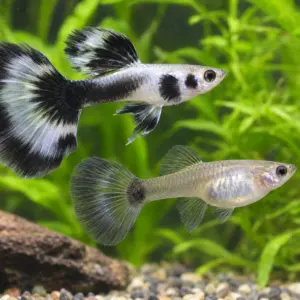
- Tuxedo or half-black: A darker area over much of the rear portion of the body, contrasted with a lighter or more colorful front.
- Solid: A largely uniform color, although the shade may change across the body or fins.
Read a compound guppy name as a set of traits
Pattern-based guppy types are useful when comparing fish, but they do not always tell you how the offspring will look. A strain can carry several visible traits, and offspring from mixed lines may show a range of patterns.
Color Types and Named Guppy Strains
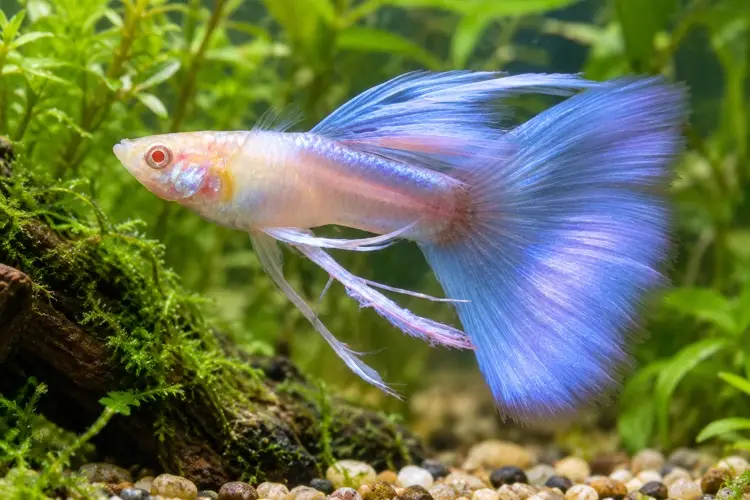
Color is one part of a guppy’s appearance
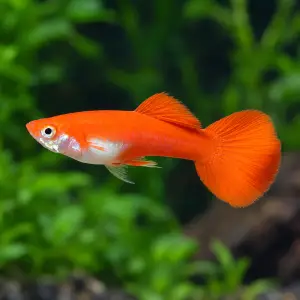
Guppy types are sold in many colors, including red, blue, yellow, orange, green, and combinations of several shades. Males are usually the more vividly colored sex, while females are often less colorful, but individual fish vary. For a closer look at color names and common combinations, read our guide to guppy color types.
Popular named strains
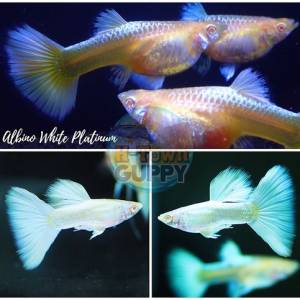
Named strains are also guppy types: bred lines associated with particular traits. Moscow guppies, for example, are known for strong, often extensive body coloration, though the exact color and coverage depend on the line. Platinum guppies are named for a pale, reflective or metallic appearance. Both names describe breeding varieties, not separate species.
Strain names can combine with pattern and tail descriptions. A listing might identify a fish by its strain, its color, and its fin shape. Ask the breeder which traits are stable in the particular line.
Guppy Types You May See for Sale
Fancy and feeder guppies
Fancy guppy generally means a selectively bred guppy type chosen for its color, pattern, fin shape, or a combination of traits. Feeder guppy is a sales category for fish sold primarily as food for other animals, not a particular tail or color type. Feeder fish may have less predictable appearance and parentage than a named show or breeding line. Ask about the fish’s health and background before deciding.
Wild-type guppies and Endler’s livebearers
Wild-type guppies tend to have a more natural-looking appearance than many fancy guppy types. They can still show color and markings, but usually are not described by the same elaborate combination of tail and strain names.
Endler’s livebearers are close relatives often sold alongside fancy guppy types. Because Endlers and guppies can interbreed, anyone keeping a pure line should avoid mixing them. Ask a breeder about the parentage if maintaining a particular line matters to you.
How to Choose a Guppy Type
Match the fish to your goals
Before choosing between guppy types, decide what matters most to you. If you want a colorful display, choose fish whose appearance you enjoy and make sure the aquarium can comfortably house the group. If you plan to breed guppies, select a line with traits you can identify and keep records of the parents. If you are a beginner, a healthy, active fish is a better choice than a rare label or an especially dramatic tail.
Also consider whether you want to keep one line or several. Mixing varieties can create attractive fish, but the offspring may not retain either parent’s appearance consistently. If predictable traits matter, buy from a breeder who can explain the line and its parentage.
Check health before appearance
Whatever guppy types you compare, observe the fish before buying. Look for steady swimming, responsive behavior, intact fins, and a body that does not appear unusually thin or swollen. Check that the fish are not gasping at the surface, clamped-fin swimming, or showing obvious sores or spots. Ask how long the seller has kept the fish and whether they are eating.
Whenever possible, choose a reputable seller who describes the fish accurately and keeps tanks clean. A guppy type name is not a health guarantee, and a beautiful fish may still need careful observation after it reaches your aquarium.
Do Different Guppy Types Need Different Care?
Keep care and tank setup consistent
Most fancy guppy types have broadly similar care needs; color or pattern alone does not require a special tank. Provide a stable, cycled aquarium, suitable water conditions, a varied diet, and enough room for the number of fish you keep. Long or elaborate fins can be more vulnerable to damage, so avoid sharp decor and tankmates that nip fins.
Keep newly purchased fish under observation before adding them to an established community aquarium. Choose compatible tankmates, maintain water quality, and avoid overcrowding. With sound care, the best guppy type is the one that fits your goals and thrives in the setup you can maintain.
Tail shape identification: an observable decision path
When you see a fancy guppy, start with a side-on video in neutral lighting. Identify the caudal fin (tail) outline before looking at its markings. Does the edge form a broad triangle, an approximately round fan, an upper or lower sword, or an extension of a few fin rays? A delta-style tail describes an outline; the same fish can have a Mosaic pattern or another body color.
Next inspect pectoral fins near the gills. Enlarged pectorals are commonly called Dumbo or Big Ear; they do not change the tail category. Finally assess any unusually long fin rays, such as Ribbon or Swallow traits, but ask the breeder what their terminology means. One photo does not reliably show all angles.
| What you can see | Possible descriptor | Do not infer |
|---|---|---|
| Broad triangular tail outline | Delta or fan-tail form | A single color, quality grade or bloodline |
| Upper or lower long tail extension | Swordtail-style shape | The same trait as a Ribbon gonopodium |
| Oversized pectoral fins | Dumbo / Big Ear | That every pictured fish has the same tail pattern |
| Long thin rays beyond fin margins | Ribbon or Swallow in some seller vocabularies | Guaranteed mating ability or fixed genetics |
Pattern versus color: how two fish can share a name
Pattern-based guppy types describe the distribution of marks while color names describe the tones you see. For example, a blue-bodied fish may have a Mosaic tail, a snakeskin body or a plain tail. Grass typically describes fine spots; Mosaic is commonly used for larger, irregular patches. These hobby labels can overlap, especially in mixed lines.
Rather than assuming all fish with “Blue” in their names are from one breeding line, compare the body, tail and dorsal fin separately. Different lighting and editing can distort saturation and hide subtle markings. Ask the seller whether an image is an AI illustration, a parent fish or the actual individual offered today.
A name such as Albino Sky Blue Ribbon can combine an eye/pigment trait, blue coloration and extended fin details. Platinum Dumbo Ear combines a metallic appearance label with large pectoral fins. Tiger Mosaic emphasizes a pattern; none of those names guarantees that every sibling or fry will match the promotional photo.
| Name on a listing | What to inspect first | What to request |
|---|---|---|
| Platinum Dumbo Ear | Pectoral fin size and balance | Side-view swimming video and true fish size |
| Tiger Mosaic | Tail pattern and the whole caudal fin | Recent photo in natural lighting |
| Albino Sky Blue Ribbon | Eyes, overall blue shade and fin-ray extensions | Current individual/sex, not a rendered catalog example |
| Red Dragon Big Ear Trio | Body/tail pattern, pectoral fins and group format | Exact number, sex ratio, parentage if breeding matters |
For a broader image-led catalog of guppy types, consult HiGuppy’s Guppy Strain List. That page catalogs many examples; this guide is a field method for classifying one fish you actually see.
Make a six-field comparison card before choosing a type
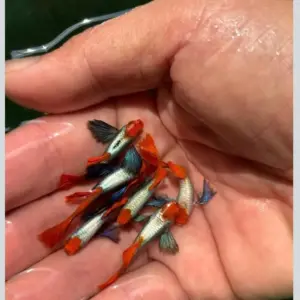
Use the same six fields for every candidate: tail outline, tail pattern, main body color, pectoral-fin size, other fin-ray traits, and actual group format (male, female, pair, trio or fry pack). This prevents a label such as “Mosaic” from masking a different tail shape or a stock photo from being mistaken for the fish in the order.
- Save a recent unobstructed side-view image of the available fish.
- Mark the tail outline separately from its pattern.
- Note whether the pectoral fins are Dumbo-sized and whether Ribbon rays are present.
- Check age/sex and whether juveniles have fully expressed the advertised color.
- Confirm that all images are labeled as actual fish or representative artwork.
- Ask about stocking compatibility and avoid buying solely for decorative rarity.
Long-finned guppy types still need guppy-appropriate clean water, low injury risk and a cycled tank. The OATA guppy care sheet describes general water conditions; it does not prescribe different pH values for individual trade names.
Frequently Asked Questions
What are the main types of guppies?
Guppy types are commonly described by tail shape, color, body pattern, and breeding strain. Examples include delta-tail, snakeskin, mosaic, tuxedo, Moscow, and platinum guppies, and one fish can fit several descriptions.
Are different guppy types different species?
Most guppies with different colors, patterns, or tail shapes are varieties of the same species, Poecilia reticulata. Endler’s livebearers are close relatives generally identified as a separate species.
Which guppy type is best for beginners?
There is no single best guppy type for every beginner; prioritize healthy, active fish from a reliable seller over a rare strain or unusual tail shape. Choose a variety you like and make sure your aquarium is suitable for the fish.
Can different guppy types live together?
Most fancy guppy types can live together if the aquarium is appropriately set up and the fish are compatible. If you breed mixed varieties, their offspring may not reliably retain the appearance of either parent line.
Do guppies with long tails need special care?
They generally need the same basic care as other guppies, but long fins can be more vulnerable to damage. Use smooth decor and avoid tankmates known to nip fins.
Is Dumbo Ear a tail type or a pectoral-fin trait?
Dumbo or Big Ear usually describes enlarged pectoral fins near the gills. A fish may also have a delta tail or Mosaic pattern, so describe each trait independently.
Can the same guppy be both Mosaic and Ribbon?
Yes. Mosaic commonly describes tail pattern while Ribbon describes elongated fin-ray traits. Confirm actual fish photographs, since sellers may use the terms differently.
References and practical next reading
For broad guppy care, use OATA guppy and molly husbandry guidance. This article is a practical field-identification workflow, not an official pedigree or show-grade certification.
Behind the care guides
Care begins with steady systems
Our guppy guides focus on practical routines: keep water stable, observe fish closely and allow for natural variation.

Care systems
Steady water, thoughtful care
Gentle filtration and regular observation support healthy aquarium routines.
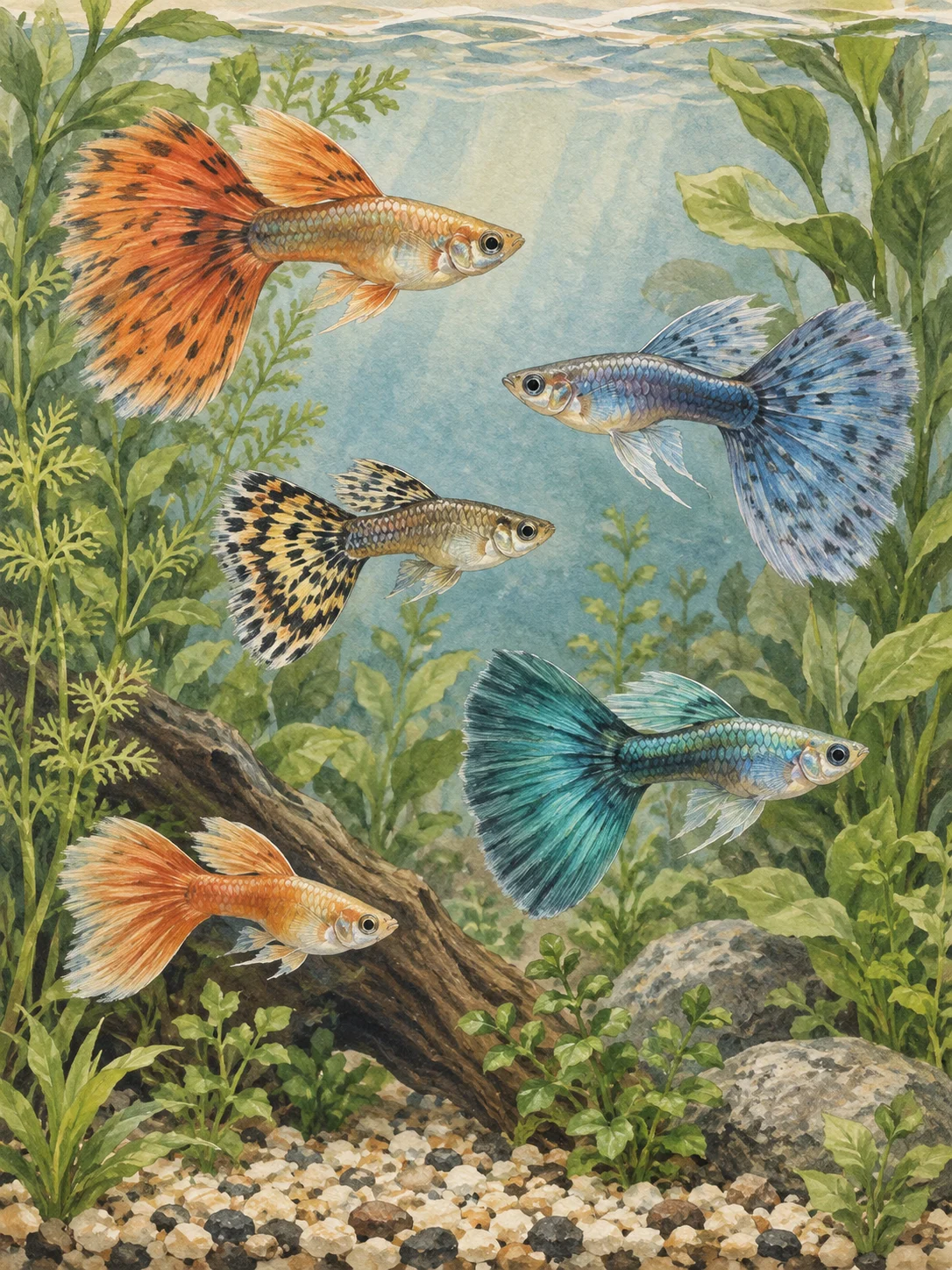
Natural variation
Every guppy is different
Color, size and fin shape vary with strain, age and each individual fish.
Editorial illustrations for context; they do not depict HiGuppy's exact facility or current fish stock.