DAILY GUPPY NUTRITION
Feed guppies by response, body condition and water quality—not by a rigid scoop.
A useful feeding routine gives every fish access to appropriately sized food without leaving a trail of waste in the aquarium. Start small, watch who eats, review body condition and waste, and adjust the routine to the fish and the filtration rather than following one fixed amount for every tank.
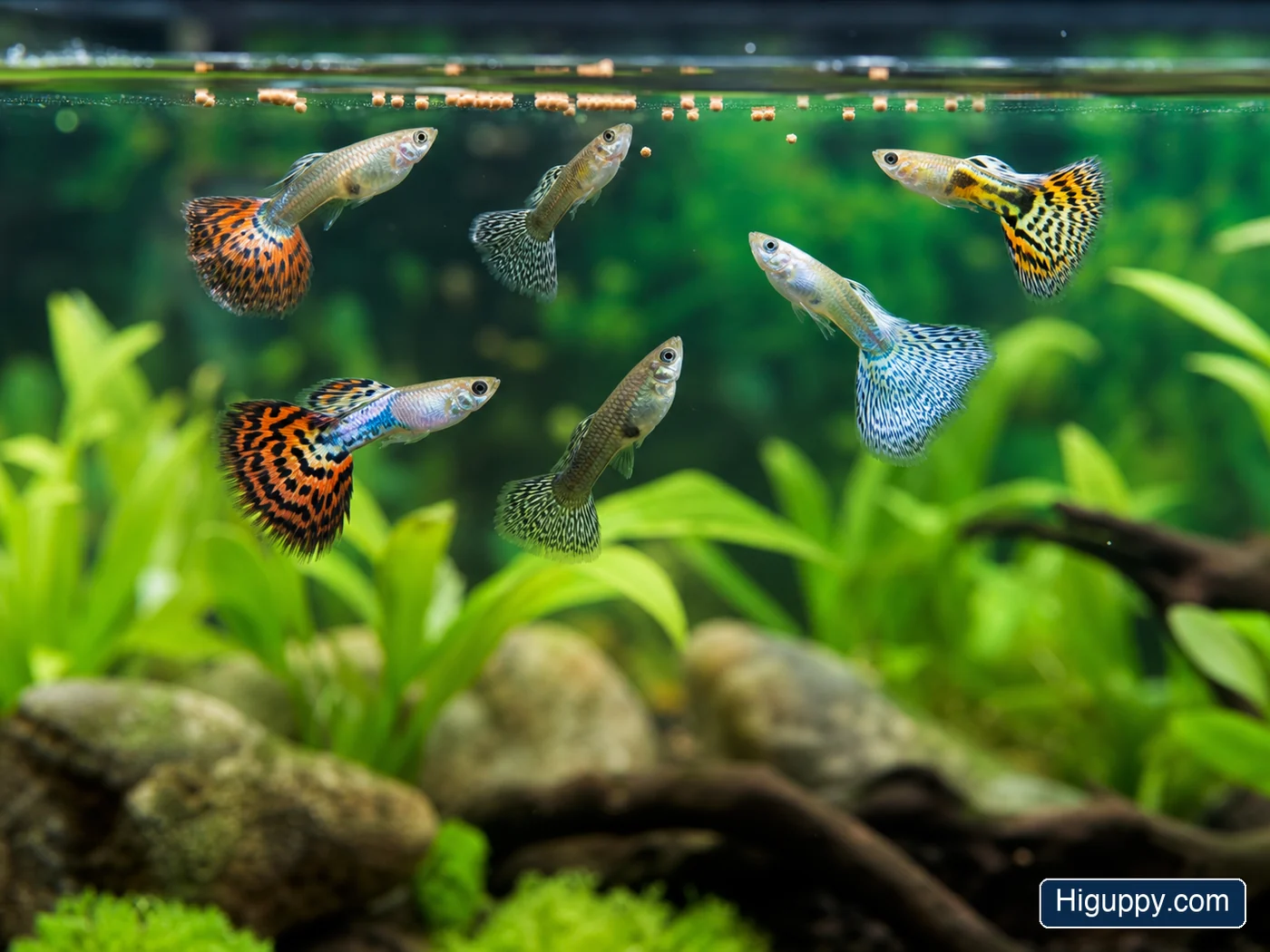
Use food as part of the whole aquarium system. Appetite alone does not tell you that a fish needs more food; competition, body condition, growth stage, temperature, illness, waste and water quality all matter.
BALANCED INPUT
What should guppies eat?
Guppies are omnivorous. The practical goal is not to chase a long ingredient list; it is to use an appropriately sized complete staple and add controlled variety without increasing the total food load beyond what the fish and filtration can support.
Complete staple
Use a small-particle tropical food labeled as a complete diet. Pellets, granules or flakes can all work when the particle size suits the fish.
Protein-rich variety
Appropriately sized brine shrimp, daphnia or other suitable frozen/live foods can add variety, especially for growth or conditioning, without becoming every meal.
Plant-based ingredients
Foods containing algae, spirulina or other suitable plant material can be part of a balanced rotation rather than a separate “vegetable day” requirement.
Freshness matters
Keep dry food sealed, cool and dry. Replace food that smells stale, has absorbed moisture or shows contamination instead of trying to use up an old container.
CHOOSE THE BASE
How to choose the main food.
- Choose a complete food intended for small tropical or ornamental fish.
- Match particle size to the fish; repeated spitting can mean the food is too large, hard or otherwise difficult to swallow.
- Buy a package size that can reasonably stay fresh after opening.
- Use ingredient and guaranteed-analysis information as context, not as a substitute for watching the fish.
- Judge the routine over time using growth, body condition, waste, appetite and water quality.
- Do not assume that a brighter package, stronger smell or more enthusiastic feeding response means the food is better.
ADULT ROUTINE
Set the adult feeding schedule from the tank and the fish.
For healthy adults, one or two small feeding opportunities per day can be a reasonable starting point, but it is not a rule for every aquarium. Temperature, breeding status, body condition, competition, food energy density, stocking and maintenance change what is appropriate.
Start smaller
Offer less than the amount you think the group might finish. You can add a little more after observing access; removing scattered food is much harder.
Watch the whole group
Check whether slower, smaller or lower-ranking fish can reach food before a dominant fish consumes most of the portion.
Use body condition
Persistent thinness, bloating or uneven growth deserves a review of competition, health, age and food access—not simply a larger meal for everyone.
Use water trends
If waste builds quickly or nitrate rises faster than expected, review total food input together with stocking, filtration and water-change practice.
PORTION BY RESPONSE
A practical portion-control method.
- 01
Offer a tiny first portion
Use food small enough to swallow and observe which fish actually reach it.
- 02
Watch swallowing
Confirm fish are eating rather than repeatedly spitting pieces or carrying food they cannot manage.
- 03
Add only when needed
If the first portion is consumed cleanly and some fish have not fed, add a little more rather than a second full meal.
- 04
Stop before leftovers spread
Do not wait until food collects on plants, substrate, décor or the filter intake.
- 05
Check access
Look for individuals being excluded by position, size or social pressure.
- 06
Review the next days
Use waste, body condition, growth and water testing to decide whether the routine should change.
CONTROLLED VARIETY
Add frozen, live and specialty foods by substitution—not by stacking extra meals.
Introduce one change at a time
Changing one food at a time makes appetite, digestion and water effects easier to interpret.
Use suitable sources
Frozen and live foods should be appropriately sized and come from a source or culture method you trust.
Keep the total load controlled
Replace part of the normal routine with a supplemental food rather than adding several full meals because the fish respond enthusiastically.
Watch water after rich foods
Thaw and portion frozen foods carefully, remove obvious leftovers, and pay attention to waste and filtration after introducing richer options.
GROWTH STAGE
Feeding fry and juveniles requires smaller portions and closer observation.
Fry have small mouths and rapid growth demands, so they often benefit from tiny feeding opportunities more frequently than adults. The safe limit is still set by food access, filtration, maintenance and water quality—not by a universal number of meals.
- Use fine fry food, appropriately crushed complete food or other foods sized for the fry.
- Newly hatched baby brine shrimp can be one useful growth food when culture and feeding practices are hygienic.
- Feed tiny portions and confirm food reaches small fry instead of accumulating in the tank.
- Protect filter intakes and maintain gentle, reliable circulation.
- Monitor ammonia and nitrite closely when feeding frequency increases.
- Separate larger juveniles when size differences consistently prevent smaller fry from feeding.
- Judge growth together with body shape, activity and water quality rather than pushing maximum growth at any cost.
OBSERVE AND ADJUST
Signs the feeding routine needs review.
Food remains visible
Reduce the portion, review particle size and remove accumulated leftovers.
Water degrades faster
Review total food input, stocking, maintenance and filter performance instead of treating feeding and water quality as separate issues.
Some fish lose condition
Observe competition, age, food size and health signs; increasing the group portion may only feed dominant fish more.
Fish repeatedly spit food
Try a smaller or softer particle and look for mouth, breathing or other health concerns if the behavior persists.
Waste changes markedly
Review the recent food change together with water quality and the fish’s overall health picture.
Appetite drops suddenly
Test water and temperature, inspect equipment and review recent changes before assuming the answer is a more attractive food.
AVOIDABLE PROBLEMS
Common guppy feeding mistakes.
Feeding the begging response
Guppies readily gather at the glass or surface. That behavior is not a precise measure of nutritional need.
Oversized particles
Food that is hard to swallow can create waste and unequal access even when the total quantity looks reasonable.
Rich food at every meal
Frozen or live foods can be useful, but enthusiasm for them is not a reason to make every meal rich or oversized.
Ignoring hidden leftovers
Check plants, gravel and décor where food may settle out of sight.
Feeding harder during water problems
If ammonia or nitrite is detectable, correct the system rather than adding extra food to “keep strength up.”
Changing several things at once
When appetite falls, avoid changing multiple foods, supplements and medications simultaneously because it becomes harder to identify the cause.
COMMON QUESTIONS
Guppy feeding FAQ
How many times per day should adult guppies be fed?
One or two small feeding opportunities can be a reasonable starting point for healthy adults, but the final routine should reflect body condition, competition, temperature, food type, filtration and water quality. There is no single count that fits every aquarium.
How much food should I give at each feeding?
Start with a very small portion, watch who eats and whether the food is swallowed, then add a little only if needed. Stop before food begins collecting in the aquarium. Body condition and water trends are better long-term checks than a scoop or pinch size.
Can healthy adult guppies have a light-feeding or fasting day?
A brief planned fast can be tolerated by many healthy adults, but it is optional and is not a cure for chronic overfeeding. Fry, thin fish, illness, temperature and individual condition change what is appropriate.
Can guppies eat only flakes?
A quality complete flake can be a useful staple if the particle size suits the fish. Controlled variety may improve the routine, but it should replace part of the existing food load rather than automatically adding more total food.
Should newly arrived guppies be fed immediately?
Let newly arrived fish complete the current acclimation process and settle first. Offer a small meal when they are stable and swimming normally unless specific receiving instructions for that shipment say otherwise.
Why did my guppies suddenly stop eating?
Check water quality, temperature, oxygenation, equipment and recent changes first. Persistent appetite loss can also accompany illness, stress, competition or mouth and gill problems, so review the whole pattern rather than only changing food.
KEEP THE SYSTEM STABLE
Pair feeding decisions with water and health checks.
Water parameters
Use measured water quality to understand whether the feeding load matches the aquarium.
Water changes
Adjust maintenance from real tank conditions rather than using food and water-change schedules independently.
Disease signs
If appetite changes with breathing, posture, skin, fins or behavior, use the health guide to review the full pattern.
Complete care
Feeding is one part of aquarium care alongside stocking, filtration, temperature, water quality and observation.
Keep the routine simple enough to observe.
Small portions, suitable particle size, fair access and stable water make it easier to tell whether a feeding change is actually helping.
Last reviewed: September 12, 2026. This guide is general aquarium husbandry information and does not replace individualized veterinary advice when appetite loss or body-condition changes are persistent or severe.