The HiGuppy Journal
Blue Guppies: Types, Tank Care & Buying Guide
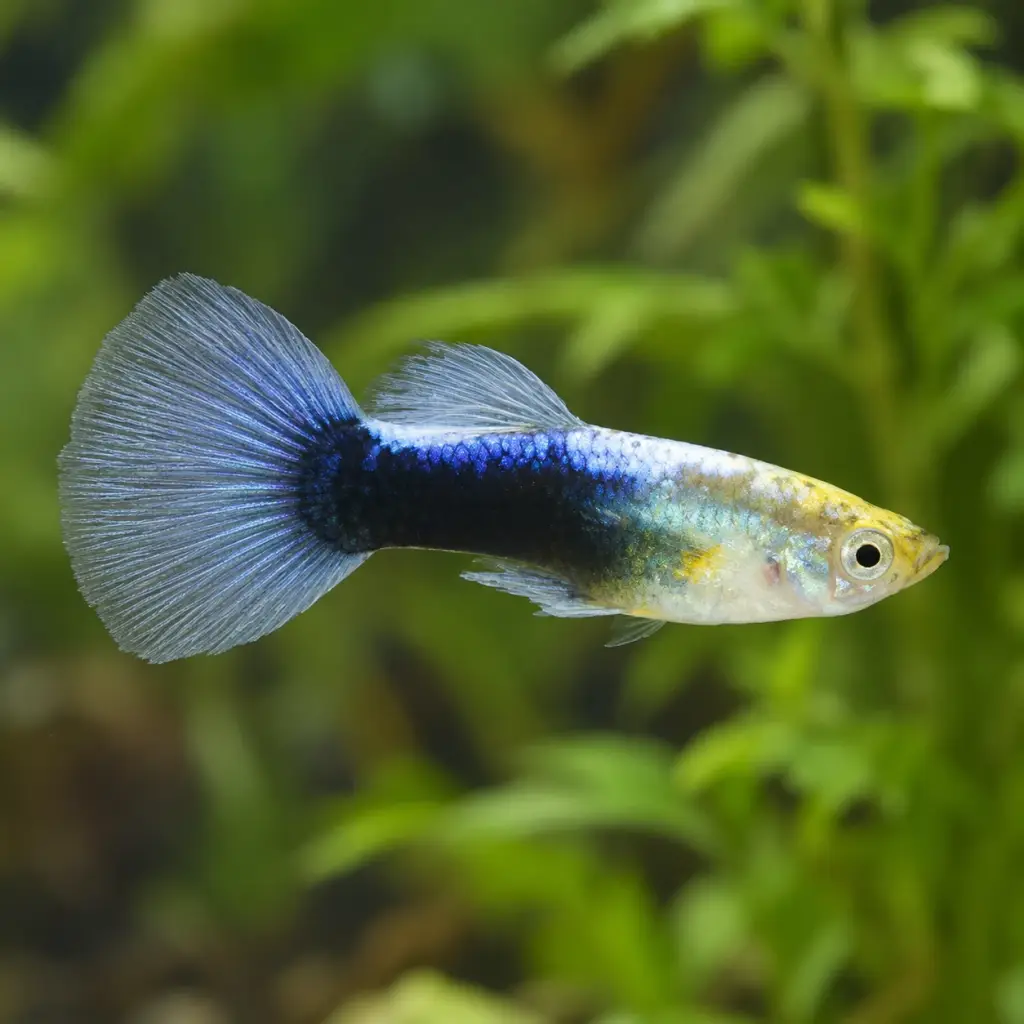
What are blue guppies? Blue guppies are fancy guppies (Poecilia reticulata) selected for blue, blue-green or turquoise coloration. The term describes a visible color, not one separate species or a guaranteed bloodline. Blue Grass, Blue Mosaic, Blue Topaz and Blue Moscow can show different patterns and body coverage. They all need normal guppy care: a cycled aquarium, stable moderately hard water and balanced feeding.
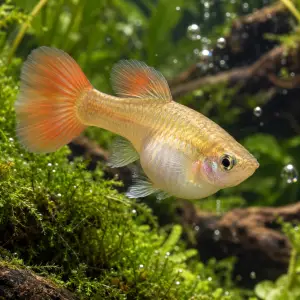
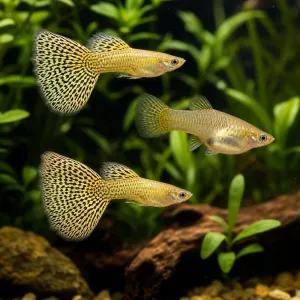
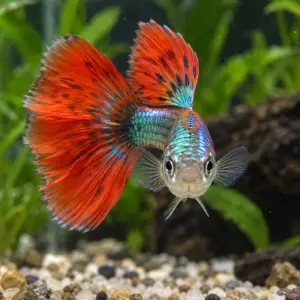
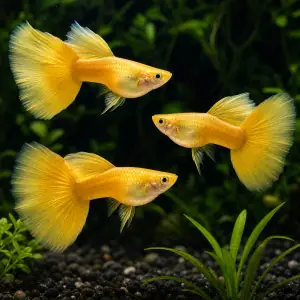
A fish with an almost solid deep-blue body, one with a spotted blue tail, and a turquoise male may all be sold as “blue guppies.” The right choice depends on which parts are blue, which markings are present and the appearance of the actual fish. This guide compares the main trade names, explains water and food care, and shows how to evaluate listings. The catalog illustrations discussed here are AI-generated representative images, not photographs of current stock.
How to recognize a blue guppy beyond its color name
Look at the body, dorsal fin and tail as separate features. Blue can be concentrated in the fins, cover much of the body, or appear as a blue-green sheen over other markings. Pattern words also matter: Grass often means many small fine speckles, Mosaic suggests larger irregular patches, and Cobra may mean snakeskin-like patterning. Tail shape labels such as delta or ribbon describe another dimension of the fish. A name combining two or three words is not proof that every specimen from that breeder has identical ancestry or markings.
- Color coverage: is the blue on the tail only, body only, or both?
- Pattern: are the marks fine grass-like flecks, larger mosaic patches or an extended body pattern?
- Fin style: note whether it is delta, ribbon, swordtail or another shape rather than confusing fin shape with color.
- Sex and maturity: males and females can look quite different, and young fish may not yet have adult coloration.
- Light and camera: compare full-fish views under neutral white light; blue LEDs and white balance can exaggerate the hue.
Our guppy color types guide explains the difference between overall color and fin/body patterns. The strain-specific guides go into individual named lines.
Blue Moscow vs Grass vs Mosaic vs Topaz: comparison
These are hobby and breeder naming conventions rather than universally standardized biological subspecies. A visual comparison can narrow down the look you want, but the exact fish, recent video and health history still determine whether a particular offer is suitable.
| Trade name | What you may see | Best question to ask |
|---|---|---|
| Blue Moscow | Deep blue to blue-green coverage over much of the body and fins | Does the current fish have the same depth of color, and how do females look? |
| Blue Grass | Blue-toned fins with small dots or grass-like fine flecks | Are the dots small and separate rather than bold Mosaic markings? |
| Blue Mosaic | Blue-toned tail with irregular dark patches or partly connected markings | Can I see the entire patterned tail under neutral lighting? |
| Blue Topaz | A bright blue, pale metallic or blue-green appearance defined by a particular seller or line | What does the breeder mean by Topaz, and can I see real fish? |
| Blue Turquoise | Blue-green body or fin areas, often with a reflective quality | How does the fish look in both cool and neutral light? |
| Half Black Blue/Tuxedo | Blue fins paired with a distinct dark rear-body patch | Is the dark patch intentionally part of the line rather than an all-blue body? |
For closer comparisons, consult the existing Blue Grass, Blue Mosaic, Blue Topaz and Moscow Guppy guides. This article is intended to help choose between the styles, not replace those more specialized guides.
Blue Grass: blue color with a dotted tail
Blue Grass typically refers to blue-toned fins covered with fine flecks, dots or short grass-like marks. It can be easier to identify the pattern in an adult male with the tail fully open, although breeders can select different intensities and body colors. If the pattern looks like bold fractured tiles rather than small separate flecks, the seller may instead call it Blue Mosaic. Always compare the actual specimen rather than assuming a close-up illustration shows every fish in that line.
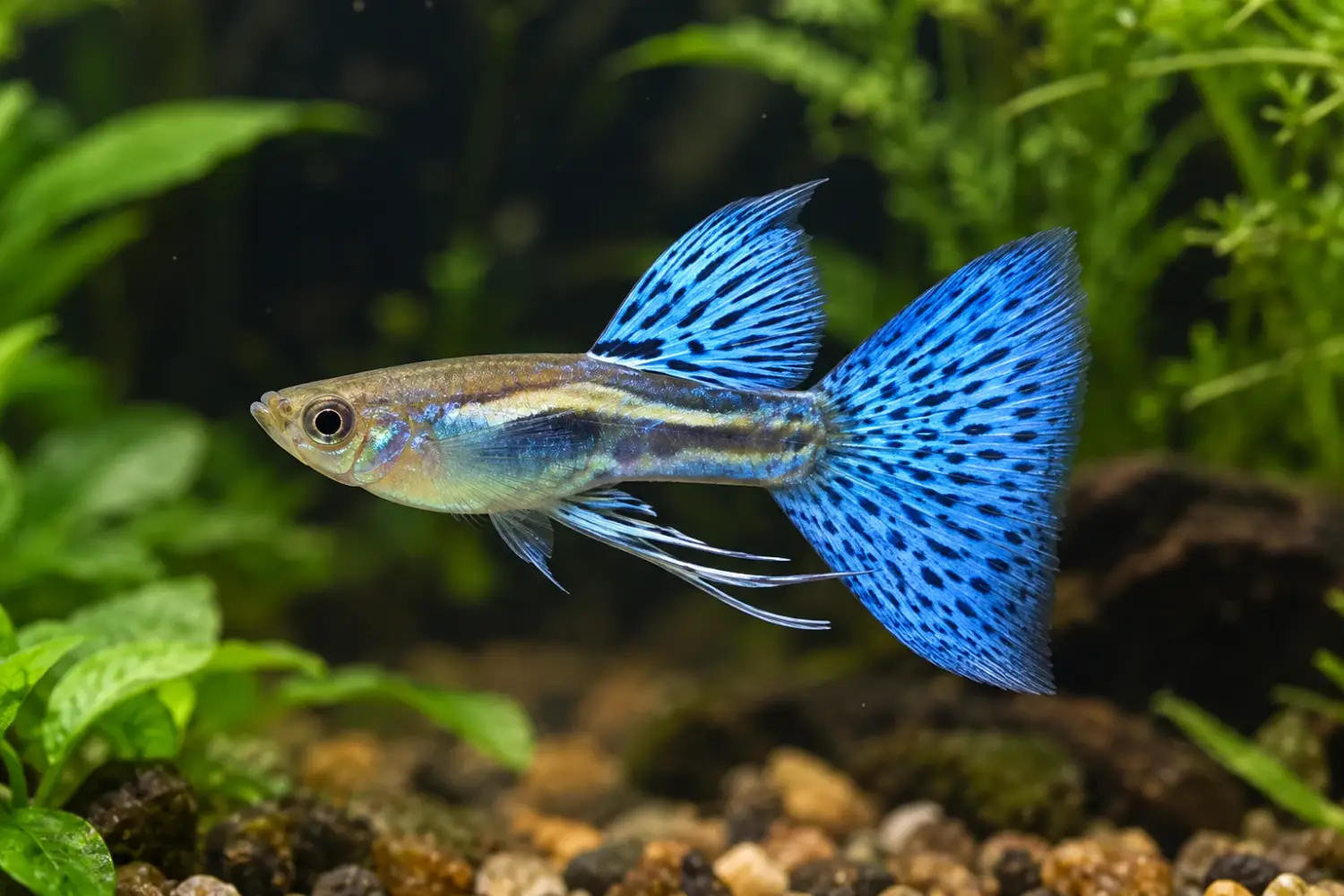
See the Blue Grass listing for one catalog naming example; request recent real-stock footage and current availability before ordering.
Blue Moscow: deep blue color and male/female differences
Blue Moscow usually refers to a breeding-line style selected for broad, relatively continuous blue coloration. Exact shade can appear midnight blue, turquoise or blue-green, depending on the fish and how light reflects from the scales and fins. Males and females can have noticeably different colors and fin shapes, so an adult male photograph should not automatically represent females in a pair or trio.
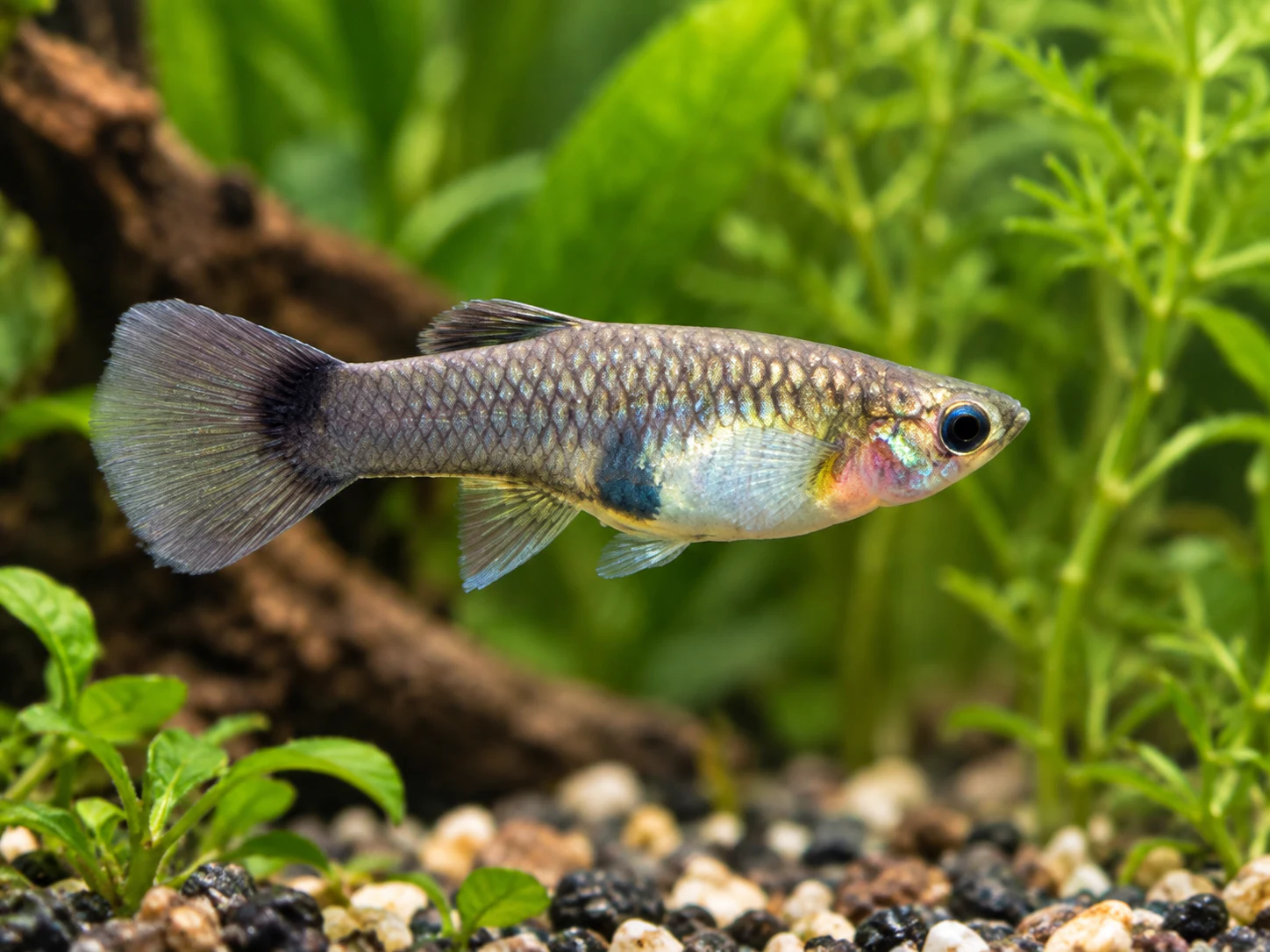
HiGuppy has a Blue Moscow Female listing. Confirm the offered fish, sex, maturity and actual color before treating it as an example of your future breeding group.
Blue Topaz, Turquoise and metallic shades
“Blue Topaz” and “Blue Turquoise” can describe brighter or more blue-green color presentations. Metallic-looking areas often change under different viewing angles; blue that looks vivid under a shop’s lighting may appear softer in a planted home aquarium. Fish coloration involves both pigments and reflective tissues, but a hobby label alone cannot identify the exact biological mechanism of one line.
A Blue Turquoise Male catalog page is one example of a blue-green style. Compare it with Blue Topaz and avoid treating every gray-blue, sky-blue or teal fish as the same variety.
Blue guppy care: tank size, water and filtration
Fancy blue guppies are still Poecilia reticulata and do not need a special “Blue Moscow pH” or color-specific water additive. The species profile at Seriously Fish provides a broad temperature range of 17–28°C (63–82°F), pH 7.0–8.5 and general hardness 8–30 dGH. The OATA care sheet for guppies and mollies also emphasizes a cycled aquarium and water-quality testing. For everyday fancy-guppy care, about 24–26°C (75–79°F), pH 7.2–8.0 and GH 8–15 dGH are practical targets for many setups when the source water supports them.
| Parameter | Suggested starting point | Important caveat |
|---|---|---|
| Tank volume | 10 US gal (38 L) for a limited adult group; 20 US gal (76 L) offers more room | Actual stocking depends on footprint, other fish, filter and expected fry |
| Temperature | Around 24–26°C (75–79°F) | Stability is more important than chasing a specific number |
| pH | Around 7.2–8.0 | Measure and avoid sudden chemical adjustments |
| General hardness | Around 8–15 dGH | Guppies typically suit moderately hard water; species range is wider |
| Ammonia and nitrite | 0 ppm in an established tank | Check whenever the aquarium is stocked or symptoms appear |
| Nitrate | Keep low and monitor the trend | Feeding, stocking, and tap-water baseline all influence changes |
| Flow and shelter | Gentle-to-moderate filtration and live plant cover | Avoid exhausting large-finned guppies with strong current |
A 10-gallon tank is not an unlimited fry nursery. Guppies breed readily when both sexes are present; plan future capacity. Regular dechlorinated, temperature-matched partial water changes are important; about 20–30% weekly is a starting routine for many tanks, but adjust according to real water tests and fish load. See HiGuppy water parameters for more on testing pH, hardness and nitrogen waste.
Aquascaping and lighting: how to see true blue
A blue-tailed guppy can stand out against fresh green plants, natural wood or a neutral substrate. Blue LEDs and strong digital saturation may change the apparent shade, however, so do not judge a seller’s fish from a heavily processed still image. Provide an ordinary aquarium lighting period, areas of shade and a consistent light source for comparing fish.
- Use neutral-white illumination when reviewing real-stock video.
- Look for normal swimming, breathing and fin condition before comparing pigment.
- Give guppies both plant cover and open swimming space.
- Avoid sharp plastic decorations and unnecessarily strong current near elaborate tails.
- Compare both sides and the whole tail, not just a cropped macro image.
A balanced, visually attractive aquarium does not require special blue lighting or expensive mineral treatments.
Feeding blue guppies for health and color
Offer an appropriately sized quality guppy flake or micro-pellet, with occasional safe brine shrimp or daphnia. Most healthy adults can be offered one or two modest meals daily, adjusting for age, water temperature and how much they actually consume. Nutrition supports condition and natural color expression but cannot guarantee the genetics of a solid Blue Moscow line or make every Blue Grass fry have matching dots.
Overfeeding creates waste that can harm water quality. Watch whether slower fish reach food and remove uneaten portions. For more detail, read the guppy feeding-frequency guide.
Why a blue guppy may look gray or lose color
Color can appear different due to lighting, viewing angle, age, sex or transport stress. Some blue-green reflective surfaces look more teal under warm light and grayer under another camera’s white balance. Do not infer disease from color alone; also do not ignore clamped fins, poor appetite or abnormal breathing. If those signs persist, test water promptly and seek appropriate fish-health advice.
| Observation | Possible explanation | Useful first step |
|---|---|---|
| Color changes between photographs | Camera white balance, LED spectrum or viewing angle | Compare full-fish footage under similar neutral light |
| Female looks less blue than male picture | Sex differences and breeder-line variation | Request real video of each offered fish |
| New fish is quiet and dull after travel | Transport and adjustment stress may be involved | Check tank temperature, water tests and suitable arrival care |
| Paleness plus gasping or clamped fins | Possible water-quality stress or other health issue | Check ammonia/nitrite and oxygenation promptly |
| Juvenile is not yet deep blue | Color may develop with age and vary genetically | Ask about maturity and actual parents/offspring |
See how to quarantine new guppies for receiving and observation guidance. Selling a fish as a “premium blue” is not evidence that it is free of disease.
Tankmates and keeping different blue lines together
Different blue strains can share a suitable community tank when stocking, size and behavior are appropriate. They can also interbreed with red, yellow or other guppies, so mixed-sex displays may produce fry with unpredictable colors. If preserving a named line matters, separate the breeding groups and document parentage. A male-only display avoids surprise broods but still requires sufficient space and behavior monitoring.
Avoid known fin-nipping fish, and consider adult size and water hardness before adding other species. See compatible guppy tankmates for a more complete discussion.
Breeding Blue Grass, Mosaic and Moscow guppies
Two blue-looking guppies do not guarantee that all their offspring will be equally blue or have the same tail pattern. Different lines have varied genetic backgrounds, and females can store sperm from past matings, complicating parentage. Choose healthy bodies, normal movement and strong husbandry before selecting for extreme blue coverage.
- Ask for recent examples of the exact breeding line and offspring.
- Track mating dates, parents, prior exposure of females and changing fry colors.
- Keep separate projects when preserving a particular Blue Grass, Mosaic or Moscow line.
- Allow juveniles time to mature before judging tail markings.
- Plan adequate grow-out tank space and responsible homes for healthy offspring.
Claims of “100% true-breeding blue fry” need actual evidence rather than relying solely on a color word. The strain consistency guide covers practical record keeping.
How to buy healthy blue guppies online
A blue guppy listing should help you inspect the exact fish available, not only illustrate a category. Images in a catalog may be AI-generated representative illustrations, older examples or seller photos; confirm which before paying. Use these checks to compare offers.
- Type and pattern: Blue Grass, Moscow, Mosaic, Topaz, Turquoise, Cobra or Half Black Blue.
- Actual fish: ask for recent neutral-light side-view video; check full body and fin shape.
- Identity: confirm sex, maturity, approximate size, fish count and whether the media is real stock.
- Health: evaluate breathing, posture, swimming, intact fins and feeding, not just saturated color.
- Breeding line: ask for parent and fry history if consistency matters; avoid unsupported genetic guarantees.
- Delivery: check weather, export/transshipper arrangements, total charges and written live-arrival terms.
HiGuppy currently has product pages titled Blue Turquoise Male, Blue Grass and Blue Moscow Female. These are examples of trade names, not proof of current inventory or a promised price or sex ratio.
Receiving blue guppies after shipping
Prepare a cycled aquarium or quarantine tank before the fish are shipped. Follow the receiving instructions appropriate to the route: long-distance bag-water chemistry can differ from local-store transport, so extended drip acclimation in opened shipping water is not universally best. Avoid adding old transport water to the aquarium, keep the surroundings calm and check fish behavior and water chemistry afterward.
A temporarily muted hue can occur with environmental changes, but severe gasping or inability to swim needs immediate water testing and appropriate help.
Blue guppy care and buying checklist
- I can distinguish blue body color from Grass, Mosaic and other tail patterns.
- I know the fish count, sex, size and real appearance of the offered group.
- My tank is cycled and water readings are suitable and stable.
- I have cover, gentle filtration and realistic space for future fry.
- I confirmed shipping costs, current availability and applicable arrival terms.
Frequently asked questions about blue guppies
Are blue guppies a separate species?
No. Blue guppies are fancy forms of Poecilia reticulata. Moscow, Grass, Mosaic and Topaz are hobby names for appearance or breeding lines, not different species.
What is the difference between Blue Grass and Blue Mosaic guppies?
Blue Grass commonly shows fine dotted or flecked marks in blue-toned fins. Blue Mosaic usually has larger irregular patches, although breeder naming can overlap. Compare the actual fish.
Are Blue Moscow and Blue Topaz the same strain?
Not automatically. Moscow often suggests more continuous body color, while Topaz is a seller label for a bright blue or metallic-looking style. The seller should show and define the line.
Do blue guppies need special water chemistry?
No. General guppy care in stable moderately hard water applies. About 24–26°C, pH 7.2–8.0 and GH 8–15 dGH can be everyday starting targets in a cycled tank, with ammonia and nitrite at zero.
Why can a blue guppy look teal or gray?
Lighting, viewing angle, camera processing, sex, age and individual appearance can change the perceived hue. Compare unedited video under neutral light.
Will two blue guppies always produce blue babies?
No. Fry can vary in color and fin patterns, and females can store sperm from previous males. Ask for documented results from the specific breeding line.
How can I buy a healthy blue guppy online?
Request recent footage of actual fish showing normal swimming, breathing, fins and body shape. Confirm strain, sex, age, availability, price, shipping and whether gallery photos are illustrative.
References and related guides
Species water ranges and basic husbandry: Seriously Fish — Poecilia reticulata and OATA — How to Look After Guppies and Mollies. Pattern and trade-name comparisons: Blue Grass, Blue Mosaic and Blue Topaz. Names and pictures alone do not certify genetic pedigree, show grade or exact current stock.
Behind the care guides
Care begins with steady systems
Our guppy guides focus on practical routines: keep water stable, observe fish closely and allow for natural variation.

Care systems
Steady water, thoughtful care
Gentle filtration and regular observation support healthy aquarium routines.

Natural variation
Every guppy is different
Color, size and fin shape vary with strain, age and each individual fish.
Editorial illustrations for context; they do not depict HiGuppy's exact facility or current fish stock.