The HiGuppy Journal
Panda Guppy Guide: Care, Breeding & Buying
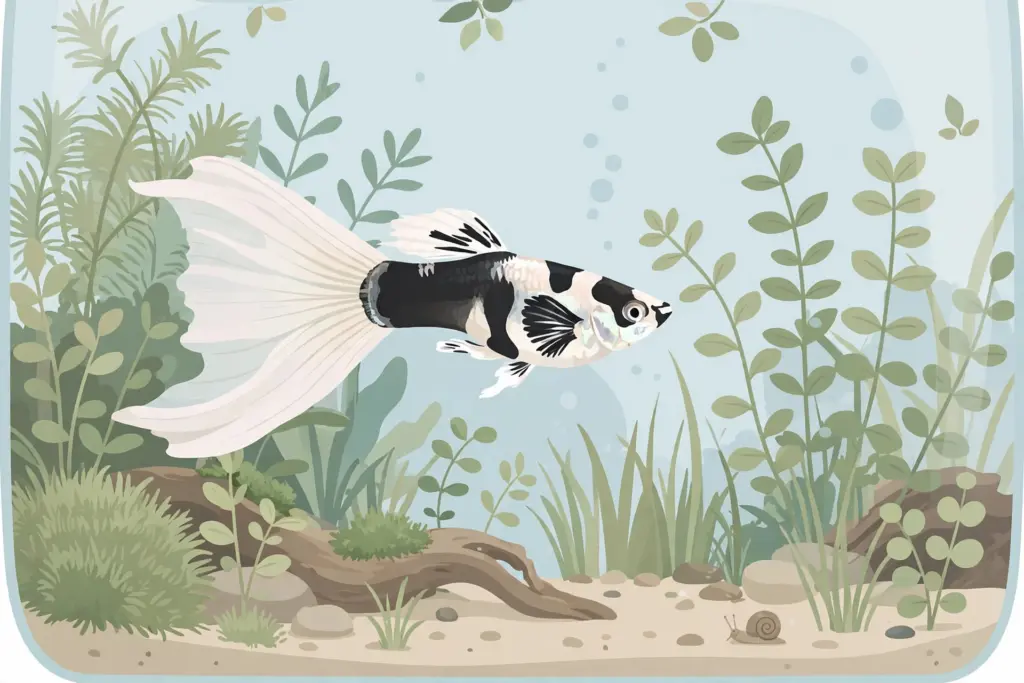
Quick answer: A panda guppy is a black-and-white fancy guppy prized for its dark body and pale, flowing tail. For a small group of smaller guppies, OATA recommends an aquarium of at least 45 L (about 12 US gal). This is a group-level reference rather than a fixed stocking formula; choose more space if the adult group, tankmates, filtration, tank dimensions or future fry require it. With stable water and gentle tank mates, a panda guppy shows bold contrast, breeds readily, and thrives for years.
The panda guppy is one of those fish that stops people in front of a tank. Its dark, almost ink-black body next to a pale, flowing tail looks like a tiny panda swimming through green plants. This guide covers the strain, the tank setup, feeding, color care, breeding, and what to check before you buy.
What Is a Panda Guppy?
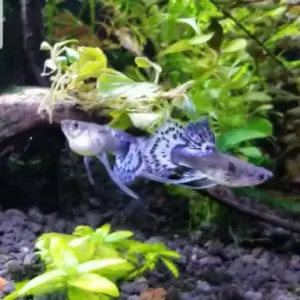
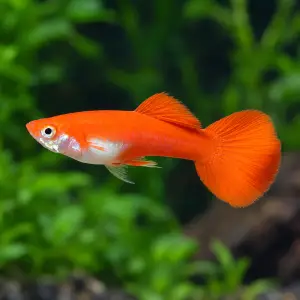
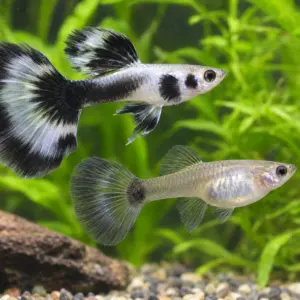
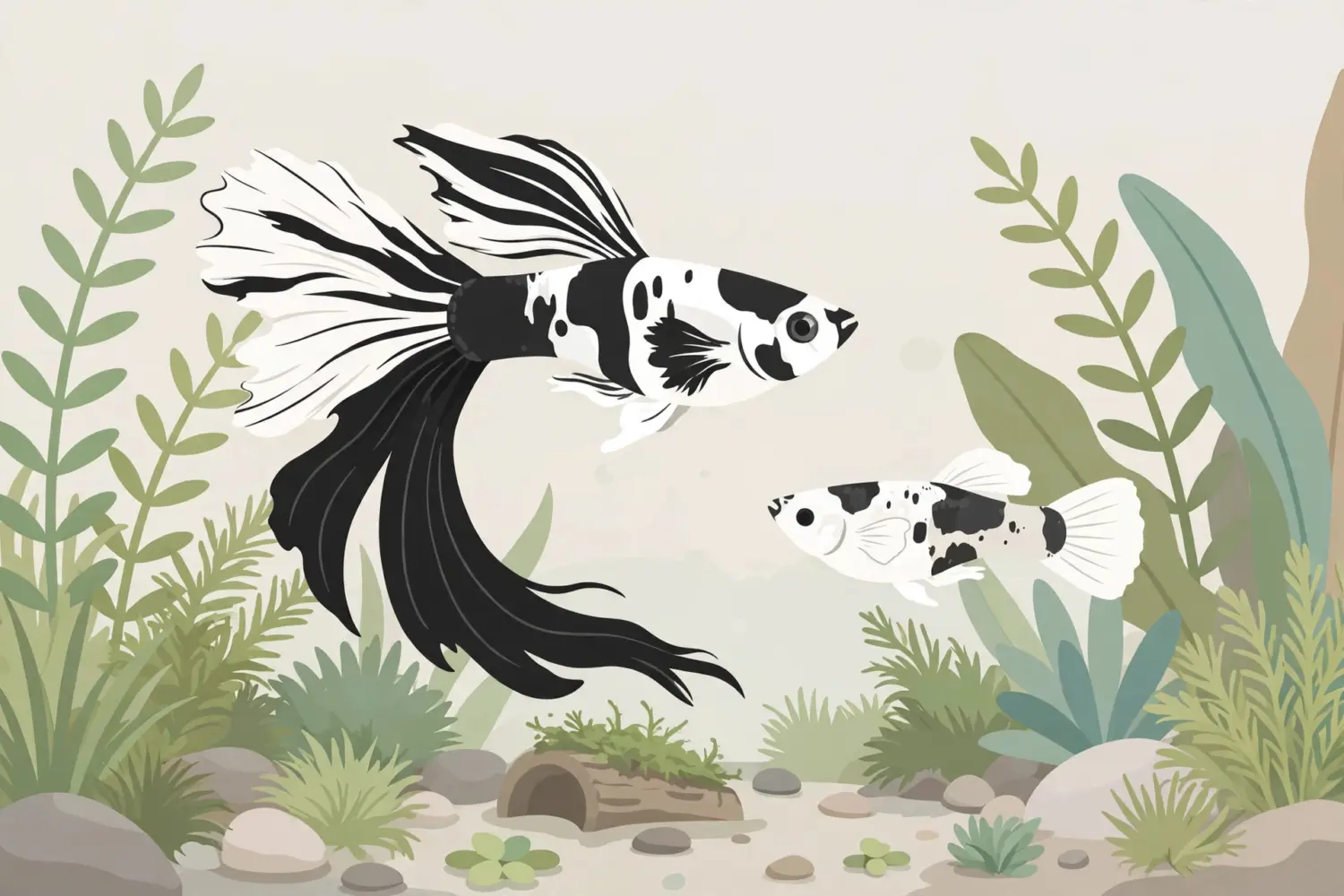
A panda guppy is a fancy guppy, Poecilia reticulata, selectively bred for a striking black-and-white pattern. The classic look is a dark body, often deep charcoal or black across the front half, paired with a pale white, cream, or very light grey tail. Some fish show a clean split between dark and light; others carry speckles or a dark dorsal fin.
It is not a separate species, and it is not a wild guppy. Wild guppies are small, greyish fish with only a hint of color on the males. The panda pattern comes from many generations of selective breeding, and it behaves like any other fancy strain for care, feeding, and breeding. That is good news for beginners: you need the same solid foundation every fancy guppy needs.
Males are smaller and slimmer, with the boldest contrast and longest tails; females are larger, rounder, and paler. Most keepers buy one male to two or three females, which spreads the male’s attention and gives you the option to breed later. To see where the panda fits among fancy patterns, read our guide to guppy color types and our overview of guppy pattern types.
Panda Guppy Care: Tank Setup and Water Parameters
Plan a well-cycled aquarium of at least 45 L for a small group of smaller guppies, following OATA’s guidance. This does not guarantee that a particular group size will fit; consider usable tank dimensions, filtration, tankmates and water-test results, and allow more room if you plan to raise fry.
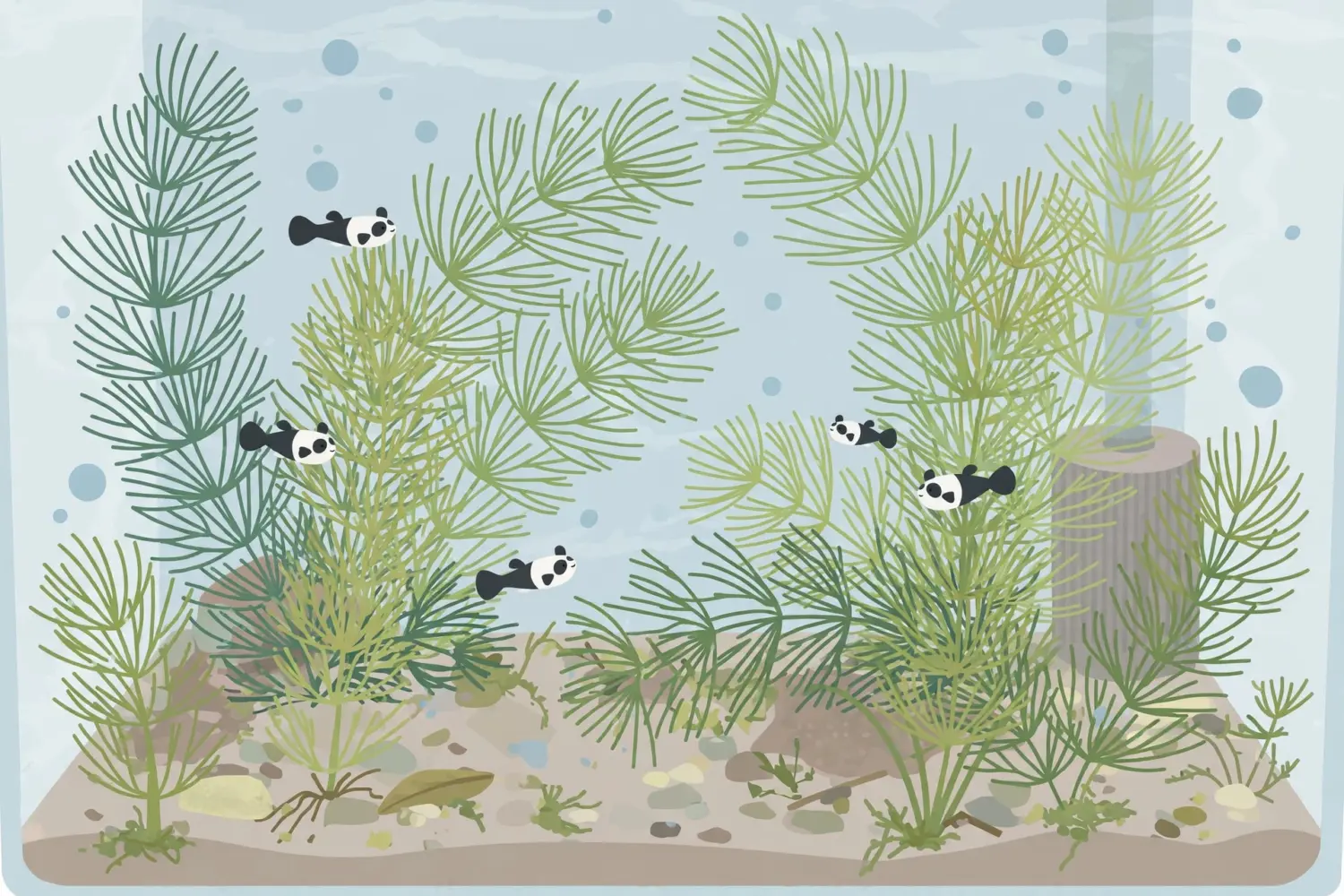
Plants are one of the best investments in a panda guppy tank. Java moss, guppy grass, hornwort, anubias, and java fern give fry somewhere to hide and make the black-and-white fish stand out against green. Fine-leaf plants are especially useful in a breeding tank, because newborn fry can slip into them and escape hungry adults. Start with easy low-light species tied to driftwood or rock, and add floating plants to diffuse the light.
Use gentle filtration: a sponge filter is ideal, filtering well without a strong current that batters long tails or sucks up tiny fry. A hang-on-back filter with a sponge over the intake works too. Never wash filter media in tap water, because chlorine kills the bacteria that keep ammonia and nitrite at zero. Run the light about eight hours a day, and use a dark substrate so the dark body reads clearly and the pale tail glows.
| Parameter | Target range | Why it matters |
|---|---|---|
| Temperature | 72–82°F (22–28°C) | Warm, stable water supports activity, appetite, and breeding |
| pH | 6.8–7.8 | Slightly alkaline to neutral water suits fancy guppies best |
| Ammonia | 0 ppm | Any ammonia burns gills and stresses the fish |
| Nitrite | 0 ppm | Any nitrite interferes with oxygen in the blood |
| Nitrate | Below 40 ppm | Keep it low with weekly water changes and plants |
| Tank size | At least 45 L (about 12 US gal) for a small group of smaller guppies; more may be needed as the group grows. | More water means more stable conditions and swimming room |
Test the water weekly with a liquid test kit and change 25–30 percent of the water every week, treating new water with a dechlorinator first. Stability matters more than an exact value: a panda guppy in stable water at 76°F will always look better than one in water that swings between extremes. Good tank mates include other peaceful guppies, endlers, small tetras, corydoras, and otocinclus. Avoid fin nippers such as tiger barbs and large or aggressive fish.
Feeding Your Panda Guppy
Feed a good-quality tropical flake or small pellet made for omnivores, in small amounts two or three times a day. Only offer as much as the fish can finish in about two minutes, and remove uneaten food so it does not rot and pollute the water. Overfeeding is one of the most common mistakes in guppy keeping: a slightly hungry guppy is a healthy guppy.
Add variety a few times a week: frozen or live daphnia, brine shrimp, and mosquito larvae are rich in protein, encourage natural hunting, and help condition a breeding pair. Blanched zucchini or spinach once a week adds fiber; remove uneaten vegetables after a few hours.
Diet does not create the black coloration of a panda guppy. The black pattern is genetic, set by the genes the fish inherited, and no food can paint black onto a fish that does not carry those genes. A good diet supports overall color health, so the black the fish already has looks deep and rich instead of faded. Fry need three to five small meals a day of powdered fry food, crushed flake, or newly hatched brine shrimp.
Keeping the Black Coloration Bold
Black coloration fades when a fish is stressed, sick, kept in poor water, or housed in a bare tank with nowhere to hide. If your panda guppy looks grey or patchy, check the water first, then look at the tank mates, the lighting, and the hiding places. Fixing the environment usually brings the color back within a week or two, because the pigment is still there and simply needs the fish to feel safe enough to show it.
Genetics set the ceiling for how dark a panda guppy can be, and environment decides how close the fish gets to that ceiling. Fish from a strong line hold deep black even in a busy community tank, while fish from a weaker line may fade to charcoal no matter what you do. That is why it is worth paying a little more for fish from a breeder who selects for dark, stable color. Keep the water clean, use a dark substrate and planted background, and avoid aggressive tank mates. None of this creates black where the genes do not exist, but together these habits let a good fish show its best color.
How to Breed Panda Guppies
Panda guppies breed as readily as any fancy guppy, so the real challenge is raising good fry and keeping the line healthy. For a small group of smaller guppies, OATA recommends at least 45 L; this does not establish capacity for a growing fry population. Plan additional space and responsible arrangements for the young before breeding. The ratio matters: a single male chasing a single female all day will exhaust her, while two or three females spread his attention. Choose the darkest male with the cleanest tail you can find, and females from the same line with good body shape.
Condition the breeders for a couple of weeks with live or frozen foods, clean water, and a temperature toward the warmer end of the normal range. A healthy female develops a dark gravid spot near her anal fin, and her belly swells as the fry grow. Gestation lasts about 21–30 days. When she is close to giving birth, her belly looks almost square from the side and she may hide in the plants. Move her to a separate planted breeding tank, or make sure the main tank is heavily planted: adults, including the mother, will eat newborn fry.
A typical brood is 20–60 fry, although a young first-time mother may have fewer and a large, mature female may have more. The fry are tiny, pale, and almost transparent at first, and the panda pattern develops over the first few weeks. Raise them like this:
- Week 1: Planted tank with a sponge filter. Feed powdered fry food or newly hatched brine shrimp three to five times a day. Change 10–15 percent of the water every two or three days.
- Week 2–3: The fry grow quickly and start to show color. Add crushed flake and small frozen foods.
- Week 4–6: Tell males from females by body shape and the developing gonopodium. Separate the sexes to control breeding, and move the fry to a larger grow-out tank if crowded.
- Week 8–12: The young fish reach near-adult size and their panda pattern becomes clear. Select the darkest males and best-shaped females for your next breeding group.
One rule matters more than any other: avoid heavy inbreeding. Breeding brother to sister again and again to fix the black pattern weakens the line: inbred guppies tend to be smaller, less fertile, more prone to bent spines and deformities, and more likely to lose color. A healthier approach is line breeding with occasional outcrossing to an unrelated panda guppy from another breeder, then selecting the best offspring back toward the panda look. Never breed a fish with a visible deformity.
Panda Guppy Buying Guide: What to Check Before You Buy
Buying well is half the hobby: a healthy fish from a good line settles in quickly, while a weak fish will struggle no matter how good your tank is. Use this checklist every time you buy.
- Active swimming: The fish should swim steadily and explore, not sit on the bottom, gasp at the surface, or list to one side.
- Intact fins: Fins should be whole and smooth, free of tears or fraying.
- No clamped fins: Fins held tight against the body signal stress or illness. Skip any fish with clamped fins, even the darkest one in the tank.
- Clear eyes: Eyes should be bright, clear, and symmetrical, with no cloudiness, bulging, or white patches.
- Clean body: The body should be smooth and free of white spots, fluffy patches, or raised scales.
- Good body shape: Choose a straight spine and a body in proportion to the tail. Avoid bent spines or pinched waists.
- Bold, even color: Pick fish whose black is solid and even and whose pale tail is clean.
Ask the seller where the fish came from and whether they were bred locally or imported; locally bred fish are often hardier because they are already used to your tap water. If you are buying a pair, ask whether the male and female are related, because that helps you plan breeding without heavy inbreeding. Price varies with quality: a young panda guppy from a pet shop may cost only a few dollars, while a show-quality pair from a specialist breeder costs considerably more.
Quarantine new fish before adding them to your main tank. A simple quarantine tank with a sponge filter, a heater, and a hiding spot is enough. Keep the new panda guppy there for two to four weeks, watch for signs of illness, and treat only if you see a problem. This protects every fish you already own from parasites and disease a new arrival might carry.
Common Mistakes to Avoid
The most common mistake is keeping a panda guppy in a tank that is too small or too bare: a male in a tiny bowl may survive, but he will not thrive, his color will fade, and his fins will suffer. The second mistake is skipping the cycle — adding fish to a brand-new tank before beneficial bacteria have established means ammonia spikes and often losses in the first week. Cycle the tank first, test the water, and only then add the guppies. Other frequent mistakes are overfeeding, mixing in fin nippers, and breeding without a plan. Finally, do not expect a panda guppy to look like a photograph on day one: new fish need a week or two to settle and color up.
Panda Guppy vs Other Fancy Strains
The tuxedo guppy is the panda’s closest cousin, with a dark front half and a colored rear half, but the tuxedo usually carries a colored tail in red, yellow, or blue, while the panda pairs its dark body with a pale tail. The Japan Blue guppy is another contrast strain, but its blue is metallic and shimmering rather than the stark black-and-white of the panda. If you like bold tails, the different guppy tail types — delta, fan, and veil — change the look of any color. For beginners, our easy guppy strains for beginners guide puts the panda alongside other forgiving strains.
The panda guppy is a good choice if you want a fish that looks dramatic without needing specialist care. It is hardy, peaceful, and easy to feed, and it breeds readily with plants and clean water. It is less forgiving than a plain feeder guppy on water quality, because the black shows stress clearly. For the species behind every fancy strain, the Poecilia reticulata profile on Seriously Fish is a useful authoritative reference on wild origins, habitat, and care needs.
Frequently Asked Questions About the Panda Guppy
How big does a panda guppy get?
A male panda guppy typically reaches about 1.5 inches (around 4 cm) including the tail, while a female grows larger, often about 2 to 2.5 inches (5–6 cm). Size depends on genetics, food, and tank space.
Is the panda guppy good for beginners?
Yes. Its care is standard fancy-guppy care, and it is peaceful, hardy, and easy to feed. For a small group of smaller guppies, OATA recommends an aquarium of at least 45 L (about 12 US gal). This is a group-level reference rather than a fixed stocking formula; choose more space if the adult group, tankmates, filtration, tank dimensions or future fry require it. Avoid overfeeding and quarantine new fish.
How long does a panda guppy live?
With good care, a panda guppy typically lives about two to three years, although some well-kept fish live longer. Lifespan depends on genetics, water quality, diet, and stress.
Why is my panda guppy losing its black color?
Usually stress, poor water quality, illness, or genetics. Check ammonia, nitrite, and nitrate first, then look for aggressive tank mates, sudden temperature changes, or a lack of hiding places. If the water is clean and the fish is otherwise healthy, the cause may be genetics, because diet cannot create black the fish does not carry.
Can panda guppies live with other guppies?
Yes, panda guppies live happily with other peaceful guppies and will interbreed with them, so keep that in mind if you want to keep the panda line pure. Mixed-strain offspring show a mix of colors rather than clean panda markings. For pure panda fry, keep the panda group in its own tank or separate the sexes.
Final Thoughts
A panda guppy earns its place in a planted tank: bold without being difficult, striking without needing specialist care, and rewarding whether you keep a single show male or breed a line over several generations. For a small group of smaller guppies, OATA recommends an aquarium of at least 45 L (about 12 US gal). This is a group-level reference rather than a fixed stocking formula; choose more space if the adult group, tankmates, filtration, tank dimensions or future fry require it. Keep the water stable, offer a varied diet and choose compatible tankmates. Buy carefully, quarantine new fish, and avoid heavy inbreeding.
Behind the care guides
Care begins with steady systems
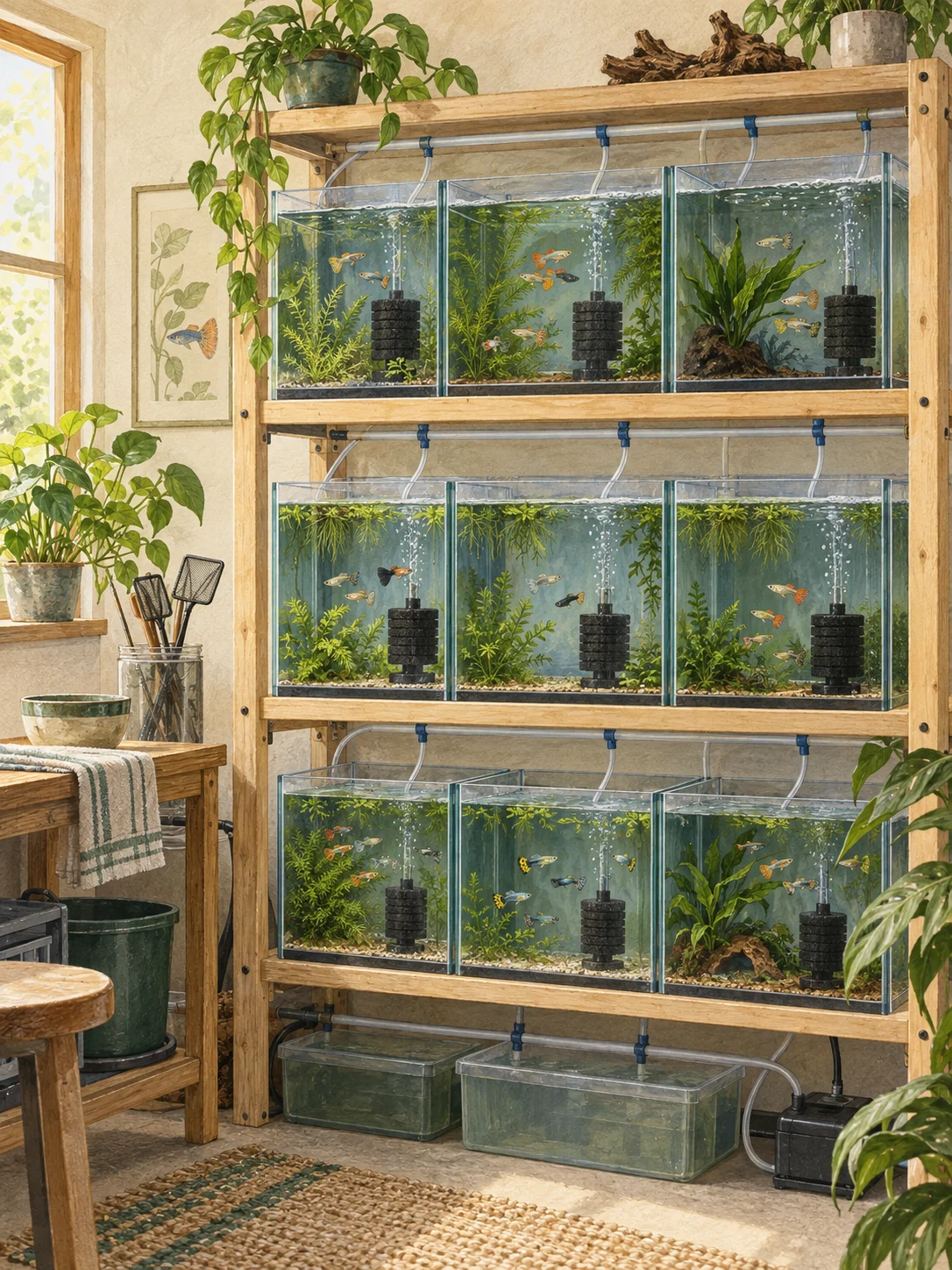
Our guppy guides focus on practical routines: keep water stable, observe fish closely and allow for natural variation.
Care systems
Steady water, thoughtful care
Gentle filtration and regular observation support healthy aquarium routines.
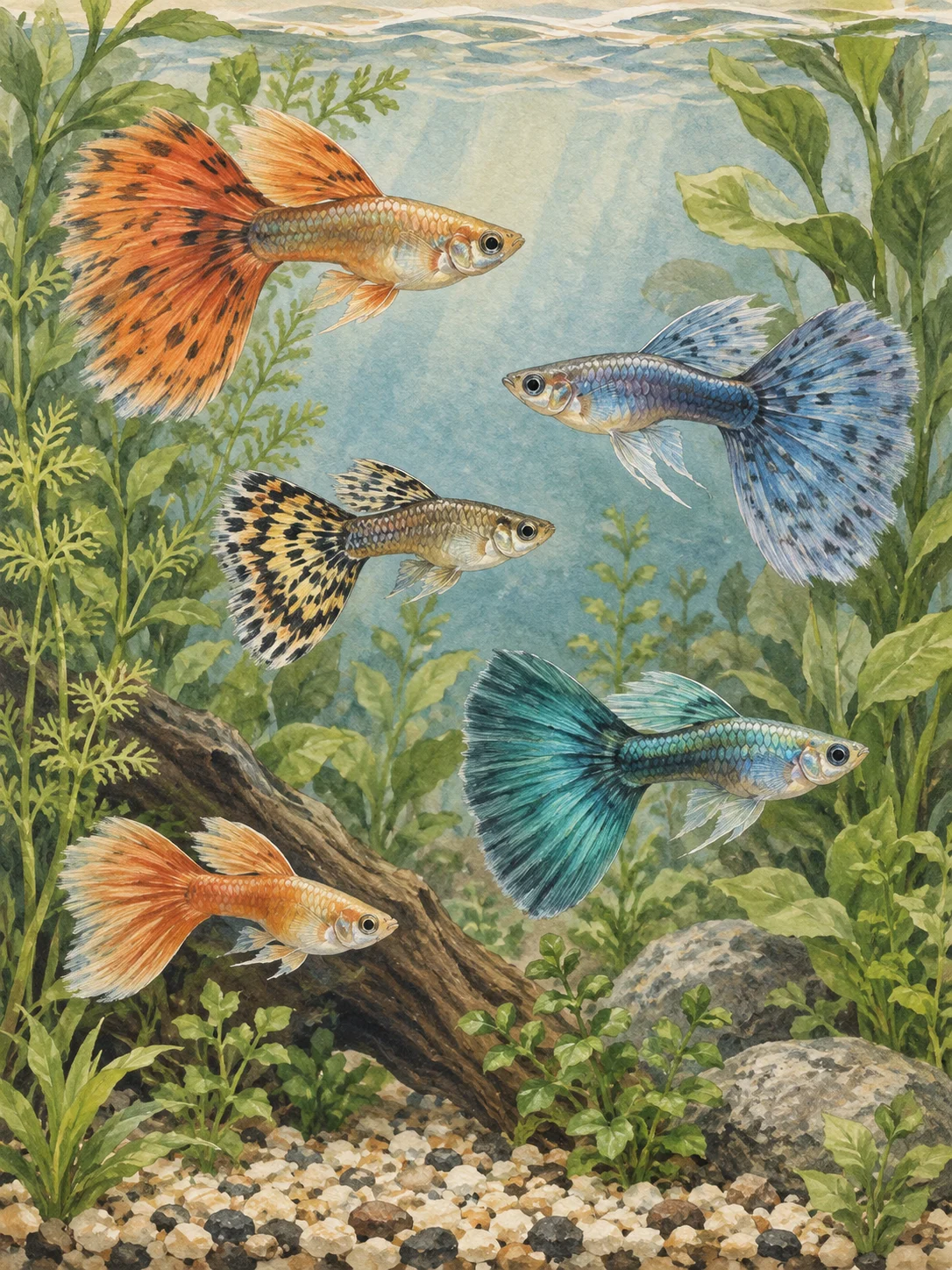
Natural variation
Every guppy is different
Color, size and fin shape vary with strain, age and each individual fish.
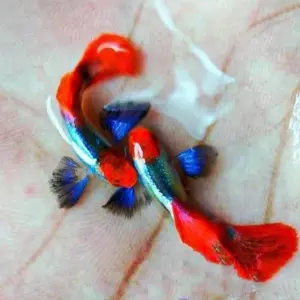
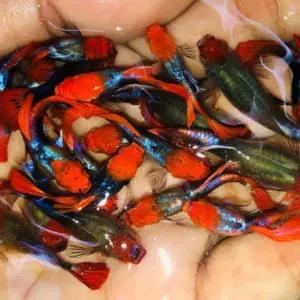
Editorial illustrations for context; they do not depict HiGuppy's exact facility or current fish stock.