The HiGuppy Journal
Japan Blue Guppy: 7 Proven Care, Breeding & Buying Secrets
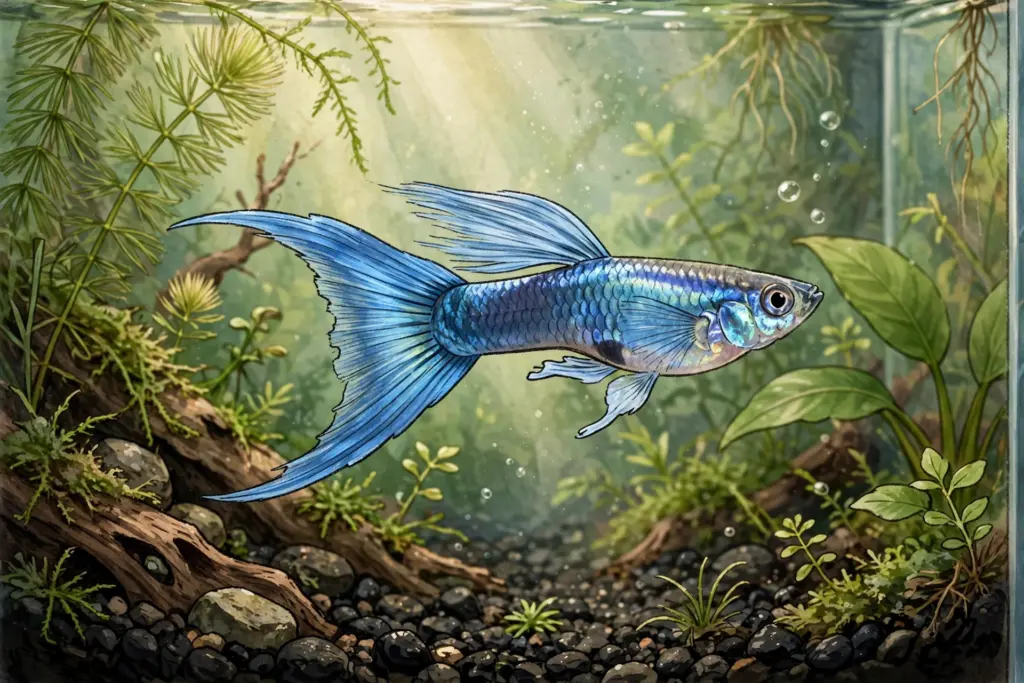
Quick answer: A Japan Blue guppy is a selectively bred fancy guppy line famous for its vivid metallic-blue body — most often sold in the double-sword tail form, though the blue can also be bred onto other tail shapes. It needs the same stable tropical water as other guppies — 72–82°F (22–28°C), pH 6.8–7.8, ammonia and nitrite at 0 ppm — plus a planted tank, a varied diet rich in carotenoids, and gentle tank mates that will not nip its flowing fins.
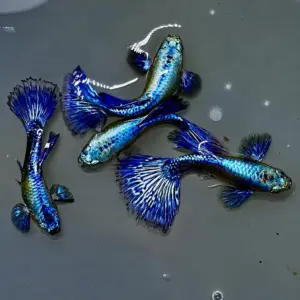
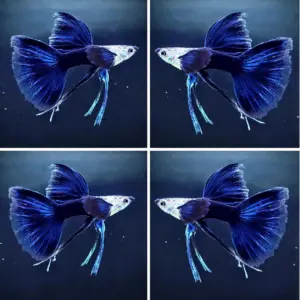
Few fancy guppies stop a room the way a japan blue guppy does. Under good light, the male’s body glows a deep metallic blue from nose to tail, and the double-sword tail — two long, pointed extensions from the top and bottom of the caudal fin — gives him a silhouette no other common strain quite matches. This guide covers everything you need to keep, breed, and buy this striking strain with confidence: its origins and genetics, exact tank and water requirements, feeding for color, breeding notes, and the checks that separate a quality fish from a disappointing one.
What Is a Japan Blue Guppy?
The Japan Blue is a line-bred fancy guppy that takes its name from the metallic-blue coloration; that shade can be bred onto several tail forms, with the double-sword being the most common commercial form. Its exact origin is uncertain — tidy origin stories, including claims of Blue Moscow descent, should be treated as unproven. In the widely sold Double Sword lines, breeders selected generation after generation for two traits at once: an intense, even blue coloration across the body and fins, and the double-sword tail shape. The result is a fish that looks almost painted — a solid blue body, often with a subtle metallic sheen, paired with a tail that extends into two elegant points.
Because the Japan Blue guppy descends from blue Moscow-type lines, its color comes from structural blue pigmentation layered over a dark body, rather than from red or yellow pigments. That matters for keepers: the blue can look washed out under poor lighting or in stressed fish, and it deepens dramatically under bright, full-spectrum light and a dark substrate. If you have kept other fancy strains, the different guppy tail types are worth comparing — the double sword is one of the more demanding tail shapes to maintain, since long fin extensions are the first thing fin-nippers target and the first thing to fray in rough water flow.
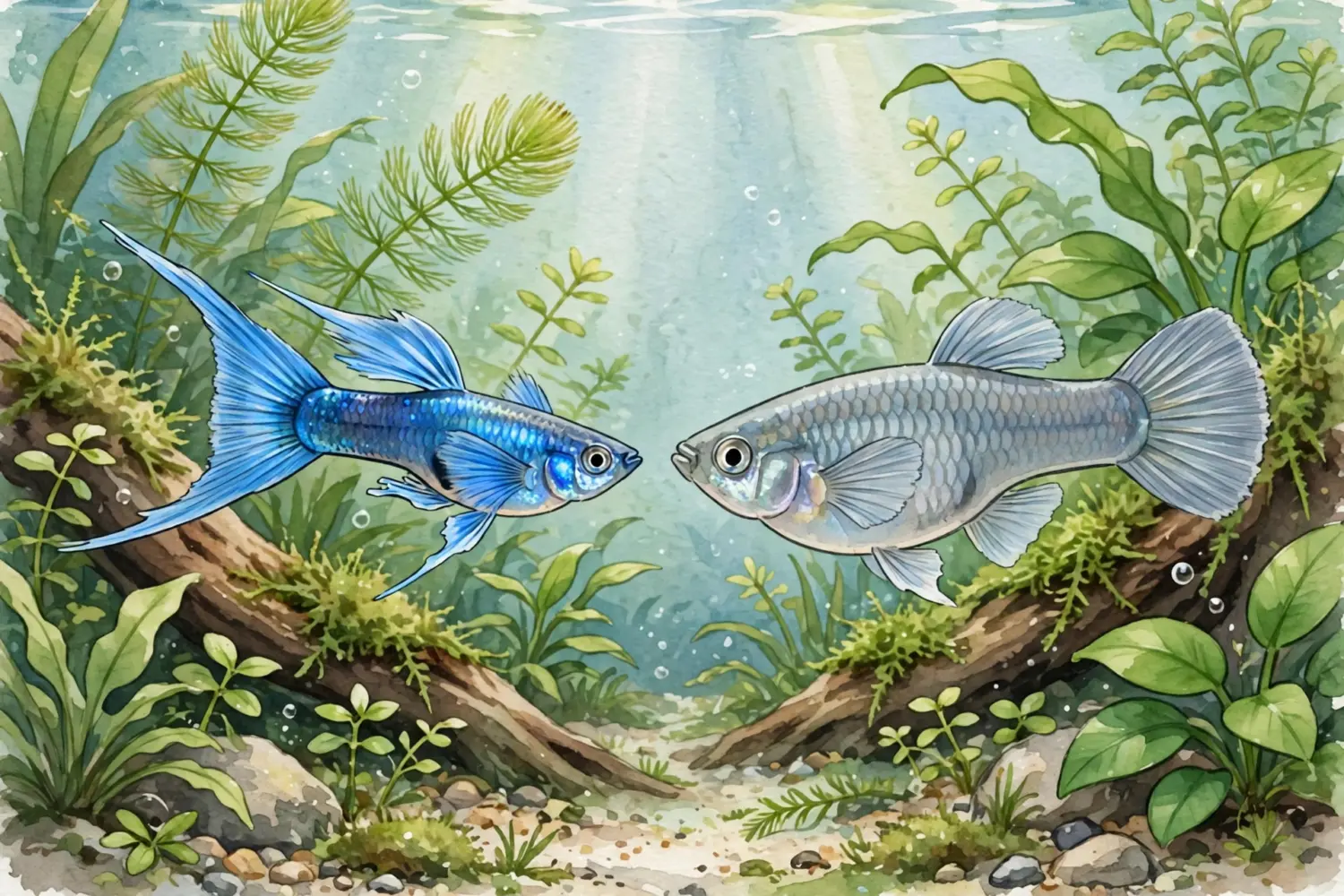
The male japan blue guppy is the show fish. Males reach about 1.5–2 inches (4–5 cm) including the tail and carry the full blue coloration and double-sword shape. Females are larger, around 2–2.5 inches (5–6 cm), and usually much plainer; in double-sword lines the tail is typically rounded, though female tail shape varies by line; a good female may show a blue tint on her fins, but she will never match the male’s intensity.
Male vs Female Japan Blue Guppy Traits
| Trait | Male | Female |
|---|---|---|
| Size | 1.5–2 in (4–5 cm) including tail | 2–2.5 in (5–6 cm) |
| Color | Intense metallic blue body and fins | Grey-blue body, faint blue tint on fins |
| Tail | Double sword — two pointed extensions | Rounded, short fan tail |
| Anal fin | Pointed gonopodium | Rounded, fan-shaped |
| Role | Display fish | Carries and passes on the blue line |
Japan Blue Guppy Care Requirements
Despite the exotic look, the japan blue guppy is a hardy tropical fish — provided its water stays stable. Guppies tolerate a range of conditions, but the blue coloration and the long double-sword fins both suffer quickly when water quality slips. Consistency matters more than chasing a perfect number: sudden swings in temperature or pH stress the fish far more than a steady value at either end of the range.
| Parameter | Recommended Range | Notes |
|---|---|---|
| Temperature | 72–82°F (22–28°C) | Aim for 76–78°F (24–26°C) for best color and activity |
| pH | 6.8–7.8 | Stable pH matters more than the exact value |
| Ammonia | 0 ppm | Any reading above zero needs an immediate water change |
| Nitrite | 0 ppm | Toxic even at low levels; a cycled filter is essential |
| Nitrate | Below 40 ppm | Keep under 20 ppm for the best fin condition |
| Water hardness | 8–12 dGH (moderately hard) | Guppies prefer harder water; very soft water can stress them |
| Tank size | 10 gallons (38 L) minimum | 20 gallons (75 L) or more is better for a breeding group |
These ranges match the established care parameters for Poecilia reticulata, the wild guppy species from which all fancy strains descend; a detailed species profile from Seriously Fish confirms the same temperature and pH windows for the species as a whole (Seriously Fish — Poecilia reticulata). Cycle the tank fully before adding fish, test the water weekly with a liquid test kit, and change 25–30% of the water every week. A cycled sponge filter or a hang-on-back filter with a gentle flow is ideal: strong currents force the males to fight the water all day and can tear the sword extensions.
Tank Setup for a Japan Blue Guppy
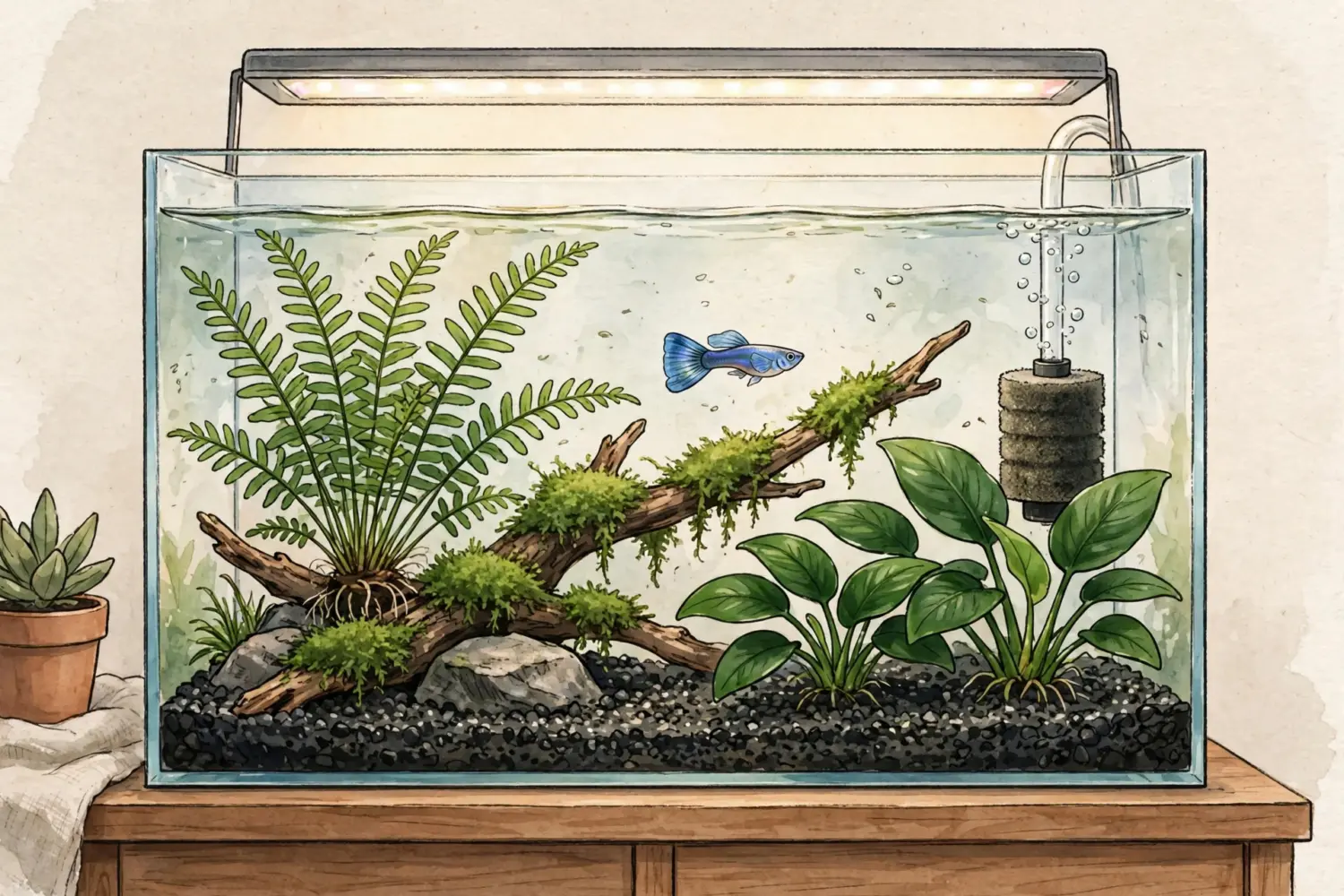
A good Japan Blue setup is a planted community tank with calm water and places to rest. Start with a dark substrate — dark gravel or aquasoil makes the blue coloration pop in a way light sand never will, and it also helps shy new fish settle faster. Add live plants such as Java fern, Anubias, hornwort, and Java moss. Dense planting serves three purposes: it gives females and fry hiding places, it softens the water flow, and it absorbs nitrates between water changes.
Lighting deserves a little thought. Full-spectrum LED lighting in the 6500K range shows off the metallic blue best, but avoid blasting the tank with light for more than 8–10 hours a day or you will be fighting algae.
Decor should be smooth. Rough rocks and sharp driftwood edges can snag and split the double-sword tail, so run your hand over every decoration before it goes in — if it catches your skin, it will catch a fin. Leave open swimming space in the front third of the tank; males display best when they have room to flare and turn.
Best Tank Mates for a Japan Blue Guppy
- Peaceful community fish: neon tetras, ember tetras, Corydoras catfish, and otocinclus are all safe companions.
- Other guppies: fine in a community, but keep Japan Blues in their own tank if you plan to breed them — crossing with other strains dilutes the blue line.
- Shrimp and snails: cherry shrimp and nerite snails make excellent cleanup crew, though shrimp fry may occasionally be eaten.
- Avoid: tiger barbs, serpae tetras, bettas, and any known fin-nipper. A single nip can permanently deform a sword tail.
Stocking follows the usual guppy rule of about one fish per gallon as a starting point, but a 10-gallon tank comfortably holds one male and two or three females, or a small group of males only if you want a display tank with no breeding. If you are new to the strain, the beginner-friendly guppy strains guide is a useful comparison — Japan Blues are not difficult, but they reward the keeper who keeps the water steady and the tank calm.
Feeding a Japan Blue Guppy for Color and Health
Color in a japan blue guppy is built from two things: genetics and diet. Genetics sets the ceiling, but a poor diet will keep a fish well below it. Feed small amounts two to three times a day, only what the fish finish in about two minutes, and vary the menu across the week.
- High-quality flake or micro-pellets as the daily staple — choose a formula made for tropical community fish, with fish meal or whole fish as the first ingredient.
- Frozen or live foods twice a week: daphnia, brine shrimp, and mosquito larvae add protein and trigger natural hunting behavior. Rinse frozen foods before feeding.
- Vegetable matter: blanched zucchini, spinach, or spirulina-based flakes once or twice a week aid digestion and support the blue sheen.
- Color-enhancing foods: foods rich in carotenoids and astaxanthin — often sold as color-enhancing flakes — help maintain pigment intensity. They support the color the fish already has; they cannot create blue in a fish that lacks the genetics.
In a japan blue guppy tank, overfeeding is the most common beginner mistake and the fastest route to poor water quality. Uneaten food decays, ammonia spikes, and the first casualty is usually fin condition — the sword tips fray and the blue fades.
Breeding the Japan Blue Guppy
The japan blue guppy breeds as readily as any guppy, which is both the joy and the challenge: keeping the line true takes more discipline than getting fry. Females can store sperm for several months and produce a new batch of fry roughly every 28–30 days, with broods of 20–50 fry from a healthy adult female. If you want to preserve the double-sword trait and the deep blue color, breed selectively rather than letting every fish in the tank reproduce.
Set up a dedicated breeding tank of at least 10 gallons with plenty of Java moss or a breeding box. Move a selected pair — the best-colored male with the longest, most symmetrical swords, and a female from the same line — into the tank, and remove the male after mating if the female seems stressed. Once fry appear, return the adults to the main tank: adult guppies will eat their own fry. Feed the fry powdered fry food or crushed flakes four to five times a day, plus newly hatched brine shrimp, and perform small, frequent water changes to support fast growth.
Color and tail shape start to show at around 6–8 weeks. This is the time to select for the line — separate the best males and females into your next breeding generation and move the rest into a display or community tank. Expect the blue to intensify steadily until the fish are about 3–4 months old, which is also when males reach their best display condition.
Common Japan Blue Guppy Breeding Mistakes to Avoid
- Crossing with other strains: a single cross with a red or yellow strain can take several generations to breed back out of the line.
- Breeding females too young: wait until females are at least 3–4 months old; younger mothers produce smaller, weaker broods.
- Overcrowded fry tanks: stunted fry never develop full color or full swords, no matter how good their genetics are.
- Ignoring the females: the female carries half the genetics. A dull, sickly female from another line will drag the whole next generation down.
Buying a Japan Blue Guppy: What to Check Before You Buy
A good japan blue guppy is not cheap, and the price difference between a quality pair and a mediocre one is usually visible if you know what to look for. Whether you buy from a local breeder, a specialty shop, or an online seller, run through this checklist before you pay.
Fin shape first. Look at the double sword from above and from the side. The two extensions should be roughly equal in length, straight, and free of splits, curls, or white frayed edges. Asymmetrical or bent swords are usually genetic or the result of past fin damage — either way, they will pass to the fry.
Color intensity second. The blue should be even and saturated across the body, not patchy or grey in the midsection. View the fish under white light, not the blue-tinted display lighting some shops use to flatter their stock. A fish that looks blue only under colored light will look grey in your tank at home. Ask to see the fish in a plain white container if the shop lighting looks suspicious.
Health signs third. The fish should swim actively with fins held open, eat eagerly, and show no white spots, clamped fins, swollen bellies, or stringy white waste. Avoid fish hovering at the surface gasping, or fish sitting on the bottom with folded fins — both are classic signs of stress or illness.
Buy the seller, not just the fish. A reputable breeder can tell you the line’s history, show you photos of the parent fish, and explain how they select for sword shape. Ask how long they have kept the line and whether they breed it true — a breeder who has kept Japan Blues for several generations is a far safer bet than a reseller who cannot name the source. If buying online, check recent reviews, confirm the seller’s live-arrival guarantee and shipping method, and be wary of prices far below the going rate: true Japan Blues take time to line-breed, and that work is reflected in the price.
Finally, quarantine every new fish for at least two weeks in a separate tank before adding them to your main display. This single habit prevents more disasters than any medication, and it gives new fish time to settle and show their true color before you judge the purchase.
Japan Blue Guppy FAQ
How much does a japan blue guppy cost?
Prices vary by quality and region, but expect to pay more for a japan blue guppy than for a common fancy guppy. A single young male from a pet shop often costs a few dollars, while a proven breeding pair from a dedicated breeder with long, symmetrical swords and deep color can cost several times that. Pay for the fish you can see — fin shape and color intensity — not for a strain name on a label.
Is a Japan Blue guppy good for beginners?
Yes, with one condition: you keep the water stable. Japan Blues need the same care as any guppy — a cycled tank, weekly water changes, and a varied diet — and they are forgiving of small mistakes. They are a poor choice for an uncycled tank or for a tank with fin-nipping tank mates, because their long sword tails are easily damaged.
How long does a Japan Blue guppy live?
With good care, Japan Blue guppies live about 2–3 years. Males often live slightly shorter lives than females because breeding and displaying take energy, and the long fins make them marginally more vulnerable to stress. Clean water, a varied diet, and a calm tank are the three factors that most extend their lifespan.
Can a Japan Blue guppy live with other guppy strains?
Yes, they can live peacefully with other guppy strains in a community tank — guppies are social and non-aggressive toward each other. However, they will interbreed freely, so if you want to keep the Japan Blue line pure, house them in a species-only or strain-only tank. A mixed tank is fine for display; a dedicated tank is required for breeding.
Why is my Japan Blue guppy losing its blue color?
Fading blue usually points to stress, poor water quality, or inadequate diet — in that order. Test ammonia, nitrite, and nitrate first, and correct any reading above zero with water changes. Then check for bullies in the tank and review the diet: a varied menu with frozen foods and a color-supporting staple helps. Blue also fades temporarily after shipping or a tank move, and it should return within a week once the fish settles.
Final Thoughts on the Japan Blue Guppy
The Japan Blue rewards the keeper who gets the basics right: stable water, gentle flow, good food, and peaceful company. In return, you get one of the most striking freshwater fish available to home aquarists — a living flash of metallic blue with a tail shape that no other common strain offers. Choose your fish carefully, give them a planted tank to show off in, and the line will repay you with color that deepens month after month.
Behind the care guides
Care begins with steady systems
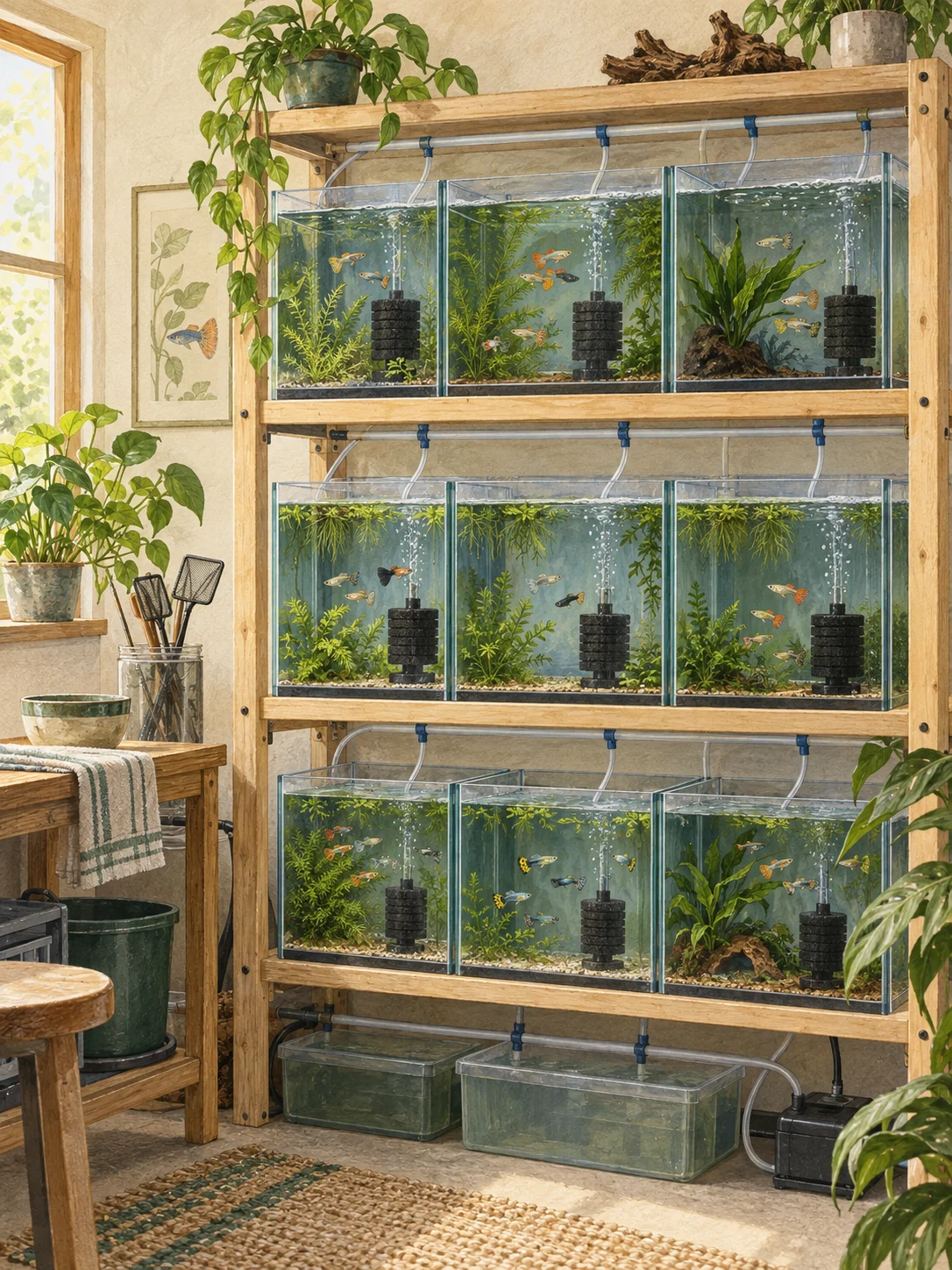
Our guppy guides focus on practical routines: keep water stable, observe fish closely and allow for natural variation.
Care systems
Steady water, thoughtful care
Gentle filtration and regular observation support healthy aquarium routines.
Natural variation
Every guppy is different
Color, size and fin shape vary with strain, age and each individual fish.
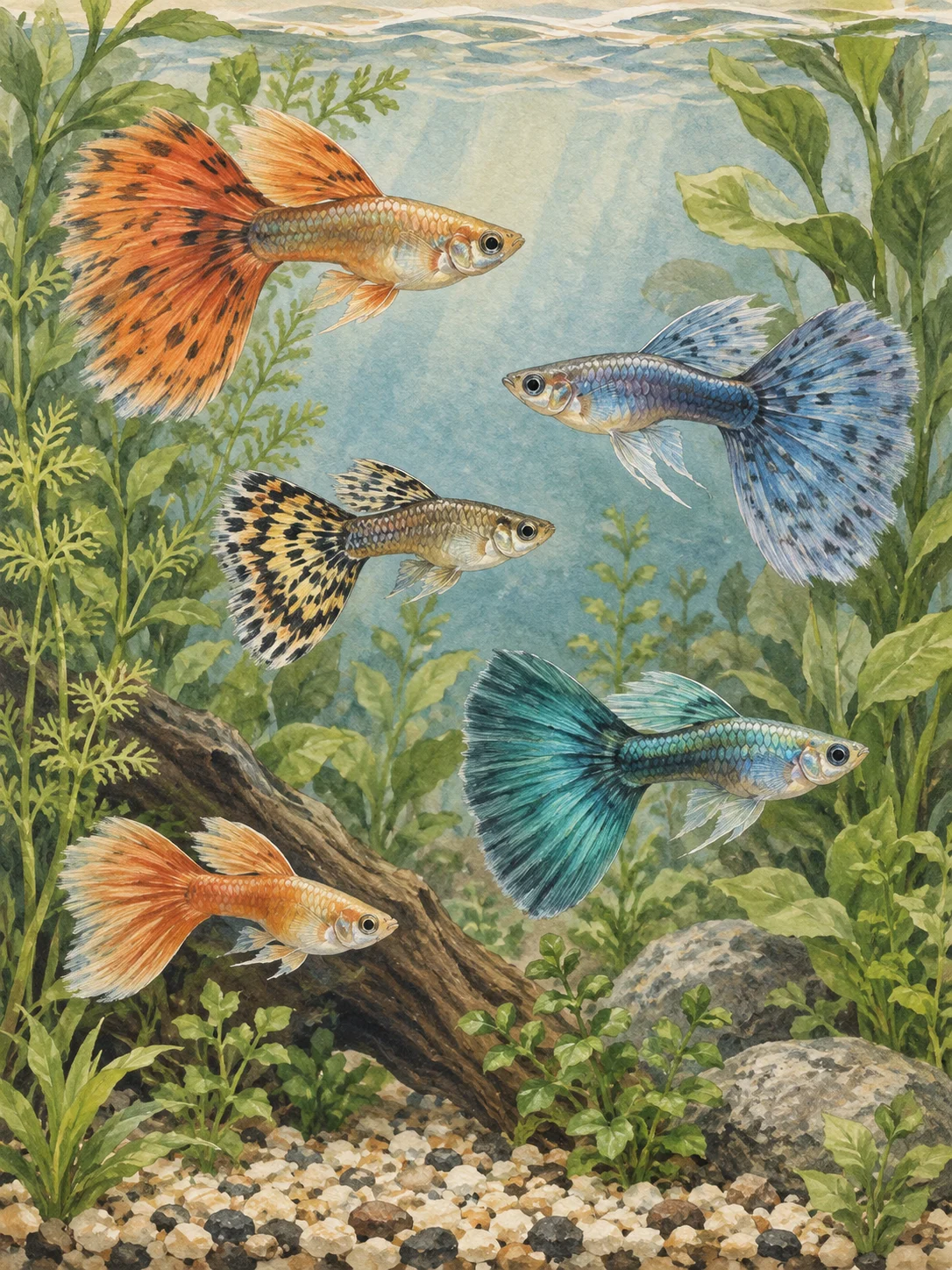
Editorial illustrations for context; they do not depict HiGuppy's exact facility or current fish stock.