The HiGuppy Journal
Betta Colors and Fin Types Explained

Betta names become easier to understand when you separate color, pattern, and fin form. “Dumbo” points to a fin feature. “Koi,” “Galaxy,” and “Marble” usually describe an appearance or pattern. “Samurai” is a commercial style label that needs a photograph and a seller's explanation. Several terms can appear in the same name because they describe different features.

Use this guide to read a listing, identify what attracts you, and ask more precise questions. It focuses on the ornamental bettas in the HiGuppy Betta category, rather than identifying wild species or predicting breeding results.
Read a Betta name in separate parts
A long product title can mix a color word, a pattern label, a fin description, and an individual nickname. Break it into three practical questions:
- What colors and markings are visible on this individual?
- Which fins does the name describe, and what can the media show?
- Which details are confirmed in the listing, such as the selection format and individual code?
Treat a memorable nickname as a way to identify the entry, not as evidence of a special biological trait. Words such as candy, super, and star need context from the seller. A short description of visible features often tells you more than a stack of names.
This overlap is recognized in research: a 2022 study of Betta diversity lists koi, candy, galaxy, and marble among commercial names associated with mosaic coloration. The useful takeaway is to examine the individual instead of assuming that every trade label marks a separate, precisely defined category.
Dumbo describes the pectoral fins
A Dumbo betta has enlarged paired pectoral fins, the fins near the gill covers. The related term elephant ear also refers to this feature. Both Betta morphology research on Dumbo fish and an earlier study of the elephant-ear phenotype describe enlarged pectoral fins.
Dumbo does not tell you the body color. A listing needs separate words or images to communicate its palette and tail appearance. Avoid identifying the feature from a large tail alone: the pectoral fins are the relevant pair.
The Dumbo Lavender reference candidate shows a large pale pectoral fin against a wine-lavender body, with pale borders on the other visible fins. That photograph illustrates why both parts of the name matter. Before selecting an individual, request a view of the other side and a video that makes both pectoral fins visible.
Samurai needs a closer look at the individual
For shopping, use Samurai as a starting point for a conversation about the pattern. Ask which visible features the seller means, then compare the scale coverage, dark areas, face, and fins. Do not assume the word establishes a fixed shade, an exact distribution of scales, or a documented lineage.
In the Samurai Blue reference candidate, the reviewed image shows bright blue and turquoise scales against dark areas, with blue lines extending through the fins. Describing those features makes the offer easier to understand than repeating the name alone.
Compare current images of Samurai listings side by side. Look at broad bright areas and the contrast between scales and the darker body. Choose the arrangement you like, while keeping sex, size, condition, and selection format as separate questions.
Koi is a useful pattern cue
When browsing Koi-labeled bettas, look for how contrasting patches are arranged across the body and fins. Record the colors you actually see rather than expecting one universal red, white, and black recipe. A product title can include several additional color or commercial terms, so the gallery should carry the detail.
The Koi Nemo Candy Multicolor reference candidate shows blue areas over a pale patchy body and fins with yellow, blue, and burgundy sections. Someone attracted to that combination should ask specifically about those colors and the opposite side. Simply asking for “a koi betta” leaves much more room for variation.
A practical comparison is to note the dominant body color, the largest contrasting patch, and the colors visible in the tail. This gives you a repeatable way to compare examples without assigning a show grade from a photograph.
Galaxy adds another description to examine
Read Galaxy as a prompt to inspect the bright, reflective-looking areas the seller is highlighting. Check whether those areas are small flecks, larger groups of scales, or broad sections in the photograph. Ask for a moving view if their appearance is central to your choice.
The Koi Red Galaxy reference candidate combines burgundy-red areas with turquoise scaling and strong blue-red tail contrast in the reviewed image. Here, the full name helps describe a combination of features. It does not establish a different tail form or guarantee that another Galaxy entry will match it.
Compare the ordinary side view with any close-up. A close crop may emphasize a small detail that looks less dominant when you see the whole fish. Use both views to understand the feature behind the name.
Marble is a broader visual description
Marble is commonly used for a patchy or mosaic appearance. Koi, Galaxy, and Marble labels can overlap, so a shopper may encounter different names for visually related fish. Ask for a plain description of the particular example when two listings use the terms differently.
A photograph records appearance at one point in time. It cannot establish a permanent future pattern or prove which variants a fish carries. For buyers, the practical step is to request current images and avoid purchasing on an unsupported promise that every marking will remain fixed.
Keep genetic claims separate from shopping shorthand. The 2022 Betta diversity study found multiple genomic regions associated with the mosaic pattern it studied. That finding does not identify the genetics of a retail fish from its name or photograph. This guide therefore uses the labels to describe what buyers can inspect.
Tail shape is a separate part of the description
Color words do not tell you whether a fish has short or long fins, or the outline of its tail. Plakat is used for short-finned forms; Halfmoon describes a tail spread associated with a semicircular outline. The IBC also recognizes a shortfin Halfmoon form, showing why a buyer should read the whole description rather than assuming every Halfmoon is long-finned. See the IBC exhibition standards, shortfin Halfmoon section.
If a specific tail form matters, ask the seller to confirm the form and provide suitable media. A tail that is folded, turning away, or partly outside the frame is difficult to compare. A pleasing image alone is insufficient to certify compliance with a show standard.
The Super Yellow reference candidate is a useful example of why color and form should be described separately. Its reviewed photograph shows yellow fins with a fine dark edge and dark scale outlines on the body. “Super Yellow” communicates a color-led name; it does not independently confirm a tail classification or a uniformly yellow body.
Use the names to build a shortlist
Start with the feature you would most enjoy watching: contrasting patches, reflective-looking scales, pale pectoral fins, or a predominantly yellow palette. Then compare that feature in current photographs and video. Keep the fish's individual code with your notes so similar names do not get mixed up.
Next, check how each entry is offered. A reference entry, representative selection, and exact-fish listing answer different buying needs. The five candidates discussed here are visual references; availability and the final offer must be confirmed on their product pages. For the purchasing checklist, read how to choose a betta online.
Practical name-reading checklist
- Separate visible colors, pattern labels and fin descriptions.
- Check current media of both sides and ordinary swimming.
- Clarify the exact-fish or representative selection format.
- Ask the seller to explain any grade, lineage or award claim.
- Keep the individual listing code with the features you want verified.
Frequently asked questions
Can a betta have more than one of these names?
Yes. A title can describe several features at once. Dumbo refers to pectoral fins, while color and pattern words add other information. Ask the seller to explain any combination that is unclear.
Does a Koi or Galaxy name prove the fish's genetics?
No. A commercial name and a photograph are insufficient evidence for a particular genetic makeup or breeding outcome. Use them to discuss appearance, and request documented provenance if that matters to your plans.
Which color or fin type is best?
There is no single best look for every keeper. Compare the visible features you prefer, the clarity of the listing, and your aquarium plans. A style name alone does not establish an individual's suitability or condition.
Behind the care guides
Care begins with steady systems
Our guppy guides focus on practical routines: keep water stable, observe fish closely and allow for natural variation.

Care systems
Steady water, thoughtful care
Gentle filtration and regular observation support healthy aquarium routines.

Natural variation
Every guppy is different
Color, size and fin shape vary with strain, age and each individual fish.
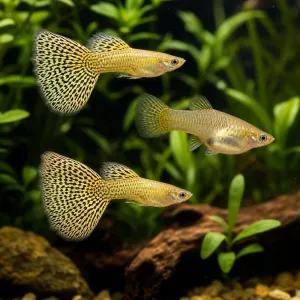
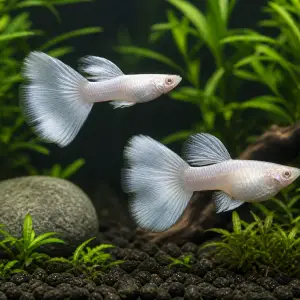
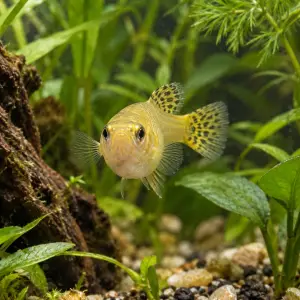
Editorial illustrations for context; they do not depict HiGuppy's exact facility or current fish stock.