Post-arrival support for a living fish
Guppy Health Support After Arrival
When a guppy arrives alive but shows a concern, HiGuppy can review the order timeline, clear media, exact water data, acclimation steps and aquarium conditions to identify the most appropriate support path.
Quick answer: Place the fish in a prepared quarantine aquarium, reduce disturbance, test the water, record breathing and swimming on video, avoid random medication and contact support with the complete timeline. This process is separate from DOA coverage and cannot replace diagnosis or treatment by an aquatic veterinarian.
Choose the correct support route
DOA and living-fish concerns use different evidence
| Situation | Correct next step |
|---|---|
| Fish appears deceased at delivery | Keep the affected fish in the original sealed bag, complete the required arrival evidence and follow the DOA Claim Process. |
| Fish arrives alive but appears stressed | Follow the Acclimation Guide, use quarantine, reduce disturbance and observe whether the fish stabilizes. |
| Living fish develops a concerning sign | Use the health-support checklist on this page and send exact water readings, clear video and the full timeline. |
| Multiple fish deteriorate or severe signs appear | Isolate affected fish, verify the environment and consider prompt aquatic-veterinary assistance rather than waiting only for order support. |
First actions
What to do when a living guppy looks unwell
Changing several variables at once can increase stress and make the cause harder to understand.
1
Move to quarantine
Keep the fish separate from established livestock in a prepared observation aquarium.
2
Reduce disturbance
Use subdued lighting, cover, gentle flow and minimal chasing or handling.
3
Test the water now
Record temperature, ammonia, nitrite, nitrate, pH and recent changes.
4
Record clear video
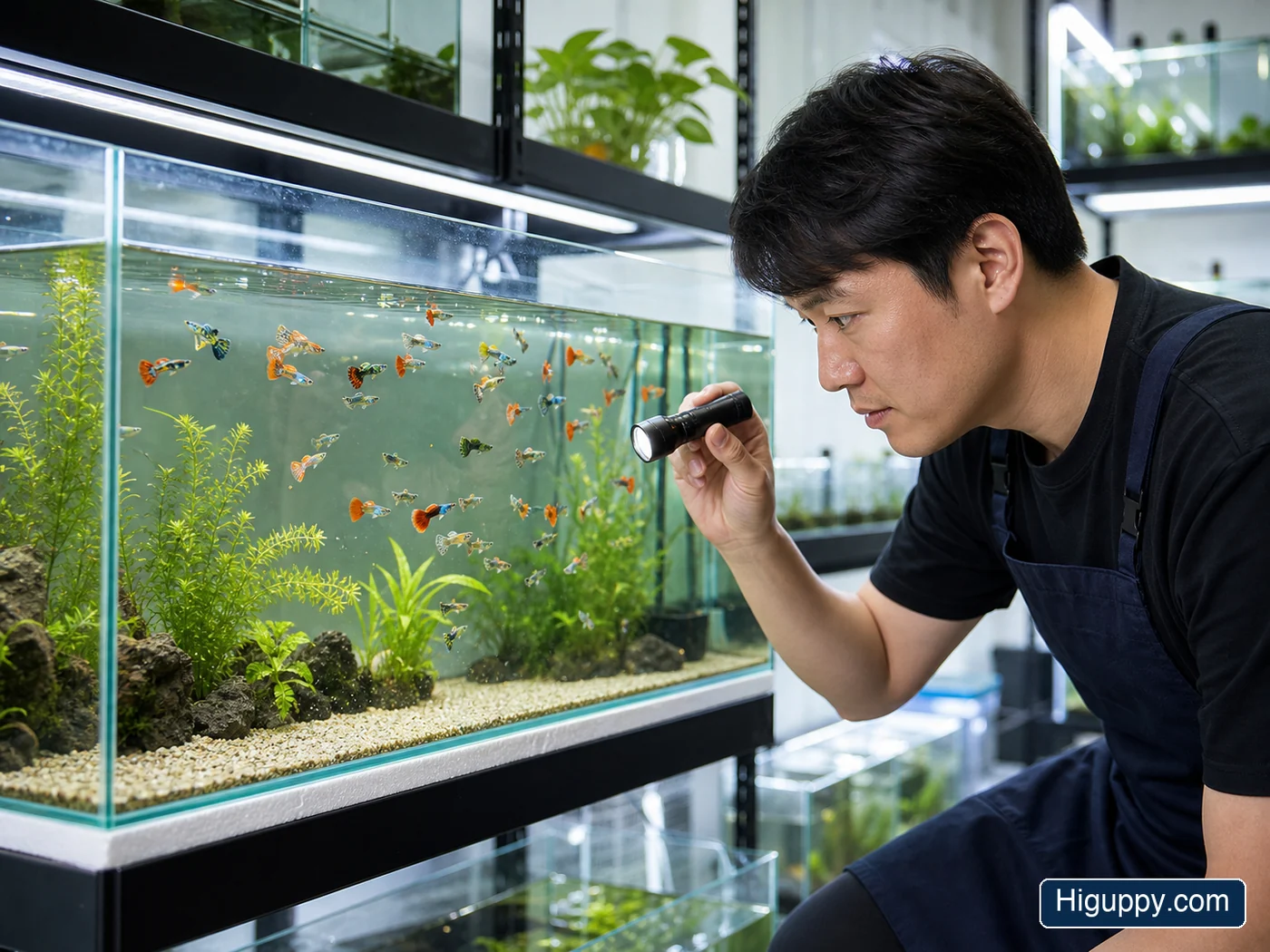
Show breathing, swimming, posture, fins, the full fish and the aquarium environment.
5
Avoid random medication
Do not combine treatments before reviewing water, history and the complete pattern of signs.
6
Send one complete message
Include the order timeline, media, test values, tank details and anything already added.
Interpret signs in context
Temporary shipping stress versus a concerning pattern
| Observation | How to respond |
|---|---|
| Muted color shortly after arrival | Darkness, motion and environmental change can temporarily reduce color. Keep conditions stable and observe the overall pattern. |
| Brief hiding or reduced appetite | Reduce disturbance, verify water and monitor whether behavior improves as the fish settles. |
| Rapid breathing or surface gasping | Check temperature, oxygenation, ammonia and nitrite immediately; record clear video and seek help if severe or persistent. |
| Loss of balance, spiraling or inability to hold position | Isolate the fish, verify the environment and consider prompt professional assistance when the sign is significant. |
| Visible wounds, swelling, spots, film or rapid deterioration | Document clearly, keep equipment separate and avoid delaying appropriate professional evaluation. |
| Several fish show the same unusual pattern | Review water, equipment, toxins and potential contagious causes; treat this as more urgent than one isolated mild sign. |
Environment first
Check the aquarium before assuming disease
Poor water quality, low oxygen, abrupt temperature or pH change, crowding, aggression, toxins and equipment failure can resemble or worsen disease signs.
- Confirm the heater, filter and aeration are working.
- Record exact water-test values rather than “water is fine.”
- Check for chlorine, sprays, cleaning products, metals or other toxins.
- Review recent water changes, filter cleaning, new décor, livestock and medication.
- Observe whether tankmates are chasing, nipping or excluding the fish.
- Keep quarantine equipment separate whenever practical.
Support checklist
What to include in the first message
Complete information helps separate a shipment concern from acclimation, water-quality, equipment, aggression or husbandry issues.
Order and timeline
- Order number and buyer name
- Delivery date and receipt time
- When the sign first appeared
- Whether it is improving or worsening
Media and behavior
- Clear current photos
- Steady video of the full fish
- Breathing, swimming and posture
- Appetite, waste and visible changes
Water and equipment
- Temperature and tank size
- Ammonia, nitrite, nitrate and pH
- Filter, aeration and heater status
- Recent water-change history
Tank history
- Tank age and cycling history
- Tankmates and stocking
- Aggression or recent additions
- Whether the fish is quarantined
Acclimation
- Method and transfer time
- Temperature and water transition
- Whether bag water entered the tank
- Lighting and feeding after arrival
Products already used
- Water conditioner
- Salt or medication
- Dose and timing
- Any mixed or repeated treatments
Exact readings matter
Numerical water results and a short timeline are more useful than a general statement that the aquarium appears normal.
Realistic support limits
What HiGuppy can and cannot determine remotely
Support can review
- Order and shipment timeline
- Acclimation and tank history
- Water data and equipment
- Visible signs in submitted media
- Which HiGuppy policy or guide applies
- Whether more information is needed
Support cannot confirm from media alone
- A definitive pathogen
- An internal condition
- A reliable prognosis
- A complete treatment plan
- That every future problem is excluded
- Eligibility for a specific resolution before review
Professional examination, microscopy, culture or other testing may be needed when a definitive cause must be identified. Submitting a concern does not guarantee a refund, replacement or other specific outcome.
When not to wait
Professional aquatic veterinary help may be appropriate
Prompt professional assistance may be warranted for severe breathing distress, repeated loss of balance, significant injury, rapid deterioration, multiple unexplained losses, suspected poisoning or a potentially contagious problem affecting other fish.
HiGuppy support is not an emergency veterinary service
Do not delay appropriate professional care while waiting for an order-support response.
Frequently asked questions
Guppy health support FAQ
Is this the same as the Live Arrival Guarantee?
No. The DOA process applies to an eligible fish documented as deceased at delivery. This page concerns a fish that arrived alive and later shows a health concern.
Can HiGuppy diagnose a disease from a video?
Video can show useful signs but usually cannot establish a definitive pathogen or internal condition. Professional testing may be necessary.
Should I medicate immediately?
Not automatically. First verify water quality, temperature, oxygen, equipment, recent changes and the complete pattern of signs. Inappropriate treatment can add stress.
Why are water-test numbers required?
Breathing, appetite, posture and swimming problems can be caused or worsened by environmental conditions. Exact values provide more useful evidence.
What happens after I contact support?
HiGuppy reviews the available order record and submitted context, may request clarification and then explains the most appropriate next step or policy route.
Does a support request guarantee compensation?
No. Any resolution depends on the evidence, order terms, timing, shipment history, aquarium conditions and whether the concern can be reasonably evaluated.
Related guidance
Use the complete arrival and care process
DOA Claim Process
Sealed-bag evidence and claim steps for arrival loss.
Quarantine Process
Separation, observation and cross-contamination control.
Water Parameters
Core readings and stable ranges for guppy care.
Disease Signs Guide
Common visible signs and sensible first checks.
Send the timeline, video and exact water data together
A complete first message helps the support team review the concern more fairly while the fish is being observed in quarantine.
Last reviewed: July 17, 2026. This page provides order-support guidance and does not replace diagnosis or treatment by an aquatic veterinarian.