The HiGuppy Journal
Black Guppies: Full Black, Moscow and Tuxedo Compared
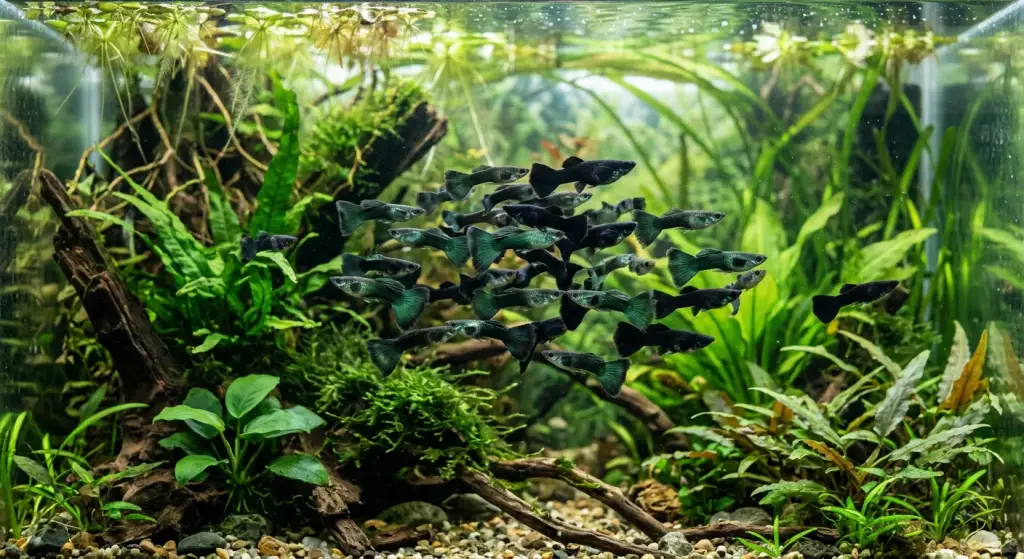
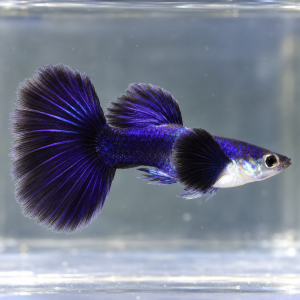
Black guppies are selectively bred guppies (Poecilia reticulata) with dark body or fin coloration. “Full Black” usually describes a fish dark across most of its body and tail, while “Half Black” or “Tuxedo” generally describes a darker rear body with a lighter front. Black Moscow and other labels can overlap; compare actual fish rather than assuming identical genetics or care.
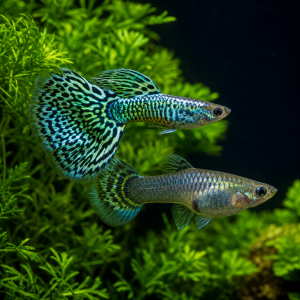
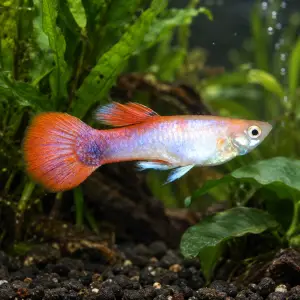
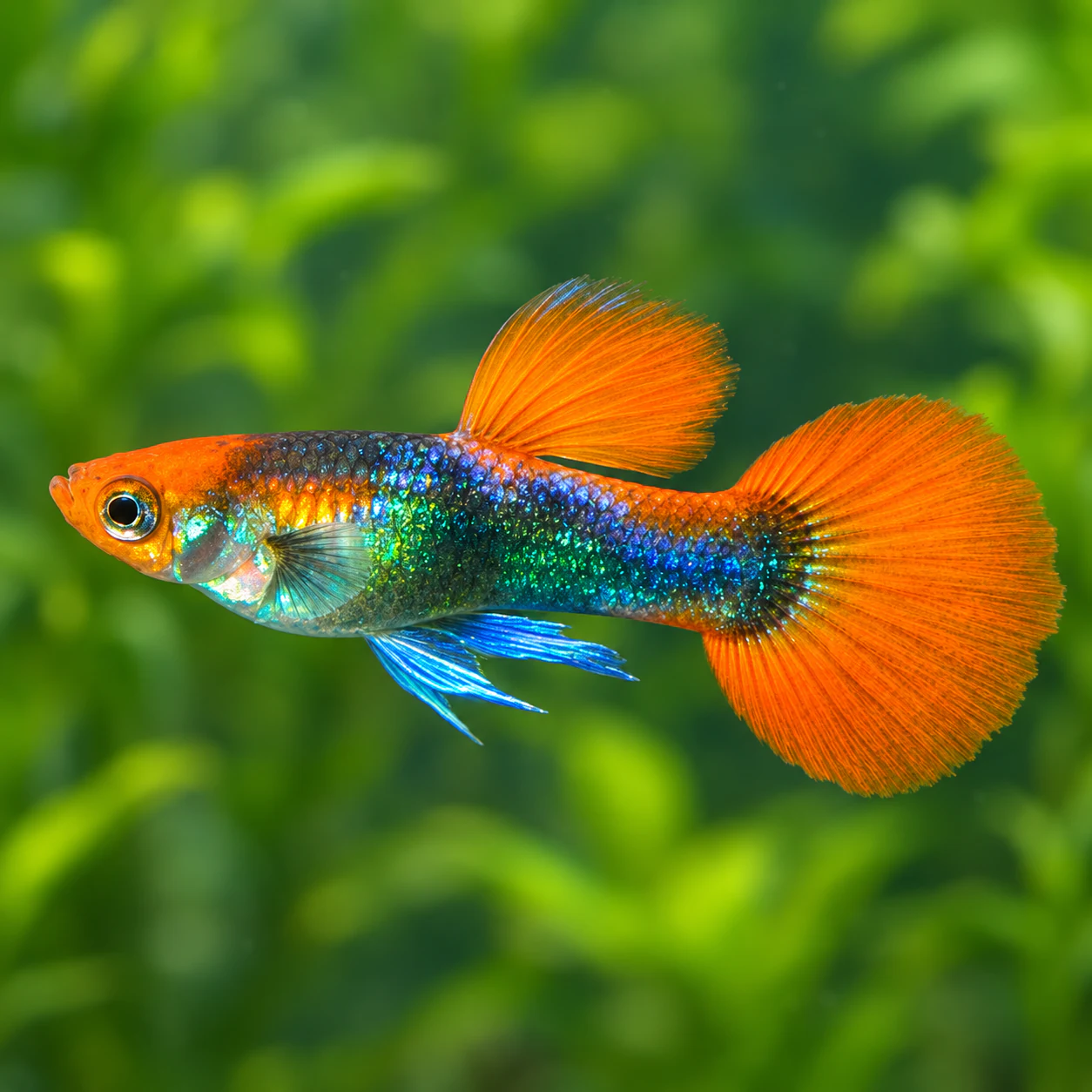
The names on a guppy listing often mix color, body coverage, tail form and breeding-line labels. That is why a black-bodied guppy with a bright red tail should not automatically be called Full Black. This guide explains the differences, suitable aquarium conditions, breeding expectations, and the questions worth asking before buying. The featured green-and-black Moscow image is an existing illustrative comparison, not proof of currently available Full Black stock.
What makes a guppy "Full Black"?
In the hobby, the label Full Black guppy generally means a fish that appears very dark over most or all of the visible body and fins. Individual lines may show hints of charcoal, blue or metallic sheen under different lighting, and females may look different from males. There is no guarantee that two sellers using the same common name are describing identical ancestry, pigment coverage or tail type. For a specific purchase, ask to see the actual fish swimming under neutral light rather than relying on a single highly contrasted photograph.
- Body: a Full Black display fish is usually dark from head or mid-body to the caudal peduncle; check both sides rather than judging only the tail.
- Fins: tail and dorsal fin darkness help assess whether a fish matches the seller’s “full black” description. Fin shape is a separate trait.
- Age and sex: adult males often show the boldest black coverage, whereas females and juveniles may not match the male advertisement.
- Health: a deep black color is not a substitute for normal breathing, smooth swimming, an appropriate body shape and intact fins.
Do not assume the word black means that the fish is rare, show-grade, unusually hardy or guaranteed to pass on its exact appearance. Those are separate questions requiring line records and, where relevant, documented show results.
Full Black vs Half Black vs Black Moscow: comparison
These are common hobby labels, not mutually exclusive scientific varieties. Half Black and Tuxedo often overlap, and Black Moscow can be used for a strongly dark, Moscow-type line. The useful task is to identify what is dark on the fish, what remains light, and which traits the breeder is actually selecting.
| Name on listing | Typical visual clue | What to verify |
|---|---|---|
| Full Black | Dark coverage across most or all of the visible body and often the fins | Ask for full side-view images and adult female examples; check whether the fish is really dark all over |
| Half Black / Tuxedo | Dark rear body, frequently paired with a lighter front and a contrasting colored tail | Usually not the same look as an all-dark fish; names can overlap between sellers |
| Black Moscow | Moscow-style line advertised for deep, even dark coloration | “Moscow” is a breeding-line style, not an additional water requirement; ask for parents and strain history |
| Red Head Black / other black combinations | Some dark body areas with a bright head, red-orange fins or other accents | Should not be marketed as uniformly Full Black without matching actual fish |
For detailed examples of the second and third categories, read our Half Black guppy guide and Moscow guppy guide. Our broader guppy pattern reference explains how different color and fin labels can be combined.
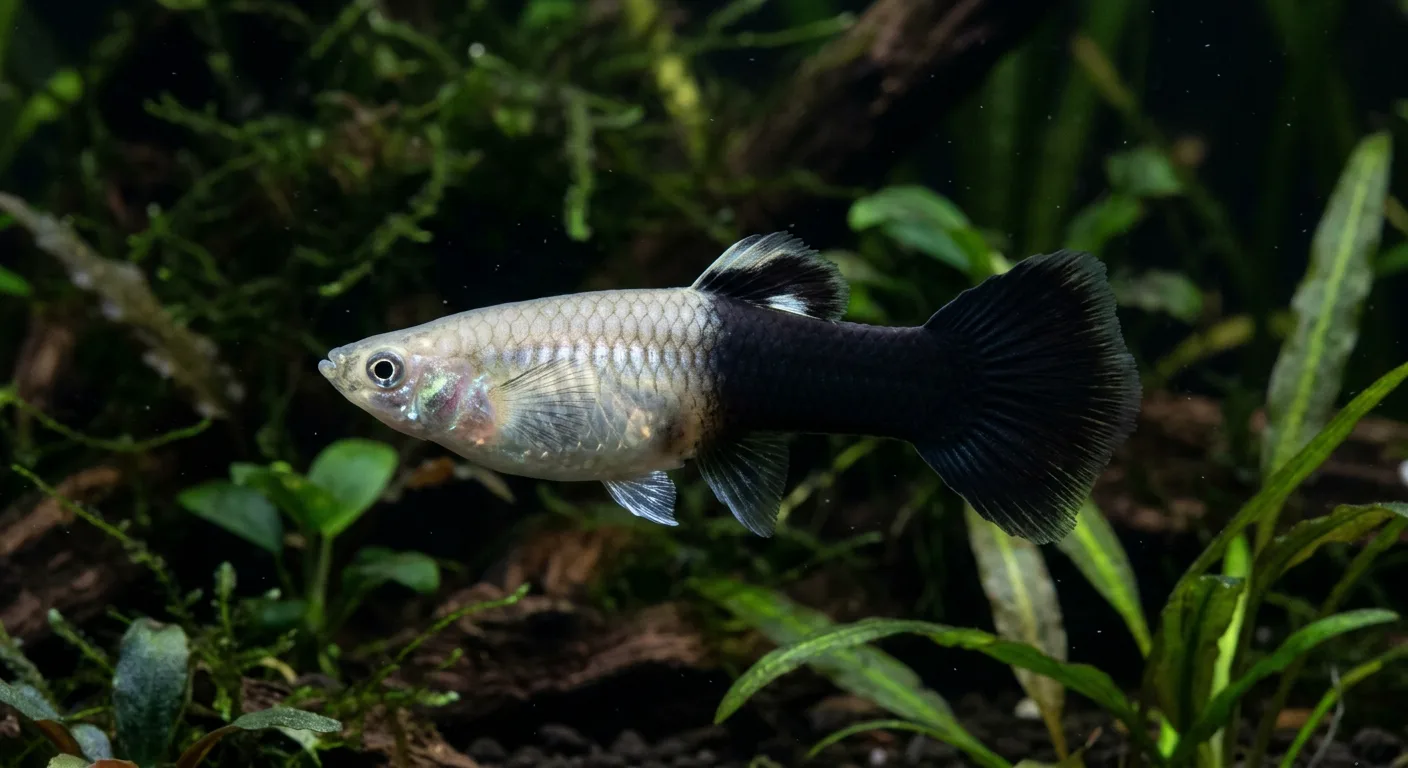
What about Red Head Black and other combinations?
A fish sold as Red Head Black may pair dark blue-black body coloration with red or orange areas. It can be attractive while still not matching a Full Black preference. HiGuppy has a separate Red Head Black Guppy listing as one example of how the word black appears in product names. Always check availability, fish sex, quantity and a current photo or video before ordering; a catalog name is not a current-stock promise.
Black guppy care: tank size, temperature and water
Full Black, Half Black and Moscow styles are all guppies (Poecilia reticulata), so no special black-fish mineral additive or exceptional pH recipe is needed. Species-level guidance published by Seriously Fish lists temperature 17–28°C (63–82°F), pH 7.0–8.5 and general hardness 8–30 dGH. An everyday target around 24–26°C (75–79°F), pH 7.2–8.0 and GH 8–15 dGH can be a practical starting point for many aquarium-bred guppies; test your tap water and avoid sudden changes.
| Parameter | Practical starting guidance | What to check |
|---|---|---|
| Tank size | 10 US gal / 38 L can suit a small adult-only group; 20 US gal / 76 L or more gives more flexibility | Tank length, group size, sex ratio, filter capacity and fry change the safe stocking |
| Temperature | About 24–26°C (75–79°F) | Stable heater/thermometer where needed; published broader species range is 17–28°C |
| pH | About 7.2–8.0 | Species range 7.0–8.5; do not chase a precise number with pH chemicals |
| General hardness (GH) | About 8–15 dGH | Published species range 8–30 dGH; hard water is generally preferable to very soft water |
| Ammonia and nitrite | 0 ppm in a cycled tank | Any detectable reading requires attention to the filter and water quality |
| Nitrate | Keep low, often under about 20 ppm where practical | Adjust water changes to actual readings and stocking |
Use a cycled filter with moderate or gentle current, a secure lid and plants for shade and cover. Broad-tailed fancy males can struggle in very strong flow or around sharp decorations. Water change schedules should respond to testing and waste load; a rough starting routine is a 20–30% partial change weekly with treated, temperature-matched water. For more on cycling and water tests, see the guppy water parameters guide.
Lighting, substrate and how to see black color clearly
Black bodies may nearly disappear against a very dark backdrop. A light or warm-neutral substrate and green plants can help outline a dark guppy, whereas a black background can create a dramatic silhouette. Neither look is a requirement for the fish, and changing substrate cannot make inherited black pigment appear in a line that lacks it. Use a consistent neutral-white lighting period appropriate for your plants, and avoid changing exposure between comparison photographs. Overly harsh lighting or a bright, bare tank can increase stress in some fish; provide cover and an area of lower light.
- Photograph one side profile under consistent light, without extremely warm or blue color filters.
- Look for the boundary between dark body and fin, and view the fish in normal movement.
- Ask whether photos show a mature male, a female, a juvenile or a specially selected breeder.
- Compare condition separately from color: observe feeding, swimming, fins and breathing.
A professional sales video should make the fish easier to assess, not hide its normal coloration. If a listing uses AI-generated representative images, those are examples of an intended style, not evidence of the exact fish that will ship.
What do black guppies eat?
A black guppy does not need a special black-color food. Offer a good-quality, appropriately sized guppy flake or micro-pellet as the staple, with occasional brine shrimp or daphnia for variety. Healthy fish often accept one or two small meals daily; avoid leftover food accumulating in the substrate or filter. Nutrition supports general health and natural color expression, but a diet cannot guarantee a genetically solid-black body or breed-standard fins.
If you are comparing foods, the guppy feeding schedule explains practical portions. If a fish suddenly becomes pale, isolate the likely problem with water testing, behavioral observation and care adjustments before buying expensive “color boosting” formulas.
Can black guppies live with other fish?
Guppies are generally peaceful community fish, but long tails may be targeted by fin-nippers. Choose tank mates based on adult size, temperature, water hardness, swimming room and behavior rather than color. Small peaceful fish, snails or compatible livebearers may work where the water and stocking are suitable. Do not combine every peaceful species in a small tank merely because their temperatures overlap.
Black guppies can also live with differently colored guppies, but breeding lines can intermix if males and females are together. A male-only display avoids unexpected fry but still requires monitoring for harassment. See best tank mates for guppies for more detail.
Breeding black guppies: what the name does not guarantee
Breeding two dark-looking guppies does not ensure that every offspring will be uniformly black. Observed color and fin traits can vary between lines and generations, and breeders may select several different features under one trade name. Females can store sperm from earlier mating, which makes parentage uncertain if a female previously shared a tank with other males. The safest practice is to keep breeding records, source fish with clear histories, and prioritize normal body shape and vigor over extreme darkness.
- Ask for a recent photo of the actual parent pair or trio and examples of previous offspring from the same line.
- Record dates, sexes, offspring appearance and whether females were exposed to other males.
- Keep distinct lines separate when ancestry matters and do not assume “Black Moscow” is genetically identical to “Full Black”.
- Choose healthy fish as breeders and have enough grow-out space and responsible homes for offspring.
- Do not release aquarium fish into waterways or buy replacements solely to intensify color without checking compatibility.
Our how to keep a guppy strain consistent guide expands on line records and careful breeding decisions.
Buying black guppies online: a practical checklist
The most useful question is not “How black is this photo?” but “What will the exact fish look like when it arrives?” Before paying, verify the following points with the seller. A representative listing or enquiry page may not show the specific fish available today.
- Exact strain label: Full Black, Black Moscow, Half Black/Tuxedo or a red-head black combination—and what the breeder means by it.
- Actual stock: fresh, unedited side-view footage of the fish offered; ask whether any gallery images are AI-generated or merely representative.
- Age and sex: confirm male/female count, size and whether the pattern is developed in juveniles.
- Health signs: normal movement, body shape, feeding, fins and breathing; color alone does not prove a fish is free of disease.
- Breeding information: documentation of parents/offspring if you care about consistency, not unsupported “100% true-breeding” promises.
- Shipping arrangements: weather, transshipper route, receiving time and the relevant live-arrival terms.
- Price and availability: clarify the exact fish price and any international, transshipper or domestic charges rather than inferring them from a catalog photo.
HiGuppy currently lists related dark-pattern products such as Half Black Blue Big Tail and Red Head Black Guppy. These are examples of named styles, not proof that a Full Black fish is in stock. Check the latest listing status and ask for current fish videos before an order.
What to do after your black guppies arrive
Prepare a cycled receiving tank or separate quarantine aquarium with stable parameters and gentle filtration before delivery. Follow the transport provider’s instructions; long-distance sealed-bag shipments may require different handling than short local trips. Prolonged acclimation in old bag water can carry risks after a bag has been opened, so avoid a rigid drip-acclimation timetable for every shipment. Do not pour transport water into the established tank. The quarantine guide covers monitoring and early warning signs.
If new fish seem pale or stay hidden for a short period after transport, check water, temperature and behavior before blaming the line’s genetics. Loss of appetite, clamped fins, gasping or unusual swimming calls for a more immediate assessment rather than a color supplement.
Quick checklist before choosing a black guppy
- I know whether I want Full Black, Half Black/Tuxedo, Black Moscow or a contrasting black color combination.
- I have checked the real fish, its age and sex, not only a representative gallery or filtered photo.
- My tank is fully cycled with appropriate temperature, pH, GH and fish numbers.
- I have a plan for live arrival, quarantine and separate breeding groups if needed.
- I have confirmed current availability, order quantity, shipping charges and relevant policy.
Black guppy FAQ
Are Full Black guppies and Half Black guppies the same?
No. Full Black usually describes dark coverage across most of the body and fins. Half Black or Tuxedo generally describes a darker rear body with a lighter front; hobby labels may overlap by breeder, so compare real fish.
Is a Black Moscow guppy always a Full Black guppy?
Not necessarily. Black Moscow is a named breeding-line style, while Full Black is an appearance description. A fish may fit both labels, but the name alone does not prove identical ancestry or all-black coverage.
Do black guppies need a different pH or aquarium temperature?
No. All these fancy forms belong to Poecilia reticulata. Suitable general care includes stable water around 24–26°C, pH roughly 7.2–8.0 and GH around 8–15 dGH as everyday starting targets, with ammonia and nitrite at zero.
Are black guppies rare or more expensive?
Not always. Availability, fish condition, verified line history, sex, fin form and current seller pricing can vary. Dark color alone does not prove rarity or show quality.
Can black guppies live with other colored guppies?
Yes, when the aquarium and group are suitable. They can interbreed, though, so separate breeding lines if you want to track parentage and preserve a particular appearance.
Will black guppy fry be completely black?
Not all offspring are guaranteed to match. Color expression varies with breeding line and genetics, and females can store sperm from earlier matings. Ask for real offspring examples from the seller’s specific line.
How can I tell whether a black guppy for sale is healthy?
Ask for a recent video of the actual fish showing swimming, full-body shape, open fins, breathing and feeding. Evaluate the fish separately from photo color grading, and confirm whether the listing image is representative or actual stock.
Sources and related guides
Species-level temperature, pH, GH, general husbandry, behavior and breeding details: Seriously Fish — Poecilia reticulata. For how naming terms work, consult the HiGuppy Half Black, Moscow and pattern vocabulary guides. These descriptions concern hobby naming practices; they do not certify a particular fish’s genetics, show award or current stock availability.
Behind the care guides
Care begins with steady systems
Our guppy guides focus on practical routines: keep water stable, observe fish closely and allow for natural variation.

Care systems
Steady water, thoughtful care
Gentle filtration and regular observation support healthy aquarium routines.

Natural variation
Every guppy is different
Color, size and fin shape vary with strain, age and each individual fish.
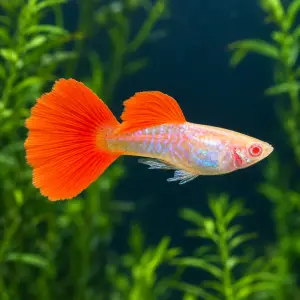
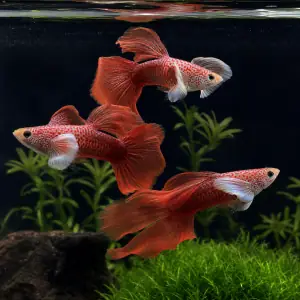
Editorial illustrations for context; they do not depict HiGuppy's exact facility or current fish stock.