The HiGuppy Journal
TDS Level for Guppies: 7 Proven Water Care & Testing Tips
Quick answer: Most guppies do well with a TDS reading roughly between 150–300 ppm, and many experienced keepers run their tanks happily at 200–400 ppm — but TDS is a context and trend indicator, not a safety or hardness test. A meter cannot tell you which minerals are dissolved, so confirm mineral adequacy with GH and KH test kits and keep ammonia, nitrite and nitrate testing in your routine. Guppies are hard-water fish that do best in stable, moderately hard water, so a steady reading matters far more than hitting one exact number. Test weekly with a calibrated TDS meter and change the water gradually — never chase a perfect reading with a sudden correction.
Understanding the tds level for guppies is one of the simplest ways to keep your fish healthy, colorful, and breeding well. TDS stands for total dissolved solids: the dissolved minerals, salts, and other compounds in your aquarium water, measured in parts per million (ppm). It does not tell you exactly what is dissolved, but it gives you a fast snapshot of your water’s overall mineral load — and guppies depend on those minerals for osmoregulation, bone and scale development, and healthy reproduction.
Many beginners test only ammonia, nitrite, and nitrate, and those tests are essential. But two tanks can both read zero ammonia and still offer very different living conditions: one may hold soft, mineral-poor water that slowly stresses the fish, while the other holds stable, moderately hard water in which guppies thrive.
What Is TDS and Why the TDS Level for Guppies Matters
TDS is the combined concentration of all dissolved substances in water, expressed in ppm. In an aquarium, those solids come from tap water, substrate and rocks, fish food and waste, plant fertilizers, and water treatments. A TDS meter measures the water’s electrical conductivity and converts it into an estimated ppm value: higher mineral content produces a higher reading.
What a TDS meter cannot do is just as important. It measures the total amount of dissolved material, not its composition. A reading of 250 ppm could come mostly from beneficial calcium and magnesium, or it could include unwanted pollutants. That is why TDS is best used as a trend-tracking tool: test the same tank the same way every week, and a rising trend tells you dissolved solids are accumulating, usually from evaporation, overfeeding, or infrequent water changes.
The tds level for guppies matters because they are livebearers from hard-water habitats, and their physiology reflects that. They need dissolved calcium and magnesium for strong bones, healthy scales, and proper fin development. Females draw heavily on mineral reserves during pregnancy, and fry grow faster in mineral-rich water. In water that is too soft, guppies often show clamped fins, faded colors, slower growth, and weaker immune responses.
The Ideal TDS Level for Guppies: Typical Ranges at a Glance
There is no single magic number, and any source claiming one exact value should be treated with skepticism. Most guppies do very well between roughly 150 and 300 ppm, and many breeders with heavily stocked tanks run 200–400 ppm with excellent results.
What matters more than the exact figure is where your reading sits relative to your tap water and how stable it stays. If your tap water reads 180 ppm and your tank reads 220 ppm, that modest rise is typical of normal accumulation between water changes — though TDS alone cannot confirm the water is suitable, so verify GH and KH with a test kit too. If your tank climbs from 200 ppm to 450 ppm over a month, that rising trend is a warning sign, even if the fish still look fine. Dissolved solids accumulate as water evaporates and food and waste break down; regular partial water changes keep that slow climb in check.
| Parameter | Typical range for guppies | Why it matters |
|---|---|---|
| TDS | 150–300 ppm (many keepers run 200–400 ppm) | Total dissolved solids; trend/context indicator, not a composition or hardness test — confirm minerals with GH and KH kits |
| GH | 8–12 dGH | Calcium and magnesium for bones, scales, fry |
| KH | 4–8 dKH | Buffers pH, prevents sudden swings |
| pH | 6.8–7.8 | Neutral to slightly alkaline suits guppies |
| Temperature | 72–82°F (22–28°C) | Warmer water speeds metabolism |
| Ammonia / nitrite | 0 ppm | Toxic even at low levels |
| Nitrate | Below 40 ppm, ideally under 20 ppm | High nitrate stresses fish, fuels algae |
If your TDS sits far outside the 150–300 ppm band, do not panic and do not try to fix it in one dramatic step. A reading of 100 ppm in a lightly stocked planted tank with soft tap water may be fine if the fish look healthy and GH is adequate. Use the range as a guide, watch your fish, and adjust gradually.
TDS, GH, KH, and pH: How the Numbers Work Together
Beginners often confuse TDS with GH, but they are not the same. GH measures specifically calcium and magnesium, in degrees of hardness (dGH). KH measures carbonate and bicarbonate ions, which buffer the water and resist pH changes. TDS measures everything dissolved, including calcium, magnesium, carbonates, and sodium. GH tells you about two minerals your guppies need, KH tells you how stable your pH will be, and TDS tells you the total load of everything dissolved.
A tank can have high TDS but low GH if the dissolved solids are mostly sodium rather than calcium and magnesium — one reason a TDS meter alone is not enough. If your TDS reads high but GH is low, your guppies may still be short on the minerals they need most. For a deeper explanation, see our guide to guppy GH vs KH water hardness. Test the tds level for guppies weekly for trends and GH and KH monthly, keeping all three in range. When GH and KH are in range, pH usually stays steady between 6.8 and 7.8.
Temperature interacts with these parameters too. Guppies at the warmer end of their range, around 78–82°F, eat more, grow faster, and breed more readily, but they also produce more waste, pushing TDS up faster. Either end of the range is fine as long as it is stable. Our guide to the ideal temperature for guppies covers heaters, seasonal changes, and breeding.
How to Test the TDS Level for Guppies: A Step-by-Step Routine
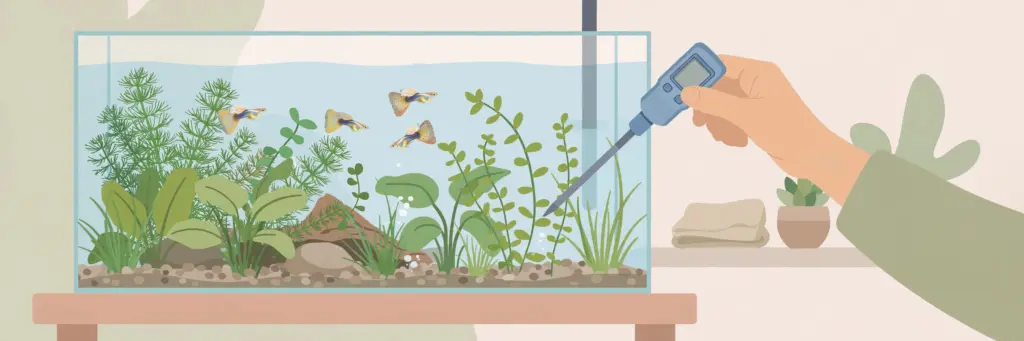
A handheld TDS meter is inexpensive and gives a reading in seconds, but small mistakes in technique can mislead you. Follow this routine once a week, always before your water change, and write the result down so you can spot trends.
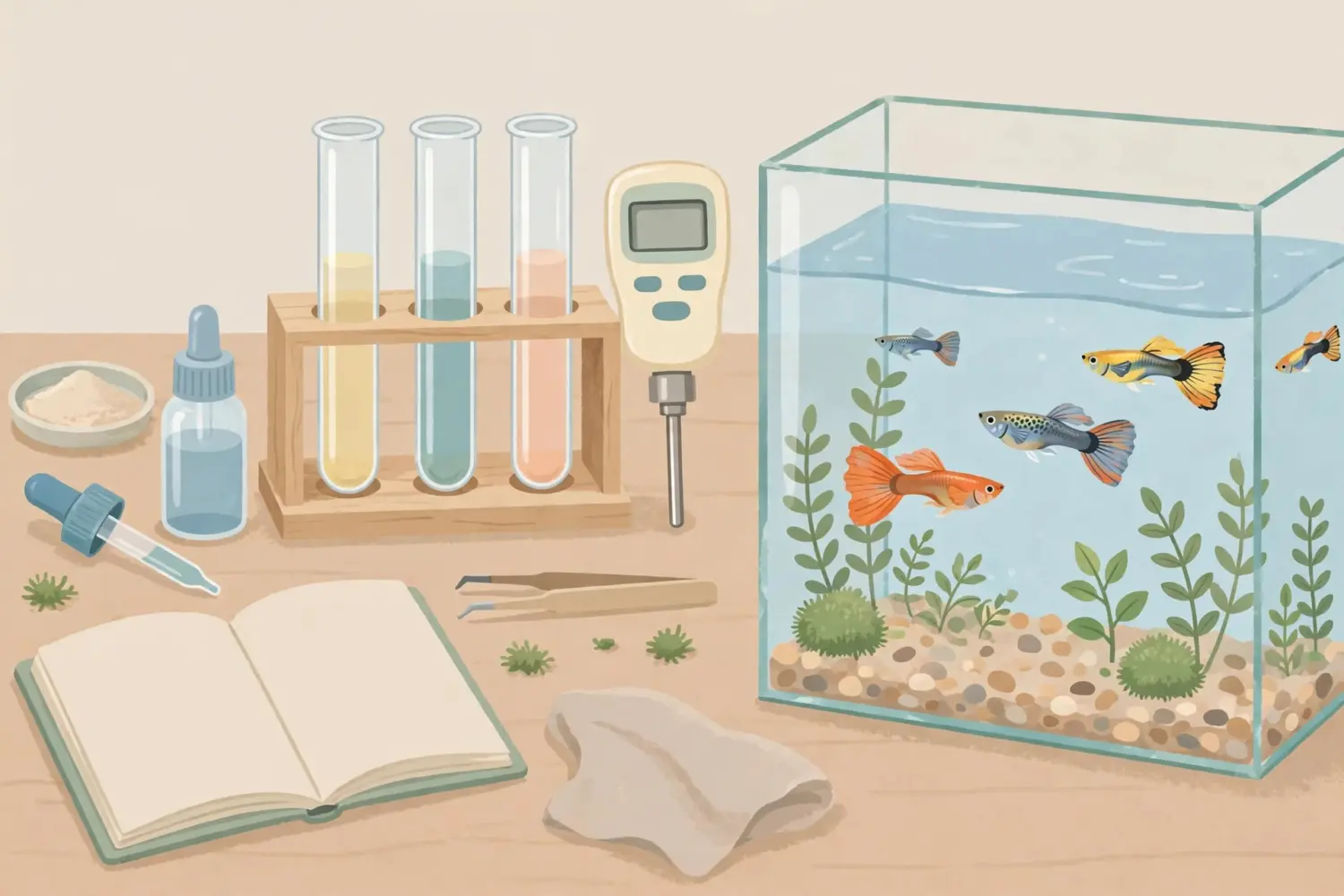
- Calibrate your meter. Most meters arrive factory-calibrated, but calibrate with a standard solution if your model supports it. A meter that has drifted can mislead you for months.
- Rinse the probe in clean water and shake off the excess. Residue from a previous test can skew the reading.
- Test the tank water. Dip the probe away from the filter outflow, switch the meter on, and wait for the reading to stabilize. Note the ppm value.
- Test your tap water the same way. Comparing tap to tank water shows how much dissolved solids build up between changes.
- Test your replacement water before it goes into the tank, so you know exactly what you are adding.
- Record all three numbers with the date. A notebook turns isolated readings into a useful history.
- Act on trends, not single readings. One high reading is not an emergency. Three readings climbing over three weeks mean it is time to review feeding, stocking, and water changes.
For the full testing workflow, including liquid test kits for ammonia, nitrite, nitrate, and pH, see our guide on how to test aquarium water for guppies. A TDS meter complements those kits; it does not replace them. Test before your water change to see peak accumulation, and occasionally a few hours after, to see how far fresh water brought the reading down.
7 Proven Tips to Keep the TDS Level for Guppies Stable
1. Do Regular Partial Water Changes to Control the TDS Level for Guppies
Changing 25–30% of the water each week is the most effective way to control the tds level for guppies. It removes accumulated dissolved solids and replaces them with fresh water at your tap’s baseline level. Large, infrequent changes are far worse: they swing TDS, temperature, and pH all at once and stress your fish. If TDS climbs by more than about 50 ppm between weekly changes, increase the volume slightly or change water twice a week. Our guppy tank maintenance schedule lays out a weekly and monthly routine that keeps TDS and nitrate under control.
2. Test the TDS Level for Guppies Before Every Water Change
Always test before you change water. The pre-change reading shows how the tank has been doing all week and whether your routine is working. If the number climbs week after week despite regular changes, something else is adding dissolved solids: overfeeding, too many fish, a dissolving decoration, or fertilizer overdosing.
3. Adjust the TDS Level for Guppies Gradually, Never Suddenly
If the tds level for guppies is too high, bring it down slowly over several water changes; if too low, raise it gradually with a remineralizer. Guppies tolerate a wide range of TDS, but they tolerate sudden change very poorly. A large sudden swing in dissolved solids can shock their osmoregulatory system and cause stress, clamped fins, and disease. Keep adjustments small and spread across several water changes.
4. Use RO Water and Remineralizers to Manage the TDS Level for Guppies
Reverse-osmosis (RO) water has almost no dissolved solids, usually close to 0–10 ppm, which makes it useful for lowering TDS. But it must be remineralized before it goes into a guppy tank: pure RO water has no calcium, no magnesium, and no buffering capacity, so its pH can crash and your guppies will be mineral-starved. Mix RO water with tap water, or add a commercial remineralizer to reach GH of 8–12 dGH and KH of 4–8 dKH, then test the TDS of the mix first.
5. Watch Evaporation and Top-Ups — They Raise the TDS Level for Guppies
Evaporation is a quiet driver of a rising tds level for guppies. When water evaporates, only pure water leaves; the minerals stay behind, so the concentration rises. If you top up with tap water, you add yet more minerals and TDS climbs further. Top up evaporated water with RO or distilled water, which adds no new dissolved solids, and reserve tap water for actual water changes. In warm rooms or open-top tanks, evaporation can be surprisingly fast, so check the water level every few days.
6. Feed Carefully — Leftover Food Raises the TDS Level for Guppies
Every pinch of food that goes uneaten eventually dissolves and adds to your TDS. Feed only what your guppies can finish in about two minutes, once or twice a day, and siphon out uneaten food within a few minutes. A varied diet of quality flake, micro pellets, and occasional frozen daphnia or brine shrimp gives better nutrition with less waste than constant heavy feeding.
7. Choose Substrate and Decorations That Suit the TDS Level for Guppies
Some substrates and decorations slowly release minerals, raising TDS and GH over time. Limestone, coral sand, and crushed coral are well known for this. That can help if your tap water is very soft, but it can push TDS too high if your water is already hard. Inert gravel or sand, driftwood, ceramic, and resin have little effect on water chemistry. For authoritative background on guppy water requirements, see the Poecilia reticulata profile at Seriously Fish: Seriously Fish — Poecilia reticulata species profile.
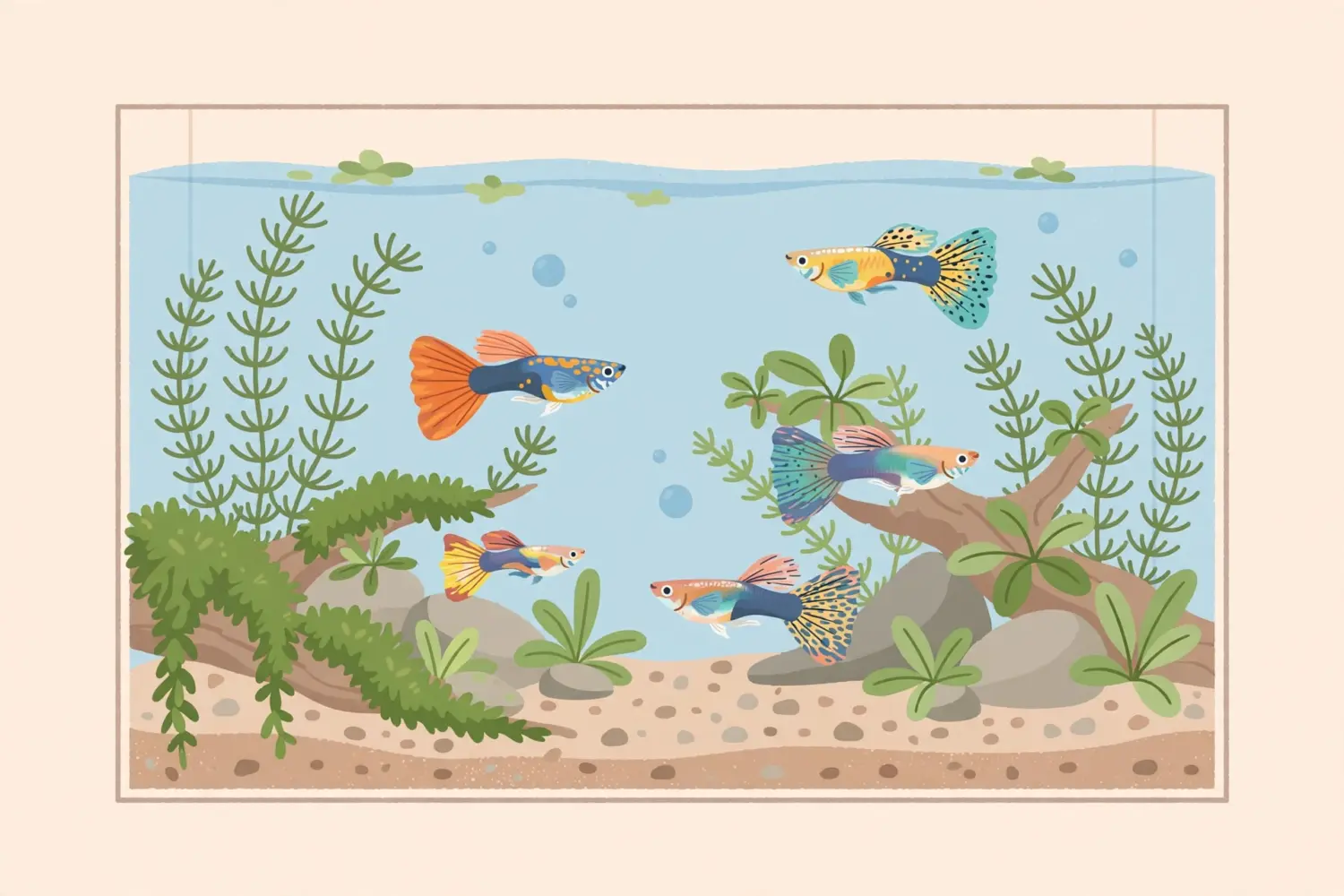
Common Mistakes When Managing the TDS Level for Guppies
The most common mistake is chasing a single perfect number. A keeper reads that guppies like 200 ppm, tests at 280 ppm, and panics into a large water change with pure RO water, crashing TDS, GH, and pH all at once. The fish were fine at 280 ppm; the sudden correction is what harms them. If your fish are active, eating well, brightly colored, and breeding, your water is working, whatever the exact number says.
A second mistake is trusting a meter without ever checking it. TDS meters can drift, especially if the probe is stored dry for months. Rinse the probe after each use, store it as instructed, and check it against a calibration solution occasionally. A third mistake is using TDS as a substitute for a full test kit: a meter cannot detect ammonia or nitrite, and a tank can have a perfect TDS reading while ammonia poisons the fish after a filter crash.
Finally, many keepers never test their tap water — yet tap water is the baseline for the tds level for guppies in the tank. Municipal supplies can vary seasonally, and a treatment change can shift tap TDS by 50 ppm or more. Test your tap water monthly, and immediately if tank readings change unexpectedly. Plants, snails, and shrimp also interact with TDS — plants absorb minerals, while snails and shrimp consume calcium — another reason to read trends rather than single numbers.
Frequently Asked Questions About the TDS Level for Guppies
What is the best tds level for guppies?
Most guppies do well with TDS roughly between 150–300 ppm, and many keepers successfully run their tanks at 200–400 ppm — but treat that band as context, not a pass/fail threshold. A stable reading matters more than one exact number, and mineral adequacy is confirmed with GH at 8–12 dGH, KH at 4–8 dKH, and pH between 6.8 and 7.8.
How do I lower the TDS level for guppies?
Lower TDS gradually with partial water changes using RO water mixed with tap water, or remineralized RO water. Change 25–30% at a time so TDS comes down in small steps rather than one sharp drop. Find the cause of the high reading — overfeeding, tap-water top-ups, or mineral-leaching decorations — so it does not climb straight back up.
Can guppies live in low TDS water?
Guppies can survive in low TDS water for a while, but they rarely thrive in it. A low reading is a hint, not proof: TDS cannot show which minerals are present, so test GH directly — readings under roughly 8 dGH usually mean too little calcium and magnesium for guppies, and you may see clamped fins, faded colors, slow growth, and poor breeding. If GH is low, remineralize water changes gradually to bring GH to 8–12 dGH rather than chasing a TDS number.
Is a TDS meter accurate enough for aquarium use?
Yes, a basic handheld TDS meter is accurate enough for routine keeping, as long as you rinse the probe, calibrate it when the model allows, and use it consistently. It measures total dissolved solids by conductivity, so it cannot tell you which substances are dissolved. Use it alongside liquid test kits and watch trends over weeks rather than any single reading.
How often should I test the TDS level for guppies?
Test TDS once a week, always before your regular water change, and write the result down. Test your tap water monthly, and test any RO or remineralized water before it goes into the tank. Test every few days if you are correcting a high or low reading, have added new substrate or decorations, or your fish show signs of stress.
Keep the TDS Level for Guppies Stable and Simple
The tds level for guppies is a simple number to check weekly and a habit that pays off over the life of your tank. Aim for roughly 150–300 ppm, keep GH at 8–12 dGH and KH at 4–8 dKH, hold pH between 6.8 and 7.8, and keep ammonia and nitrite at zero with nitrate below 40 ppm. Change 25–30% of the water each week, top up evaporation with RO water, and adjust gradually whenever a correction is needed.
Your guppies will tell you when the water is right: active, brightly colored, eager at feeding time, and regularly producing fry. Pick up a meter, start a log this week, and let the numbers guide your routine instead of guessing.
Behind the care guides
Care begins with steady systems
Our guppy guides focus on practical routines: keep water stable, observe fish closely and allow for natural variation.
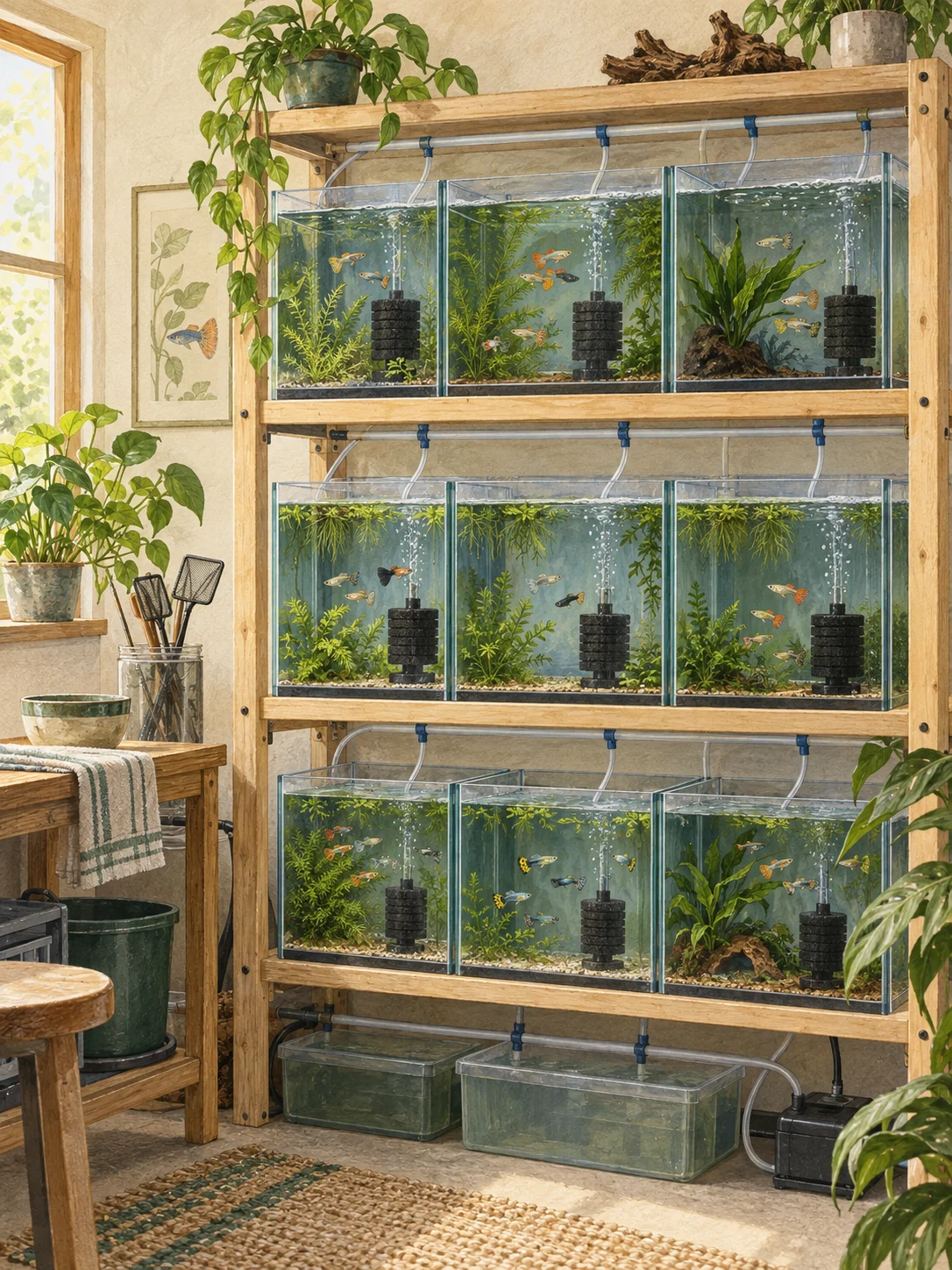
Care systems
Steady water, thoughtful care
Gentle filtration and regular observation support healthy aquarium routines.
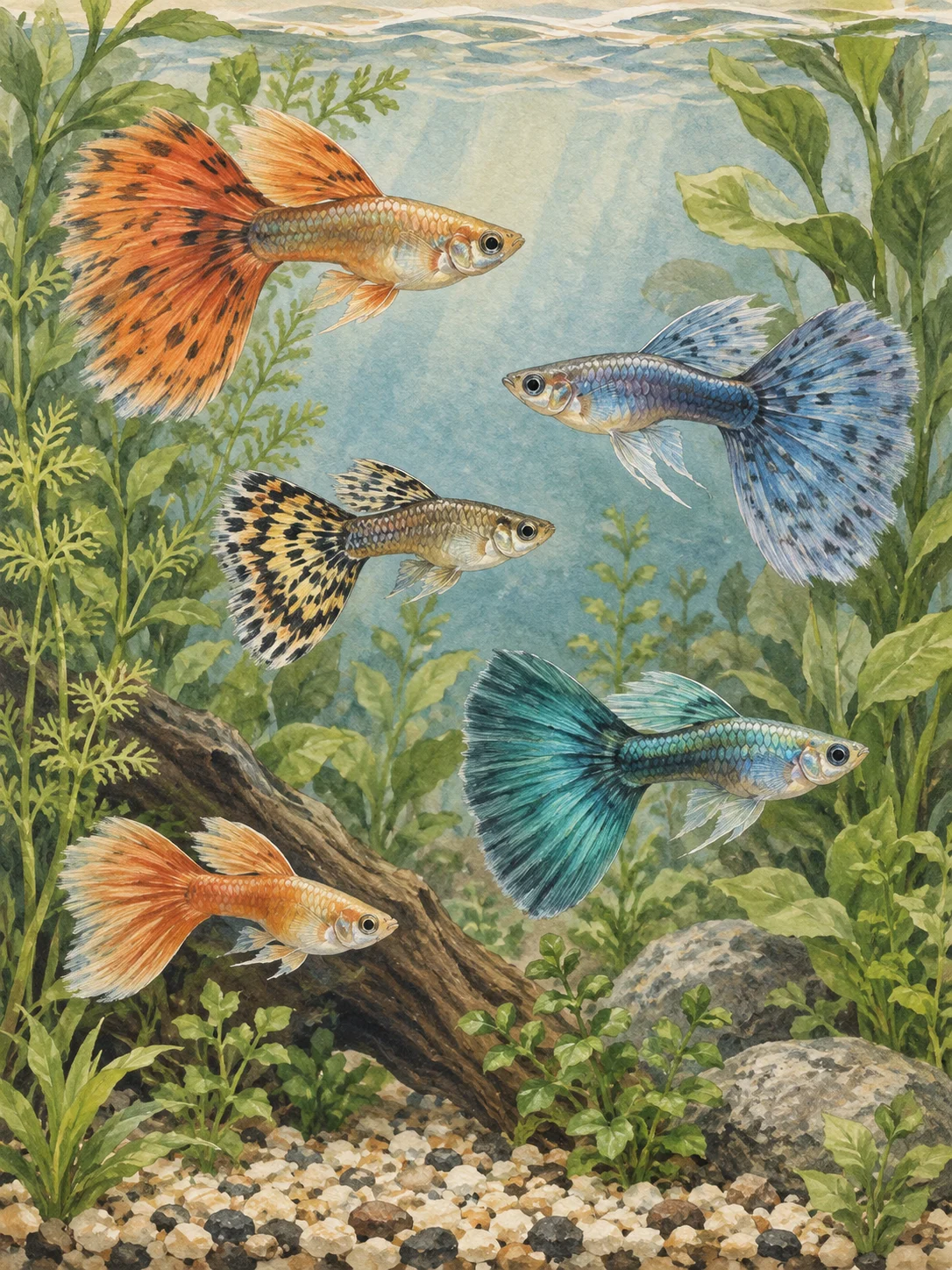
Natural variation
Every guppy is different
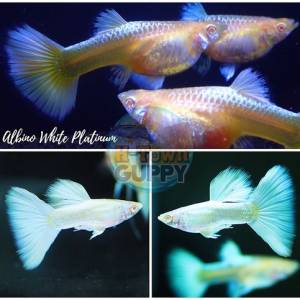
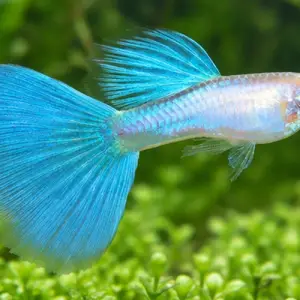
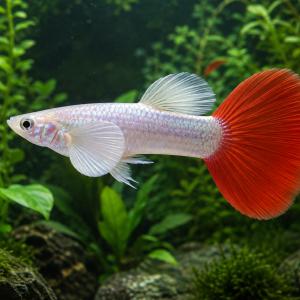
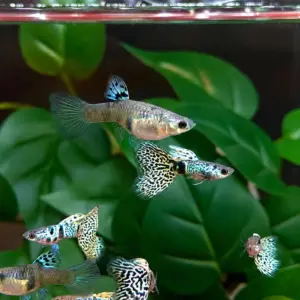
Color, size and fin shape vary with strain, age and each individual fish.
Editorial illustrations for context; they do not depict HiGuppy's exact facility or current fish stock.