The HiGuppy Journal
Mosaic Guppies: Tail Patterns, Care and Buying Guide
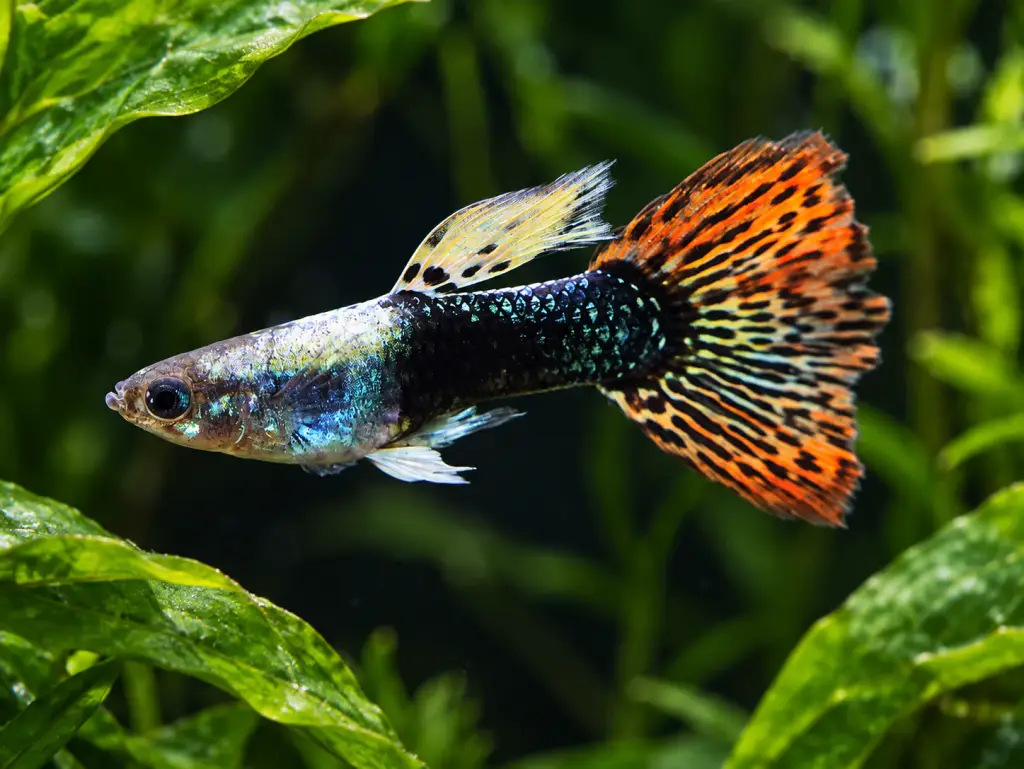
What are mosaic guppies? Mosaic guppies are fancy guppies (Poecilia reticulata) recognized by irregular, often connected patches on the tail rather than one solid color. “Mosaic” describes a fin pattern, not a separate species or a guaranteed bloodline. Care is typical guppy care: a cycled planted tank, stable moderately hard water, gentle filtration and varied food. Confirm the actual fish and seller’s pattern description before buying.
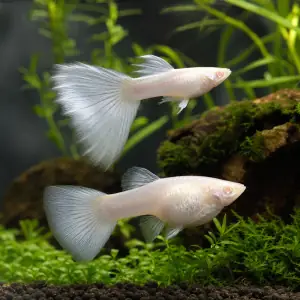
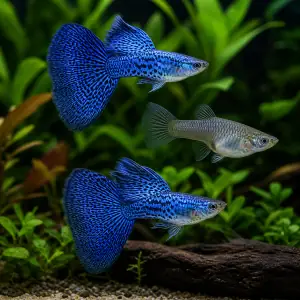
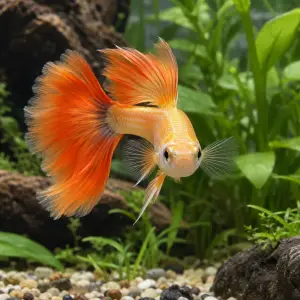
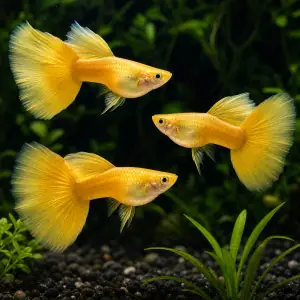
A vivid red, blue or yellow tail can carry a mosaic pattern, and the same fish may also have a half-black body, Dumbo pectoral fins or a delta tail. This guide focuses on how to recognize the Mosaic tail, compare variants, choose healthy fish and plan a suitable aquarium. For the broader vocabulary of guppy appearances, start with our guppy pattern types guide.
What makes a Mosaic guppy different?
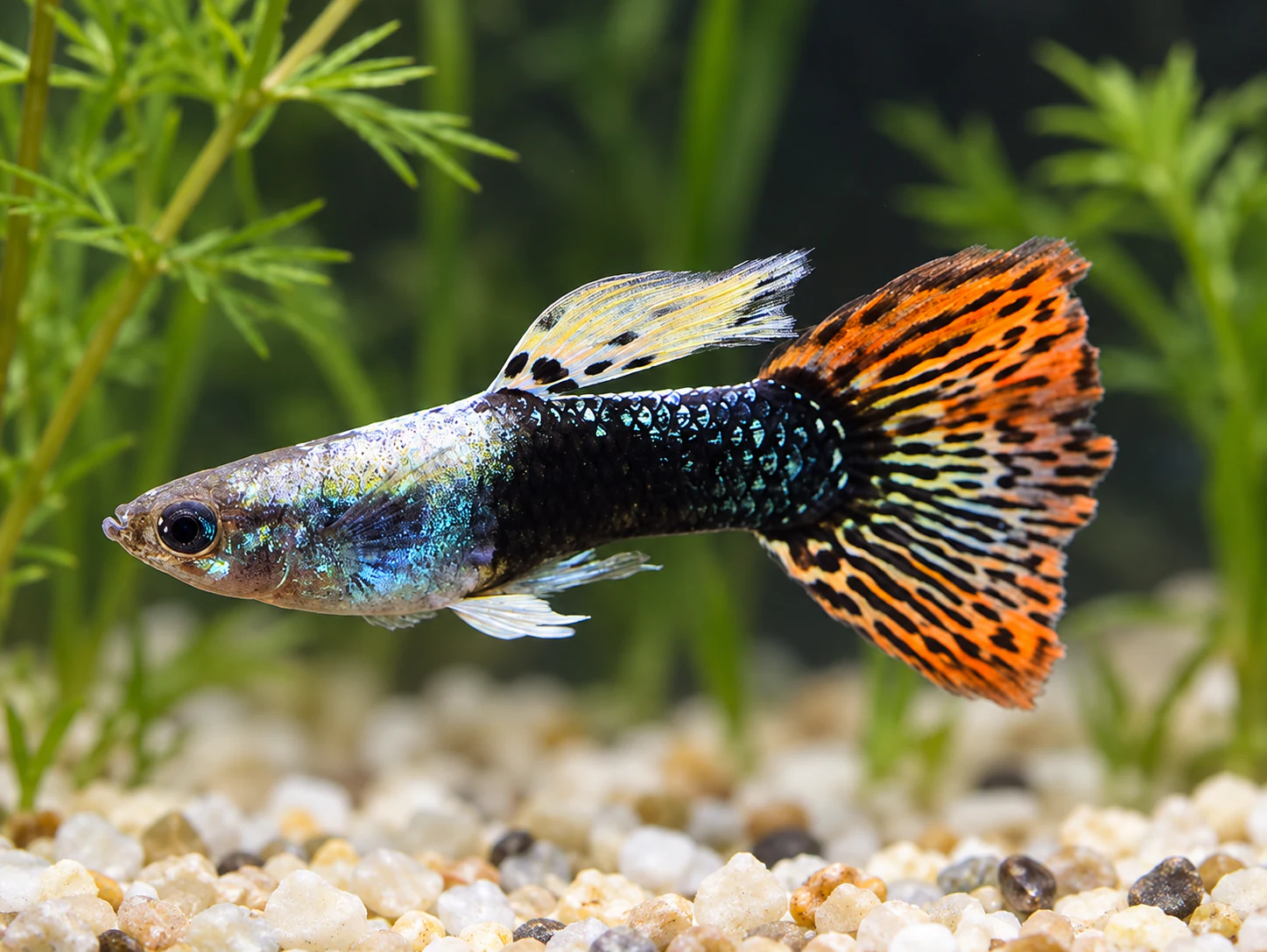
The classic mosaic look is a tail with irregular, contrasting patches that may join into bold lines or blotches, like fractured tiles. On an adult male, the broad caudal fin is often the easiest place to examine the markings; the dorsal fin may show related color or pattern. Some sellers use “mosaic” for finer or more scattered markings, so compare the actual photograph and moving fish rather than relying on one universal naming standard.
- Tail pattern: irregular dark or contrasting marks distributed across a colored background, sometimes connected.
- Body color: can be metallic, silver, half-black or another named form. “Mosaic” is not itself a body-color category.
- Tail shape: delta, round, halfmoon and other fins can carry mosaic-like markings; tail shape and tail pattern are separate labels.
- Sex and age: adult males usually display the most obvious pattern. Females and juveniles may show much less, even when part of a mosaic breeding line.
Think of a fish listed as “Blue Mosaic Delta” as three separate claims: a blue-toned color, a mosaic-patterned fin and a broad triangular tail. None of those words alone proves the fish’s exact genetic background, condition or future breeding results. For tail shapes, see the guppy tail type guide.
Mosaic vs Grass vs Lace vs Leopard: a quick comparison
The easiest distinction is not the tail color—it is the size, shape and connection of the markings. Hobby terms overlap across breeders, so treat the table as a visual checklist, not an official judging standard.
| Pattern | What to look for in the tail | How it differs from Mosaic |
|---|---|---|
| Mosaic | Irregular spots, dark patches or broken bars, often partly connected | Bolder, uneven patchwork; pattern may look marbled |
| Grass | Many small separate pinpoints or pepper-like speckles | Dots are usually finer and less connected |
| Lace | Fine web or mesh-like lines, sometimes part of a snakeskin line | More delicate and regular netting |
| Leopard | Larger distinct spots on a contrasting base | Often more isolated round or oval spots, rather than connecting patches |
If the markings are mostly tiny independent dots, compare our Blue Grass guide. If they resemble thin interconnected lines, look at the Red Lace guide. Those examples are more helpful than forcing every unusual tail into a single label.
Popular Mosaic guppy names and what they tell you
Color and fin labels can stack with Mosaic. Names vary between farms and sellers; they should help you ask better questions, not substitute for checking the real fish.
Red Mosaic and Tiger Mosaic
Red Mosaic usually indicates warm red or orange areas contrasted by darker fin markings. Tiger Mosaic is a seller term for striped or broken, tiger-like patterning layered into a mosaic-looking fin. Individual markings, tail shape and body coloration vary. HiGuppy has separate Red Mosaic and Tiger Mosaic Guppy catalog listings; use them as named examples, and confirm actual availability and recent stock media with the seller.
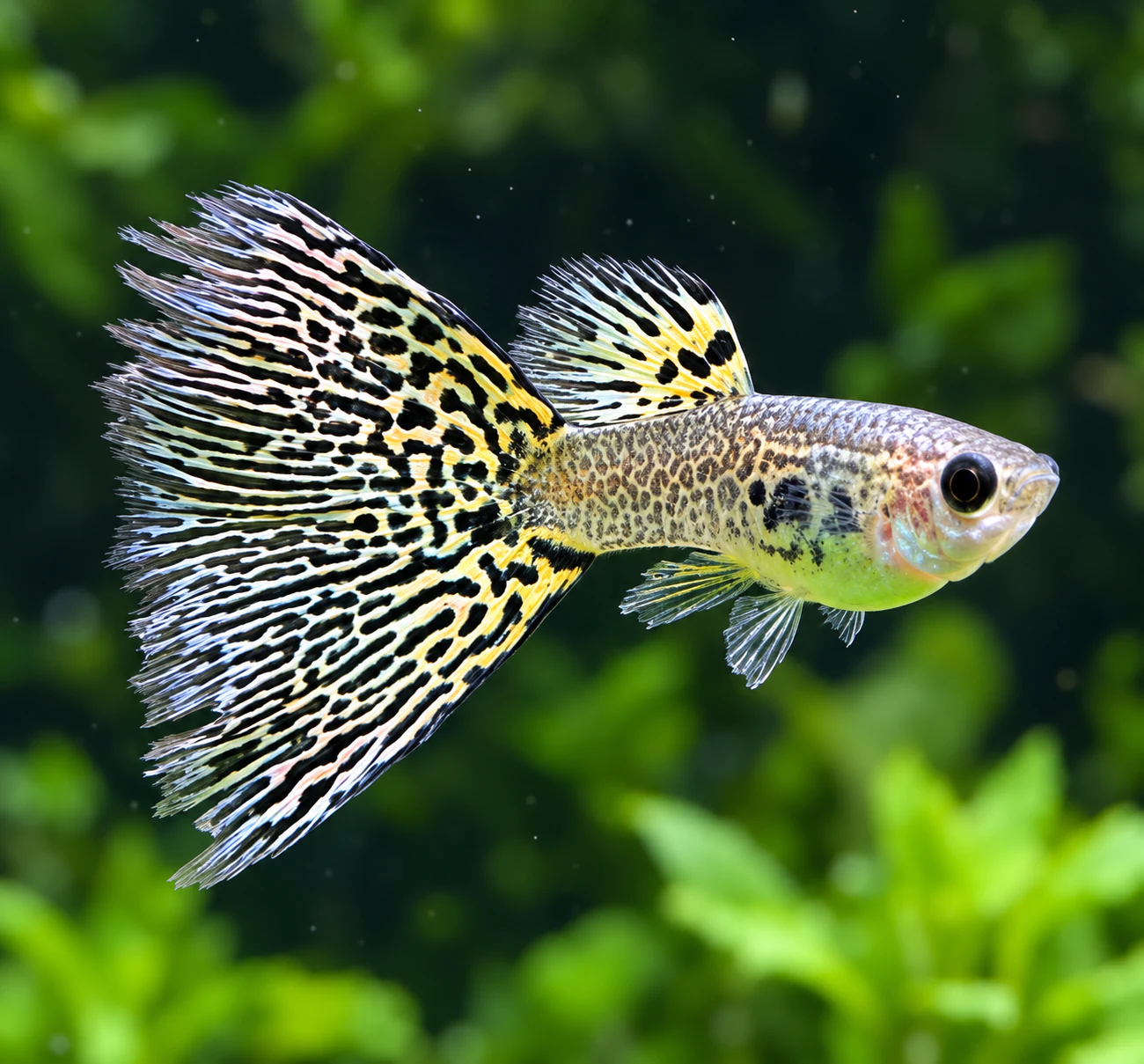
Blue Mosaic and mixed color labels
Blue Mosaic pairs blue-toned coloration with a mosaic-like fin. Our Blue Mosaic guppy guide focuses on that named color form, while this article covers the pattern family overall. Other listings may combine Mosaic with purple, platinum, half-black or enlarged pectoral fins. Do not assume “platinum” or “Dumbo” requires different water chemistry; those labels describe appearance and fin traits, not another species.
How to evaluate a Mosaic guppy before buying
An impressive still photo may hide fin damage, weak swimming or an unusually thin body. The most useful evidence is a recent side-view video of the exact fish being offered, recorded in neutral light with the entire tail visible. Ask how the seller distinguishes real-stock photos from representative catalog images.
- Pattern: compare left and right views, base-to-edge coverage and whether the markings are spots, bars or netting.
- Condition: look for normal swimming, a straight body, open fins, steady breathing and fish that can reach food.
- Offer details: confirm adult or juvenile status, approximate size, sex, fish count, exact color and whether the advertised image depicts your order.
- Breeding history: ask for parent photos and examples of offspring from that specific line if consistent Mosaic tails matter.
- Arrival plan: review shipping dates, local weather, the seller’s live-arrival policy and whether you can receive the parcel promptly.
An AI-generated product image or a representative photo is useful for showing a style, but it is not evidence of the actual fish available. A name such as “Grade A” should be defined by the seller; it is not automatically an independently verified competition award.
Mosaic guppy care: tank size, water and setup
Mosaic fish are guppies, so avoid making up separate water requirements for each color. The published Poecilia reticulata profile gives a broader range of 17–28°C (63–82°F), pH 7.0–8.5 and GH 8–30 dGH. For an everyday fancy-guppy tank, about 24–26°C (75–79°F), pH around 7.2–8.0 and GH roughly 8–15 dGH are practical starting targets when your source water supports them. Stable, suitable conditions and regular testing matter more than chasing one number.
| Parameter | Practical starting point | Why it matters |
|---|---|---|
| Aquarium size | Cycled 10 US gal / 38 L for a small adult group; 20 gal / 76 L offers more room | Tank dimensions, filtration, other fish and breeding affect stocking |
| Temperature | About 24–26°C (75–79°F) | Avoid rapid changes; check with a thermometer |
| pH | Roughly 7.2–8.0 | Guppies generally prefer neutral-to-alkaline conditions |
| General hardness (GH) | About 8–15 dGH | Check source water; published species range is wider |
| Ammonia and nitrite | 0 ppm | Do not add fish until the aquarium is biologically cycled |
| Nitrate | Keep low, preferably under ~20 ppm when feasible | Adjust water changes to test results and stocking |
Use gentle, reliable filtration with an intake safe for small fish and future fry. Leave an open swimming area beside plants or floating cover, and avoid sharp plastic decorations that can tear large tails. A 10-gallon setup is not a license to add unlimited males, females or other species: guppies reproduce readily, and fry increase the bioload. Our water parameter guide explains how to test and interpret the readings.
Feeding, tank mates and maintenance
Feed an appropriately sized quality flake or micro-pellet as the staple, with occasional daphnia or brine shrimp for variety. Most healthy adults do well with one or two small meals a day. Watch whether slower fish can eat and remove leftovers; overfeeding worsens water quality rather than improving the tail pattern. A balanced diet can support condition, but it cannot guarantee a specific inherited mosaic color.
Choose tank mates by water needs, size, behavior and swimming space. Small peaceful fish may work in a larger tank, while known fin-nippers or predators are poor partners for broad-tailed males. A male-only display prevents unexpected fry but still needs space and monitoring; a breeding group needs a plan for repeated births.
- Observe appetite, swimming, breathing and fin condition daily; check the filter and temperature.
- Test pH, GH and nitrogen waste when setting up, after additions or whenever behavior changes.
- As a common starting routine, change about 20–30% weekly with dechlorinated, temperature-matched water, adjusting to real nitrate and stocking trends.
- Rinse only clogged reusable filter media as needed in removed aquarium water; preserve beneficial bacteria.
- Keep new arrivals in a separate observation or quarantine tank when possible before mixing them with established fish.
See the complete HiGuppy guppy care guide for cycling, maintenance, feeding and community planning.
Breeding Mosaic guppies: what to expect
A Mosaic-looking male and female from the same named line may produce offspring with different tail markings and color intensity. The visible pattern is not a guarantee of one simple, predictable inheritance ratio. Females can store sperm from earlier mating, so a female’s offspring may not all come from the male currently sharing her tank.
- Begin with healthy, well-conditioned fish from a line whose recent offspring you can review.
- Record the sexes, parentage, dates, feeding, water conditions and which fry show the target pattern.
- Keep breeding projects separate when parentage matters; isolate new stock with appropriate quarantine.
- Allow juveniles enough time to mature before judging their tail pattern; do not select based on color alone.
- Plan growing space and responsible homes for healthy fish not selected as breeders; never release aquarium fish into local waterways.
A breeder’s documented parent and offspring history is more useful than an unsupported promise such as “100% true-breeding Mosaic”. Prioritize normal swimming, fertility and overall health alongside attractive fins.
A simple Mosaic guppy buying checklist
- I can tell Mosaic tail markings from Grass, Lace and Leopard well enough to compare real fish.
- I have tested the tank for ammonia, nitrite, pH and GH and prepared gentle filtration.
- I know whether the listing photos are exact-stock photos, representative images or AI illustrations.
- I have confirmed the number of fish, sexes, tail form, size and seller’s recent availability.
- If breeding, I have asked about parentage, possible stored sperm and variable fry patterns.
- I have checked the arrival policy, shipping weather and a suitable observation/quarantine setup.
When you are ready, compare the current Red Mosaic and Tiger Mosaic listings, or browse the premium guppy pairs category. Availability, sex mix, pricing and exact fish may change; request current-stock details before ordering.
Frequently asked questions about Mosaic guppies
Are Mosaic guppies a separate species?
No. Mosaic is a tail-pattern trade label for selectively bred guppies (Poecilia reticulata), not another species.
What is the difference between Mosaic and Grass guppies?
Mosaic tails commonly show irregular, sometimes connected patches or bars. Grass tails usually have many finer, separate dots. Breeder descriptions can overlap, so compare the exact fish.
Do Mosaic guppies need special water?
No color-specific treatment is required. Guppies generally do best in stable moderately hard to hard water; a practical target is about 24–26°C, pH 7.2–8.0 and GH 8–15 dGH, with ammonia and nitrite at zero.
What size tank is best for Mosaic guppies?
A cycled 10 US gallon (38 L) tank can work for a small adult group, but 20 gallons (76 L) gives more space and an easier margin for maintenance and possible fry. Exact stocking depends on tank length, filtration and fish count.
Can Mosaic and other guppy strains live together?
Yes, if the tank has appropriate room and water conditions. They can also interbreed, so keep different breeding lines separate if preserving a named strain is your goal.
Will two Mosaic guppies produce all Mosaic fry?
Not necessarily. Offspring can vary in tail markings and coloration, and females may store sperm from previous mates. Ask for examples from the breeder’s specific line rather than assuming a fixed percentage.
How can I tell whether a Mosaic guppy for sale is healthy?
Check a recent video of the exact fish for steady swimming, intact fins, normal breathing, body shape and feeding behavior. Ask whether listing images show current stock or only representative styles.
Further reading
For species-level temperature, pH, hardness and reproduction, consult Seriously Fish: Poecilia reticulata. For pattern terminology and visual comparisons, see the HiGuppy guppy pattern reference and our Blue Mosaic guide. These care references do not certify the genetics or availability of a particular product listing.
Behind the care guides
Care begins with steady systems
Our guppy guides focus on practical routines: keep water stable, observe fish closely and allow for natural variation.

Care systems
Steady water, thoughtful care
Gentle filtration and regular observation support healthy aquarium routines.

Natural variation
Every guppy is different
Color, size and fin shape vary with strain, age and each individual fish.
Editorial illustrations for context; they do not depict HiGuppy's exact facility or current fish stock.