The HiGuppy Journal
Guppy Tail Biting: 7 Proven Causes, Fixes & Prevention Tips
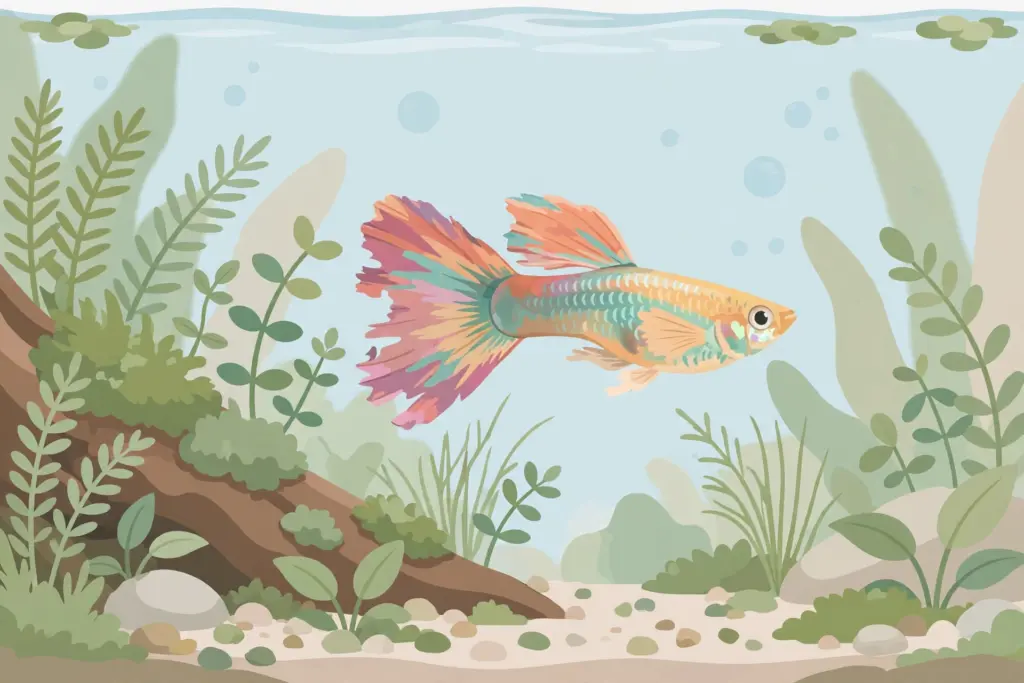
Quick answer: Guppy tail biting is usually a sign of stress, boredom, overcrowding, or an aggressive tank mate — and in fancy strains, a heavy flowing tail can tempt the fish to nip at its own fins. Test your water, remove or separate the aggressor, add plants and hiding spots, and keep the water clean so the fin can regrow.
Nothing worries a guppy keeper quite like finding a once-flowing tail suddenly ragged, notched, or half missing. Guppy tail biting is one of the most common — and most misunderstood — problems in the hobby. It can be caused by the guppy itself, by a tank mate, or by a disease that only looks like biting, and each needs a different fix. This guide shows how to tell them apart, lists the seven most common causes, gives a step-by-step plan to stop the nipping, and explains how to help a damaged tail heal.
What Is Guppy Tail Biting?
Guppy tail biting is the behaviour — or the damage — that appears when a guppy’s tail fin is nipped, torn, or chewed, leaving ragged edges, V-shaped notches, or a suddenly shorter tail. It covers three different situations, and telling them apart is the first step to fixing the problem:
- Self-biting: the guppy turns and nips at its own tail — most common in fancy males with very long, heavy fins.
- Tank-mate nipping: another fish chases and bites the guppy’s tail — often a fin-nipping species or another guppy competing for dominance.
- Fin rot that looks like biting: a bacterial infection eats away at the fin edges, leaving a ragged outline many keepers mistake for bites. It usually comes with white, black, or red edges and gradual fraying, while bites appear suddenly and leave cleaner notches.
If you are unsure which one you are dealing with, our guide to guppy fin rot explains the warning signs of infection and how its treatment differs.
7 Proven Causes of Guppy Tail Biting
Most cases of guppy tail biting come back to one of seven causes — this table pairs each cause with the signs to look for and the fastest fix.
| Cause | Typical signs | Fastest fix |
|---|---|---|
| Stress | Hiding, clamped fins, loss of appetite | Remove the stressor; keep the tank calm |
| Boredom and a bare tank | Repetitive nipping, pacing, picking at its tail | Add plants, driftwood, and hiding spots |
| Overcrowding | Constant chasing, nipped fins, poor water readings | Reduce stocking or upgrade the tank |
| Aggressive tank mates | One fish chasing others; damage on the slowest fish | Remove the aggressor or rehome it |
| Poor water quality | Irritation, flashing, frayed fins on several fish | Test the water and do partial water changes |
| Heavy flowing fins | One fancy male nipping its own long tail | Reduce filter flow; add resting spots |
| Parasites or irritation | Flashing, scratching, clamped fins, white spots | Inspect closely; improve water; treat if confirmed |
1. Stress — the Top Cause of Guppy Tail Biting
Stress is the single most common trigger behind guppy tail biting. Guppies are hardy but sensitive to sudden change: a new tank mate, a rearranged tank, bright lights with nowhere to hide, or loud vibrations can all trigger stress behaviour. A stressed guppy may clamp its fins, hide, stop eating — or start nipping at its own tail. Find the stressor and remove it: keep the tank quiet, keep lighting steady, and avoid netting fish unless you have to.
2. Boredom and a Bare Tank Trigger Guppy Tail Biting
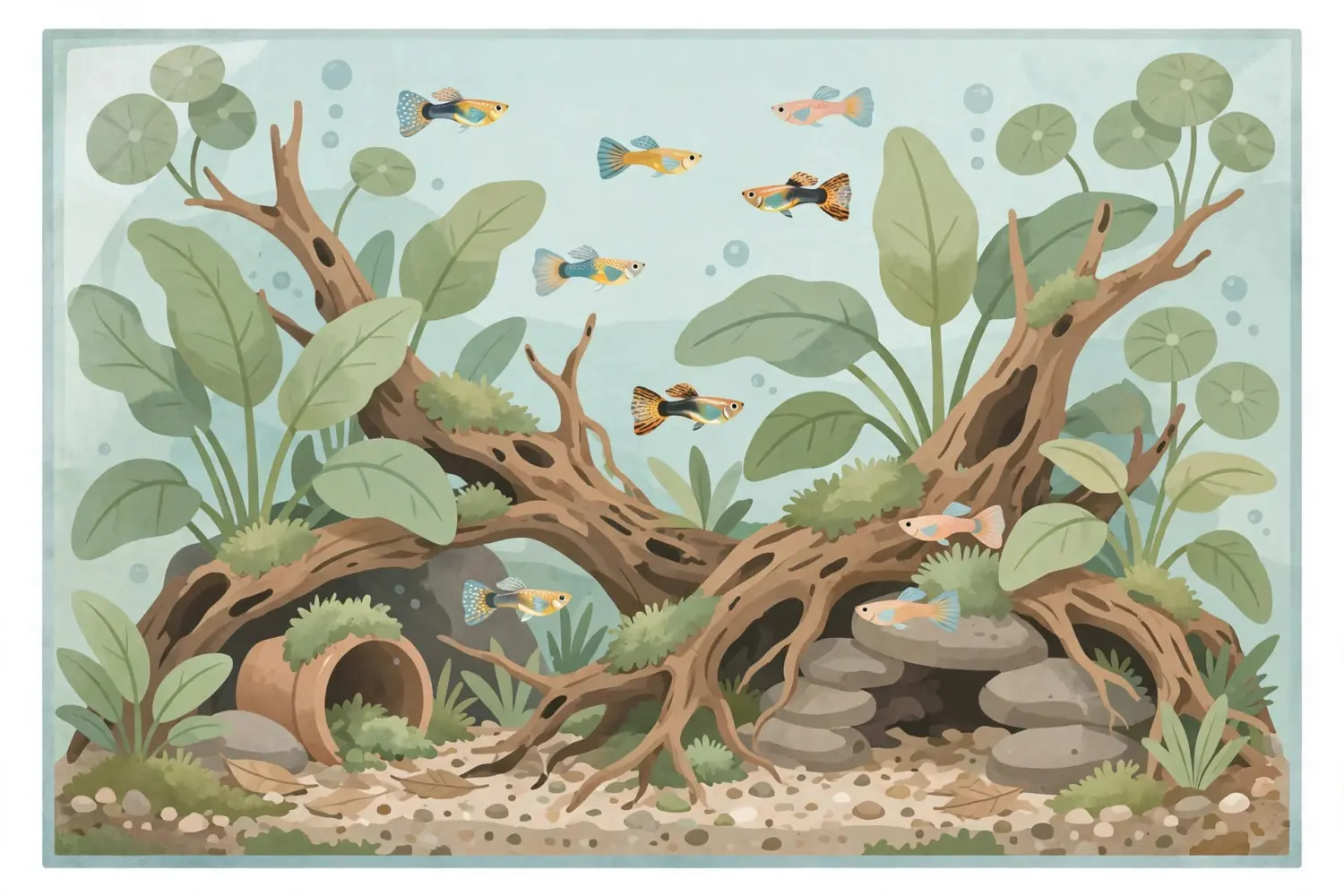
A bare tank invites repetitive behaviour. In the wild, guppies spend their days picking through plants, chasing food, and dodging predators. In a glass box with smooth gravel and a single ornament, there is nothing to do — and some fish redirect that energy into nipping their own tails. Live or silk plants, driftwood, caves, and floating plants give a guppy places to explore. A well-planted tank is not decoration; it is enrichment, and one of the most effective long-term preventions for guppy tail biting.
3. Overcrowding and Guppy Tail Biting
Too many fish in too little water raises stress for everyone. Guppies breed fast, and a tank that was perfectly stocked six months ago can quietly become overcrowded as fry grow up. Overcrowding means more competition for food and territory, more waste, and more chances for one fish to nip another. Give each adult guppy at least 1–2 gallons of water, and watch the group: if chasing and nipping are constant, the tank is too full. Move extra fish out or upgrade.
4. Aggressive Tank Mates and Guppy Tail Biting
Not every fish that looks peaceful in the shop stays peaceful at home. Some popular community species — certain tetras, barbs, and even other livebearers — can turn into fin nippers, especially in small groups or cramped tanks. Male guppies also nip each other when competing for females, and a long-finned male is an easy target. Watch the tank for ten minutes at feeding time and again in the evening: the aggressor usually reveals itself quickly. The only reliable fix is to separate the bully — move it to another tank or return it to the shop. Choose compatible companions from the start; check our guide to the best tank mates for guppies before adding any new species.
5. Poor Water Quality Causes Guppy Tail Biting
Bad water irritates fins and weakens fish, and irritated fish nip. When ammonia or nitrite rise above zero, or nitrate climbs too high, guppies feel it on their skin and gills first. They may flash against objects, clamp their fins, and nip at the irritated fin edges. Poor water can also open the door to fin rot, which then looks like biting. Test with a liquid test kit and aim for the established guppy ranges: temperature 72–82°F (22–28°C), pH 6.8–7.8, ammonia and nitrite at 0 ppm, and nitrate below 40 ppm. If any reading is off, do a partial water change of 25–30% and find the cause — overfeeding, a dirty filter, or too many fish are the usual suspects.
6. Heavy Flowing Fins on Fancy Strains
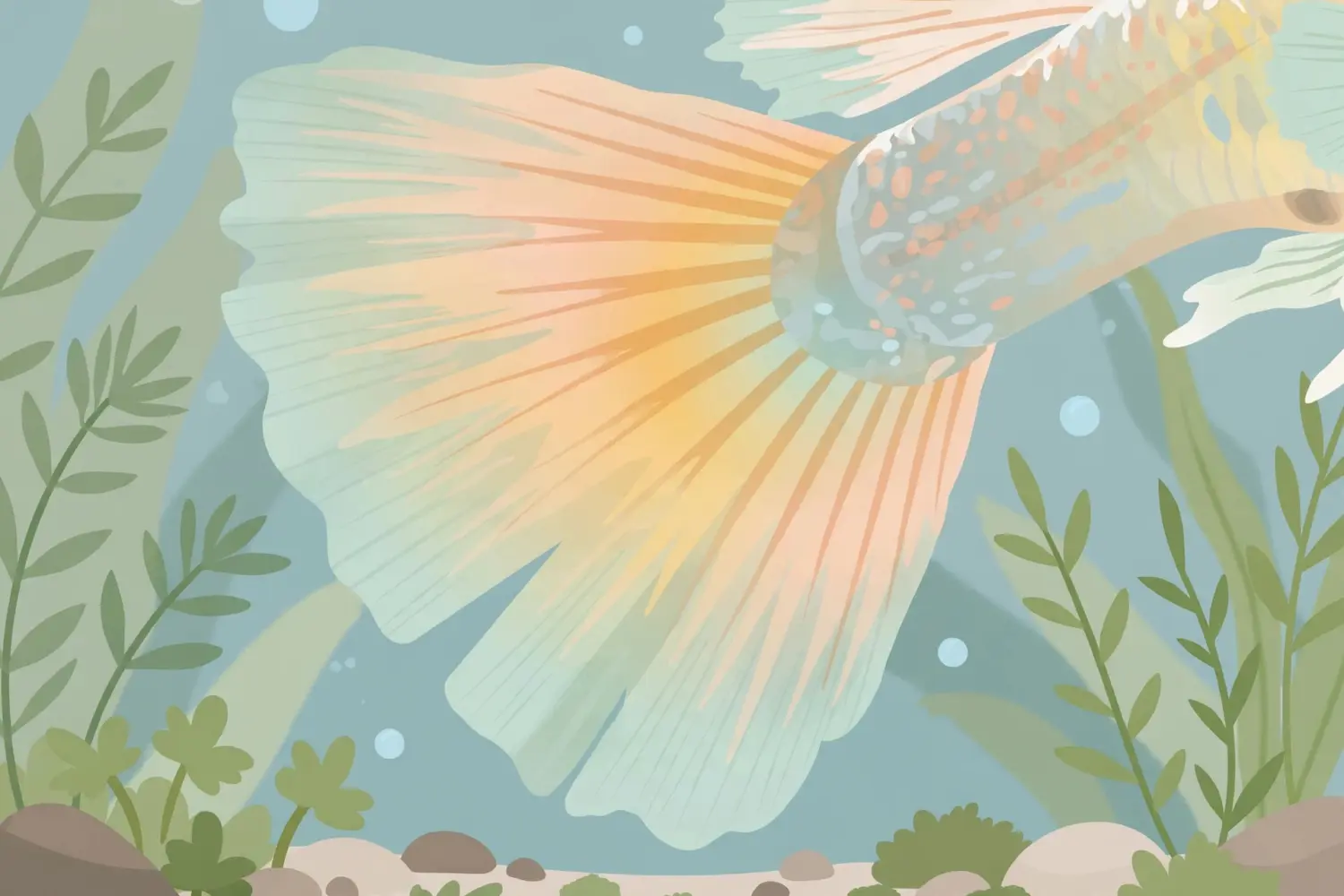
Fancy guppies have been bred for spectacular tails — veiltails, fantails, and delta tails that trail behind them like silk. But a tail that big is heavy to carry and easy to catch on plants, filter intakes, and decor. Some males seem irritated by the drag of their own fins and nip at the edges. If only one long-finned male is affected and the rest of the tank is peaceful, this is the most likely cause. Reduce the filter flow, add broad-leaf plants near the surface where it can rest, and cover filter intakes with a sponge pre-filter.
7. Parasites or Irritation That Lead to Guppy Tail Biting
External parasites and skin irritation can make a guppy feel as though something is crawling on its fins, and the fish may nip at the irritated area. Watch for flashing (rubbing against plants or gravel), clamped fins, loss of appetite, or tiny white spots. Parasites are less common than the other causes here, so do not reach for medication first. Improve the water, observe for a day or two, and only treat when you can see clear signs of a parasite or infection — guessing with medication stresses the fish and can harm your filter bacteria.
How to Tell Self-Biting From Fin Nipping and Fin Rot
Before you change anything, spend a few minutes diagnosing which kind of guppy tail biting you are seeing. The right fix depends on the right diagnosis:
- Watch the tank for 10–15 minutes. If you see another fish chase and bite the guppy’s tail, you have your answer: tank-mate nipping. If the guppy curls around and nips its own tail, it is self-biting.
- Check who is affected. Damage on several fish points to water quality or a shared aggressor; damage on one long-finned male points to self-biting.
- Look at the fin edges. Clean notches that appeared overnight suggest bites; gradual fraying with discoloured edges suggests fin rot.
- Test the water. Ammonia or nitrite above 0 ppm, or nitrate well above 40 ppm, means water quality is part of the problem.
- Look for other symptoms. Flashing, white spots, clamped fins, or lethargy point toward parasites or disease rather than simple nipping.
If the edges look infected, compare the symptoms in our guppy fin rot guide before you medicate.
How to Stop Guppy Tail Biting: A Step-by-Step Fix
Work through these steps in order — most guppy tail biting cases improve within days.
- Test the water and fix it first. If ammonia or nitrite are above 0 ppm, do a 25–30% partial water change right away, and repeat daily until readings settle. A fish in bad water cannot heal.
- Remove the aggressor. Move a fin-nipping tank mate to a separate tank or breeder box. Do not wait to see if it stops on its own — nipping is a habit that usually continues.
- Separate the victim if nipping continues. Move the guppy to a quiet quarantine tank with clean water. Separation stops the damage immediately.
- Add plants and hiding spots. Fill the tank with live or silk plants, caves, and driftwood so every fish can break line of sight and retreat. Floating plants soften the light and give long-finned males resting spots.
- Reduce the stocking. If the tank is crowded, move some fish out — fewer fish means less competition, less waste, and less stress.
- Slow the current. Strong filter flow exhausts long-finned guppies. Baffle the output with a sponge, turn the flow down, and cover the intake so tails cannot be pulled in.
- Feed a varied diet. Offer a good quality flake or micro-pellet as the staple, plus frozen or live foods such as daphnia and brine shrimp a few times a week. Feed small amounts twice a day.
- Watch for a week. Observe daily after making changes. New nipping should stop within a few days; the tail takes longer to heal, but the behaviour should improve first.
Treating a Damaged Tail
A bitten tail looks alarming, but guppy fins are remarkably good at regrowing — provided the water stays clean and the guppy tail biting has stopped. Treatment starts with clean water, not medication: keep up regular partial water changes, with ammonia and nitrite at 0 ppm and nitrate below 40 ppm while the fin heals.
For a mild case with no sign of infection, clean water and a calm tank are usually enough — no bath or additive is required. Aquarium salt is sometimes suggested as a supportive measure, but it is not a universal remedy: a safe amount depends on exposure time and on the fish, plants, and tank mates involved, and salt harms many plants and sensitive species. If you use it at all, follow the product label or a veterinarian’s instructions exactly, treat in a separate hospital container rather than the display tank, and remove the fish at the first sign of distress. When in doubt, skip it.
A bitten tail is an injury, not a diagnosis — visible signs alone cannot confirm a bacterial infection. Signs that suggest something more than a simple bite include white or fuzzy edges spreading along the fin, a tail that keeps shrinking despite clean water, redness at the fin base, or a fish that stays lethargic and stops eating. They are a reason to suspect a secondary infection, not proof of one, and environmental stress can look similar. Medicating “just in case” adds stress and can damage your filter bacteria, so do not treat a fish that is eating and healing. If these signs persist or worsen after water quality is corrected, ask an aquatic veterinarian or an experienced aquatic professional before choosing a medication; when a medication is genuinely indicated, follow the label exactly and treat in a hospital tank.
In clean, warm water, a mildly damaged tail usually shows new growth at the edges within a week or two, and fins can regrow substantially over several weeks. The new growth often looks transparent at first. Severe damage that reaches the fin base may never fully regrow, but the fish can still live normally if the water stays clean and the nipping does not return. Keep the fish separated until the fin has started to regrow, then reintroduce it slowly.
For background on guppy care and water requirements, see the Seriously Fish profile for Poecilia reticulata, which lists the water ranges that keep guppies healthy.
Preventing Guppy Tail Biting Long Term
These habits prevent guppy tail biting and keep a guppy tank peaceful over the long term:
- Keep the water stable. Test weekly, change 20–30% of the water each week, and never let ammonia or nitrite rise above zero.
- Stock thoughtfully. Keep the male-to-female ratio around one male to two or three females, avoid known fin nippers, and check compatibility before adding new fish.
- Keep the tank planted and furnished. Plenty of plants, caves, and driftwood give every fish somewhere to hide.
- Feed well and consistently. A varied diet on a regular schedule keeps fish in good condition and reduces stress behaviour.
- Quarantine new fish. New arrivals can bring parasites and disease and upset the pecking order. A two-week quarantine in a separate tank protects the whole community.
- Check the tank every day. A daily two-minute look — fins, appetite, behaviour — catches guppy tail biting while it is still small. A notch spotted on day one is a quick fix; ignored for two weeks, it can become an infection.
Frequently Asked Questions About Guppy Tail Biting
Why is my guppy biting its own tail?
Self-inflicted guppy tail biting is most often caused by stress, boredom, or a very heavy flowing tail on a fancy male. A bare tank, strong filter flow, or poor water quality can push a guppy to nip at its own fins. Add plants and hiding spots, slow the current, and test the water — the behaviour usually fades within days.
Will a bitten guppy tail grow back?
Yes, in most cases. If the nipping has stopped and the water is clean — ammonia and nitrite at 0 ppm, nitrate below 40 ppm — a mildly damaged tail usually starts regrowing within a week or two, with substantial regrowth over several weeks. New fin tissue often looks clear at first. Damage that reaches the fin base may not fully regrow, and any sign of infection needs treatment.
Should I separate a guppy that is being bitten?
Yes, if the nipping continues after you have removed the aggressor or improved the tank. A short stay in a quiet quarantine tank stops the damage and lets the tail heal. Keep the fish separated until you see new growth, then reintroduce it slowly.
Is guppy tail biting the same as fin rot?
No, although they can look similar. Guppy tail biting leaves sudden notches or missing chunks, while fin rot causes gradual fraying with white, black, or reddened edges. Biting is a behaviour problem; fin rot is a bacterial infection. If the edges look infected, treat for fin rot; if the damage appeared overnight and the edges are clean, look for a nipper.
Can aquarium salt help a bitten guppy tail?
Not as a routine step. Clean water heals most mild bites on its own, and salt is not risk-free: a safe amount depends on exposure time and on the fish, plants, and tank mates involved. If salt is used, follow the product label or a veterinarian’s directions exactly, treat in a separate container, and remove the fish at any sign of distress. For a tail that keeps shrinking or a fish that stays unwell despite clean water, get advice from an aquatic professional instead of escalating home remedies.
Final Thoughts
Guppy tail biting looks dramatic, but it is usually the tank telling you something simple: the water needs attention, the tank needs more cover, a bully needs to move out, or a fancy male is struggling with a heavy tail. Diagnose first, fix the cause, keep the water clean, and give the fish a calm place to heal. In most cases the nipping stops within days and the tail grows back over the following weeks — with a planted tank, sensible stocking, and steady maintenance, you may never see it again.
Behind the care guides
Care begins with steady systems
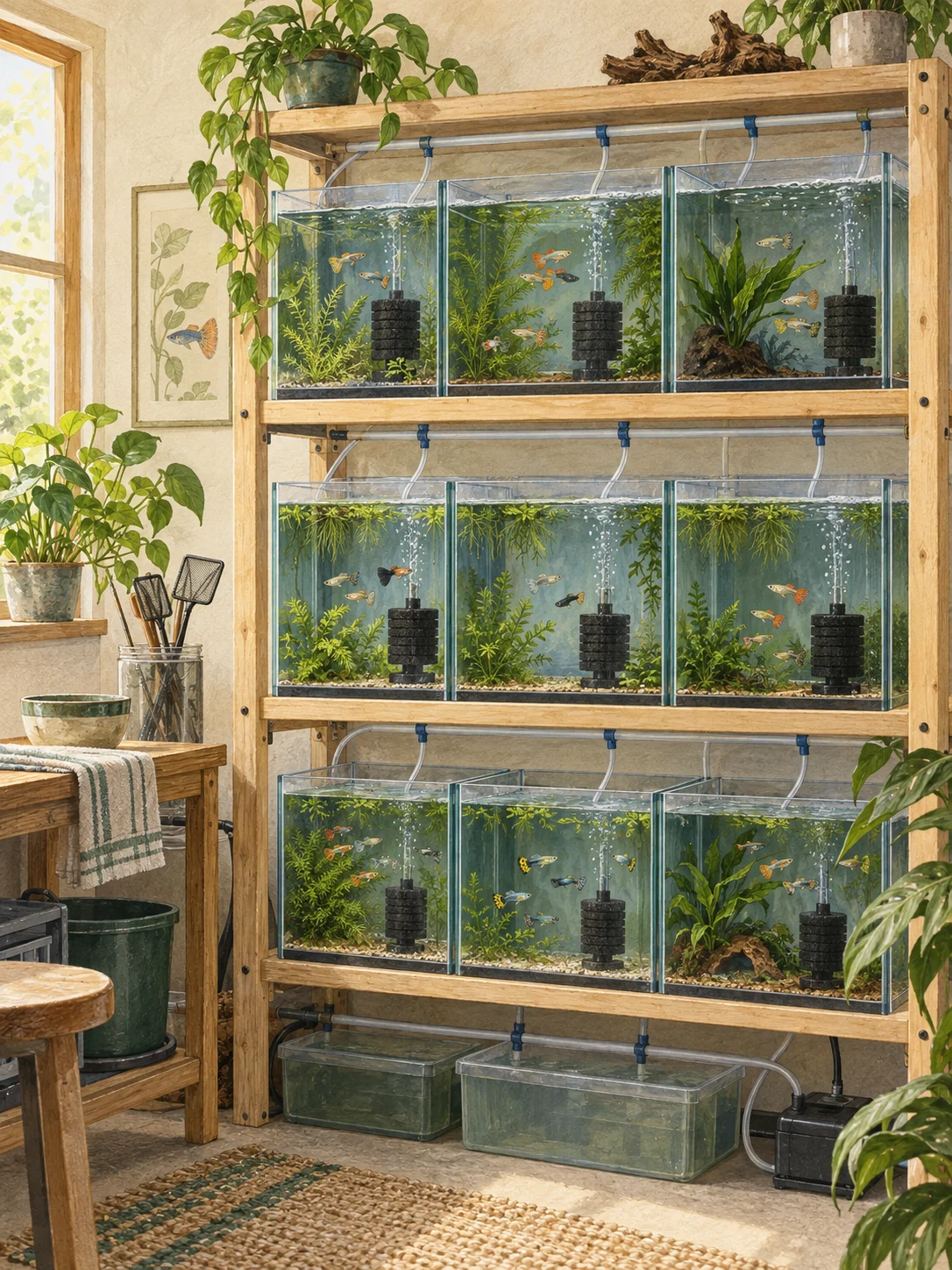
Our guppy guides focus on practical routines: keep water stable, observe fish closely and allow for natural variation.
Care systems
Steady water, thoughtful care
Gentle filtration and regular observation support healthy aquarium routines.
Natural variation
Every guppy is different
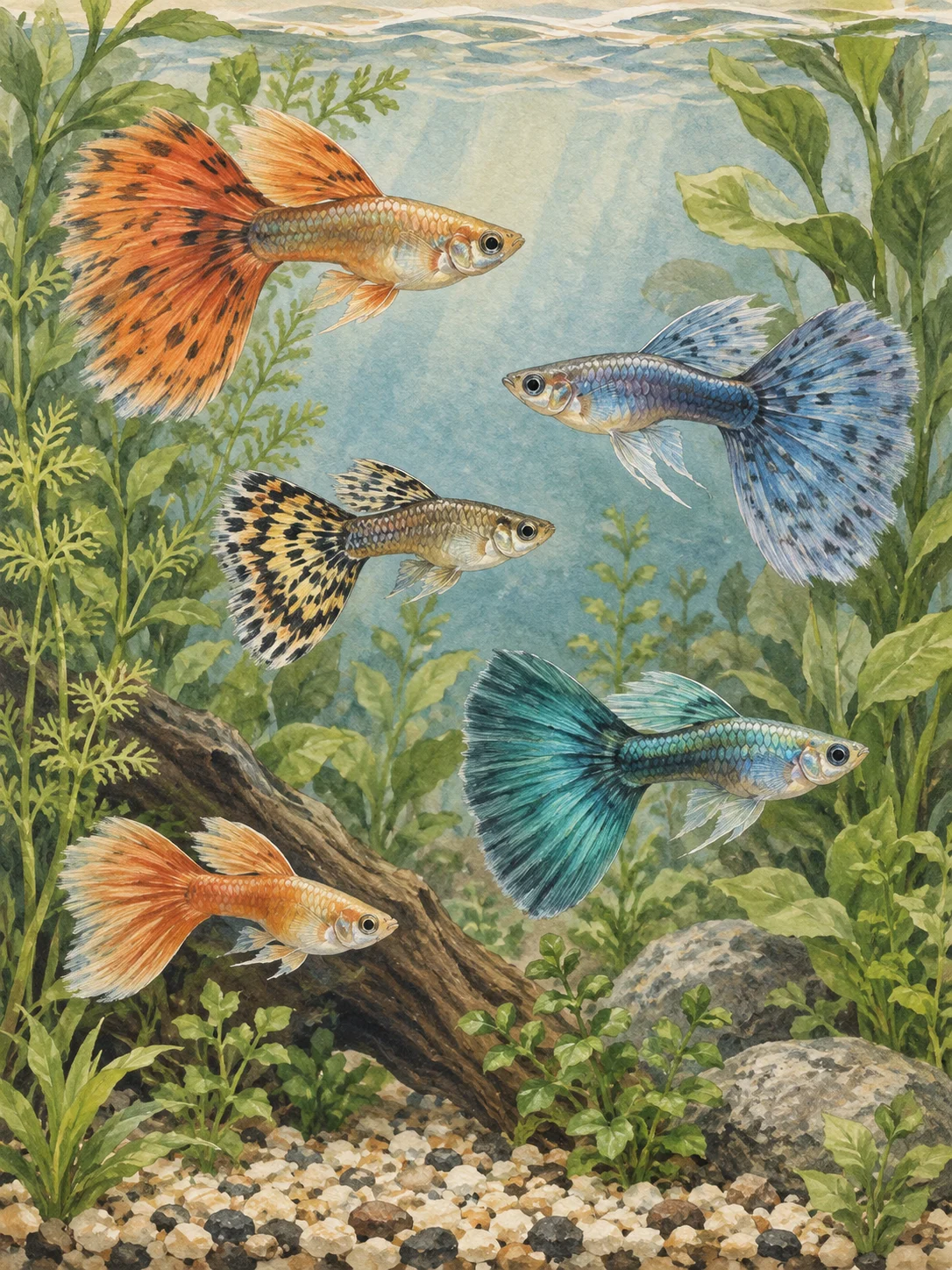
Color, size and fin shape vary with strain, age and each individual fish.
Editorial illustrations for context; they do not depict HiGuppy's exact facility or current fish stock.