The HiGuppy Journal
Ideal Temperature for Guppies: Safe Range, Heaters and Fixes
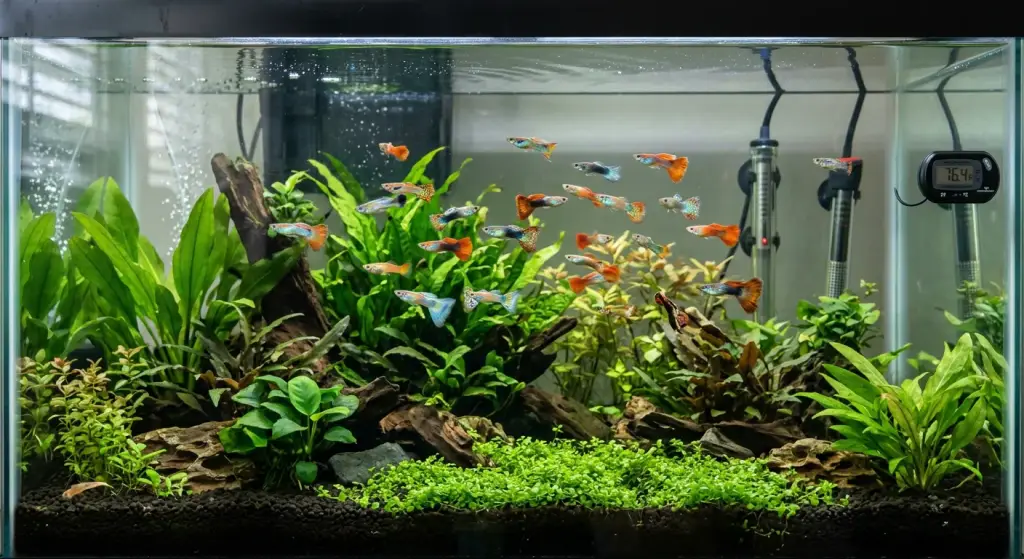
What is the ideal temperature for guppies? Most keepers aim for 74 to 82 °F (23 to 28 °C), with a steady 76 to 80 °F (24 to 27 °C) being the sweet spot for fancy guppies. Within that band guppies eat well, color up, breed and fight disease better. This guide belongs to our complete guppy care guide and explains the safe range, what happens when water runs too cold or too hot, how to choose and set a heater, and how to handle power cuts, summer heat and shipping day.
Temperature is the one water setting that changes everything else: metabolism, appetite, oxygen levels, breeding speed and how fast diseases spread. Getting it stable matters more than hitting one exact number, so we cover measuring, adjusting and troubleshooting step by step, with tables you can copy into your own routine.
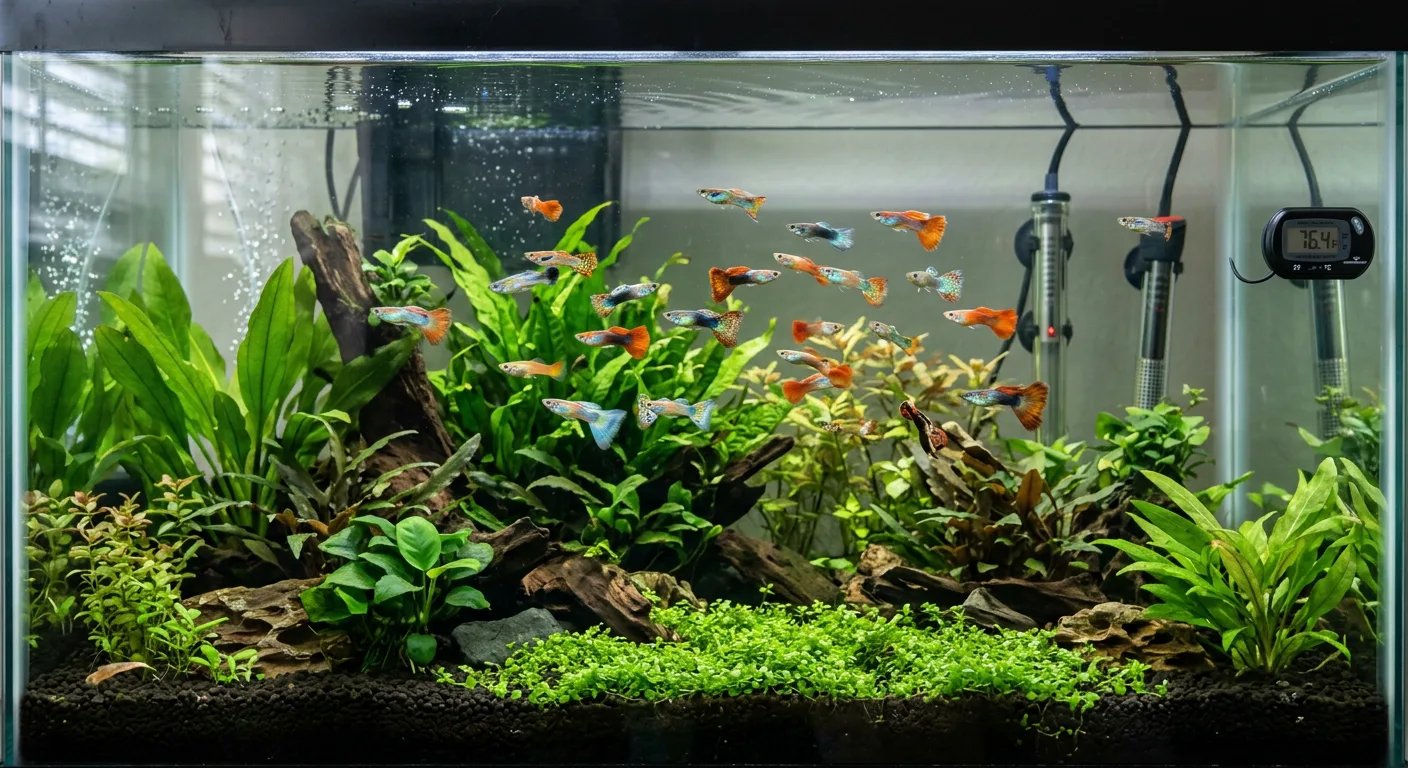
What is the ideal temperature for guppies?
Guppies are tropical freshwater fish. Wild populations come from warm streams and pools in northern South America and nearby islands, so the species handles warm water far better than cold. Hobby guidance usually lands on 74 to 82 °F (23 to 28 °C) as the safe working range, and most experienced keepers hold fancy guppies near 77 to 78 °F (25 to 26 °C).
The short version
- Safe range: 74 to 82 °F (23 to 28 °C).
- Best everyday target: 76 to 80 °F (24 to 27 °C).
- Breeding and fry growth: the upper half of the range, roughly 78 to 80 °F (25.5 to 27 °C).
- Stability: try to keep daily swings under about 2 °F (1 °C).
Why stability beats the perfect number
A tank held at 75 °F all week is usually healthier than one that bounces between 72 and 82 °F every day. Fish are cold blooded, so rapid swings stress their bodies and weaken immunity. This is why a quality heater and a separate thermometer are among the first things we recommend in our guide to the {L(“aquarium-setup/best-tank-setup-for-guppies”,”best tank setup for guppies”)}.
Fancy guppies versus hardy feeder guppies
Heavily bred fancy guppies with large tails tend to be less tolerant than older, hardier lines. Tolerance depends on the strain and on how the fish were raised, so avoid pushing the edges of the range. If you are unsure which type you have, our comparison of {L(“guppy-buying-guide/fancy-guppies-vs-feeder-guppies”,”fancy guppies vs feeder guppies”)} explains the differences.
Temperature ranges at a glance
The table below summarizes what different temperatures usually mean for adult guppies. These are practical hobby ranges, not laboratory limits, and individual fish and strains vary.
| Water temperature | What it usually means | What to do |
|---|---|---|
| Below 68 °F (20 °C) | Dangerously cold; fish become sluggish and prone to disease | Warm gradually with a heater and check for illness |
| 68 to 73 °F (20 to 23 °C) | Survivable but too cool for fancy guppies; slow growth and appetite | Raise slowly into the safe range |
| 74 to 75 °F (23 to 24 °C) | Acceptable, slightly slower metabolism | Fine for adults; nudge up for breeding |
| 76 to 80 °F (24 to 27 °C) | Ideal for most tanks | Aim here and keep it steady |
| 81 to 82 °F (27 to 28 °C) | Upper comfortable limit; less oxygen in water | Add surface agitation and watch fish |
| Above 84 °F (29 °C) | Heat stress; gasping and rapid breathing possible | Cool the tank slowly and boost aeration |
How the number changes by life stage
Adults, pregnant females and fry all prefer warm water, but their needs differ a little. Fry grow faster in the upper range, while older fish usually live longer in slightly cooler, stable water. We explain this tradeoff in our article on {L(“guppy-care/how-long-do-guppies-live”,”how long guppies live”)}.
Why pH and temperature work together
Warmer water holds less oxygen and makes ammonia more toxic. That is one reason to check your numbers together, as covered in our {L(“guppy-care/guppy-water-parameters-guide”,”guppy water parameters guide”)} and the page on the {L(“guppy-care/ideal-ph-for-guppies”,”ideal pH for guppies”)}.
What happens when the water is too cold
Cold water is the most common temperature problem, especially in winter and in rooms without heating. Guppies slow down, eat less and become more open to infection.
Signs your guppies are too cold
- Lethargy and hanging near the bottom or in a corner.
- Clamped fins held close to the body.
- Reduced appetite or ignoring food.
- Faded colors and rough looking scales.
- More white spot (ich) or fin rot outbreaks.
Diseases linked to cold stress
Cold does not directly cause most diseases, but it lowers the immune response and lets parasites and bacteria take over. If you see small white dots, read our {L(“troubleshooting/guppy-ich-treatment”,”guppy ich treatment guide”)}. If fins look ragged, check {L(“troubleshooting/guppy-fin-rot”,”guppy fin rot”)} and {L(“troubleshooting/guppy-clamped-fins”,”clamped fins in guppies”)}.
How to warm a cold tank safely
- Measure first. Confirm the real temperature with a trusted thermometer.
- Set the heater only a little higher. Aim to raise the water about 1 to 2 °F (0.5 to 1 °C) per hour at most.
- Do not add hot water. Pouring warm water into the tank can create dangerous hot spots.
- Check again after a few hours. Make sure the heater is cycling and the number is stable.
- Feed lightly. Slow digestion in cold water means less food is better until fish recover.
What happens when the water is too hot
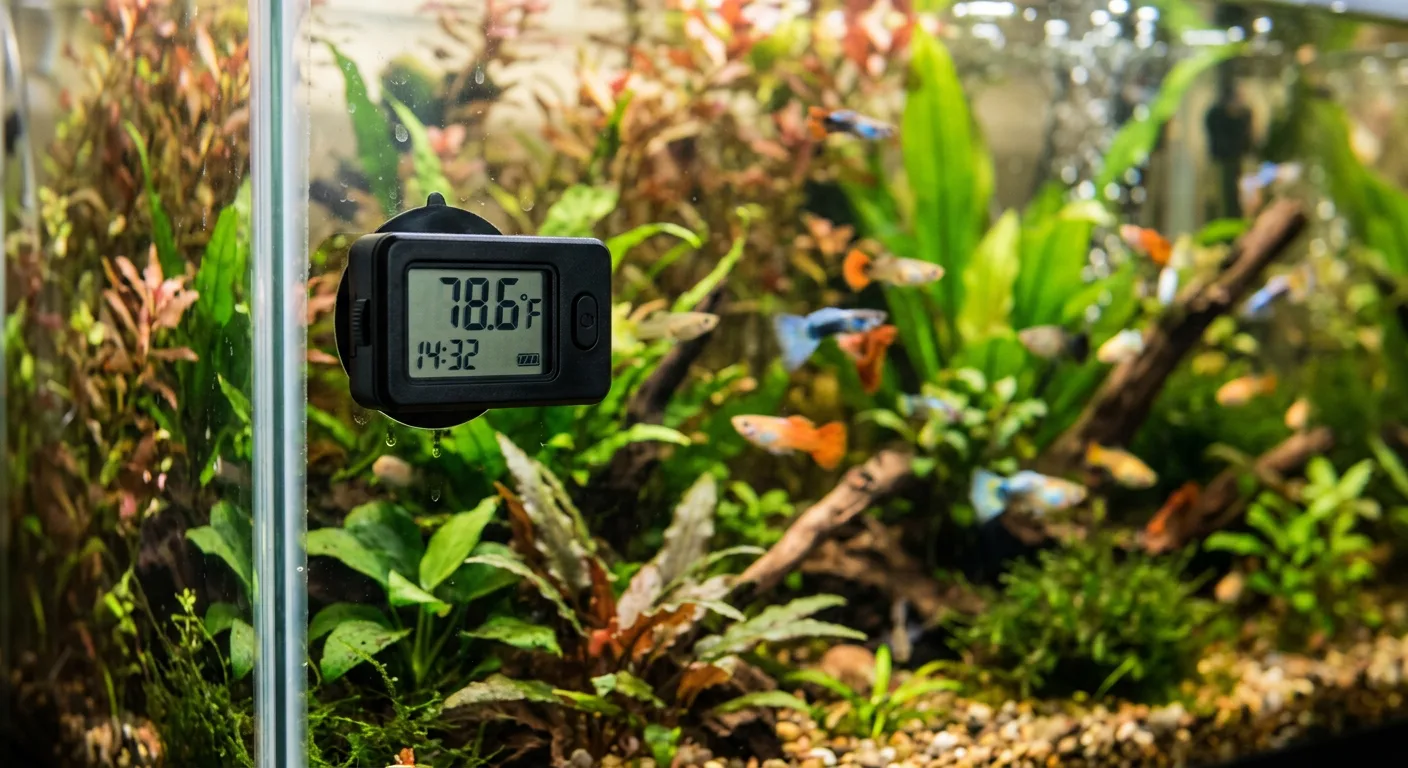
Warm water suits guppies, but there is a limit. Above roughly 84 °F (29 °C) oxygen drops, metabolism races and stress rises. Summer heat waves, tanks near windows and strong lights are common causes.
Signs of overheating
- Gasping at the surface or crowding near the filter outflow.
- Rapid gill movement.
- Frantic swimming followed by lethargy.
- Faster growth but shorter lifespan over time.
See our guide on {L(“troubleshooting/guppy-gasping-at-surface”,”guppies gasping at the surface”)} for a full checklist, because low oxygen has other causes too.
How to cool a tank safely
- Move the tank out of direct sun. Close curtains and avoid heat sources.
- Remove the lid partly. More evaporation cools the water, but keep a screen on top because guppies jump.
- Increase surface movement. Raise the filter outflow or add an air stone.
- Point a small fan across the water surface. This can lower the temperature by several degrees through evaporation.
- Do a small cool water change. Change only 10 to 20 percent with dechlorinated water a few degrees cooler, never ice cold.
- Turn off or lower the heater. Check that it has not stuck on.
Do not shock the fish
Cool the tank slowly, aiming for no more than about 2 to 3 °F (1 to 1.5 °C) per hour. A sudden drop is almost as stressful as the heat itself.
How to choose and set a heater for a guppy tank
A reliable heater is the backbone of stable temperature. If you are weighing whether you need one at all, read {L(“aquarium-setup/do-guppies-need-a-heater”,”do guppies need a heater”)} for the full discussion.
Heater size by tank volume
A common rule of thumb is about 3 to 5 watts per gallon, with the higher end for cooler rooms. The table gives a starting point for typical tanks.
| Tank size | Typical heater wattage | Notes |
|---|---|---|
| 5 gallons (19 L) | 25 to 50 W | Small tanks swing fast; choose an adjustable heater |
| 10 gallons (38 L) | 50 W | Very common guppy setup |
| 20 gallons (75 L) | 100 W | Or two 50 W heaters for safety |
| 30 gallons (113 L) | 150 W | Place near the filter flow |
| 40+ gallons (150 L+) | 200 W or two heaters | Two heaters reduce the risk of total failure |
Features worth paying for
- Adjustable thermostat with a visible dial or display.
- Shatterproof construction such as titanium or heavy glass with a guard.
- Auto shut off when the heater is out of water.
- Indicator light so you can tell it is working.
Step by step: installing and setting your heater
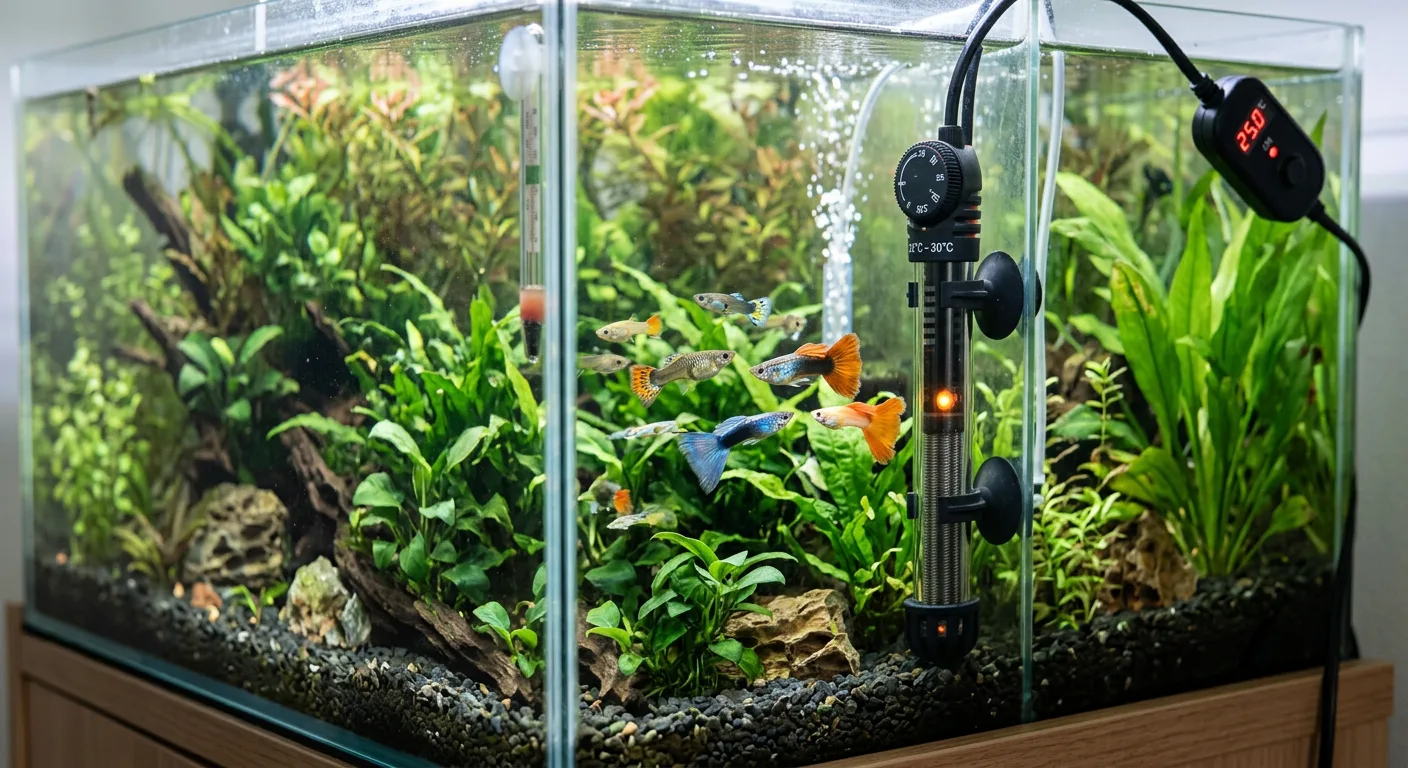
- Unplug and wait. Let the heater sit in the water for 15 to 20 minutes before plugging in so the glass adjusts.
- Place it near flow. Mount it close to the filter outlet so warm water spreads evenly.
- Set the dial. Start at about 77 °F (25 °C).
- Wait 24 hours. Compare the dial with a separate thermometer on the far side of the tank.
- Fine tune. Change the setting in small steps and wait several hours between changes.
How to measure temperature accurately
Heater dials are not always accurate, which is why a separate thermometer is essential. Many keepers find that a dial can be off by a few degrees.
Types of thermometers
| Type | Pros | Cons |
|---|---|---|
| Stick on strip | Cheap and easy to read | Often less accurate and shows only the glass temperature |
| Glass floating or suction | Inexpensive and reliable if checked | Can break and be hard to read |
| Digital probe | Easy to read, often more accurate | Needs batteries and a sensor in the water |
| Smart controller | Heater and alarm in one | Costs more and relies on one device |
Where to put the thermometer
Place it on the opposite side from the heater, at mid depth. This shows the coolest part of the tank, which is what your fish actually live in. Check it each morning and each evening for the first week, then weekly once the tank is stable.
Calibrate with a second thermometer
If you have two thermometers, place both in a cup of room temperature water and compare. A difference of more than 1 to 2 °F means one is wrong, so replace the worse one.
Temperature for breeding, pregnancy and fry
Warm water speeds up almost everything in a guppy life cycle. Gestation is commonly around 21 to 30 days and shortens when water is warmer. Fry grow faster at 78 to 80 °F (25.5 to 27 °C), as long as oxygen and water quality stay high.
Breeding tank settings
For a dedicated tank, hold 78 to 80 °F (25.5 to 27 °C) and keep it steady. Our {L(“guppy-breeding/guppy-breeding-tank-setup”,”guppy breeding tank setup”)} guide walks through the full build, and {L(“guppy-breeding/guppy-pregnancy-stages-and-gestation”,”guppy pregnancy stages and gestation”)} explains the timeline.
Caring for fry
Newborn fry are delicate. Match the fry tank temperature to the main tank so they are not shocked, then keep it warm and steady. For feeding and growth see the {L(“guppy-breeding/guppy-fry-feeding-schedule”,”guppy fry feeding schedule”)}.
Do not run hot for too long
Running at the top of the range makes fish mature fast but may shorten lifespan. Many breeders keep show fish and long term breeders a little cooler once growth is complete, for example 76 to 78 °F.
Handling temperature emergencies
Things go wrong: power cuts, a stuck heater, a heat wave or a broken thermostat. Having a plan prevents panic.
Power outage in winter
A guppy tank loses heat slowly if you insulate it. Cover the lid with a towel or blanket, keep the room closed, and stop feeding during the cold period. For longer outages, see our guide to a {L(“aquarium-setup/guppy-tank-power-outage”,”guppy tank power outage”)}.
Stuck heater
If water is climbing past 84 °F, unplug the heater immediately and follow the cooling steps above. Replace any heater that has overheated the tank once, because thermostats do not repair themselves.
Heat wave without air conditioning
Use a fan on the surface, shade the tank, add floating plants for shade, and keep the lights off during the hottest hours. Do not drop frozen bottles directly into the tank unless sealed and used carefully, because the cold surface can shock fish.
Emergency checklist
- Check the thermometer first, not the heater dial.
- Change temperature slowly in either direction.
- Add aeration during heat.
- Stop feeding during extremes.
- Watch fish behavior for 24 to 48 hours afterward.
Temperature during acclimation and quarantine
New fish often arrive after a trip in a bag, so temperature matching is a core part of acclimation. A bag that sat in a cold truck or hot porch is far from your tank temperature, which makes floating the bag important.
Acclimation steps
- Float the sealed bag for 15 to 20 minutes to even out temperature.
- Add small amounts of tank water over the next 20 to 30 minutes.
- Net the fish into the tank. Do not pour bag water in.
Our guides on {L(“guppy-care/how-to-acclimate-guppies”,”how to acclimate guppies”)} and {L(“guppy-buying-guide/what-to-do-when-guppies-arrive”,”what to do when guppies arrive”)} cover the process in more detail. Use the same stable temperature in your {L(“guppy-care/quarantine-new-guppy-fish”,”quarantine tank”)}.
Shipping and heat packs
Live fish shipments travel in insulated boxes, often with heat or cold packs depending on the season. After delivery, check how the fish look and move quickly to a matched, stable tank. See {L(“guppy-care/guppy-heat-packs-cold-weather-shipping”,”heat packs and cold weather shipping”)} for what to expect.
Common temperature mistakes and how to fix them
Most temperature problems come from a short list of habits. Check these before blaming the fish.
Mistakes table
| Mistake | Why it hurts | Fix |
|---|---|---|
| Trusting the heater dial | Dial can be several degrees off | Use a separate thermometer |
| One undersized heater | Cannot keep up in cold rooms | Size by volume or use two heaters |
| Heater out of the flow | Uneven heating and cold spots | Place near filter output |
| Fast water changes with cold water | Sudden drop stresses fish | Match temperature within 1 to 2 °F |
| Tank by a window or heater vent | Large daily swings | Move to an interior wall |
| No backup plan | Failure can kill the tank | Keep a spare heater and thermometer |
Tips for new keepers
Buy the thermometer first, the heater second and set both before the fish arrive. Run the tank for a day to see how stable it is. Our {L(“aquarium-setup/guppy-tank-cycling-checklist”,”guppy tank cycling checklist”)} fits this step into your first weeks.
Tips for experienced keepers
Consider a thermostat controller with an alarm, a spare heater on a shelf and a seasonal routine. Some keepers lower the setpoint a little in summer to avoid the tank drifting upward, and raise it for breeding rounds.
A simple temperature routine
You do not need complicated gear to keep temperature steady. A small repeatable routine does most of the work.
Daily
- Glance at the thermometer and watch fish behavior at feeding time.
- Check that the heater light is cycling normally.
Weekly
- Match the temperature of new water within 1 to 2 °F when changing 20 to 30 percent of the tank. See our {L(“aquarium-setup/guppy-tank-maintenance-schedule”,”guppy tank maintenance schedule”)}.
- Wipe the heater and check the suction cups.
Seasonal
- Before winter, test the heater and replace old units.
- Before summer, plan shade, fans and extra aeration.
Quick checklist
- Target 76 to 80 °F (24 to 27 °C), safe range 74 to 82 °F.
- Use an adjustable heater sized to your tank and a separate thermometer.
- Place the thermometer on the far side from the heater.
- Change temperature slowly, 1 to 2 °F per hour at most.
- Match water temperature during water changes and acclimation.
- Prepare for power cuts and heat waves before they happen.
- Watch fish behavior, because it tells you more than any dial.
Strong stock handles temperature changes better, so browse our male guppies and premium guppy pairs. For general species background, see Guppy on Wikipedia, and return to our guppy care hub for more setup guides.
FAQ
What is the best temperature for guppies?
Most keepers aim for 76 to 80 °F (24 to 27 °C), inside a safe range of 74 to 82 °F. Steady water matters more than the exact number. Use a separate thermometer to confirm it.
Can guppies live in unheated water?
They can survive in a warm room where water stays steady in the mid 70s, but fancy guppies suffer in cold or swinging water. Most keepers use a heater to avoid stress and disease.
What temperature is too cold for guppies?
Below about 70 °F (21 °C) guppies become sluggish and vulnerable, and below 68 °F it becomes dangerous. Warm the tank slowly rather than all at once.
What temperature is too hot for guppies?
Above roughly 84 °F (29 °C) oxygen falls and fish show gasping and stress. Add aeration, shade and a fan, and cool the tank gradually.
What temperature do guppies breed at?
Guppies breed across the safe range, but warmer water around 78 to 80 °F speeds up gestation and fry growth. Keep it steady and the oxygen high.
How fast can I change the aquarium temperature?
Aim for no more than about 1 to 2 °F per hour when warming and 2 to 3 °F per hour when cooling. Faster changes cause stress and can trigger disease.
How big a heater do I need for my guppy tank?
A common starting point is 3 to 5 watts per gallon, such as a 50 W heater for 10 gallons. Cooler rooms and larger tanks may need more or two heaters.
Do guppies need a thermometer?
Yes. Heater dials can be inaccurate, and a thermometer on the far side of the tank shows what your fish actually feel. It is a cheap and essential tool.
Behind the care guides
Care begins with steady systems
Our guppy guides focus on practical routines: keep water stable, observe fish closely and allow for natural variation.

Care systems
Steady water, thoughtful care
Gentle filtration and regular observation support healthy aquarium routines.

Natural variation
Every guppy is different
Color, size and fin shape vary with strain, age and each individual fish.
Editorial illustrations for context; they do not depict HiGuppy's exact facility or current fish stock.